
• Skip to main content
  • Skip to after header navigation
  • Skip to site footer
  • Facebook
  • Instagram
Member Account
Oceanic Art Society Australia

Oceanic Art Society

Promoting the understanding and appreciation of Oceanic art.

  • About
  • Journal
    • OAS Journal | Online
    • OAS Journal | PDF
  • Membership
  • Events
  • News
    • Latest News
    • Social Media News
  • Links
  • Video
  • Advertising
  • Contact
  • Support Us
  • Login / Account
    • Your Account
    • Edit your profile
    • Update Billing
    • Logout

The Moon, the Stars and the Demon Shrimp

01/03/2017

Peter McCabe will be presenting a lecture on:

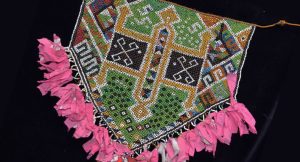
The Moon, the Stars and the Demon Shrimp: Deciphering Patterns in Beaded Aprons of Geelvink Bay, North West New Guinea

A little extra : After the lecture, there will be a very short introduction to our newest OAS international members, Shiva Lynn Burgos and her partner Dominic Palfreyman – and their artistic and filming ventures in the Upper Sepik Kwoma Village of Marawai – with a little show and tell. www.shivalynn.com

Event information

Cenderawasih Bay (better known to Oceanic art collectors by its old name of Geelvink Bay) is famous for its Korwar art and elaborately carved canoe ornaments.  The beaded aprons from this area, with their beautiful and fascinating designs, are also much sought after by collectors.  The aprons were worn only during ceremonial occasions.  The intricate and complex patterns of the aprons are unique in New Guinea and, unlike other aprons of the region, are five-sided rather than rectangular. This raises the question as to origin of the aprons and their patterns.  Are they a relatively recent innovation or are they based on long traditional designs?

The peoples of the northwest coast of New Guinea have interacted with the outside world for thousands of years.  Trade of plumes, wood products, and slaves from the area is documented during the peak of the spice trade and during the Dutch dominance of SE Asia.  In the mid-nineteenth century prau from Cenderawasih Bay made annual trips of over 1000 km  to pay tribute to the Sultan of Ternate.  Archaeological evidence, however, shows trade patterns go much further back. Imported textiles, from the Indonesian archipelago, and beads and ceramics, from Asia, were treasured by the inhabitants of the Cenderawasih Bay area as heirloom articles passed on to the next generation at marriages or at death.

Beaded aprons from Cenderawasih Bay. Early 20th century. From the collection of Peter McCabe.

It has been suggested by several authors that the patterns of Geelvink Bay aprons are copied from imported textiles.  However, an understanding of the traditional beliefs of the coastal inhabitants of the bay before conversion to Christianity suggests that most, if not all of the patterns, had powerful meaning to the wearers.  The symbols have meaning in their mythology and reverence for ancestors. Patterns represent mythological creatures and significant astronomical features – symbols that are not surprising for what was mainly a hunter-gatherer community with strong ties to the sea.  Even the five-sided shape of the aprons has a special meaning related to the night sky.

The similarity with patterns in SE Asian textiles is presumably because of a shared history. Many of the peoples of the coastal area of  Cenderawasih Bay speak Austronesian languages and the area was presumably populated during the great Austronesian oceanic migrations, displacing Papuan-speaking people inland. Patterns in the beaded aprons may be best explained as a combination of Austronesian and Papuan cultural symbols.

Share this content:

  • Click to email a link to a friend (Opens in new window) Email
Category: Lectures, V22 Issue 1

Sidebar

Categories

  • All Journal Articles (281)
    • Art Fairs (7)
    • Artefacts (3)
    • Artists (3)
    • Book Launch (1)
    • Book Reviews (33)
    • Collections (8)
    • Collectors (3)
    • Conferences (3)
    • Cover Story (48)
    • Cultures (3)
    • Documentaries (1)
    • Exhibitions (36)
    • Expeditions (3)
    • Forums (4)
    • Galleries (4)
    • History (1)
    • In Memoriam (22)
    • Interviews (7)
    • Lectures (24)
    • Letters to Editor (1)
    • Meet Our Members (1)
    • Museums (12)
    • Mystery Object (4)
    • News (4)
    • Next Lecture (3)
    • OAS 25 years (2)
    • Objects (5)
    • Research (26)
    • Reviews (6)
    • Societies (1)
    • Special Pieces (1)
    • Symposium (1)
    • Theatre (1)
  • Exhibitions (3)
  • Featured (3)
  • Featured Slider (2)
  • Journal Volumes (286)
    • Volume 20 (17)
      • V20 Issue 1 (6)
      • V20 Issue 2 (1)
      • V20 Issue 3 (1)
      • V20 Issue 4 (2)
      • V20 Issue 5 (7)
    • Volume 21 (21)
      • V21 Issue 1 (3)
      • V21 Issue 2 (1)
      • V21 Issue 3 (1)
      • V21 Issue 4 (8)
      • V21 Issue 5 (7)
    • Volume 22 (33)
      • V22 Issue 1 (8)
      • V22 Issue 2 (6)
      • V22 Issue 3 (6)
      • V22 Issue 4 (7)
      • V22 Issue 5 (6)
    • Volume 23 (21)
      • V23 Issue 1 (5)
      • V23 Issue 2 (5)
      • V23 Issue 3 (5)
      • V23 Issue 4 (6)
    • Volume 24 (22)
      • V24 Issue 1 (3)
      • V24 Issue 2 (5)
      • V24 Issue 3 (6)
      • V24 Issue 4 (8)
    • Volume 25 (24)
      • V25 Issue 1 (6)
      • V25 Issue 2 (6)
      • V25 Issue 3 (5)
      • V25 Issue 4 (7)
    • Volume 26 (25)
      • V26 Issue 1 (6)
      • V26 Issue 2 (7)
      • V26 Issue 3 (6)
      • V26 Issue 4 (6)
    • Volume 27 (31)
      • V27 Issue 1 (6)
      • V27 Issue 2 (8)
      • V27 Issue 3 (9)
      • V27 Issue 4 (8)
    • Volume 28 (30)
      • V28 Issue 1 (7)
      • V28 Issue 2 (6)
      • V28 Issue 3 (8)
      • V28 Issue 4 (9)
    • Volume 29 (26)
      • V29 Issue 1 (7)
      • V29 Issue 2 (9)
      • V29 Issue 3 (4)
      • V29 Issue 4 (6)
    • Volume 30 (25)
      • V30 Issue 1 (6)
      • V30 Issue 2 (6)
      • V30 Issue 3 (6)
      • V30 Issue 4 (6)
    • Volume 31 (12)
      • V31 Issue 2 (6)
      • V31 Issue1 (6)
  • Members Only (41)
  • Members Only PDF (101)
  • OAS News (7)
  • PDF Journals (146)
  • PDF Legacy Journals (95)
  • Publications (3)
  • Video (15)

Join the Oceanic Art Society

Provide your support and become a member for access to premium content, event discounts and other benefits.

Become a Member
OAS Newsletters

Get the latest news, events and announcements straight to your inbox.

Subscribe
Latest Journal Stories

Living Arts and Living Archives

Living Archives: The F.E. Williams Collection and PNG’s 50th Independence Anniversary

Tiki in Architecture

Where Taiwan Meets the World – Contemporary Museology of Oceania

Site Map
  • OAS Journal – PDF
  • OAS Journal – Stories
  • OAS News
  • Videos
  • Social Media News
  • Events
  • Resources
  • Publications
  • Links
  • Donations
  • Membership
  • Advertising
  • Contact Us
Postal Address

Secretary OAS
PO Box 3287,
Wareemba NSW 
Australia 2046

[email protected]


  • Facebook
  • Instagram

Copyright © 2026 | Oceanic Art Society Inc | All Rights Reserved