
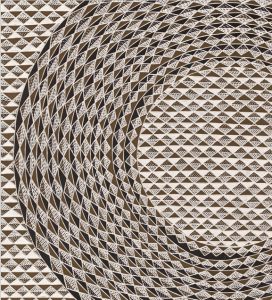
2023, pages, Maia Nuku, Met Publications, New York, Distributed by Yale University Press. Reviewed by Erin Vink (Ngiyampaa), Curator, First Nations art (local and global), AGNSW
Oceania: The Shape of Time by Maia Nuku (Ngai Tai) is a beautifully illustrated hardback edition reflecting on both the Metropolitan Museum of Art’s 2023-24 touring exhibition The Shape of Time: Art and Ancestors of Oceania, and the museum’s current curatorial reimagining and the elevation of Oceanic art hxstories for a new Oceania gallery in The Michael C. Rockefeller Wing, due for completion in 2025.
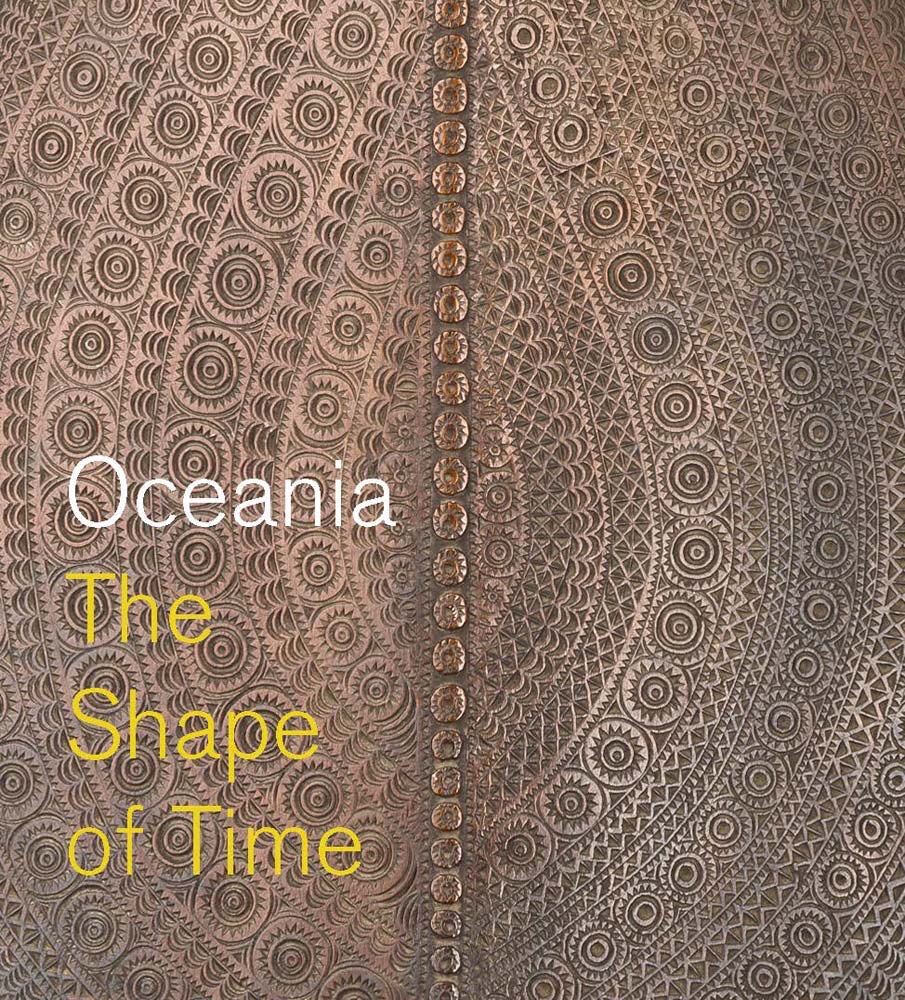
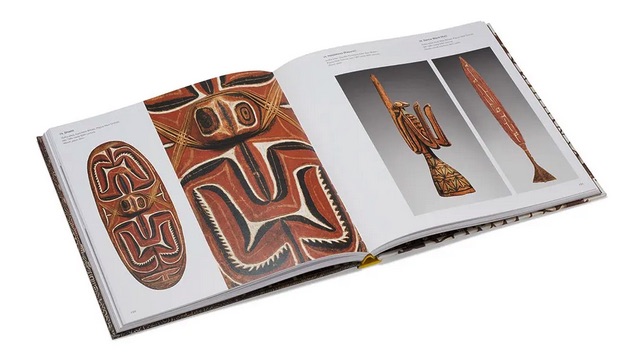
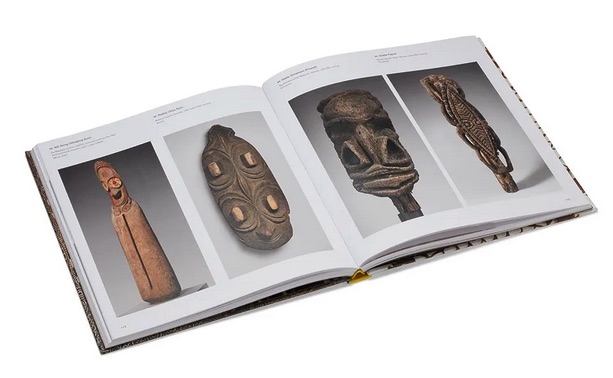
Oceania: The Shape of Time has two purposes: to introduce the Met’s significant collection of Oceanic art to international audiences in Shanghai and Doha (along with any and all international readers), but arguably most importantly, it serves to restore Indigenous knowledge and perspectives to the Met’s collection items and associated interpretative material. I know this is by no means a simple or easy task for a curator to undertake, having myself gone through this process at my own art museum in 2022, so I respectfully acknowledge Nuku’s labour on behalf of the Indigenous communities whose collection she cares for.
In Nuku’s introduction to the text Origins: An Ocean of Islands, she acknowledges the interchangeable language used across Oceania by Indigenous peoples to describe the expansive body of water that covers one third of this planet, and which connects us all. My own preference as a First Nations person and what I will use for the rest of this review is “the Great Ocean”, as Oceania does little to acknowledge the rich history of this region and, as a term, has only existed since 1831, coined by an European in an attempt to understand this relational space known by various names to many Indigenous kin.
The provocation put forward by Nuku and which underwrites ‘Voyaging’, ‘Ancestors’, and ‘Time’, the three main sections of this book, is that sometimes, it is not so much about how art looks, rather, it is about the why and how it looks the way it does. This is certainly true of many ‘Ancestral Belongings’ from the Great Ocean, to use a term introduced to me by Sāmoan curator, artist, and writer Dr. Léuli Eshrāghi (in efforts to replace cold, difficult words such as ‘artifact’ – such as which features heavily in this publication), particularly the works she brings together in the first section to explore the physical and spiritual elements of voyaging. Looking beyond the physical elements of a canoe, or the ceremonial carving in a voyager’s ‘origin house’, intangible elements reveal themselves as integral to a culture being laid down; that which remains steadfast or develops. It is found in the cultural knowledge transmission from the maker to their apprentice; the songs sung by a mother to her child. Nuku’s storying reveals that a tangible artwork exists to serve the intangible: the two are inseparable. This is not altogether unlike Sāmoan author Albert Wendt’s description of the Vā, that relational space which allows separate things to exist together across time, space, place.
The third section, ‘Time’, includes the text Visual Efficacy: The Brilliance of Shimmer and Light, which seeks to unpack what art from the Great Ocean actually does. Of course, it does many things, however I will find it easier to come to terms with this explanation by talking about the Australian First Nations art that Nuku has included and which I know intimately well. Four dazzling works by the recently passed Mrs N. Marawili (Madarrpa) illustrate how she believed the atmospheric effects created as Country is brought to life through the movement of water, wind, or lightning, is not simply just a storm, rather, it is the unseen forces of her Ancestors. This part of the text is brilliant in its focus on the continuing customary forms of mark making in Australia, however Oceania: The Shape of Time does not accurately reflect the many facets of Aboriginal and Torres Strait Islander art as well as has been done with other art forms from the Austronesian-speaking islands. It is a broad task of any curator or author to make a final selection of works for a book or exhibition, but to me the limited inclusions of Australian First Nations work – from only the northern parts of the continent – is lacking. This also ignores the rich and distinct cultural practices of the seafaring peoples of the Southeast region, whose Ancestral Belongings, including some finely detailed parrying shields that bear the hallmarks of possum-tooth zigzagging and diamond-like incisions, patterns distinct to this region, can be found in the Met’s collection.
This is a luxurious publication, and as a production of the Met, has long been overdue in its elevation and interweaving of Indigenous knowledge systems alongside the Euro-American art hxstories that have long sought to make sense of art from the Great Ocean. As Dr. Léuli Eshrāghi recently argued, ‘Literacy in Indigenous art hxstories of the Great Ocean is well overdue in 2022’.[i] Representing a premier visual cultural institution, Nuku has met this challenge with this ambitious publication and touring show, and I eagerly await to see her curation of the new Oceania galleries at the Met when they open in 2025.
[i] Dr Léuli Eshrāghi, ‘Planting Season: A New Great Ocean Art Criticism’, Indigenous Aesthetics and Knowledges for Great Ocean Renaissances, 2023, Common Room, Melbourne: 45