
Lecture to Oceanic Art Society, Sydney, 14 September 2016. Report by Jude Philp
In 1875 Maino of Mowatta welcomed William John Macleay’s Chevert expedition party to his village, and introduced him to the neighbouring village of Tureture. The Chevert stayed nearly two weeks, as the various men of Macleay’s party and those of Maino’s village collected animals. They also collected a fair amount of cultural items: finely woven bilum, hair ornaments of feathered fringes and woven collars, bows, arrows and skirts although there is scant comment in Macleay’s diary on these or the human remains that were also traded for here. Although early for this area of PNG, the collections at Mowatta, Hall Sound and in the Torres Strait are not unique. Between 1874 and 1876 this one village received visits from the police magistrate from Somerset (Henry Chester), the London Missionary Society’s various representatives (Archibald Murray, Samuel McFarlane, Mare island teachers Josaia, Simene, Kerisani and Waunafa and their wives) and Maria Luigi D’Albertis, at that time stationed at Yule Island. Of these, d’Albertis and McFarlane were also collectors. D’Albertis’ cultural collections are today spread between the Anthropology Museum of the University of Florence and the National Ethnographic Museum, Rome; while the objects and animals that McFarlane acquired are predominantly in the British and Natural History museums. Together they show the great variety of material that could be traded for along the south-western coast of Papua. The extent of red calico incorporated into these items is telling of the kinds of things that these Kiwai people acquired in return.
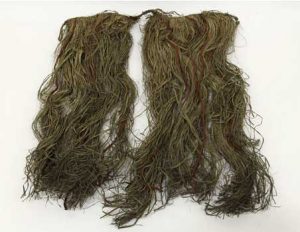
Before the collections came to the University, Macleay acquired a number of other cultural items from across the Pacific. Like his own collection these seem to have come in with the more sought after natural history material. This haphazard group of things is indicative of the extent of European travels across the region, and of the fleeting relations they had with the local people they met. Comparing the 1865 collections of Macleay’s friend the conchologist (shell collector) John Brazier on the HMS Curacao with those of the more official collections made by Julius Brenchley in the British Museum and elsewhere, one can see indications of ‘mass’ production of particular styles of objects such as lime containers, at this time in the Solomon Islands.
From Niue of the 1860s are different kinds of objects – finely woven hats in a European style that the missionary Fanny Lawes donated to the museum in 1897. Fanny and her husband William were among the few successful missionaries to the island that had been besieged by European ‘pacification’ and Peruvian slave traders. The small number of things including an arrowroot plait are not the kinds of objects often found on European Oceanic art markets, and are important for what they represent of this time and place.
The second part of the talk focused on the change to the Macleay Museum, in its move to a new facility that will house the Macleay, Nicholson and Art collections of the University. It will be an exciting opportunity to show things that we’ve not been able to exhibit before.
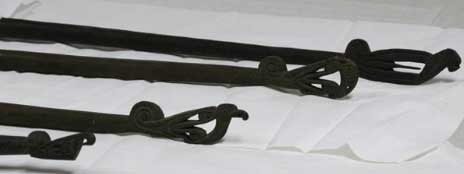
Cloths, mats, paddles and large shields have predominantly been shown as single items and we’re looking forward to the new spaces of the Chau Chak Wing Museum. The talk finished with a brief outline of one of the proposed exhibitions ‘Sydney Pacific’ (working title) that will tell the stories of individuals who visited Sydney throughout the 19th century. From Tupaia’s voyage on the Endeavor, to Maori diplomats such as Hongi Hika, passing through on their way to see Queen Victoria, and the beginnings of the ‘blackbirding’ slavery era with Ben Boyd’s 1847 shipment of workers from Loyalty and Vanuatu islands. There were also holiday makers, like Joseph John (aka Tongatapu Joe) who came to Sydney from work in the pearlshell industry of the Torres Strait. Joseph John has a special place in the Macleay family story too – originating in Tonga, this able seaman fought in the Crimean war, led the London Missionary Society people to Mowatta and was pilot for the Chevert’s expedition on its journey to Mowatta.
Jude Philp,
Senior Curator
Macleay Museum, Sydney University