


• Skip to main content
  • Skip to after header navigation
  • Skip to site footer
  • Facebook
  • Instagram
Member Account
Oceanic Art Society Australia

Oceanic Art Society

Promoting the understanding and appreciation of Oceanic art.

  • About
  • Journal
    • OAS Journal | Online
    • OAS Journal | PDF
  • Membership
  • Events
  • News
    • Latest News
    • Social Media News
  • Links
  • Video
  • Advertising
  • Contact
  • Support Us
  • Login / Account
    • Your Account
    • Edit your profile
    • Update Billing
    • Logout

Behind the lens: Richard Aldridge and his Oceanic art series of short documentaries

01/11/2016

behindthelens2

Richard Aldridge has produced a series of short documentaries on the art and culture of Papua New Guinea. These can be viewed on Youtube (see below for web address). In this article Richard describes why he set out on this path and what he feels that he has achieved in his documentary, Malangan Culture and Art Form.

Years ago while at the De Young museum after looking at the Jolika Collection, my feet aching, I decided to sit down and watch a video of several Aboriginal women discussing their contemporary ‘dot’ paintings.  Watching that video made me realise for the first time that the patterns on the canvas represented places of spiritual significance and also allowed me to see the artists and hear their stories. It made me realize the canvases were not decorative but were full of meaning – they were visual representations of Aboriginal ‘dreaming’ stories.  This experience ignited my interest in Aboriginal art.

Years later when field-collecting Oceanic art started to slow down, I thought it would be great to do a similar video documentary on a piece of Oceanic art.

When looking at a Malangan sculpture in a museum or art gallery most patrons do not really understand what is before them. The label describing the piece tells them it is Malangan, where it is from, who it was collected by and when. But this level of detail in the information age is horribly insufficient.
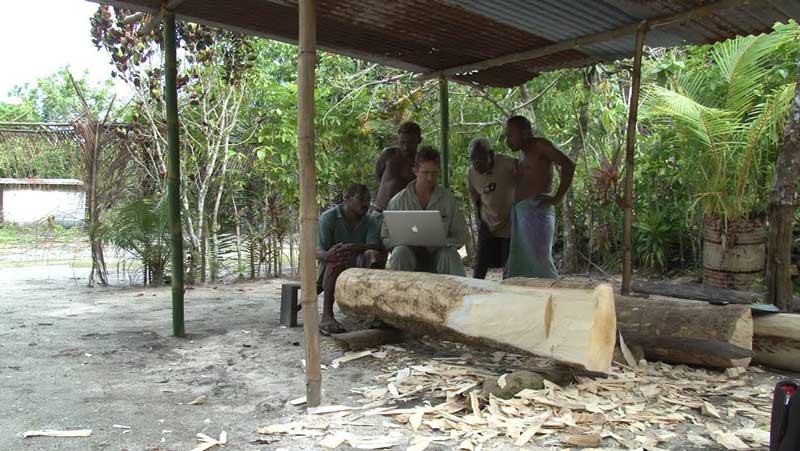
Richard Aldridge on location in New Ireland. Image courtesy Richard Aldridge.

Although some excellent books have been written by Michael Gunn about Malangan, many people, especially of the younger generation, do not want to buy and read a book and would rather learn about something for free from Youtube. Information through visual media is more readily accessible and more easily absorbed by many people.

I did not want just a documentary in isolation though. My hope was to have a Malangan sculpture in a gallery space with a QR code or Video screen next to it. A QR code allows you to use your mobile device to link straight to a video of the Malangan being made and information about the spiritual beliefs surrounding the Malangan.

You can see the artist at work and the tools he uses, you can see a Malangan ceremony taking place and you get to understand why Malangan are made and the spiritual beliefs behind them.

I had no background in film, a very tight budget, and was learning as I went along  in a remote location. I also do not like being in front of a camera.  The hardest part, though, was learning to edit and doing a voice-over because I don’t like the sound of my own voice.

The time frame was much longer than I thought it would be. I am used to PNG time where everything takes longer than you expect, but Malangan time is something different all together. It took a year and a half for the Malangan to be finished when I was expecting 3 – 6 months. I was very lucky though to already have a close friendship with Matthew and Edward Salle and an extremely understanding wife.

Apart from the fishing, the best part for me was getting a deeper understanding of what Malangan and Malangan ceremony are spiritually. I went thinking Malangan were memorial figures and the ceremony a funeral and left realising Malangan are a magically empowered object and the ceremony more akin to a séance.

The documentary by itself has very little Australian commercial TV value. Commercial TV programmes today are often made to fit with advertisers. Cooking programs for supermarkets to advertise and promote their products for instance. Advertisers do not really want to advertise during a cultural documentary.

I am hoping that the Malangan created by Matthew will sell to a gallery or museum and they will display it alongside the documentary. If the gallery is happy to take inclusive rights the documentary can then be uploaded onto the web and also given to Papua New Guinea Film Institute for broadcast to a Pacific island audience.

I am not sure what the future will bring but I am sure it will be in New Guinea as the place still fascinates me. Unfortunately I don’t think it will be another art related cultural documentary and artwork as they do not sell for much more than they cost to make. Like everyone I have bills to pay and a mortgage!

Share this content:

  • Click to email a link to a friend (Opens in new window) Email
Category: Documentaries, V21 Issue 5

Sidebar

Categories

  • All Journal Articles (281)
    • Art Fairs (7)
    • Artefacts (3)
    • Artists (3)
    • Book Launch (1)
    • Book Reviews (33)
    • Collections (8)
    • Collectors (3)
    • Conferences (3)
    • Cover Story (48)
    • Cultures (3)
    • Documentaries (1)
    • Exhibitions (36)
    • Expeditions (3)
    • Forums (4)
    • Galleries (4)
    • History (1)
    • In Memoriam (22)
    • Interviews (7)
    • Lectures (24)
    • Letters to Editor (1)
    • Meet Our Members (1)
    • Museums (12)
    • Mystery Object (4)
    • News (4)
    • Next Lecture (3)
    • OAS 25 years (2)
    • Objects (5)
    • Research (26)
    • Reviews (6)
    • Societies (1)
    • Special Pieces (1)
    • Symposium (1)
    • Theatre (1)
  • Exhibitions (3)
  • Featured (3)
  • Featured Slider (2)
  • Journal Volumes (286)
    • Volume 20 (17)
      • V20 Issue 1 (6)
      • V20 Issue 2 (1)
      • V20 Issue 3 (1)
      • V20 Issue 4 (2)
      • V20 Issue 5 (7)
    • Volume 21 (21)
      • V21 Issue 1 (3)
      • V21 Issue 2 (1)
      • V21 Issue 3 (1)
      • V21 Issue 4 (8)
      • V21 Issue 5 (7)
    • Volume 22 (33)
      • V22 Issue 1 (8)
      • V22 Issue 2 (6)
      • V22 Issue 3 (6)
      • V22 Issue 4 (7)
      • V22 Issue 5 (6)
    • Volume 23 (21)
      • V23 Issue 1 (5)
      • V23 Issue 2 (5)
      • V23 Issue 3 (5)
      • V23 Issue 4 (6)
    • Volume 24 (22)
      • V24 Issue 1 (3)
      • V24 Issue 2 (5)
      • V24 Issue 3 (6)
      • V24 Issue 4 (8)
    • Volume 25 (24)
      • V25 Issue 1 (6)
      • V25 Issue 2 (6)
      • V25 Issue 3 (5)
      • V25 Issue 4 (7)
    • Volume 26 (25)
      • V26 Issue 1 (6)
      • V26 Issue 2 (7)
      • V26 Issue 3 (6)
      • V26 Issue 4 (6)
    • Volume 27 (31)
      • V27 Issue 1 (6)
      • V27 Issue 2 (8)
      • V27 Issue 3 (9)
      • V27 Issue 4 (8)
    • Volume 28 (30)
      • V28 Issue 1 (7)
      • V28 Issue 2 (6)
      • V28 Issue 3 (8)
      • V28 Issue 4 (9)
    • Volume 29 (26)
      • V29 Issue 1 (7)
      • V29 Issue 2 (9)
      • V29 Issue 3 (4)
      • V29 Issue 4 (6)
    • Volume 30 (25)
      • V30 Issue 1 (6)
      • V30 Issue 2 (6)
      • V30 Issue 3 (6)
      • V30 Issue 4 (6)
    • Volume 31 (12)
      • V31 Issue 2 (6)
      • V31 Issue1 (6)
  • Members Only (41)
  • Members Only PDF (101)
  • OAS News (7)
  • PDF Journals (146)
  • PDF Legacy Journals (95)
  • Publications (3)
  • Video (15)

Join the Oceanic Art Society

Provide your support and become a member for access to premium content, event discounts and other benefits.

Become a Member
OAS Newsletters

Get the latest news, events and announcements straight to your inbox.

Subscribe
Latest Journal Stories

Living Arts and Living Archives

Living Archives: The F.E. Williams Collection and PNG’s 50th Independence Anniversary

Tiki in Architecture

Where Taiwan Meets the World – Contemporary Museology of Oceania

Site Map
  • OAS Journal – PDF
  • OAS Journal – Stories
  • OAS News
  • Videos
  • Social Media News
  • Events
  • Resources
  • Publications
  • Links
  • Donations
  • Membership
  • Advertising
  • Contact Us
Postal Address

Secretary OAS
PO Box 3287,
Wareemba NSW 
Australia 2046

[email protected]


  • Facebook
  • Instagram

Copyright © 2026 | Oceanic Art Society Inc | All Rights Reserved