
An English Girl in New Guinea: Kathleen Haddon’s Journal and Photographs from New Guinea 1914. Kathleen Haddon, edited by Virginia Lee-Webb and Jonathon Fogel. Hardcover, 192 pages, over 200 B/W photographs. Limited to 500 copies, available via www.PremierArtsEditions.com
Review by Crispin Howarth

An English Girl in New Guinea is the first publication by the new publishing house Premier Arts Editions. With essays by Sebastian Haraha, Anita Herle, Henry Risbeth and Virginia Lee-Webb, this work is an excellent crossover of history, exploratory travel and photography centring upon an unpublished manuscript of Kathleen Haddon, likely the first female anthropologist and photographer in Papua New Guinea.
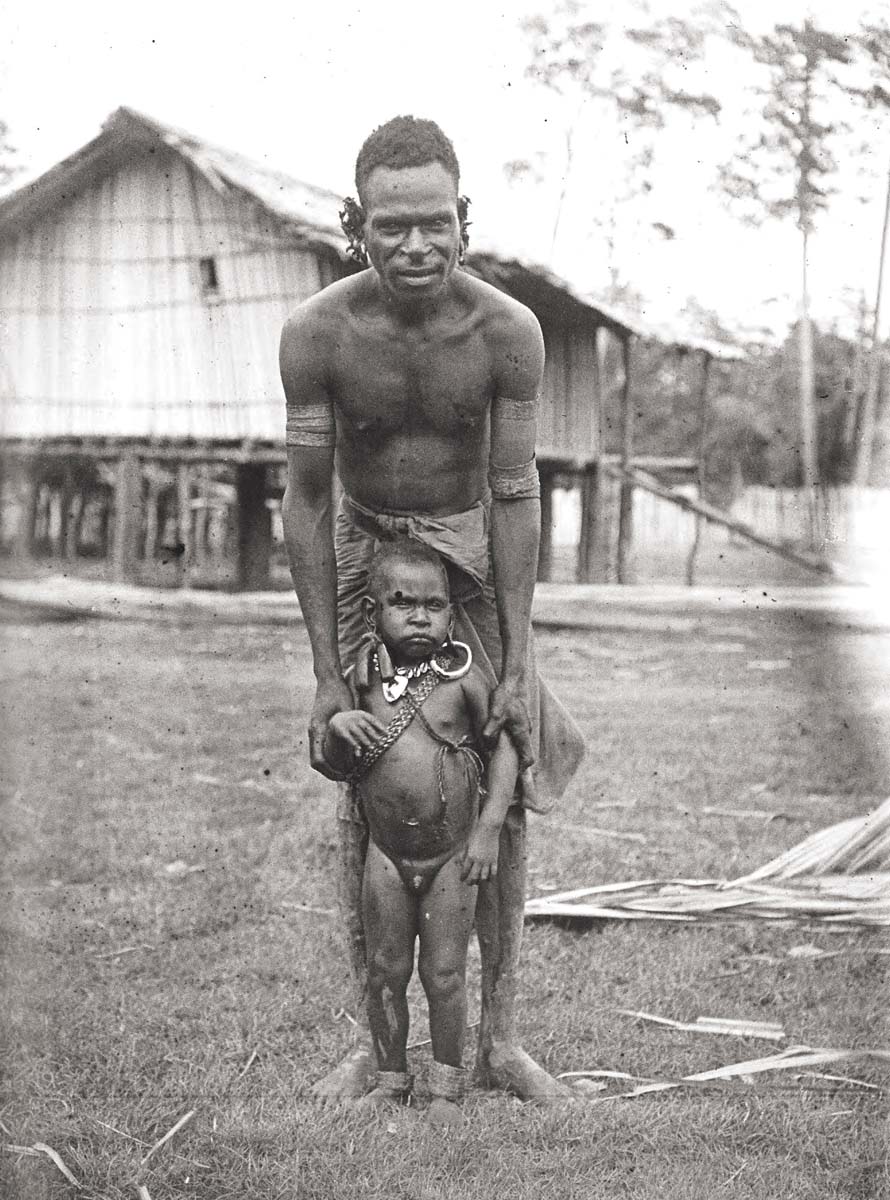
Haddon’s father Alfred Cort Haddon, the grandfather of anthropology, is a well-known name in New Guinea art studies, he visited New Guinea three times and several works on his expeditions are previously published[1], yet here, Virginia Lee-Webb has brought to the fore a series of previously unpublished photographs by Haddon’s daughter, Kathleen, who travelled with her father on his third expedition to New Guinea. In the text we are provided with a rare glimpse into British New Guinea cultures over a century ago. At 26, Kathleen was working in the sciences and her knowledge of zoology, photography and ethnography her interest in string figures also known as ‘Cat’s cradles’ had already led to publications in 1911. All these qualities made her the ideal companion to accompany her father as assistant and photographer on the last of the three Cambridge Anthropological expeditions to the Torres Straits in 1914. During the expeditions she collected various natural history specimens while her father sought to collect material culture from the villages they visited, her images of New Guineans are often more relaxed, candid portraiture and less static than those of her anthropologist contemporaries. Kathleen held a unique position on the expedition, this was an era where very few foreign women travelled in New Guinea, her gender gave access to local women who otherwise would have had no direct contact with the male expedition members. Her engagements and encounters make for fascinating reading.
The essays provide a broad understanding of both Alfred Haddon and Kathleen Haddon and the era of expansion for anthropology as a field of study. Kathleen’s son, Henry Risbeth, provides a biography of his mother’s life pre and post the New Guinea expedition. Anita Herle (recently retired Senior Curator for Anthropology at the Museum Anthropology at the Museum of Archaeology & Anthropology, Cambridge) gives a rich biography of both the father and daughter, setting out details of the Anthropological Expedition to the Torres Straits which Kathleen joined. Sebastian Haraha (Papuan gulf man and previously a Senior Technical Officer, Anthropology at the National Museum of Papua New Guinea) notes in his essay ‘there is so much to learn and understand from these images’ and asserts his belief that a wide variety of historical threads have shaped Papua New Guinea — the writing and photography of Kathleen Haddon are one of those threads.
It is Kathleen’s diaries that form the body (and title) of the book, previously unpublished, they record the two month long expedition between September and November 1914 from the Torres Strait venturing clockwise to Daru, the Kiwai region of the estuary of the Fly River with its many islands, to Goaribari Island and then into the Kikori delta and onward to Orokolo on the Gulf coast. The expedition continued east towards Port Moresby, following the coast as far as Mailu before returning westward across the Gulf of Papua to the Torres Strait Islands. For a slice of insightful history Haddon’s diaries have great use, they refer to numerous interactions with London Missionary Society missionaries, including John Henry Holmes and William Saville, at almost every mission she notes lay teachers to be invariably Samoan, those teachers were key to the success of the missions in New Guinea at the turn of the 20th century. Equally, there are observations on the copra plantation business, the challenges facing planters, observations of the developing city of Port Moresby and details of a cargo-cult on Saibai island all of which provide a better understanding of this era.
Haddon’s writing is detailed and, while of its time, it is a rare opportunity to read the experiences of engaging with New Guineans in this relatively early contact period from a female perspective and within the tough environments that are the Western Province and Gulf Provinces. Her recollections of staying at Mr Palmer’s home at Dimiru, encountering insects, putting her foot through the floor of the house and trying to wash with a sponge riddled with ants, or her travel and reception at Tirio village provide elements of sensitivity and situational humour (such as her father becoming stuck on a flimsy bamboo bridge resulting in his repeated drenching). Those endearing moments are often lost in other travel diaries of this period.
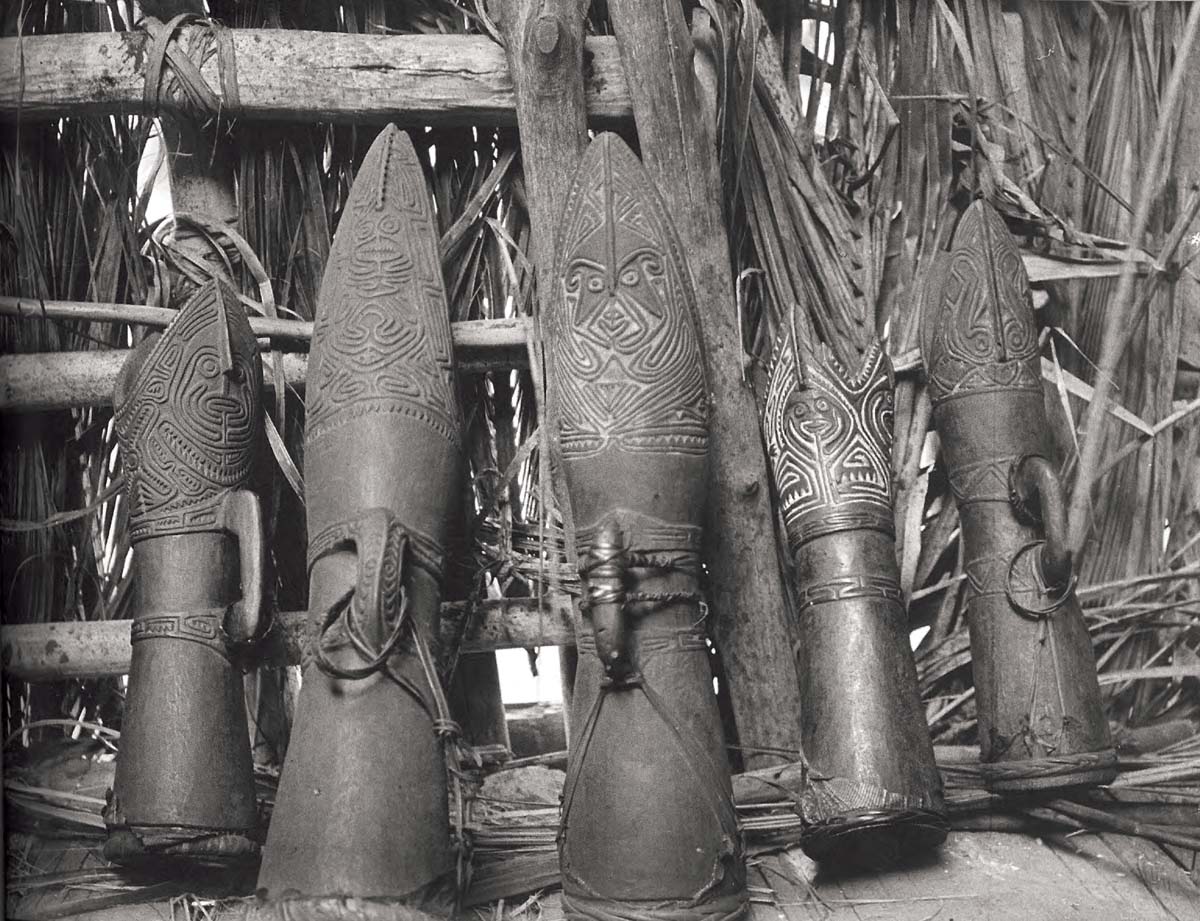
At Ukiaravi village, Haddon takes the opportunity to enter a men’s club-house Ravi, forbidden to local women but an exception was made for this white visitor accompanied by her father and her description of the Ravi’s interior is brought to life by her photography. Luckily for Haddon, the elders of the Ravi did not object to her use of large cameras in the space which is also lucky for us as the images are remarkable documents of buildings and arts that are longer extant. The images are wonderful for their details; on page 108 (Fig 5.82) Interior of a Ravi, Maipua 17th October 1914 an image of the inside of a men’s club-house shows an array of dance masks and spirit boards with piles of pig skulls either side of the central walkway of the house leading off into the gloom. I found this image particularly interesting as the walkway is partially paved with the carved side panels of long defunct canoes with their designs just visible.
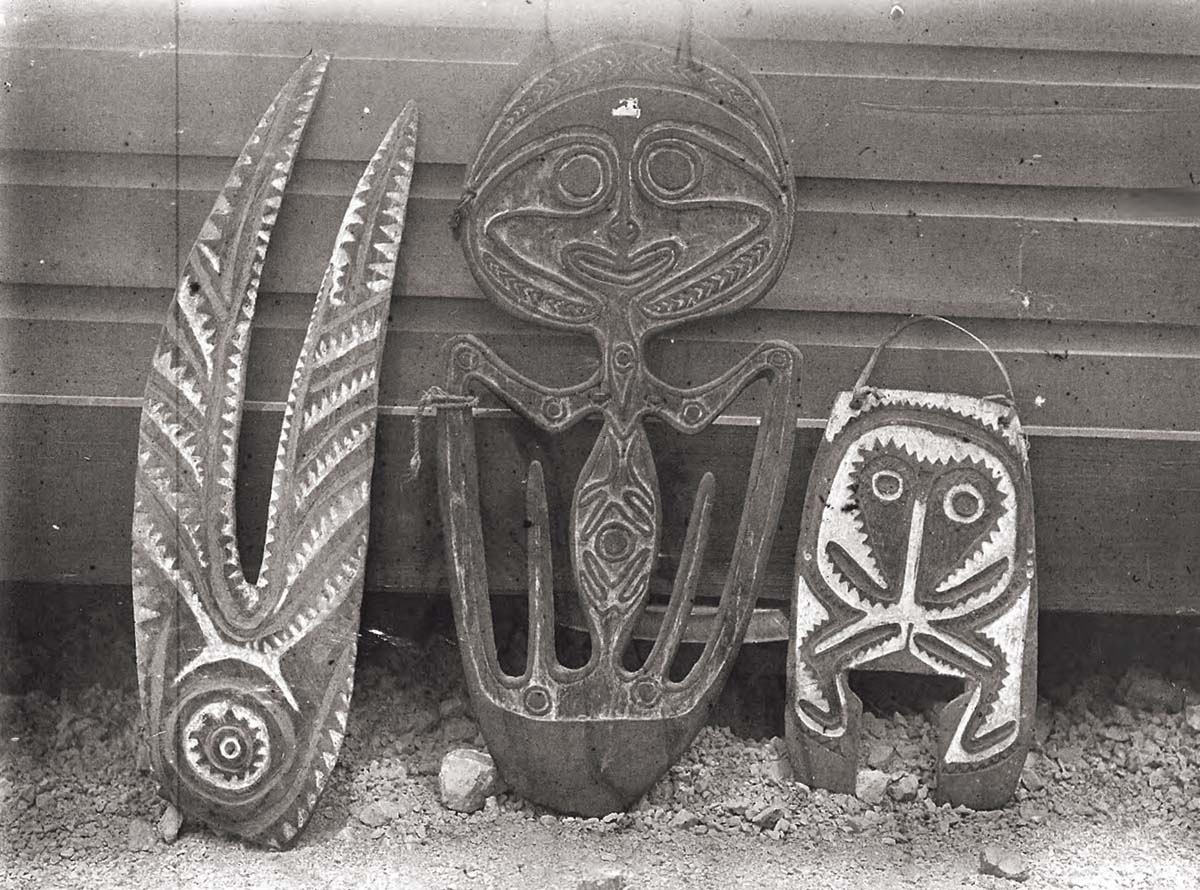
In Port Moresby Haddon worked to photograph the collections of the fledgling museum, a building of corrugated iron situated on a bare hill constantly in the blazing sun. We have the images but as notes she and her father could have both expired in the stifling heat of the museum. Several photographs show objects that were taken out of the building to gain the best images possible.
Lee-Webb has meticulously brought together Kathleen’s photographs forming a powerful narrative; it was an interesting editorial decision to retain the images as they were produced – in difficult environmental conditions. Some images show minor exposure issues or markings from their development with brackish water and excessive heat and humidity. These minor blemishes add to the reader’s sense of travel and the need to visually capture encounters and experiences by the expedition; in her diaries Haddon writes that she would be developing her films at 5.30am as the available water would be too warm to use by 7am.
Following Haddon’s dairy is an appendix of images taken by Haddon of artefacts which are mostly now part of the Papuan Official Collection formed by Lieutenant-Governor Hubert Murray, now housed at the National Museum of Australia. This appendix is a work in progress to identify and locate objects which Haddon documented through her photography.
An English Girl in New Guinea was awarded the 2024 Pierre Moos Prize at Christie’s last September in Paris, but this book would not have existed without the drive of Virginia Lee-Webb who has long wanted to bring recognition to Kathleen Haddon for her great contribution to the field of visual anthropology.
[1] Herle, Anita 2009, Cambridge and the Torres Strait: Centenary Essays on the 1898 Anthropological Expedition. Cambridge University Press & Philp, Jude with Herle, Anita 2020 Recording Kastom: Alfred Haddon’s Journals to the Torres Strait and New Guinea, 1888 and 1898. Sydney University Press.