
by Pierre Laffont
The 2024 three day annual Pacific Art Association Europe conference took place in October at the Ethnologisches Museum in the Humboldt Forum in Berlin. (David Hourigan shared images of displays at the Humboldt Forum in the Spring 2024 edition of the Journal).
The general theme was the multiplicity of voices and collaborations in exhibitions and museum collections, in other words the politics of display in museums worldwide including the Met in New York, the Peabody Yale, the Queen Emma Summer Palace in Honolulu, the de Young in San Francisco, etc.
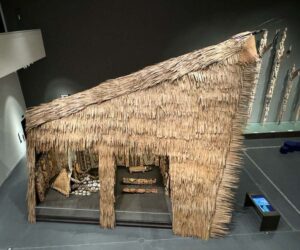
An additional benefit of place for two presentations was being able to experience the display on the spot: the Abelam haus tambarandiscussed by Amelie Roussillon from Utrecht university and the Fijian drua (double-hulled sailing canoe) talked about by the University of East Anglia’s Steven Hooper are located in two spectacular halls, dedicated to Buildings and Boats from Oceania.
The Abelam presentation strikes my Occitan cord: many cloisters of my region in France have been “reassembled” in the same haphazard way in museums and private collections worldwide, the most famous being in its namesake, the Cloisters in New York. In the same way, the rich Abelam haus can be found in public and private collections worldwide; for example, in Australia, three Abelam ceremonial houses have made their way in whole or in parts to museums in Sydney, Canberra and Adelaide. Large Fijian boats (11 or more metres long) have been more difficult to ship.
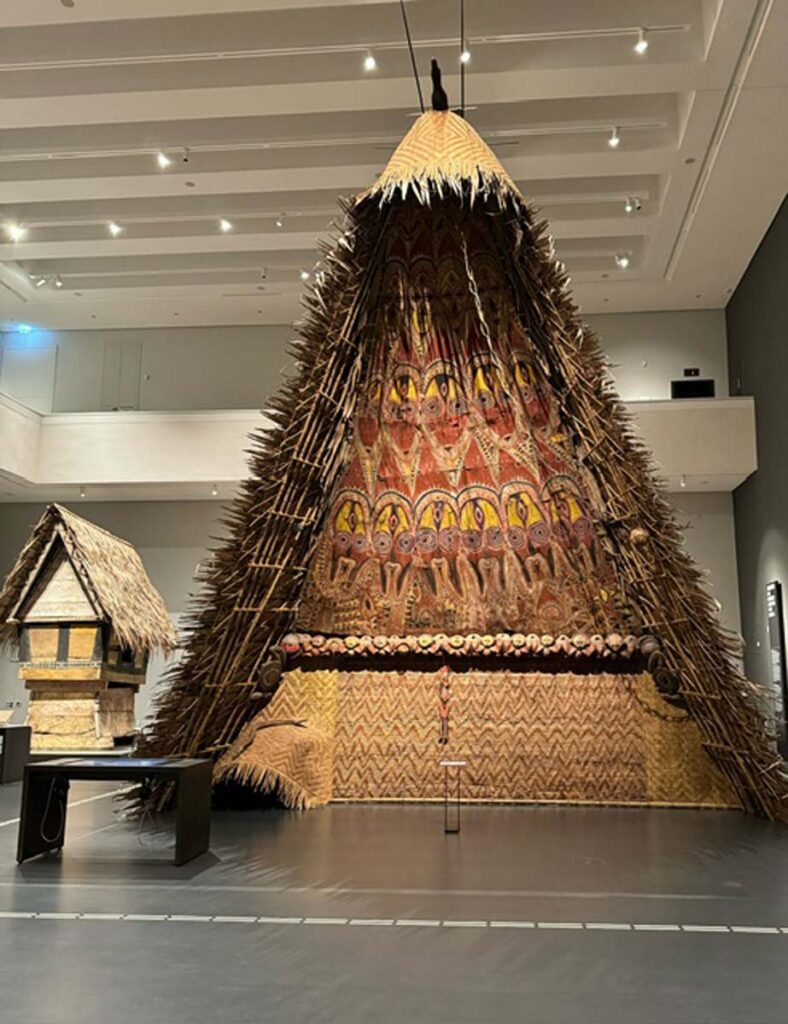
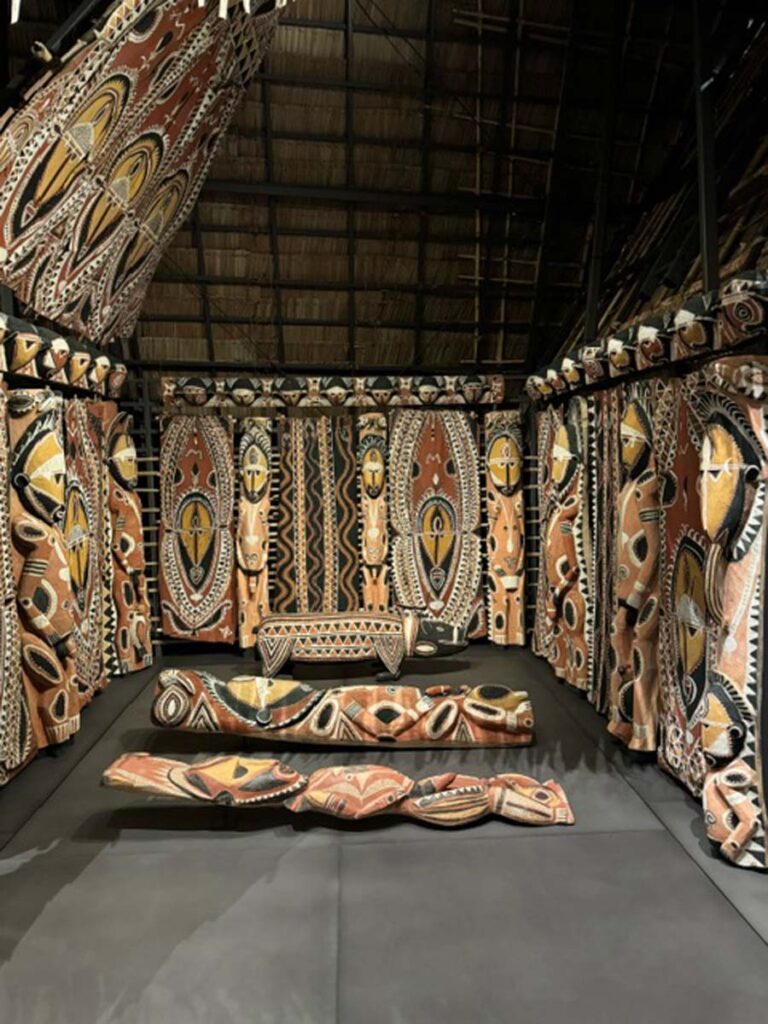
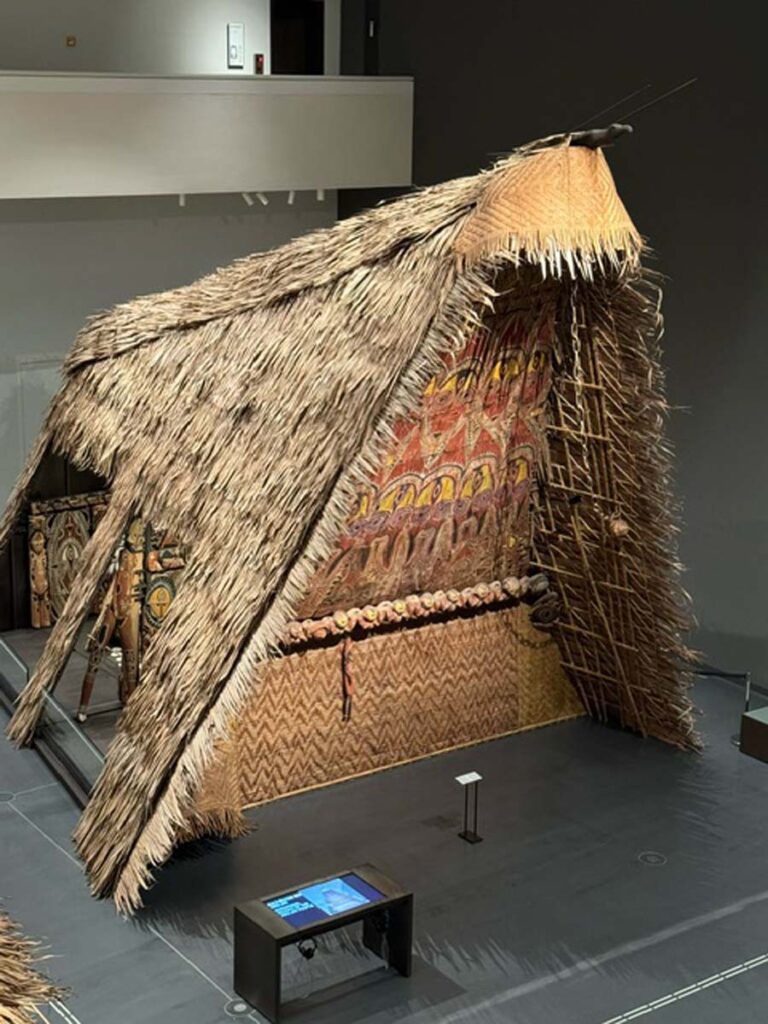
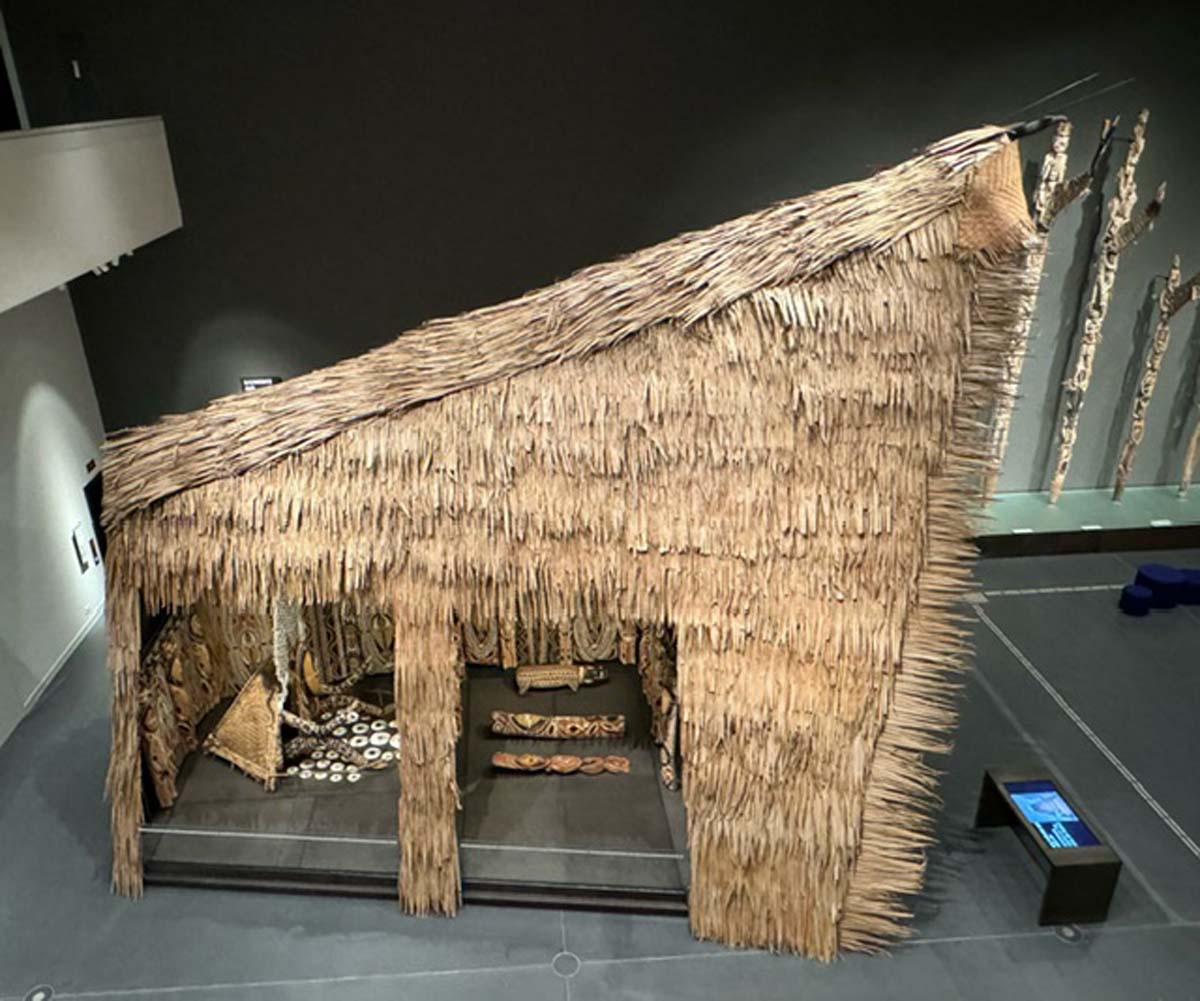
The Abelam ceremonial house at the Humboldt Forum perfectly illustrates the theme, that the displays are a sort of chimera born out of the imaginations of many authors. Like the Benedictine Saint-Guilhem Cloister at the Metropolitan Museum of Art in New York, where the doorway originates from an Augustinian priory some 400km away, the Abelam haus originates from two different time periods, two different locations, and possibly two different traditions.
The façade of the ceremonial house was painted and sculpted in 1966 in Kalabu by Waivu Urula. This artist was also one of the main informants to Gerd Koch, who collected the facade at that time. The façade was restored just before being packed and shipped to Germany. Some objects were added to the shipments including the hornbill and the head which were meant to be for the ceremonial house but remained in the storage house for quite some time when the façade was displayed in the Ethnologisches Museum in Dahlem, West Berlin. Eventually the façade and the sculptures were transferred to the Humboldt Forum in 2021 alongside the Pacific Art displays. Dahlem is now used solely as a restoration centre and storage facility.
Two initiation chambers were added behind the façade of the ceremonial house when it was transferred to the Humboldt Forum in 2021, creating the ceremonial house as seen today. These initiation chambers were acquired from another village called Apangai through anthropologist and collector Noel McGuigan in 2013, arriving in Berlin in 2014.
How did these two initiation chambers end up being displayed in Berlin? In 2009, while on a trip to the Abelam region that was intended to revisit places where he had previously done field research, McGuigan was asked by Keli Kandi who was a big man in Apangai village to find a market for the carvings and the painting contents of the initiation chambers in the ceremonial house on the site. Born in 1947, Keli Kandi has been a renowned artist since the 1980s. The ceremonial house, including the chambers, has been created under the supervision of Keli Kandi, but with the help of other local artists. The assemblage was part of the current and continuing project started by Keli Kandi to further artistic creation in Apangai and to demonstrate to the younger generation the original role of painting and carving in Abelam society, even though these initiations were no longer happening. The ceremonial house was also created to attract tourists and the accompanying artistic demand for the artists’ works.
No initiation ceremonies ever took place although the original idea was that it was a way for younger generations to understand what these initiations were like and there was a lingering desire to create some kind of re-enactment of an initiation ritual. When McGuigan came to Apangai in 2009, the house and the displays had become solely an attraction for foreign tourist groups with advertising for the Initiation rooms in the arrival area at the airport in Wewak.
The Berlin museum already had an extensive collection from the Abelam region, especially the one acquired by Gerd Koch in 1966. However, with the absence of this kind of initiation room displayed, this purchase was filling a void in the collection. A deal was struck: the purchase consisted of around 135 Abelam items, including the painted panels and carvings and all the other elements from the initiation rooms in addition to masks and costumes acquired at the same time. Many of these artifacts are an expression of artistic and practical licence of the artists in Apangai. For example, the shells on the floor are made of wood. Shells are a very important wealth element in Abelam culture but very expensive to acquire. When Keli Kandi created the scene in Apangai, he felt that wooden shells painted in white were a way to recreate the display but were also much less fragile than real shell; tourists could step in the initiation chambers without breaking them.
Like the reconstructed cloisters in New York, the Humboldt Forum reconstruction mixing two separate collections truly highlights how this assemblage falls in a long tradition of accretion of multiple voices and relationships; in this case started in PNG and continued in Germany. It is also entirely fitting that this piece of installation art is called haus tambaran as it sits at the heart of the Humboldt Forum, the former and reimagined Berliner Schloss at the historic centre of the German capital, an everlasting reconstruction and reinvention of times and places.
The next Pacific Art Association Europe conference will be held in June 2025 in Norwich, the United Kingdom and the 14th PAA International Symposium will be held in Leiden, the Netherlands, from 23-27 June 2026.