
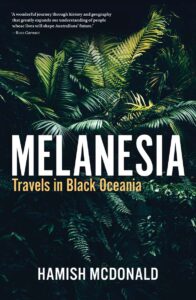
Hamish McDonald, 2025, 330 pages, Black Ink.
Review by John Greenshields
Quite by chance I sat next to Hamish McDonald at the OAS Forum in Brisbane in 2013. He was at the Forum to research a trip and then write a book on Melanesia. This book is the result of 12 years of work, and it is excellent.

I read the book twice. At first it reads as a breezy, anecdotal travelogue through Melanesia, largely by boat, with insightful encounters from villagers to politicians. The second time I noted more deliberate accounts of colonial history and its legacy, of both kastom[custom] and Christian religious conflicts, of detailed social and political histories of each of the Melanesian countries.
It should be read by all Pacific scholars, diplomatic staff, defence personnel, NGO staff and business people before they venture there, as it gives insights that inform and should caution. It should be compulsory reading for DFAT staff. Each country has a distinct chapter, and some like Malaita, Bougainville, PNG Highlands, Sepik, West Papua etc. get special mention with great insights on internal conflicts.
The author makes his interests quite clear, “The Polynesian nations, with their chiefly hierarchies and stern Methodism, interested me less … it was the diverse mix of the Melanesian world that fascinated.”
He writes a very good summary of the “out of Africa” migration to the Pacific and Australia over the last 60,000 years … including the Austronesians, an Asiatic maritime people originating in Taiwan, who developed canoes for fast long-distance voyaging and settling the vast Pacific as far as Easter Island [500 AD] and NZ [1200 AD]; the greatest migration in history.
The book then explores a number of themes, common to most of
these countries:
- There are many examples of the conflict where the duality of the state and kastom are hard to reconcile: “As well as introducing codes of conduct…governments have tried to take the pressure off MP’s by giving them an annual personal fund of 3 million [Vanuatu] vatu, about A$38,000 to spend at their own discretion. By the standards of slush funds allocated to MP’s in PNG and the Solomons it is modest…”
- A former Director General of the Prime Minister’s office, Gregoire Nimbtik explained: “In Vanuatau, the kastom practice of distributing goods to close families and political supporters is in fact considered moral, because a leader is fulfilling their social duty. However, in a legal-rational governance system, this practice is labelled as corrupt because a leader is favouring his close relatives and ingroups and therefore distorting the process of justice, fairness and equity.”
- The rise of the “Big Man” politician, favouring larger tribes and family, and leaving others out, is described in some detail. This is in spite of many Western-styled constitutions and Westminster style governments. Democracy as we’ve known it is under threat in the Pacific, in Africa and even the US.
- The influx of foreign nationals on “visa-free” arrivals is changing the Pacific. It is coming to the point where some countries are in danger of compromising their sovereignty. In PNG, new arrivals open trade stores and supermarkets, activities limited to citizens when I left in 1980. There is much visitor visa overstaying. Corruption is rife.
- He describes secession movements in Bougainville and New Caledonia in great historical and contemporary detail. The book refers to the superb account by Bill Brown, A Kiap’s Chronicle of the whole, sad BRA mining fiasco, available online at: https://www.pngattitude.com/a-kiaps-chronicle.html Furthermore, “Marape … said his officials were investigating a compromise such as an ‘’’associated status for Bougainville, like the Cook Islands have with NZ.” So, for Canberra, “the question is excruciating.”
- There were vibrant indigenous business and social movements like the Fiji Company and Hahalis in Bougainville that became like a second administration, so they were shut down. “This suppression, rather than support, might have led to a greater sense of Fijian control, and helped avoid the racial conflict that unfolded decades later.”
In conclusion, the author writes, “a start to grappling with these fast-emerging new realities could be that Australians put aside their arrogance about their place in the Pacific. For one thing, they could start appreciating that for all their economic poverty, the indigenous people of the region have given the world far more original art than they have. Or that the plunder and near-slavery run out of Sydney and Brisbane into the early twentieth century, the suppression of indigenous movements and the ruinous ecological and social side-effects of big mines have not left an unalloyed feeling of affinity among Melanesians”.
“The population of Melanesia will steadily catch up with that of Australia. The trickle of Melanesians coming into Australia will build into a significant flow back and forth. With wise statesmanship, the region could be embraced as a source of strength and renewal. It could be the way Australia decolonises.”
Sadly, most Pacific art is locked away in our museums, as the OAS has strived to highlight. The French would showcase this material, and so should we, as a soft-power demonstration of our deep and longstanding Pacific ties.
The author suggests Australia decolonises. I’d use the word transform, as decolonise is a loaded term, and some posit that there were good examples of colonialism. The legacy of Sir Hubert Murray [HM] as Lieutenant Governor Papua [British New Guinea] from 1908 to 1940 is one good example of which Australia should be proud. He set the path towards independence, yet his grave lies untended and forgotten at Badihagwa cemetery in Port Moresby. I asked Minister Tanya Plibersek to have it listed as an Australian Monument Overseas three years ago, but her office declined, as they were “reviewing the legislation”. I sense that Australia is uncomfortable with colonial monuments. In the case of “HM”, we shouldn’t be.
This book inspires further reading including Empire by Niall Ferguson and Bruce Gilley’s The Case for Colonialism.