Fondation D’Entreprise Francès in Senlis (23 February – 29 June 2024) and Clichy (1 – 14 March 2024). Review by Elsa Spigolon
This exhibition’s title, which sounds as much like an urgent need for preservation as it does a victory against oblivion, has left its mark on the minds of all French lovers of contemporary art from Papua New Guinea (PNG).
Renowned Kwoma artists Agatoak Kowspi and Chiphowka Kowspi were welcomed in residency at the Cité Internationale des Arts in Paris from 6 February to 4 April 2024 as part of a project developed by the Association Françoise pour l’œuvre contemporaine, in partnership with the Institut Français. Agatoak and Chiphowka Kowspi are the sons of the acclaimed artist and chief of the Wanyi clan, Kowspi Marek; all three continue to live in the Upper Sepik near Ambunti.
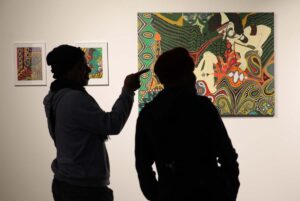
From this artistic residency in Paris emerged the ambitious exhibition From my painting, my soul emerges and lives on, presented across Senlis from February to June 2024 and Clichy in March 2024 at the Fondation D’Entreprise Francès. The exhibition featured a total of one hundred and thirty-five works by Kowspi Marek and his two sons. Although only Agatoak and Chiphowka Kowspi took part in the residency, this exhibition is built on all three voices.
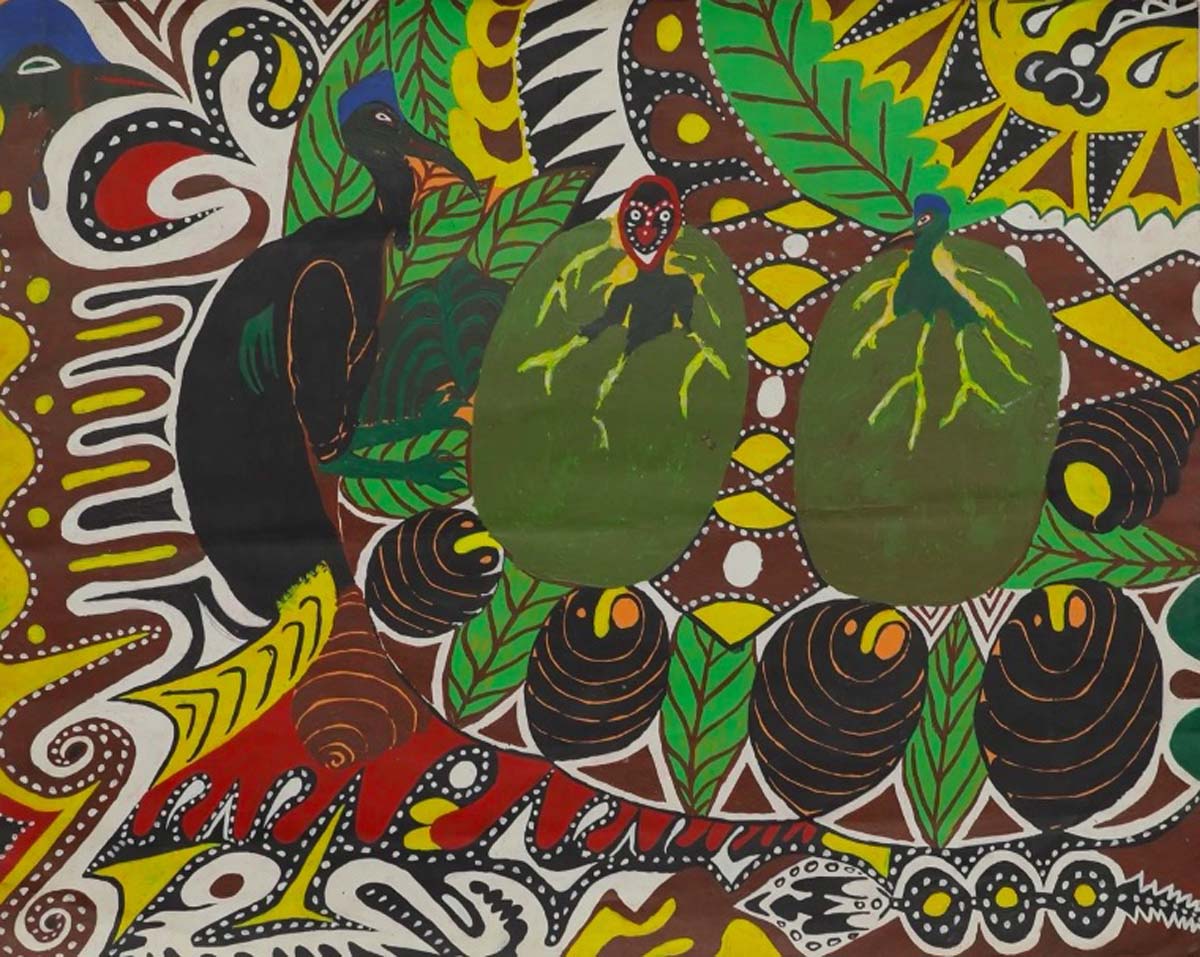
Born in Bangwis in 1956, Kowspi Marek continues to live and work in PNG alongside his sons. The eldest son of Marek Klapuach, the secular chief of Washkuk, he began selling his first creations, paintings on sago petiole (the stem base of sago palm leaves) and wood sculptures, in 1971. He was initially self-taught under the guidance of his father, before doing an artist’s residency at Stanford University in California in 1996. His practice grew in visibility thanks to his work as a tourist guide in the Sepik region. In 2002, he met the philosopher and writer Maxime Rovere, with whom he embarked on a large-scale cultural project to transcribe Kwoma myths, called numa, into writing and painting, assisted by his sons.[1]
Marek’s first son Chiphowka Kowspi was born in 1974. Considered a renowned sculptor, his work includes a statue of the mythological figure Kumurr which was acquired by the American Ron Perry in 1999. He prefers to devote himself to his artistic practice working from his village. His intuitive and almost immediate mastery of acrylic on paper and canvas led his father to consider him the best Kwoma painter of all time.[2]
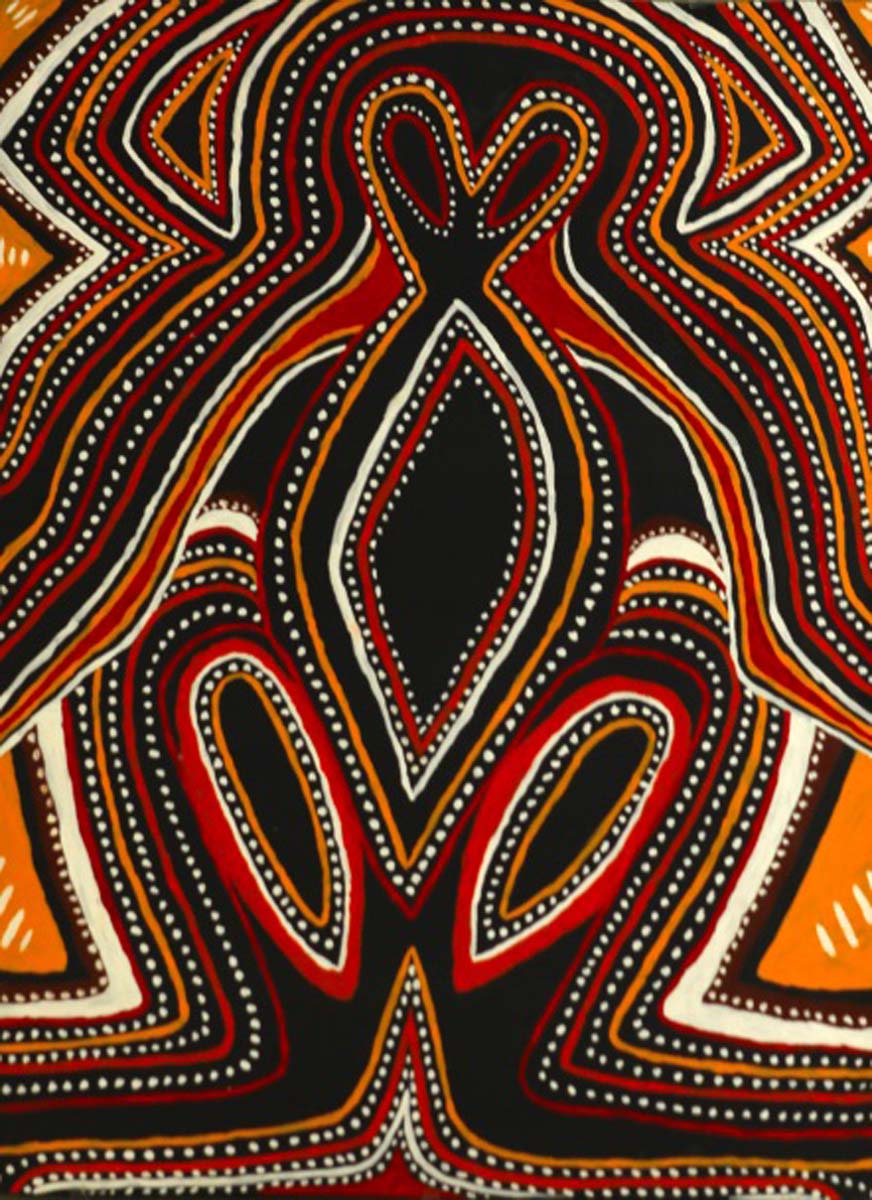
Agatoak Kowspi is Marek’s second son and was born in 1977. He developed his artistic skills by observing his father and brother but did not start working on his own until 2002. His work, more than that of his father and brother, is marked by his experience of urban life when he lived in Lae between 1996 and 1998. In 2001, he created a mural for the official opening of the Ambuti Tresory House cultural centre.[3]
The first exhibition of works of these three artists, Rouge Kwoma. Peintures mythiques de Nouvelle-Guinée [Kwoma Red: Mythical Paintings from New Guinea] was held at the quai Branly – Jacques Chirac museum in Paris from 14 October 2008 to 4 January 2009. It was co-curated by Magali Mélandri, head curator of the Oceania Unit at the quai Branly museum, and by Maxime Rovere, who, due to his close involvement with the Kwoma people, holds clan responsibilities at the museum. After their first trip to Europe for this exhibition, the three artists acquired a new local status, considered Big Men among Kwoma[4], this title is inherited down a line of ritual leaders[5].
This second exhibition in France, From my painting, my soul emerges and lives on, has been initiated through the Association Françoise pour L’œuvre Contemporaine, which supports contemporary artistic creation and was founded by collector Estelle Francès in 2015. All works presented in this exhibition are fundamentally mythical in nature. They convey a narrative chosen by the artists using the Kwoma visual tradition aimed at both the next Kwoma generation and the European public. Kowspi Marek expresses their aim, ‘Showing and telling is the meaning of each of our works. And the idea of working on transmission, of sharing the memory of ancestors by giving it a modern twist, can only allow History to remain for later, and later still.’[6] The three men’s artistic practice comes from a fear that their culture was dying out.
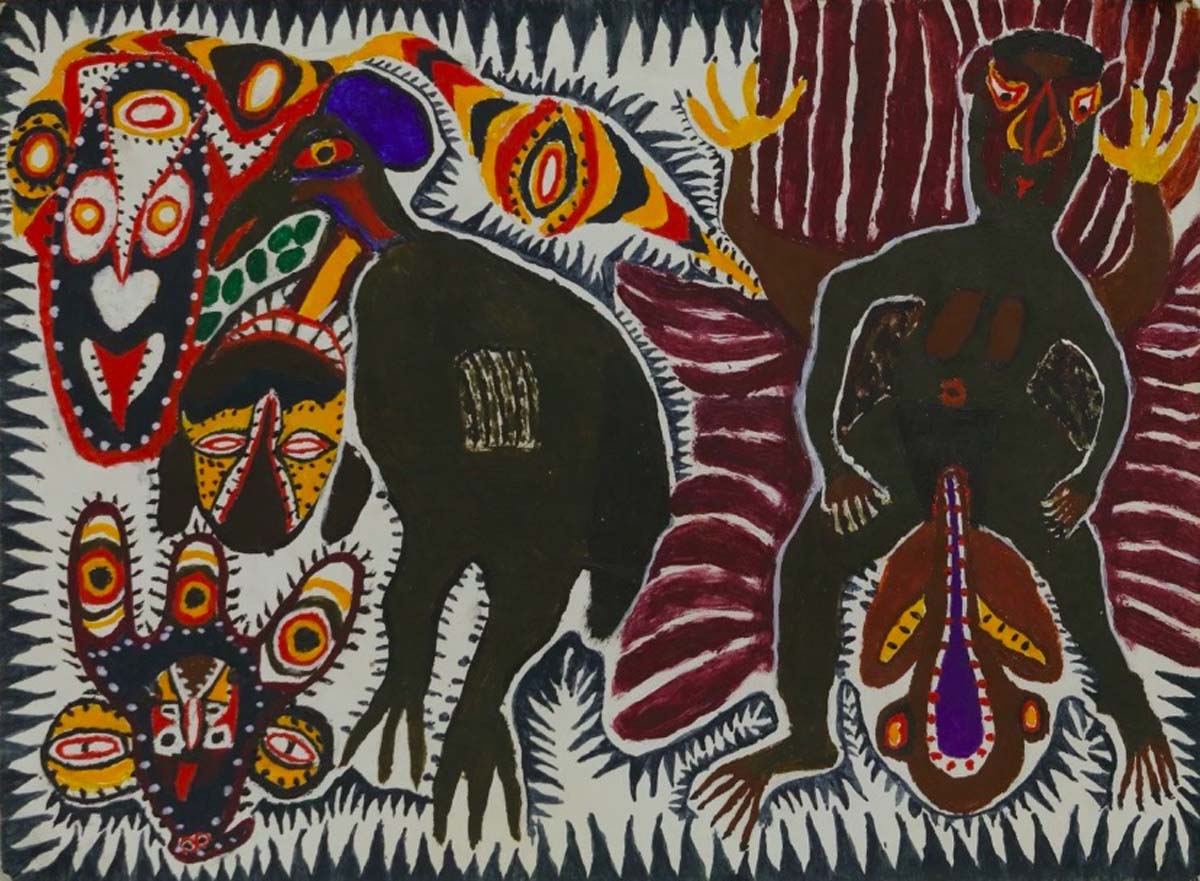
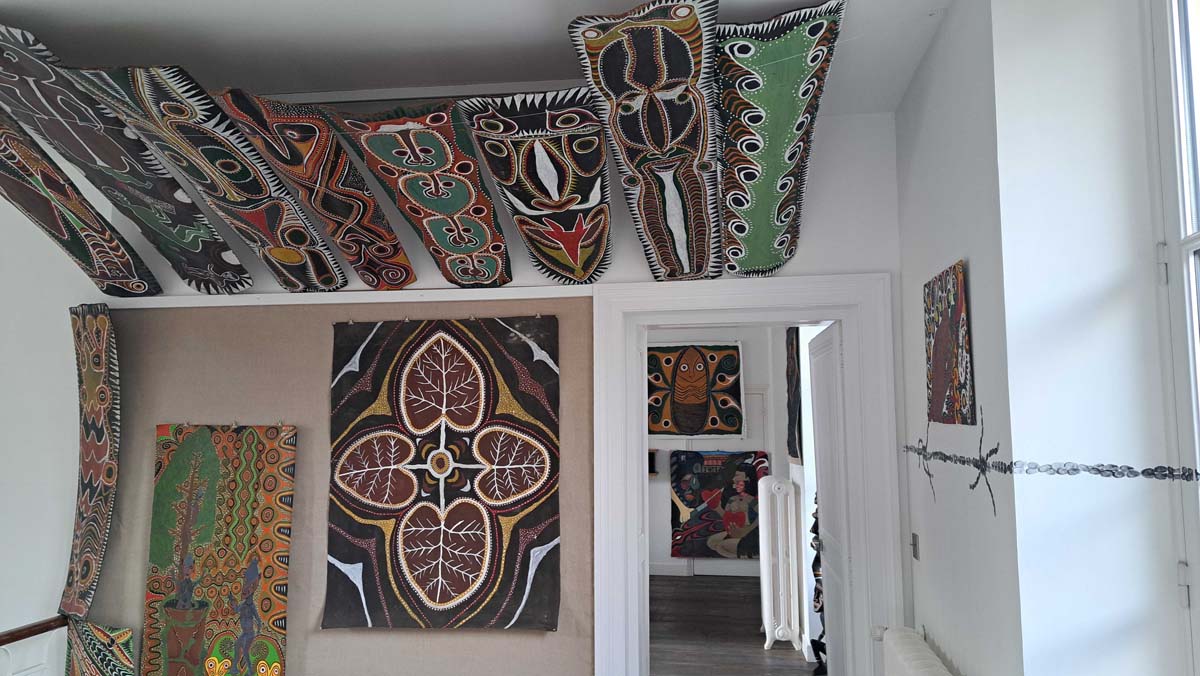
The body of work uses traditional colours of black, white, yellow, orange and red with the broad palette offered by contemporary acrylics, in a perpetual quest for visual impact and effective representation. These new colours were first introduced by Maxime Rovere, with Kowspi Marek expressing his enthusiasm for these new colours in the Kwoma Red catalogue, explaining that they had enabled him and his sons to overcome the material limitations imposed by natural pigments[7]. Blue and green were only made by a few men, and didn’t have the same visual qualities that acrylics offer today. The images take shape on media as diverse as canvas, paper, cardboard, bark, stalks and wood. In Kwoma context, pangal representations on bark or stalks are the subject of a specific visual device developed on the ceiling of koromb spirit houses.
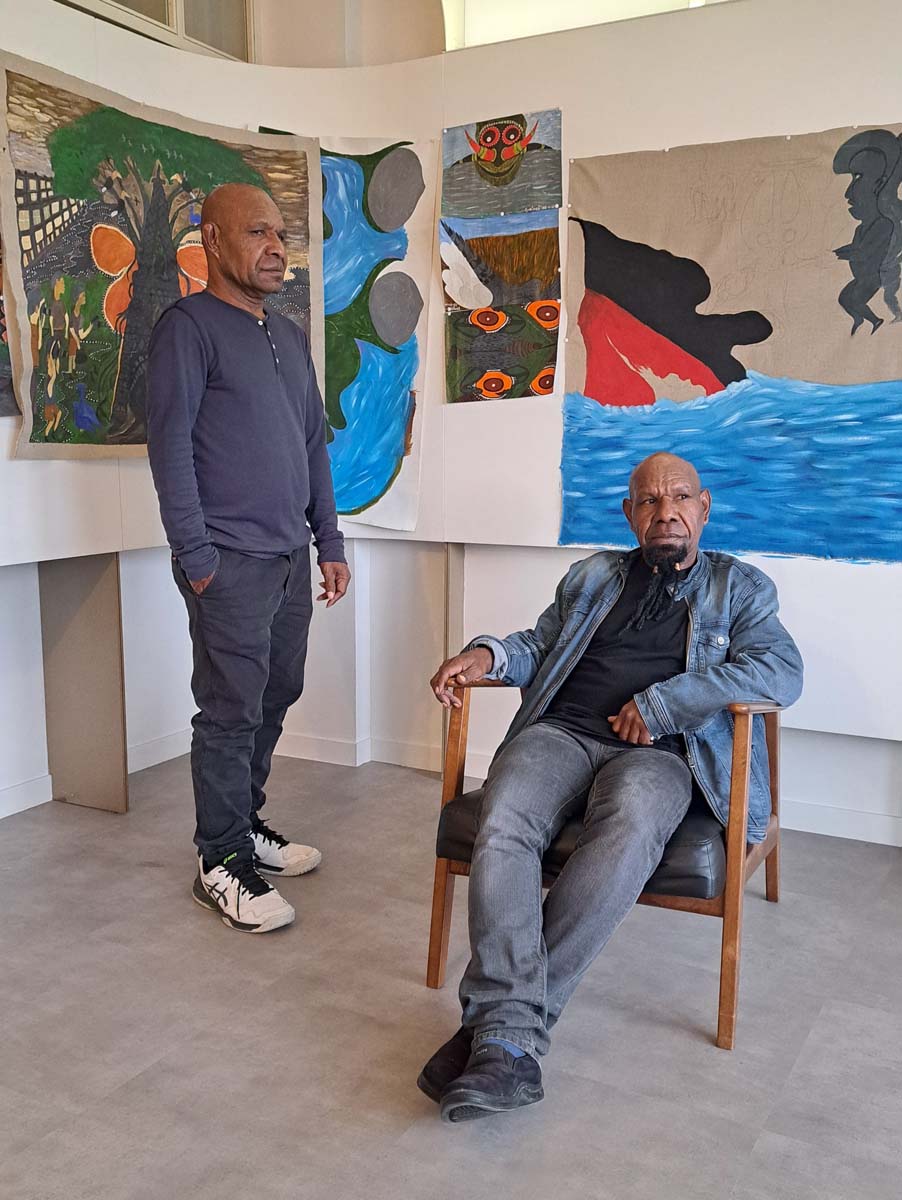
Pangal motifs are clan-based, so their execution is strictly controlled and is subject to certain rights. They are rooted in and draw their substance from both numa (ancestral) Kwoma stories and the artists’ close observation of their living environment. Agatoak and Chiphowka, during their residency in Paris, explained that every detail of this environment could lead to the creation of a motif[8].
The three artists have made this visual language their own, demonstrating both continuity with tradition and a degree of innovation in their practice, in the colours they use and the subjects they chose. Living in the contemporary world marked by the ever-accelerating flow of people and ideas, they look beyond myths to the effects of globalisation on their culture and identity. They draw their inspiration from the Kwoma mythical corpus as well as from literature, film, art history, architecture and their travels. During his 2024 residency, Agatoak created a large-scale painting called Sybil Vane which explores themes from Oscar Wilde’s novel The Portrait of Dorian Gray while Chiphowka produced Eiffel Tower, a work comparing the Parisian icon to a huge ficus around which tourists, like the birds of the New Guinea forest, gather to eat the fruit.
The seeds of Kwoma Red were sown in 2002 when Maxime Rovere started supporting the artistic project of Kowspi Marek and his sons to safeguard Kwoma culture. The exhibition, which asserted its determination not to ‘usurp the voice’[10], proceeded with respect and subtlety, pointing out that it was impossible to exhaustively reveal the complex mysteries of Kwoma culture.
Echoing Kwoma Red, From my painting emerges and survives my soul follows the breadcrumb trail of a founding myth to guide visitors through the two exhibition spaces of the Francès Fondation in a way that is faithful to Kwoma pedagogy. The scenography was designed to respect the Kwoma way of presenting images in order to maximise their visual impact on those who discover them in Europe. In Senlis, several pangal were hung from the ceiling of the exhibition room, evoking the visual device in Kwoma koromb spirit houses.

This is reminiscent of the decision of the Metropolitan Museum of Art in New York for the monumental ceiling suspension of the Kwoma koromb, with its two hundred and seventy paintings commissioned by Douglas Newton between 1970 and 1973[11]. The suspension chosen for the Kowspi paintings in Senlis also recalls the exhibition No 1 Neighbour: Art in Papua New Guinea 1966-2016 at the Queensland Art Gallery of Modern Art in Australia in 2016-2017. The Kwoma koromb 2012 ceiling was commissioned for APT7 and was one of the many spectacular pieces displayed there[12].
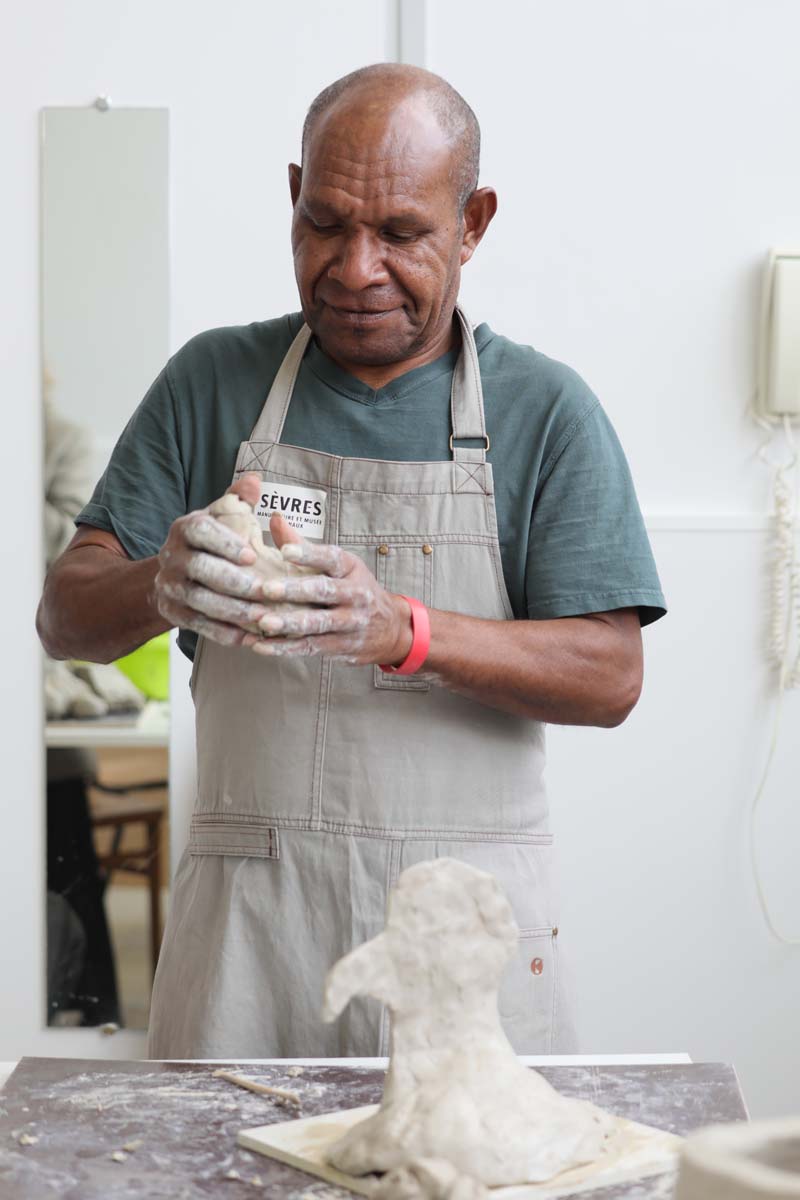
During their 2024 residency, the artists had the opportunity to take part in several workshops and visits to French cultural institutions sharing their experience with other practitioners. Agatoak and Chiphowka Kowspi attended a ceramics workshop with French visual artist Myriam Mechita at the Manufacture de Sèvres. After visiting the kilns, they sculpted pots, a skull, a cassowary and the map of Papua New Guinea, which they painted a few days later, extending their practice to an unfamiliar medium.
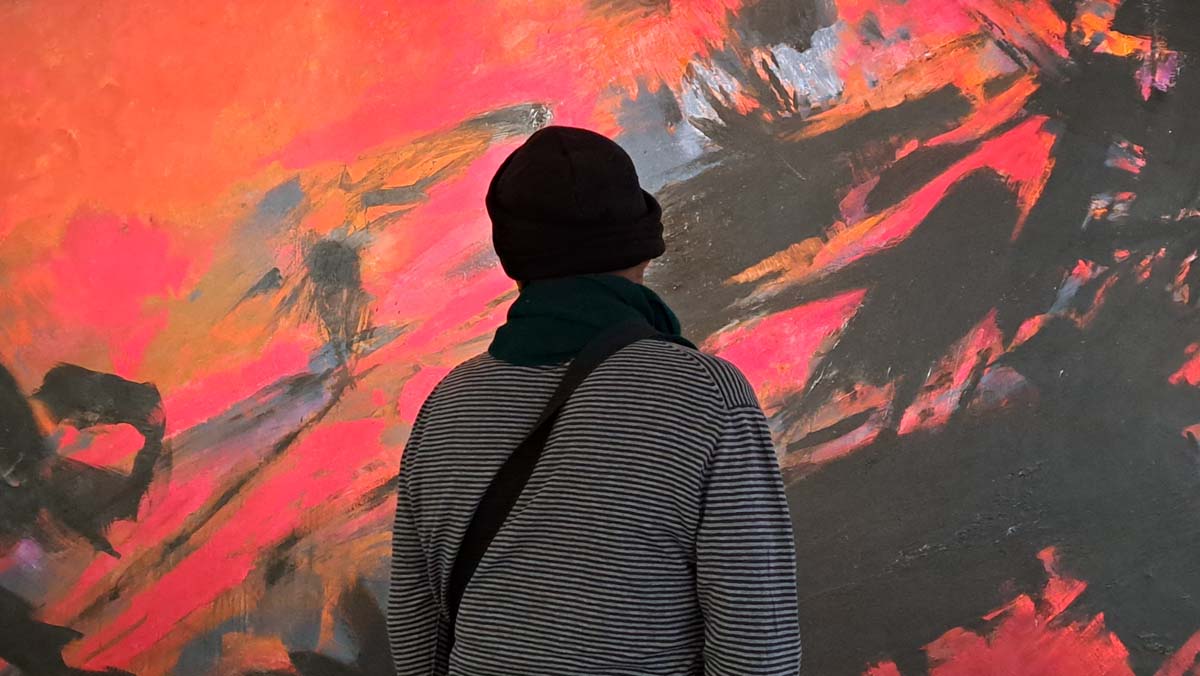
Agatoak and Chiphowka visited the Musée d’Art Contemporain du Val-de-Marne and discovered the contemporary practices of Hans Hartung, Jean Dubuffet and the New Realists Daniel Spoerri, Arman and César. Their visit to the exhibition La Mémoire des Hauts Fonds [The Memory of Shoals[13]] at the Cité internationale des arts allowed them to see the work of their father exhibited alongside that of other contemporary non-European artists.
The Palais de Tokyo in Paris and the museum of national archaeology of Saint-Germain-en-Laye also welcomed them as visitors, with the latter opening their storerooms housing collections relating to PNG to them.
Agatoak Kowspi and Chiphowka Kowspi joined a conference hosted by Magali Mélandri at the quai Branly museum, presenting their approach to preserving and passing on Kwoma myths to the next generation and the considerable importance that this second showing in France represented for them. It was also an occasion for the public to discover, or see again, works by the three artists that had been acquired by the museum after the Kwoma Red exhibition. This exchange with Magali Mélandri was matched with a session with Maxime Rovere, in the Galerie F. in Senlis, symbolically concluding a visit rich in encounters. Their works were also showcased at the 17th Drawing Now Art Fair in Paris in March 2024.
The project confirms the success of the three artists’ mission to preserve, develop and pass on Kwoma culture, in the words of Kowspi Marek, ‘Now that it’s my turn to be an Elder, I can give birth to many more things than the Ancients had. It’s important, very important, to expand knowledge, to go from the bottom up, from the past into the future. These colours have shown me a new way. I show things related to numa that have never been shown…because they’re hard to get out. And then the old ideas, the old way of painting, come back to life in my heart and mind. I’m even happier about that: it’s a new tradition I’m starting.’[14]
[1] ‘Kowspi Marek’, https://www.fondationfrances.com/artistes/marek-kowspi/.
[2] ‘Chiphowka Kowspi’, https://www.fondationfrances.com/artistes/chiphowka-kowspi/.
[3] ‘Agatoak Kowspi’, https://www.fondationfrances.com/artistes/agatoak-roni-kowspi/.
[4] Mélandri, Magali, 2012. « “Kwoma red”: Sharing Contemporary Experiences in a French Museum Context ». Museum Anthropology, 35: 23-34. p. 27.
[5] loc. cit. As M. Mélandri points out in her previously cited article, ‘in Melanesia, the concept of ‘Big Man’ is characterised mainly as an inherited title earned through skills and activities: exchange, war, hunting, magic, et cetera. Nevertheless, in some places, such as the Kwoma area, descendants of Big Men can be part of a prestigious lineage that confers on them power and elevated status. This status is similar to that of ‘Great Men,’ as defined by Maurice Godelier (1982)’. She refers to Godelier, M. 1982. La production des Grands Hommes. Pouvoir et domination chez les Baruya de Nouvelle-Guinée. Paris: Fayard.
[6] My own translation, from ‘Montrer et raconter, c’est le sens de chacun de nos travaux. Et l’idée de travailler sur la transmission, de partager la mémoire des ancêtres en lui offrant une modernité ne peut que permettre à l’Histoire de rester pour plus tard, et plus tard encore.’ Kowspi Marek, cited from ‘De ma peinture surgit et survit mon âme [From my painting emerges and survives my soul]’, https://www.fondationfrances.com/de-ma-peinture-surgit-et-survit-mon-ame/.
[7] Rovere, Maxime, ed. 2008. Rouge Kwoma: Peintures Mythiques de Nouvelle-Guinée [Kwoma Red: Mythical Paintings from New Guinea]. Paris: RMN, Musée du quai Branly. p. 25.
[8] ‘De ma peinture surgit et survit mon âme [From my painting emerges and survives my soul]’, https://www.fondationfrances.com/de-ma-peinture-surgit-et-survit-mon-ame/.
[9] op. cit. p. 13.
[10] loc. cit. p. 13.
[11] Kjellgren, E., 2007. Oceania: Art of the Pacific Islands in the Metropolitan Museum of Art. Yale University Press. p. VI & pp. 69-70.
[12] McDougall, Ruth, ed. 2016. No. 1 Neighbour, Art in Papua New Guinea 1966-2016. Queensland Art Gallery editions.
[13] My own translation.
[14] My own translation, from the original text translated to French: ‘Aujourd’hui que c’est mon tour d’être un Ancien, je peux faire naître beaucoup plus de choses que n’en avaient les Anciens. C’est important, très important pour étendre le savoir, aller de bas en haut, du passé vers l’avenir. Ces couleurs m’ont indiqué une nouvelle voie. Je fais voir des choses liées aux numa qui n’ont jamais été montrées…parce qu’elles sont difficiles à sortir. Et puis les anciennes idées, l’ancienne manière de peindre reprennent vie dans mon cœur et dans mon esprit. Je suis encore plus heureux de cela : c’est une nouvelle tradition que je commence.’ published in Rovere, Maxime, ed. 2008. Rouge Kwoma: Peintures Mythiques de Nouvelle-Guinée [Kwoma Red: Mythical Paintings from New Guinea]. Paris: RMN, Musée du quai Branly. p. 28.
Bibliography:
Fondation Francès 2024. ‘De ma peinture surgit et survit mon âme’, https://www.fondationfrances.com/de-ma-peinture-surgit-et-survit-mon-ame/.
Kjellgren, E., 2007. Oceania: Art of the Pacific Islands in the Metropolitan Museum of Art. Yale University Press.
McDougall, R., ed. 2016. No. 1 Neighbour, Art in Papua New Guinea 1966-2016. Queensland Art Gallery editions.
Mélandri, M., 2012. « “Kwoma red”: Sharing Contemporary Experiences in a French Museum Context ». Museum Anthropology, 35: 23-34.
Rovere, M., ed. 2008. Rouge Kwoma: Peintures Mythiques de Nouvelle-Guinée [Kwoma Red: Mythical Paintings from New Guinea].Paris: RMN, Musée du quai Branly.