
by Crispin Howarth, Curator Pacific Arts, National Gallery of Australia
The 16th of September 2025 marks the historic milestone of the 50th anniversary of Papua New Guinea’s Independence, the beginning of a new Pacific nation.
Following on from the previous article written by my fellow curator, Dan Toua, Bilong Papua New Guinea: Reflecting on 50 years of independence and published in the Autumn 2025 edition of this Journal, it is timely to expand on what visitors to the Bilong Papua New Guinea: 50 years of independence exhibition at the National Gallery of Canberra will see. The exhibition brings together a selection of the Gallery’s remarkable collection of Papua New Guinean art to mark this 50th anniversary.
Over eighty works from the Pacific Arts collection present stories, historical moments, and elements of custom and modernity in the leadup to the formation of the nation of Papua New Guinea and its development over the last fifty years. Together the works display multiple facets of the art of Papua New Guinea, although as any member of the OAS will understand, in a country of over 800 distinct communities and more than 20 provinces, it is impossible to be fully representative in one exhibition. In the words of the first Prime Minister Michael Somare ‘One of the most important and difficult tasks facing any new country is the creation of a national identity. In order to weld together the multiplicity of cultures and languages that make up Papua New Guinea, we must first of all know what our complex cultural heritage is’[i].
The cultural arts of Papua New Guinea are well represented in the exhibition with sculpture, bilum bags, bark cloth, pottery, shields and other works from the Sepik River, Oro Province, New Britain and New Ireland.
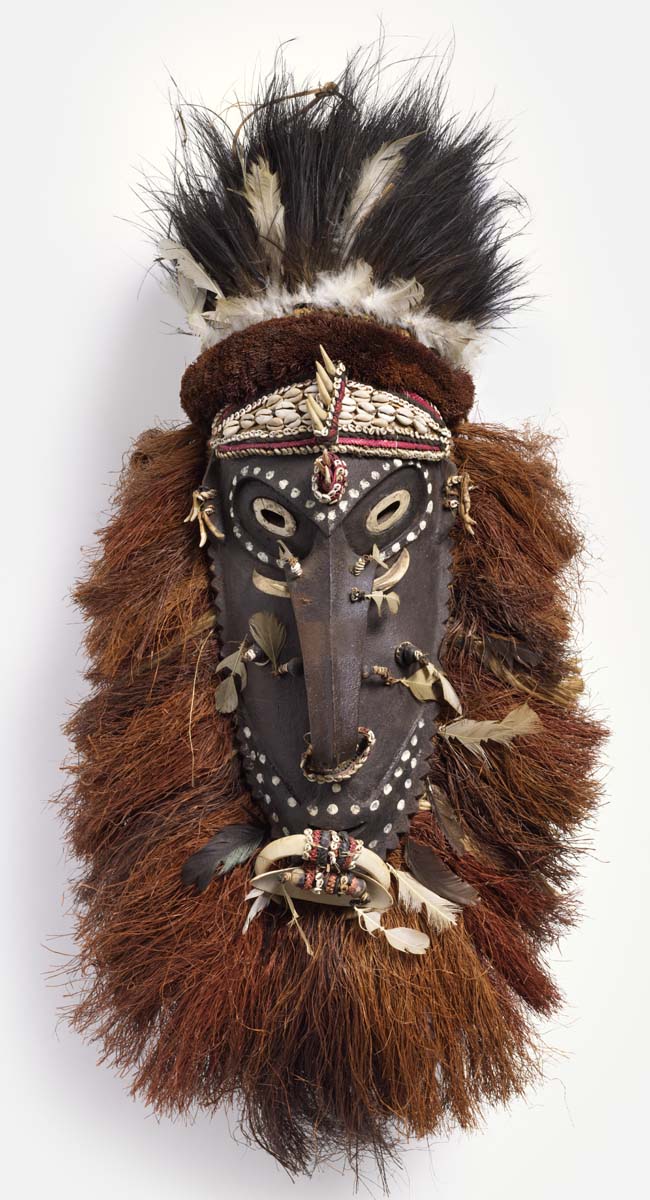
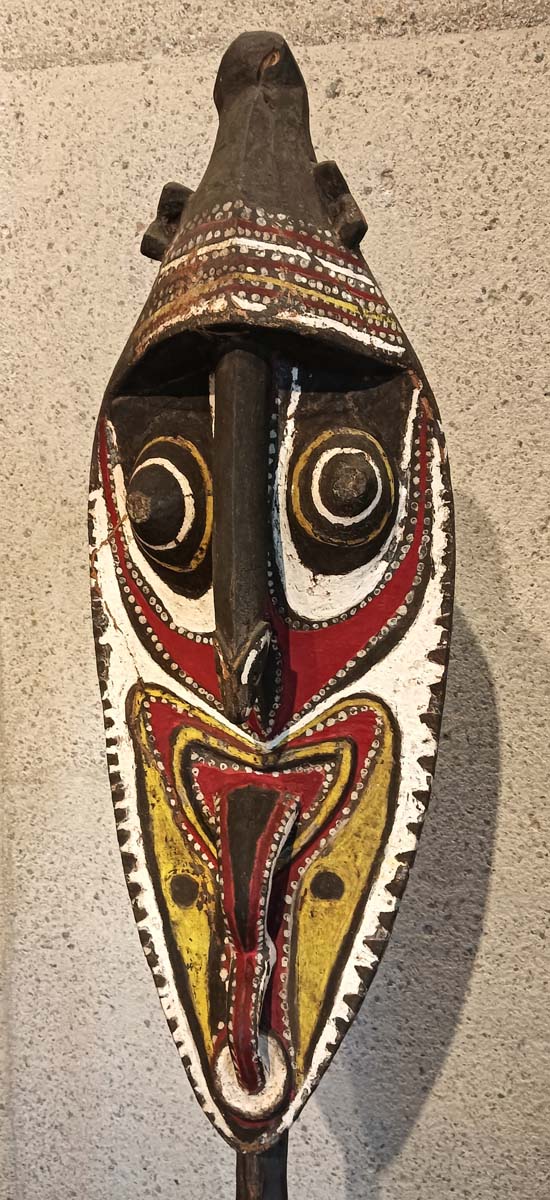
One of the rarest ancestral figures, a Telum, from Astrolabe Bay will be shown; however, another remarkable work among these is the coastal Sepik Brag mask that retains most of its spectacular decorations of fibre, cassowary feathers, dog’s teeth and boar tusks. Brag are spirits which can be ancestral in nature or beings from the sea or the bush, each mask is an individual with a name, personality, and community history. While we do not know the name of this Brag mask it has historic connections (including to two OAS members) as the Brag appeared in performances during Independence Day festivities at a village along the coast of Broken Water Bay on 16 September 1975. The Brag found its way to the arts and crafts shop Melanesian art in Lae, run by the late Robin Hodgson who sold it to the late Eric Coote back in 1977. The mask was one of five works gifted to the Gallery by Eric Coote in 2022 before he passed away.
Another work from that same gift which will be on display is a Yena figure with the spirit-name Arubukabuka. Yena are shown at the first of three harvest ceremonies centred on yams. This Yena was collected by Peter Hallinan at the Kwoma village of Sasellman on the Sepik River between 1968 and 1978. We know this because the Gallery’s Yena sculpture for Arubukabuka is a replacement for the spirit’s previous body which is now in the Museum der Kulturen, Basel, Switzerland[ii]. Important Sepik sculpture gets replaced over time due to pest, environmental or other damage, so when needed, a new sculpture/body is created fit for a community’s purpose.
The 1970s and the 1980s were marked by a surge in artistic creativity with artists imaging a new national identity through their work. The country presented an intriguing fusion of urban modernity and rural tribalism. Port Moresby developed with the construction of office blocks, shopping malls and skyscraper hotels which co-existed with traditional social practices. Beyond the regional centres it was and remains a nation of smaller communities with customary laws and local agriculture where people can live on smaller incomes than in the cities. Neither environment is mutually exclusive, with urban New Guineans often keeping ties to their ancestral villages and continuing the oral histories and stories of their communities. In John Danger’s work Untitled [man and woman] 2000, this theme of connection is shown through two people split down the middle wearing the fashions, clothes and styles of both the village and the town. Danger has captured the unique nature of the evolving social landscape for many New Guineans.
Two important artists in the exhibition, Timothy Akis and Mathais Kauage, are connected within the story of Papua New Guinea’s modern art history. Akis began his artistic career drawing for anthropologists researching in the Highlands[iii]. In the late 1960s Akis visited Port Moresby and encountered Georgina and Ulli Beier, an English-German couple working for the University of Papua New Guinea. The Beiers were a catalyst for contemporary arts in Papua New Guinea, encouraging, supporting and championing New Guinean artists as the country moved towards independence. Akis, a Maring man, enjoyed drawing insects, lizards, cassowaries, birds, spirit beings and people, all informed by his life in the Simbai Valley. He was the first New Guinean artist to hold a solo exhibition[iv]. This exhibition is recognized as a milestone in contemporary Papua New Guinean creative practice and Akis’ contribution to the arts was considerable. In 2024 the annual Akis Art Prize was inaugurated in Port Moresby by the Arts Society of Papua New Guinea to recognize and celebrate artists active today. A group of prints and drawings by Akis are a feature of the exhibition.
That first exhibition by Akis proved pivotal in many ways. Mathias Kauage, then working as a cleaner at the University, attended the opening and the exhibition introduced him to art. From this fortuitous encounter Kauage, from Simbu Province, became the most internationally recognized artist from Papua New Guinea and worked in printmaking, drawing, painting, textile appliqué, and copper-beating over a long career beginning in the 1970s. He found inspiration in the urban changes occurring around Port Moresby at that time, the growing number of cars, motorbikes, and helicopters, and changes in social attitudes.
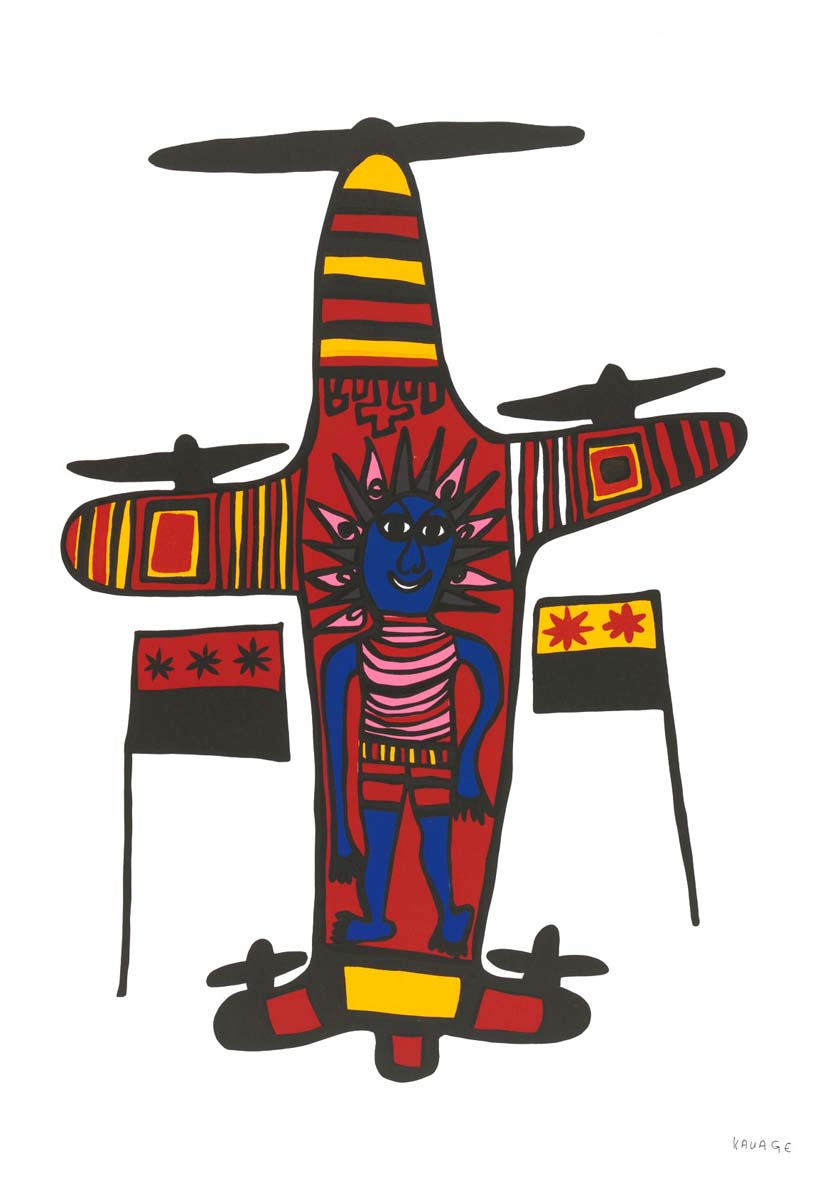
Mathias Kauage’s work is featured in the exhibition and one work is an unusual portrait. Independence plane shows a man wearing shorts and striped t-shirt wearing a headdress, as Kauage did for most of his subjects, travelling in the sky. Kauage had an interest in modes of transport and here he has created his rendition of the RAAF VIP plane for Prince Charles, then a 27-year-old Prince of Wales and now King, who officiated at the raising of the new nation’s flag fifty years ago in Port Moresby. His Royal Highness delivered a speech in tok pisin as part of the raising of the new national flag ceremonies at Sir Hubert Murray Stadium in September 1975. Kauage’s sense of humour is evident in many of his works and he is perhaps depicting the young Prince dressed ready for his exciting visit to PNG. Within the body of the aircraft shown in Independence plane is a warmly humorous portrait of the young prince in his summer clothes, wearing a highlander headdress. In 1996 Kauage attended the opening of the Gallery of Modern Art in Glasgow, Scotland, and met Queen Elizabeth II. After the meeting Kauage created a painting for the Queen, and in 1998 received an OBE for his services to the arts.
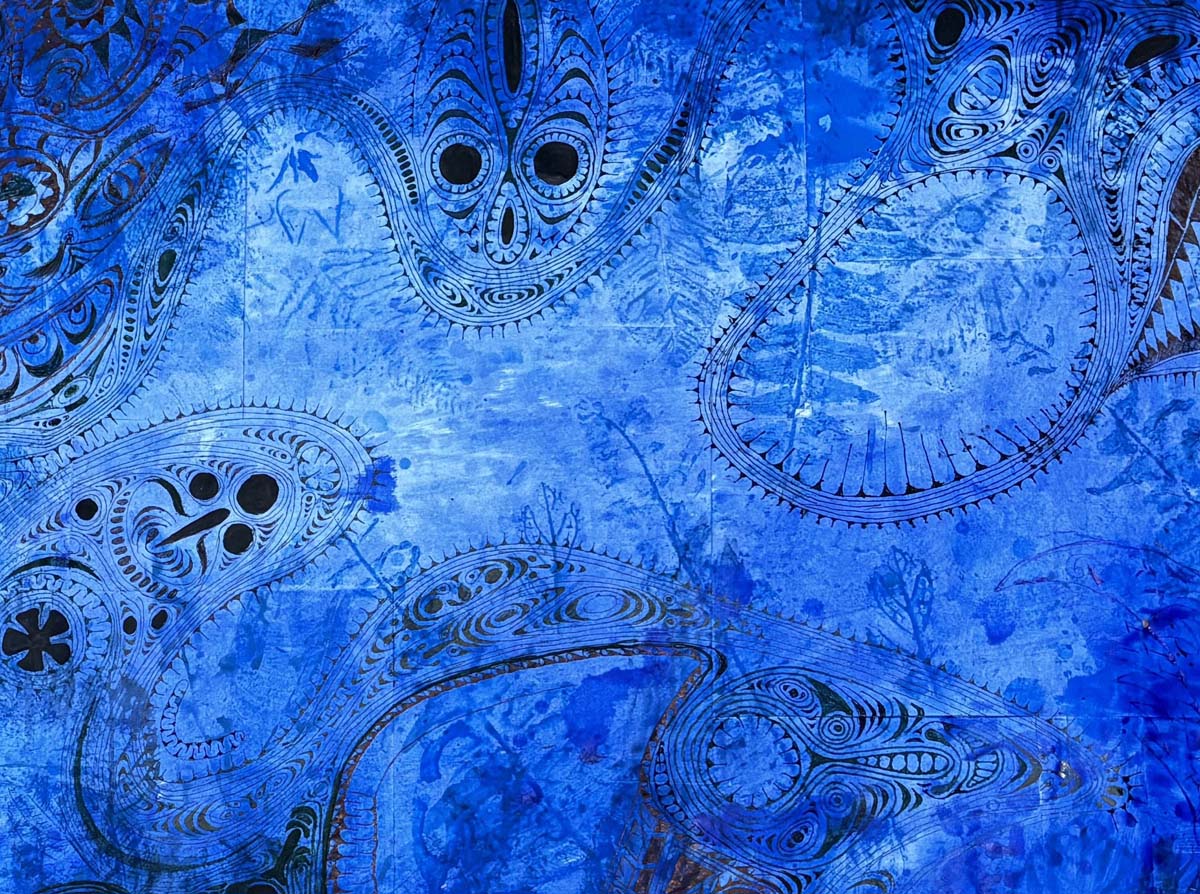
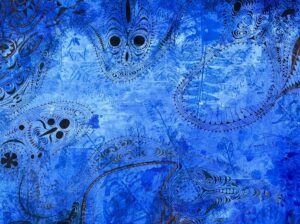
As part of the exhibition development the curators, Danielle Toua and myself, visited Madang and at the University of Madang we were introduced to Allan Riko Maule, one of a group of artists working collectively on art projects with the support of Nicolas Garnier. Maule along with Yatha Baram and others[v] was involved in a Divine Word University, Madang art project that culminated in the large work Nawian (fireflies) which was acquired for the exhibition. Across the 8.9 metre work images printed from leaves are laid over intricate traditional and non-traditional designs drawn in black ink, creating a nocturnal forest landscape. New Guinean forests during daylight hours are the domain of people but they are uncontrolled environments; accessible during daylight hours but at night they become an otherworldly realm. When fireflies appear, it can be a signal that spirit-beings are active and evening being the time when spirits hold power. Increasingly the sale of pockets of tribal lands to external businesses had led to destruction from cash crops such as palm oil and widespread logging. These modern practices have created imbalances between the human and supernatural realms, for some, this is something to be feared: where can the bush spirits, ghosts and ancestral beings of the forest live now?
Nawian connects to the oldest Pacific work in the collection, the Ambum Stone, also displayed in Bilong Papua New Guinea. Both embody reverence for the natural and supernatural environments of Papua New Guinea.
The Ambum Stone is a small sculpture known to many by its inclusion on Papua New Guinea’s 1970 5-cent stamp. The Ambum Stone is at least 3500 years old and possibly around 10,000 years old. It was created by an unknown culture active in the Ambum Valley, Enga Province, whose identity is now unknown. The form of the Ambum Stone suggests a puggle, a baby echidna. During a visit to the National Gallery in March this year Prime Minister James Marape viewed the Ambum Stone and noted how this highly refined sculpture created by his Papuan ancestors rivalled the arts of the contemporary era of Mesopotamia, considered the ‘cradle of civilization’.
The traditional cultural arts are represented in the exhibition through a selection of ancestors and spirit being sculptures, woven Bilum bags, bark cloth, pottery, shields and other works from the East Sepik, Oro, New Britain and New Ireland provinces.
From prehistory to the Independence era of the 1970s and into the present day, Bilong Papua New Guinea is a timely, and rare, opportunity to see such a wide selection of Papua New Guinean arts drawn from the collection of the National Gallery of Australia.
[i] Gigibori magazine Vol 1, no 1, December 1974. (iii).
[ii] This is the replacement for either Vb 22352a or Vb 22354 collected by Christian Kaufmann in 1968. Further research to confirm this is required. Sasellman village is recorded as Saserman village by Kaufmann.
[iii] During the 1960s, anthropologists Georgeda Buchbinder & Ann Rappaport hired Akis to create images of plants and animals to assist their work.
[iv] Akis’ exhibition was held from 28th February 1969 at the University of Papua New Guinea’s library. During the 1970s, the University and more specifically its Creative Arts School became the locus for many of Papua New Guinea’s exceptional artists.
[v] The full list of artists on this project was Allan Maule, Yata (Yatha) Baram, Philip Wambi, Peniel Sakol, Eluid Wal, Jason Tara, Israel Gaor, Ellias Tebaum, Ipaul Wanak and Harold Bakasi.