by Susan Cochrane
As Papua New Guinea approaches its 50th anniversary of Independence on 16 September 2025, it is timely to widen the dialogue between Papua New Guinea’s artists and their international audiences. Given the long history of involvement with PNG, what do Australians in particular really know and understand about the people’s vibrant cultures and creative arts – are we ‘neighbours, but strangers’?
Within the five decades from the 1970s to the 2020s, non-indigenous Australians have become increasingly aware and appreciative of our country’s First Nations’ arts, the diversity and longevity of their tangible and intangible cultural heritage. This enlightenment has enabled recognition, reconciliation and inclusion of Aboriginal and Torres Strait Islander arts and cultures as an integral part of Australia’s national consciousness. Compared to the opportunities for Australian First Nations, or New Zealand’s Māori and Pasifika artists, the curatorial activity, acquisition, presentation, promotion, and publication of Papua New Guinean contemporary artists and their art is negligible.
The common perception of Papua New Guinea ‘contemporary’ artists is as urban-based, individualistic practitioners whose work engages with global concepts of the modern and contemporary. Since the 1970s, a flourishing, urban-based, contemporary art movement has emerged, and its present circumstances are discussed below. Nevertheless, in Papua New Guinea this narrow description – or any concept of ‘contemporary’ art as the marketable product of professional artists working with introduced media – excludes extraordinary artistic achievement in indigenous art forms and the virtuosity of many talented individuals.
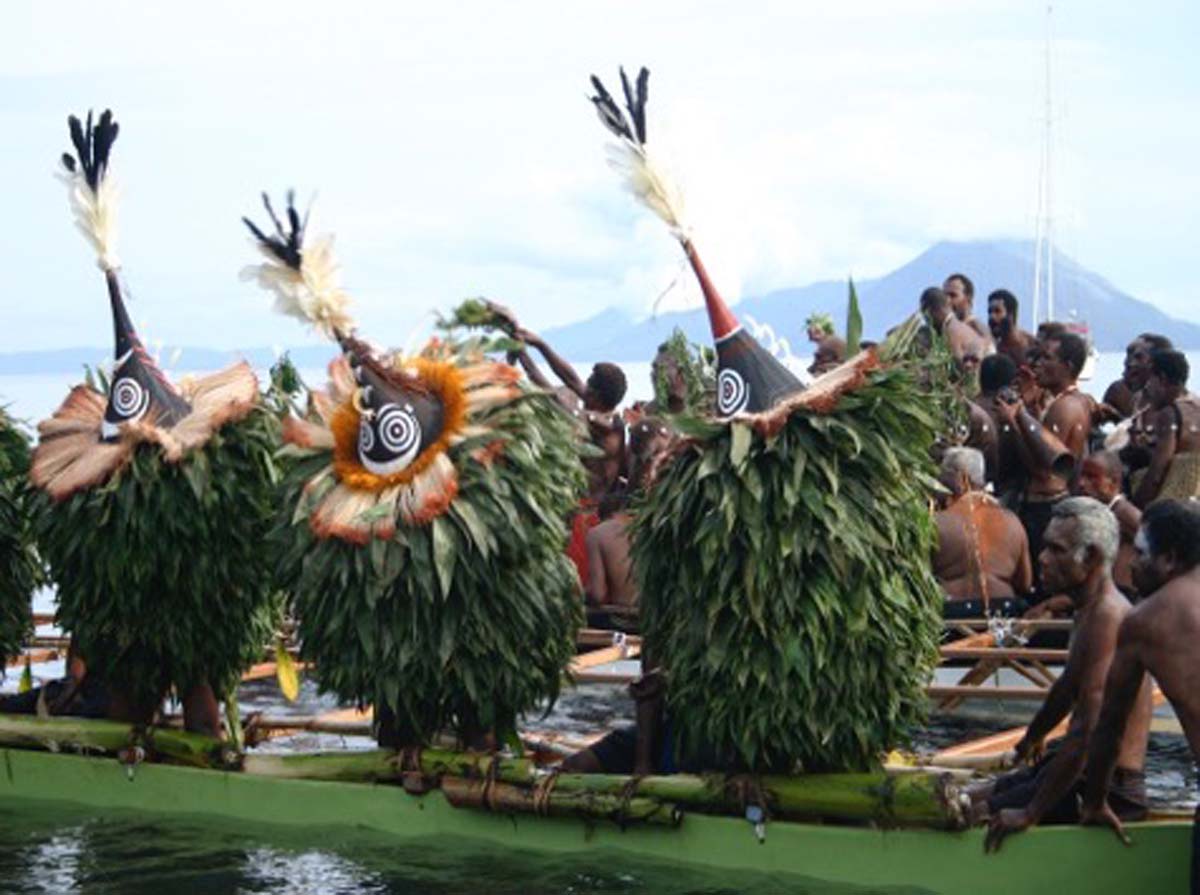
Each indigenous artistic system operates within its contemporary framework, intimately connected to its place and society. Multiple contemporary forms of creative expression are currently practiced in Papua New Guinea, including art styles that have no roots in Western traditions or their designated periods. In Papua New Guinea, ‘the land of a thousand tribes’, cultural identity and visual messages are coded in the ephemeral forms of bilas (costume and self-adornment), painted on tapa (bark cloth), pangal (panels of bark), kuman (shields), worked into sculptural forms like masks and figures, integrated into architecture, displayed in live performances, and chanted in song cycles. Performances in meticulously prepared grounds, framed with colourful plants such as cordylines combine multiple sensory experiences with bodies gleaming with fragrant oils and the smell enhanced by the perfumes of fresh plants, rhythmic dance, melodic chanting and the throb of kundu drums. Each clan group has its specific identity defined in the visual language of their sets of bilas (self-adornment) headdresses of iridescent plumes, distinctive face paint styles and elaborate costumes. Michael O’Hanlon called the knowledge of this visual language ‘reading the skin’.[1] Far more than adornment, every element of bilas is a signifier, the ensemble contains the visual language of place, clan affiliation and status.
Throughout Papua New Guinea’s 22 provinces, plans and preparations are already underway for each community, composed of several clans, to produce its most resplendent celebration in honour of their country’s 50th anniversary of independence.
Ephemeral forms and collaborative works of Papua New Guinea creative expression are infrequently presented internationally. One exception is the Queensland Art Gallery of Modern Art’s (QAGOMA) Asia Pacific Triennial (APT), which has been a pathfinder since its inception in 1993, and does not compromise in its collaborations with PNG creators.[2]
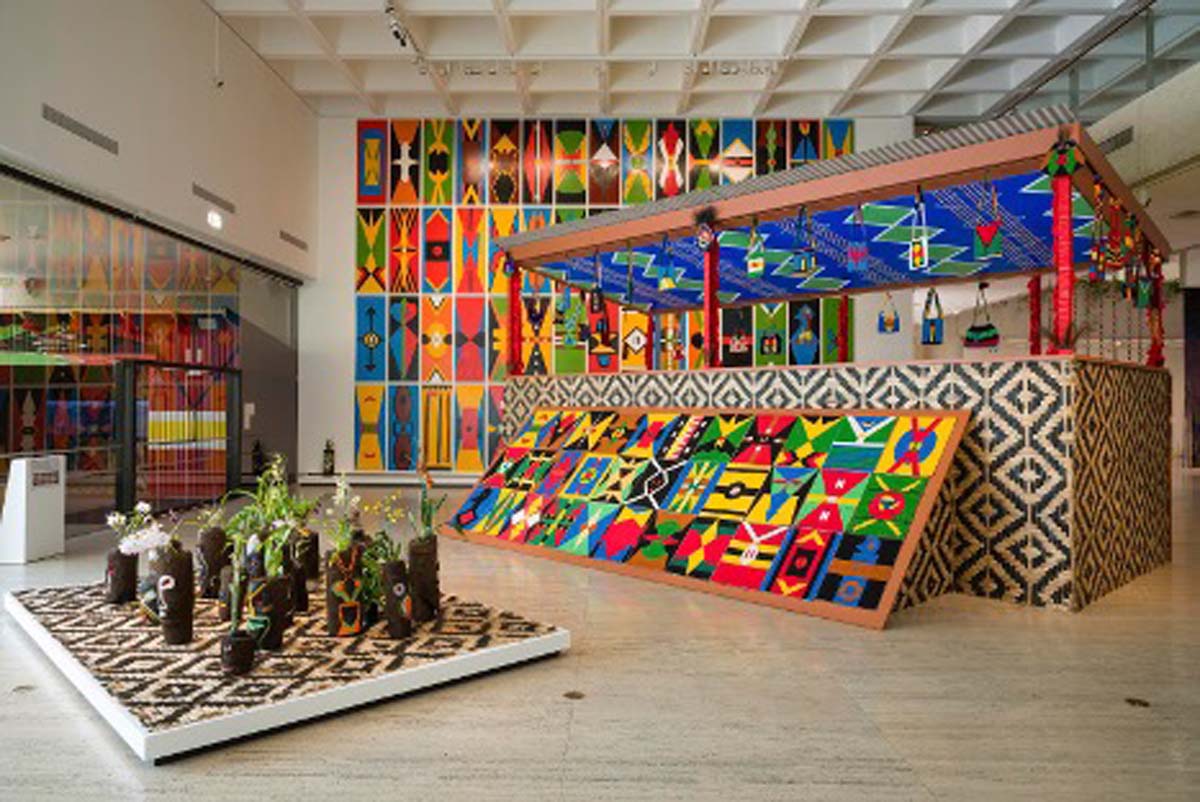
Recently showing in the ‘blockbuster’ APT 11 (30 November 2024 – 27 April 2025), was the complex collaborative installation created by Yuriyal Eric Bridgeman with the Haus Yuriyal collective of 28 artists, men and women, from the Highlands province of Jiwaka/Simbu. Built into and surrounding Haus Yuriyal are sequences of paintings based on the clan designs painted on kuman (war shields), woven cane panels, displays of bilum (net bags) with clan emblems, complimented by a flourishing garden of plants endemic to the PNG Highlands outside in QAG’s sculpture garden.[3]
The multiple painted panels and woven onto the bilum bags are not simply attractive geometric designs; they originate from the ancestral clan designs painted on kuman (war shields). As well as identity markers for a specific clan or the moiety within a clan, each motif is an abstracted emblem representing an animal, bird, plant, or other element in the Jiwaka cosmos. This visual language is foreign to outsiders, but is readily interpreted and acknowledged within Highlands communities. This visual communication is elaborated by all the other elements presented in the Haus Yuriyal structure and its surrounds, and in the bilas worn by members of the group. The highlight of the Haus Yuriyal display, which enlivens all the other elements in the composition, is a spectacular group performance.
Urban based contemporary art movements
How do Papua New Guinea’s urban-based artists manage to make a living from their creative talents without the equivalent of government-funded support for the arts, such as the programs delivered by Creative Australia and Creative New Zealand? There is no network of private galleries promoting their stable of artists, nor long-lasting arts associations, nor established sources of philanthropic funds.
The fluctuating history of the Papua New Guinea National Museum and Art Gallery is presently on one of its downslides. In 2016-18, PNG National Museum and Art Gallery (the Museum) benefited from an architectural redesign and renovation project funded by the Australian government,[4] designed by an Australian architectural firm, with the National Gallery of Australia curators and conservators assisting the Museum’s staff. But by September 2024, the Museum was forced to close because of the collapse of the air condition system, a disaster for the institution’s natural history collections and valuable historical objects.[5]
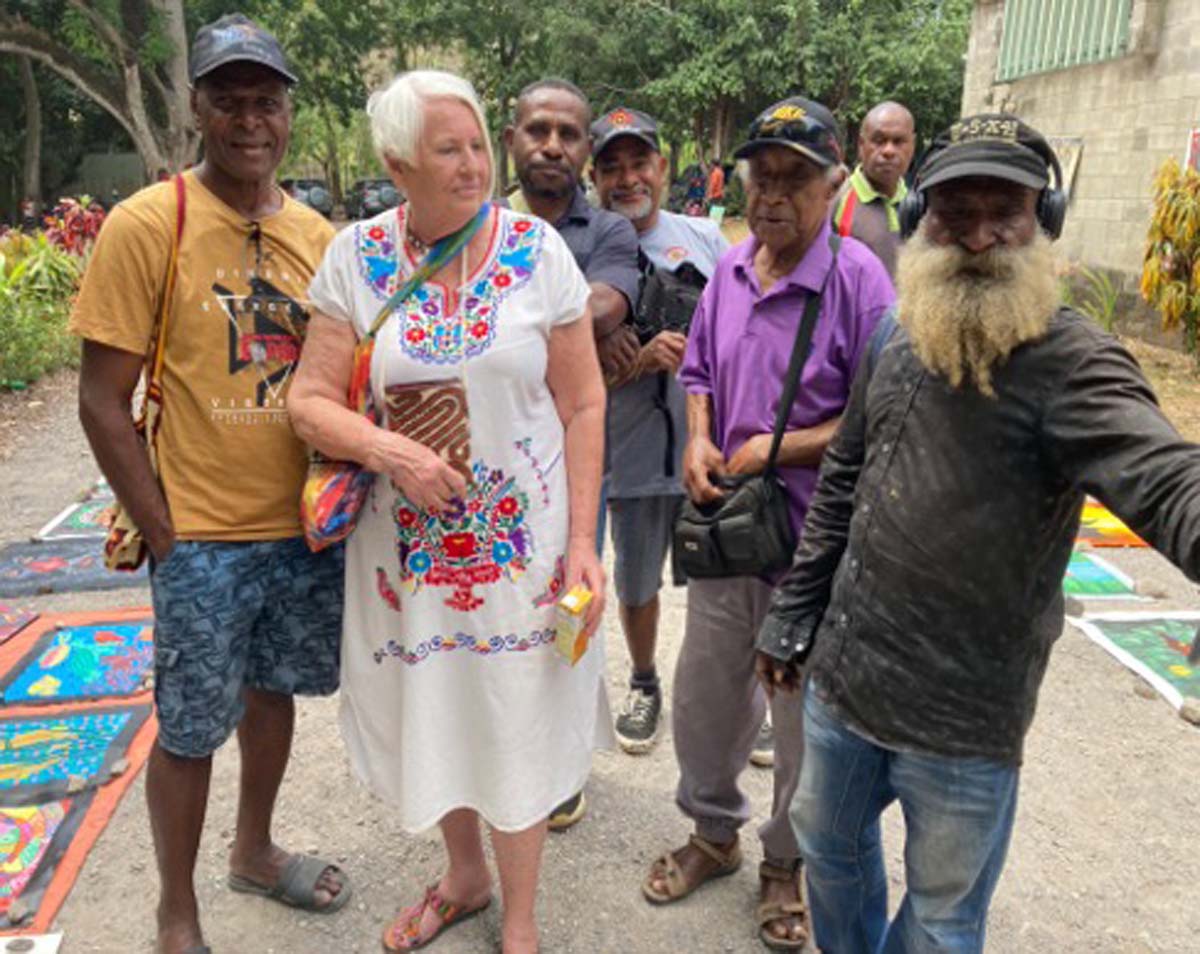
Since the 1970s in Papua New Guinea’s capital city, Port Moresby, there has been a fluctuating history of art galleries and artist associations flourishing for a while, then fading out. A brief review of the 2024 art scene in Port Moresby, the country’s capital, is revealing. At that time there were no commercial art galleries operating in Port Moresby; even leading artists were selling their work at the Saturday markets suspended on washing lines, or laid out on the ground, and negotiating personally with potential purchasers.
Port Moresby’s weekly Saturday art market alternates between Ela Beach and the Waigani Arts Centre. It is the social event of the week, where established individual artists sell their work or wander around greeting their peers. Here are outdoor stalls of bilum sellers, high quality artisan-made objects such as Trobriand Island carved bowls, prized Lufa baskets in all sizes, and handmade items of adornment.
Lae, Goroka and other provincial towns have their street art sellers showing their paintings outside the tourist hotels, imitating the entrepreneurial system instigated by Mathias Kauage and his wantoks (kinsmen) Simbu street artists’ display outside Port Moresby’s Islander Hotel.
Without private galleries, artists have to be entrepreneurial. Some have clustered together forming arts associations like the Tumbuna Artist’s Association headed by Clement Koys, to negotiate public and private commissions, organise art shows and raise the profile of their artists.
The recently formed Arts Association of Papua New Guinea, with the cultural entrepreneur Lani Auvita Scott as its President, initiated the inaugural Akis Art Prize.[6] Named for Papua New Guinea’s first recognised contemporary artist, Timothy Akis, there were three divisions – Open, Youth and Junior –with entries responding to the theme ‘Looking Forward. Dreams and Aspirations for the future of Papua New Guinea’. The nationwide art prize was well publicised and entries were received online from every province, it also attracted generous corporate sponsorship. Just as the prizewinners were announced and the exhibition was about to open in the Museum’s gallery, the disastrous state of the Museum’s air conditioning forced it to close. Undeterred, the Arts Association of PNG is preparing to launch the 2025 Akis Art Prize.
Another popular outlet for artistic expression in Port Moresby and provincial towns is public art, whether large-scale mural paintings or monumental sculptures. As Don Wotton noted, mural painting started in the early 1990s when some corporations like Telecom desired to enhance the concrete walls around their premises.[7]
For some artists, like John Siune, this became a family business, sharing the work with his wife and son. Martin Morobubuna painted murals in hospitals and other public institutions, while Leo Peter Ella led teams decorating the long sea walls beside Port Moresby’s harbourside streets.
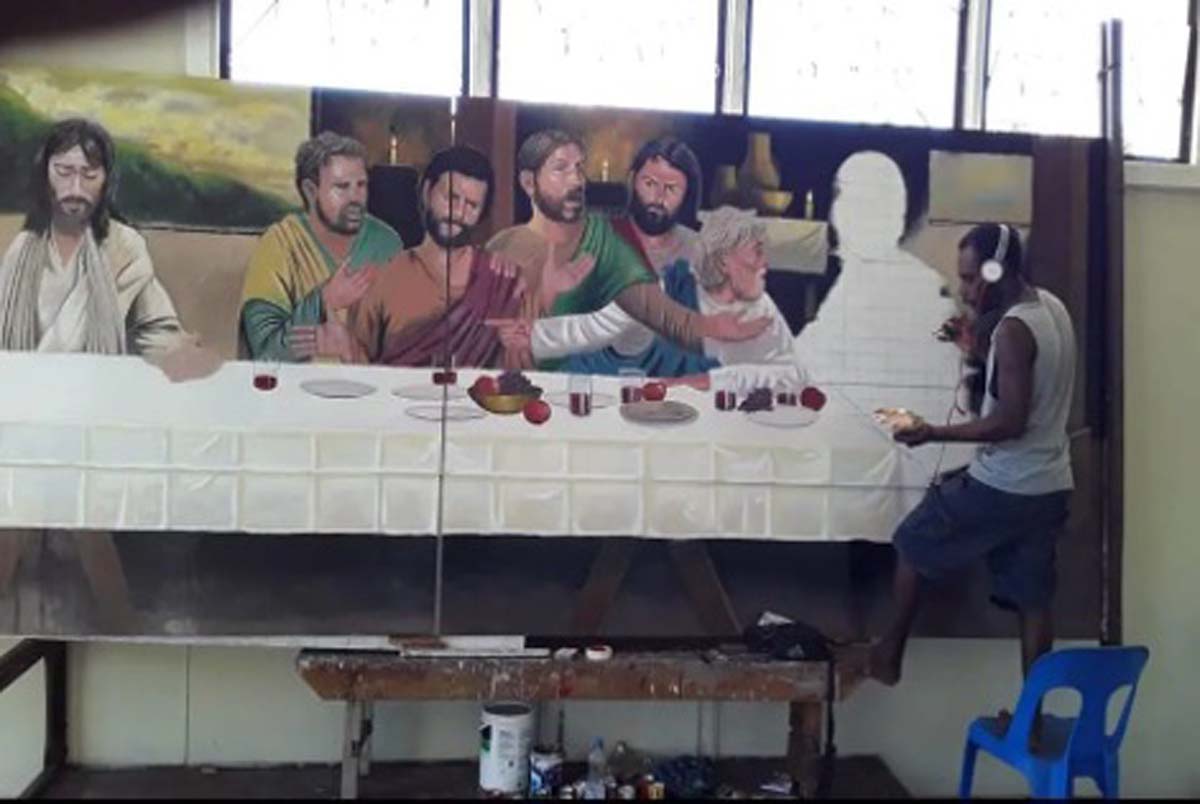
The country’s airports are decorated by local artists. As well as public buildings like airports and hospitals, corporations sponsor major artworks like the huge mural of life-like portraits along the entrance to the Hilton Hotel, recently completed by Lesley Wembago. Schools and churches frequently commission local artists to enhance their buildings, for example between 2021-23, Edwin Siroi completed a number of large-scale paintings, including his version of the Last Supper, for the Catholic church in Rabaul.
Port Moresby’s long-serving Governor, Powys Porkop, is a firm believer in urban beautification and consistently commissions monumental sculptures for roundabouts and other key points in the city. Many of these commissions have been designed and fabricated by the renowned metal sculptors Ruki Fame, Gickmai Kundun and Tom Deko. Gazellah Bruder is the first woman artist to undertake large-scale metal sculptures commissions; in 2023, the USA Embassy commissioned her ‘Tribute to Amelia Erhardt.’
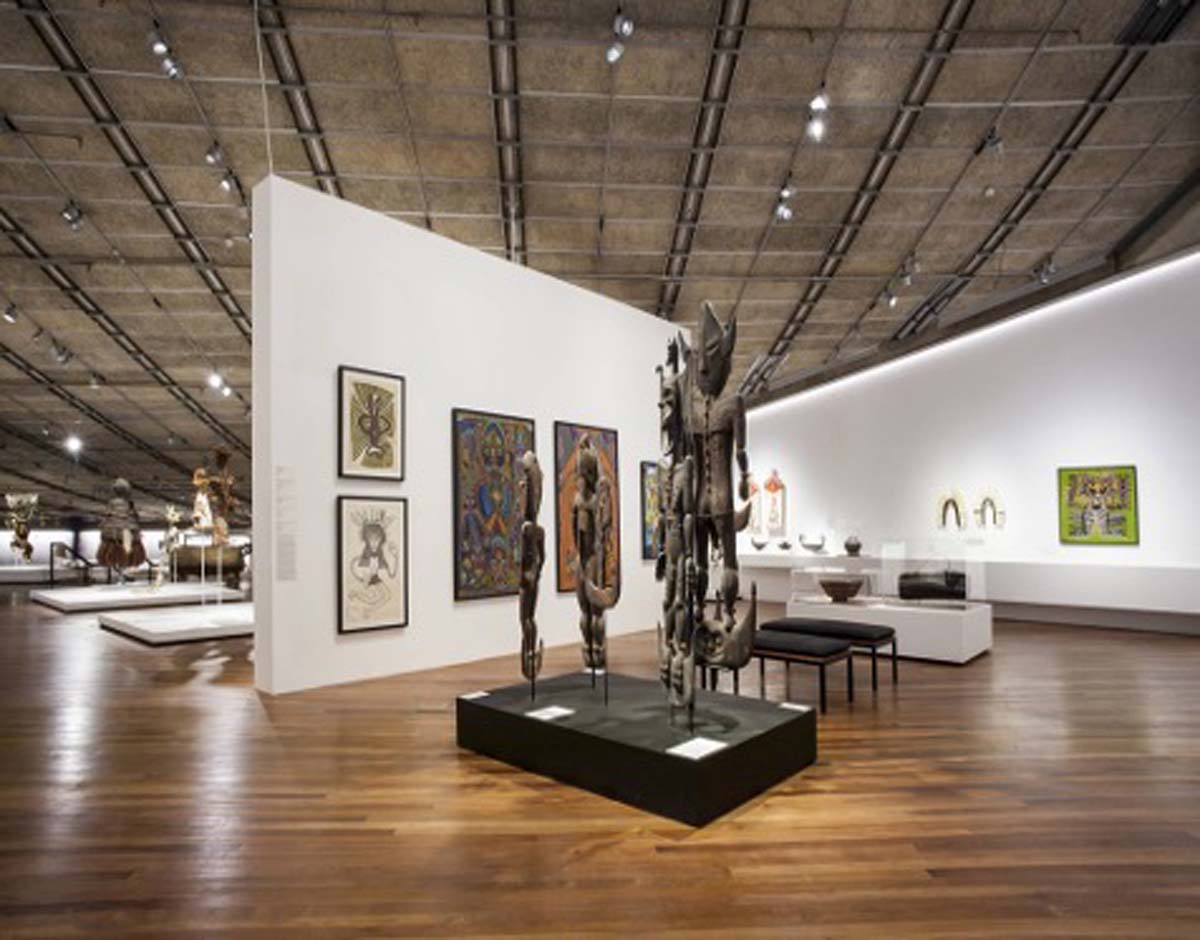
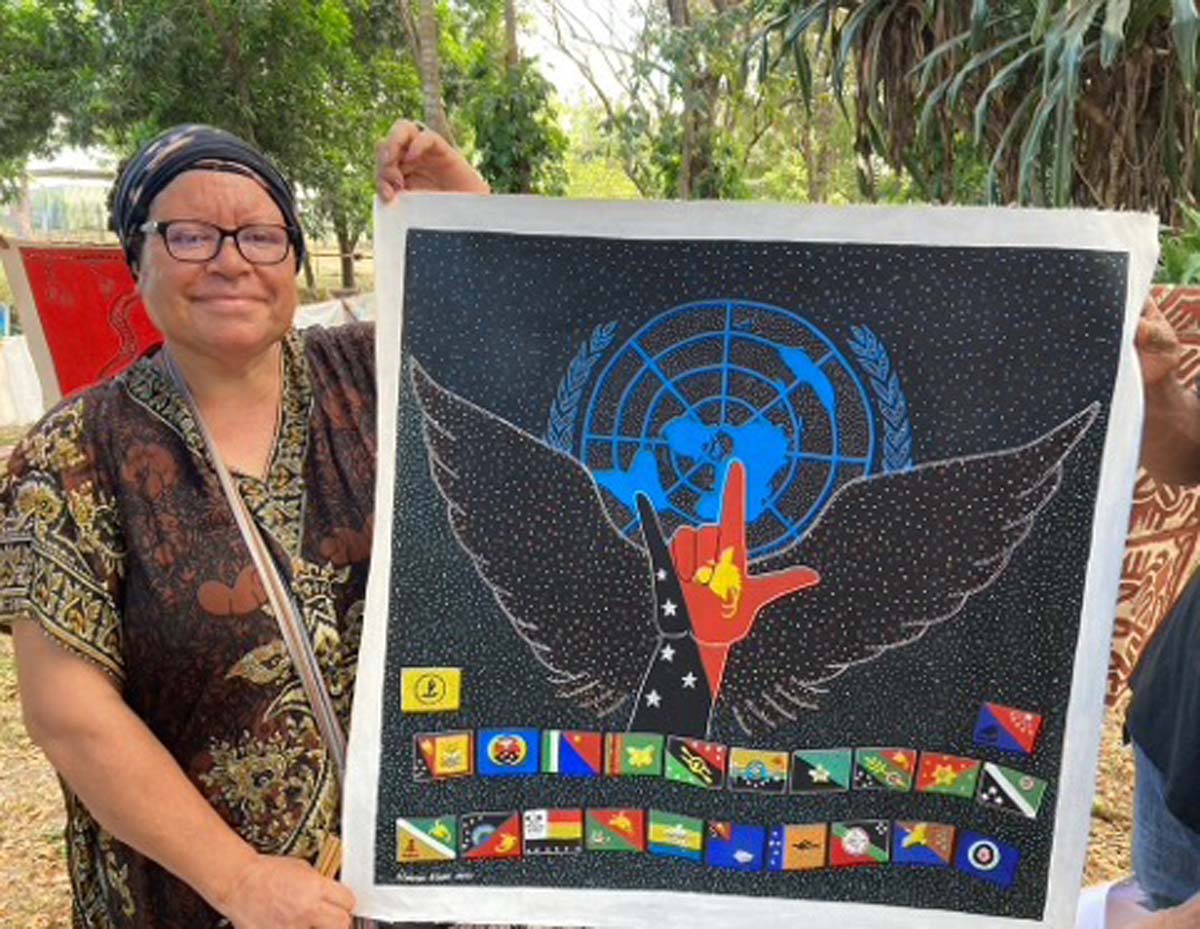
In the grounds of the University of Papua New Guinea, the National Arts School campus– the crucible of creativity from the late 1970s to 1990s[8], is a set of derelict buildings. Attempts to resurrect it as the Melanesian Institute of Arts and Communication (MIAC), in 2008 with Daniel Waswas at the helm foundered again due to lack of funding. Among Waswas’ initiatives were outreach programs to foster creativity and art skills development from the grass roots level, as many Papua New Guineans, however talented, do not have the level of education required to enrol in university courses.
Michael A. Mel, the current Director of MIAC, is pessimistic about managing its revival. Even the exhibition gallery is structurally unsafe. MIAC requires a complete rebuild of all its facilities in order to become fully functional and operate as an incubator of music, theatre, writing and visual arts.
Daniel Waswas took the initiative to start a private organisation, the Centre for Arts and Innovation (CAI), attracting some of the most respected teachers from the University of PNG (UPNG) and the University of Goroka. Located at 8-Mile, the CAI has a gallery, classrooms and workshop facilities for visual arts, pottery, sculpture and textile design and production, but in 2024 there were still no accredited courses available at the CAI.
The Creative Arts stream at UPNG, is headed by Dr Philemon Yalamu, offers creative arts courses, including digital arts media, however a greater investment in facilities, more under-graduate courses and opportunities post-graduate studies, are highly desirable. Mel, Yalamu, and other academics, are convinced that cultural education and expressive arts are elemental at all levels of formal curriculum in Papua New Guinea.
In 2023 the National Cultural Commission (NCC) launched its radical ten-year policy aimed at the substantial development of Papua New Guinea’s arts and culture sector. Under the active leadership of the Executive Director, Steven Emomb Kilanda, the NCC’s Cultural Service and Development Division had implemented new initiatives in marketing and promotion of cultural events and programs at the international, national, district and local level government levels.[9]
Its website highlights the kaleidoscope of some 68 festivals supported by the NCC. This investment is building up cultural pride and identity throughout Papua New Guinea and internationally, especially with the support that it provides for the spectacular ‘sing sings’ which are the most popular forms of creative expression for Papua New Guineans. In July 2024, the NCC led a large contingent of artists, musicians, performers and cultural leaders to the 11th Festival of Pacific Arts in Hawaii to showcase their talents across all artistic genres.
The NCC sponsors the National Art Prize, which had its third iteration in September 2024. Since 2023, it has also enabled Paradise Palette exhibitions, paintings by urban-based contemporary artists curated by Don Wotton, to be displayed in several Australian cities including Cairns, Brisbane, Darwin and Melbourne. A review of the Melbourne exhibition can be found in the Autumn 2025 edition of this Journal.
The NCC is lobbying the PNG Government to change its funding model for arts and culture, placing creative industries and tourism in the economic growth sector, rather than with the dependent social services sector where it has languished for decades.
In Papua New Guinea’s current circumstances, a large portion of investment in arts development for local and export markets is in the hands of private individuals, foundations, and cooperatives formed by NGOs. These are essential mainstays assisting artists and communities to realise their full potential. For example, since 2008, Omie Artists[10], a cooperative of women from fourteen villages in the Oro Province, has developed an increasingly successful presence internationally for the nioge (hand-painted barkcloth), Social enterprises like Bilum and Bilas are directed to empower women to gain from their creative work and provide outlets for their talents. and Papua New Guinea’s Fashion Week, first launched in 2018, has become a national movement. “Fashion is not just about clothes; it’s about identity, culture and opportunity’, said its founder, Philma Keleegal.[11] The talents of fashion designers who create spectacular ‘bilum wear’, like Florence Jaukae Kamel and Anna Amos, have taken their place in the international high couture platforms of New York, London and Milan Fashion Weeks.
Since its foundation in 2014 by Shiva Lynn Burgos with Kwoma leaders and artists from Mariwai village in the East Sepik Province, The Mariwai Project [12], has radiated community-led initiatives, collaborations and cultural exchanges reaching world audiences. Already in its program for 2025, the LifeShip ‘Pyramid on the Moon’ launched its capsule containing “a record of earth in its diversity of arts, ideas and biodiversity”, including photo portraits and leading-edge film of Mariwai people and ceremonies and has landed on the Moon.[13] The new installation of the ‘Ceremonial House Ceiling’ (AKA Kwoma Ceiling), was revealed in May 2025 at the Metropolitan Museum of New York’s Michael C Rockefeller Wing. This collective artwork of over 200 pangal (painted panels) of a ceremonial house was originally collected by Douglas Newton in the early 1970s from Mariwai Village. The new configuration has been negotiated in a long collaborative project between the Met’s curators with the descendants of the original Kwoma artists to present the Ceremonial Ceiling in accordance with the Kwoma vision and knowledge. What’s next? Oh, yes, the Venice Biennale in 2026.
On 16 September 2025, attention will turn towards Papua New Guinea as it celebrates the 50th anniversary of taking its place as a nation in the world community. Australians and other international audiences may take this opportunity to engage with Papua New Guinea’s spectacular cultures and artistic wealth over the next 50 years.
[1] Michael O’Hanlon, Reading the Skin: Adornment, Display and Society Among the Wahgi, 1990, British Museum Publications
[2]https://www.qagoma.qld.gov.au/about/apt/ Extensive information on each Asia Pacific Triennial and PNG artist’s participation is accessible on the QAGOMA APT website.
[3]https://www.qagoma.qld.gov.au/about/apt/ Extensive information on each Asia Pacific Triennial and PNG artist’s participation is accessible on the QAGOMA APT website.
[4] ‘Refurbished National Museum and Art gallery reopens to all’ 22/10/2018 /https://png.embassy.gov.au/pmsb/939.html
[5] Jeffrey Elapa, Post Courier 26/9/24 https://www.postcourier.com.pg/museum-collections-in-rotting-state/
[6] Akis Art Prize https://www.artssociety.org.pg/akisartprize
[7] Pers. comm. D. Wotton, who was one of the first to commission mural paintings such as that illustrated in
[8] S. Cochrane 1997.
[9] National Cultural Commission https://www.ncc.gov.pg/events/
[10]Japingka gallery, Omie Artists Barkcloth from Papua New Guinea https://japingkaaboriginalart.com/articles/omie-artists-barkcloth-from-papua-new-guinea-in-gallery-2/
[11] Fashion Week, Post Courier, https://www.postcourier.com.pg/png-fashion-week-more-than-just-clothes-its-a-revolution/
[12] The Mariwai Project https://themariwaiproject.com/
[13] The Mariwai Project x LifeShip 15/01/25 https://themariwaiproject.com/wp-content/uploads/2025/01/png-on-the-moon.pdf