
by Margaret Cassidy
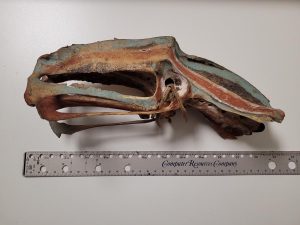
Last edition we heard from Timothy Pietsch, Manager, Wantok Place, North Adelaide (Museum of Papua New Guinea Artefacts) that when having their collection assessed the museum staff had come across a piece that was a mystery. While their professional assessors thought it was a skull from the notches thought to be teeth holes, nothing further was known other than it was painted quite a long time ago, is almost certainly from Papua New Guinea and was collected by a Lutheran missionary. There are no records. The measurements of the object are: 28cm long, 10cm deep, 8cm wide.

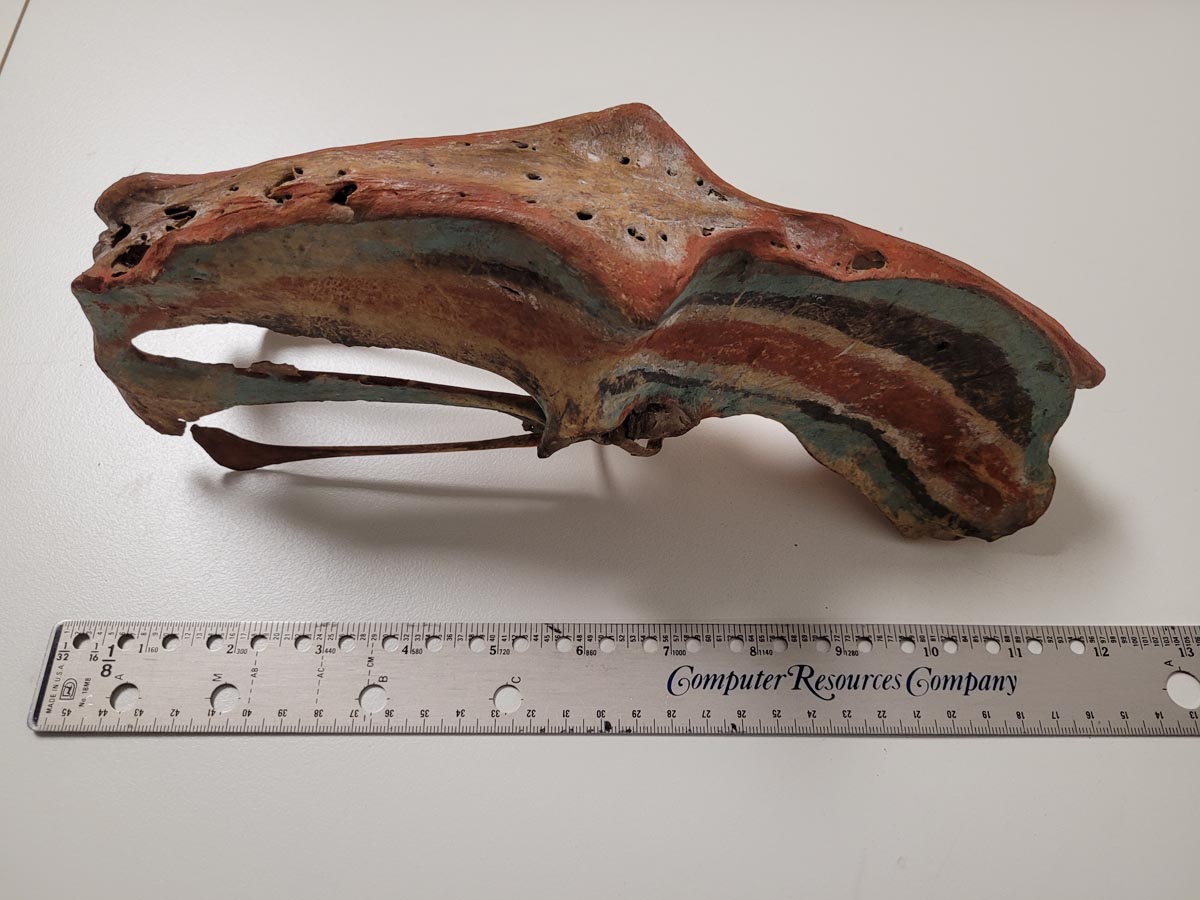
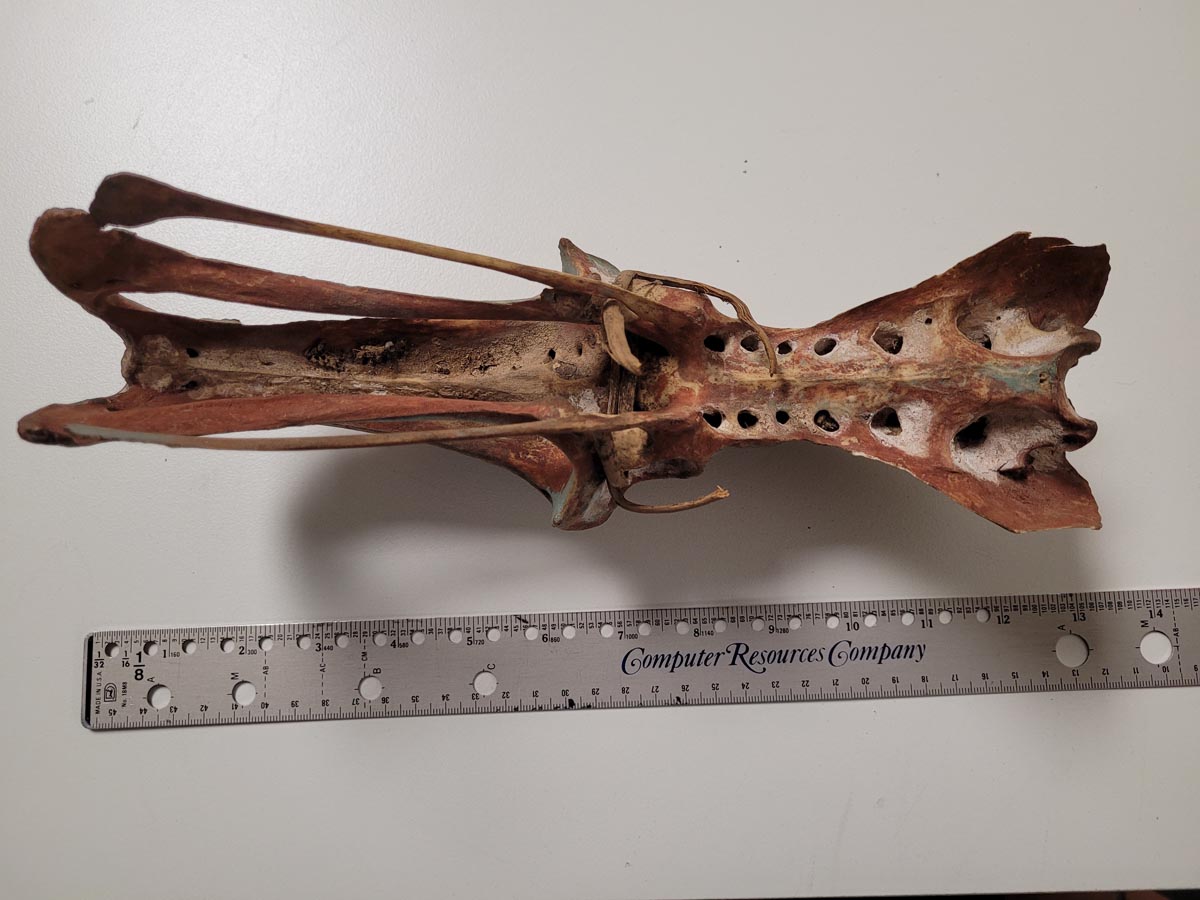
Photos of this mysterious “painted skull” were shared in the last edition of the Journal. Timothy has since advised me that the colour of the paint in the Journal photos was not particularly true – in reality, the ‘green’ paint is closer to a light blue. Since then Timothy and I have had correspondence from many of the world’s eminent experts in PNG artefacts and fauna who have generally concluded that the object is a bone from a cassowary. Some of the comments about colour have also reflected this colour disparity identified by Timothy.
Former SA Museum Curator Barry Craig informed us that he thinks that it is a synsacrum of the cassowary. “It is not a skull; it is the bird equivalent of the pelvis. The synsacrum is located towards the end of the spine and to which the two legs and the tail bones are attached. They are often kept as hunting trophies, especially by the Mountain Ok of central New Guinea, but also by other tribes.” He said that green pigment is unusual in New Guinea so that may narrow down the location where the synsacrum was obtained. Barry has seen green pigment used by the Sulka and Mengen of East New Britain but it may have been used elsewhere too.
This identification was confirmed independently by Dr Loukas Koungoulos, a zooarchaeologist, who had been sent the information by Jim Specht, former Head of Division of Anthropology and co-Chief Scientist at the Australian Museum. Loukas immediately recognised it as a cassowary pelvis viewed side-on. “The left-hand end of the top image is the back part. The two bones tied to the pelvis are naturally attached to the pelvis. The size of the pelvis suggests that it is from the mainland New Guinea species Casuarius casuarius, which would be consistent with it coming from a collection of a Lutheran missionary.” Wantok Place is owned by the Lutheran Church of Australia (LCA) and governed by the LCA Committee for International Mission.
Loukas Koungoulos completed his doctorate at the University of Sydney and is now a postdoctoral fellow working with Professor Sue O’Connor (ANU) and Emerita Professor Jane Balme (UWA) on faunal remains from several Australian and PNG sites. He is currently based at the Australian Museum.
Heide Lienert-Emmerlich, M.A., Leitung / Projekt Archiv at the Mission EineWelt, Centrum für Partnerschaft, Entwicklung und Mission der Evangelisch-Lutherischen Kirche in Bayern reported that her institution located in Neuendettelsau, Germany keeps a similar item in the archived collection from Missionary Karl Wacke, Kalasa, Morobe Province, Papua New Guinea collected around 1921; it was sent to Germany in 1928. The object in Germany is reported to be a pig skull painted in dark red with a rattan loop, to hang it over the Kalasa church altar. Around 1921 the Hube congregation gave the pig skull to the Kalasa congregation as a reminder that they had to organise the next Tutumang [church conference / Synod].
Jim then shared Heide’s photos with Loukas, and he confirms his original identification of the bones as a cassowary pelvis and not a pig skull. The holes on the underside apparently are vestiges of vertebrae that are fused on the cassowary pelvis (rather like the synsacrum of the human pelvis). As Jim has written, “the story attached to the Mission specimen is delightful and the misidentification is not of great consequence to it.”
Jim has also commented that green pigment is not all that unusual in parts of PNG. It is frequently found in New Britain on Sulka/Mengen artefacts, occurs in rock art on the Huon Peninsula coast, and among the Mendi and other highlands’ groups. He would rule out New Britain as a possible source for the pelvis on the grounds of its size, likely to be too large for C. bennetti, the dwarf cassowary that is the only form found on New Britain. He would also question a possible origin in coastal areas of the Huon Peninsula where the green pigment rock art occurs as the area is dominated by grasslands, not the generally accepted habitat for cassowaries. He concluded that a Highlands origin is more likely, but which one? “That’s the problem with unique items – they can’t be compared with anything”.
Eric Kjellgren also provided independent confirmation of the Cassowary pelvis identification, writing that it “certainly appears to be a cassowary pelvis (rather than a skull) and, from the style and distinctive colours of the pigments, is likely from the Sulka or Mengen people of New Britain. However, I have no idea what it was used for, though the fact that it was carefully preserved and decorated certainly suggests that it had some religious and/or ritual significance.”
Timothy is extremely grateful for the amount of interest in and time devoted to seeking an identification for this object.