
Art Gallery of South Australia until 21 January 2024;
National Gallery of Australia March-July 2024.
Review by Margaret Cassidy
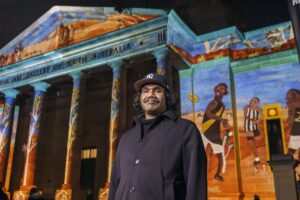
Image caption: Vincent Namatjira with his work Going Out Bush, Art Gallery of South Australia, Adelaide presented as part of Illuminate Adelaide 2022 and also included in Vincent Namatjira: Australia in Colour. Image: Sia Duff.
Adelaide lays claim to being at the heart of Australian Aboriginal art with its annual Tarnanthi (come forth and appear) Fair including exhibitions at the Art Gallery of South Australia, other galleries across Adelaide and art fair, featuring the work from over 40 art centres across Australia.
Walking past the magnificent suite of works created by the Spinifex People from the Great Victoria Desert depicting the powerful Wanampi, the Water Serpent who safeguards the water sources, the artistic style shifts to representational as I enter the first survey exhibition of Western Aranda artist Vincent Namatjira.
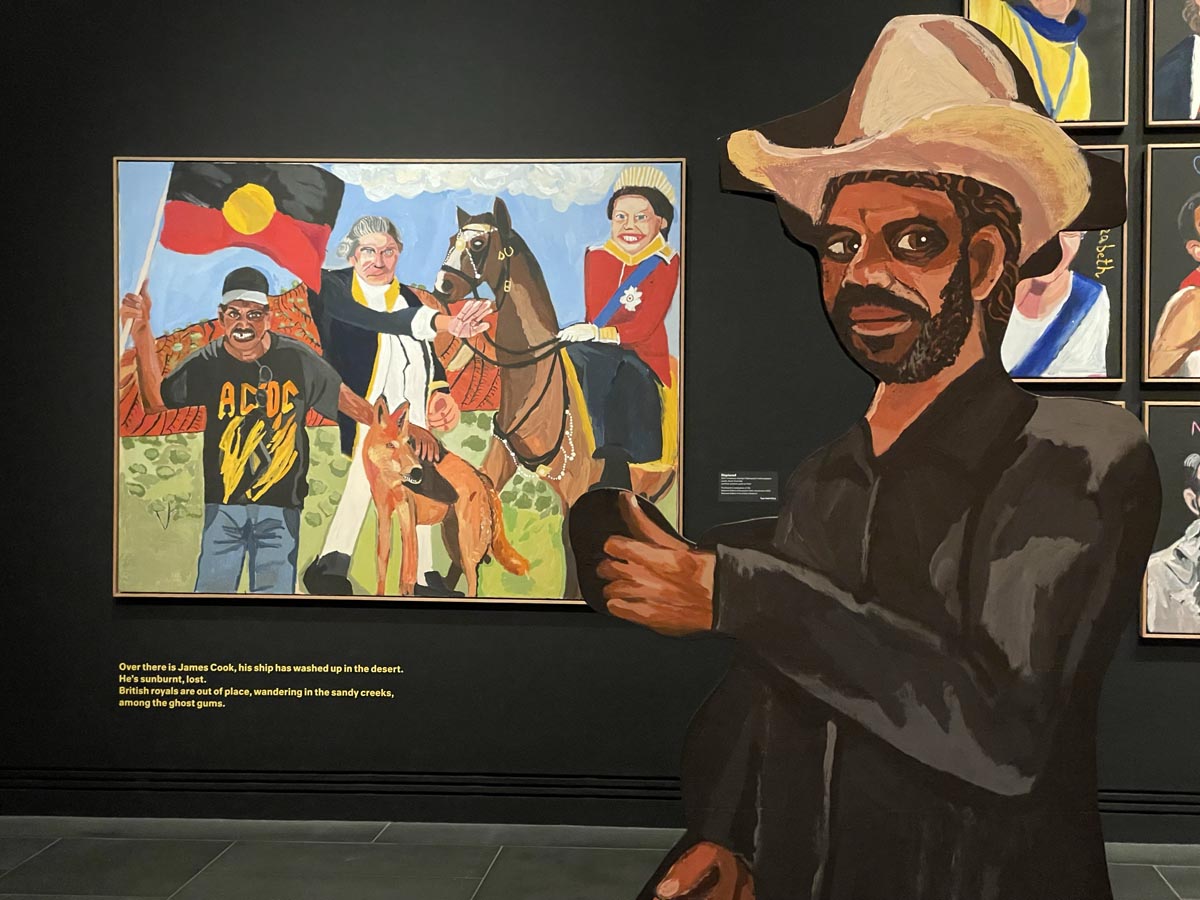
A life-size painted figure of the artist stands in the middle of the space, giving the thumbs up to those who enter. His gaze is firm and confident, reflecting his placement of himself in most paintings.
“Over there is James Cook, his ship has washed up in the desert. He’s sunburnt, lost. British royals are out of place, wandering in the sandy creeks, among the ghost gums.”
Presented as part of Tarnanthi 2023, Vincent Namatjira: Australia in Colour comprises more than 100 works painted from 2014 to 2023 and will travel to the National Gallery of Australia in 2024, fitting for this highly skilled and witty portraitist, the first Indigenous artist to win the Archibald Prize in 2020 for a portrait of former AFL player and community leader “Goodsey”, Adam Goodes, in ‘Stand Strong for Who You Are’.

The paintings are bright and superficially upbeat, but Namatjira’s paintings examine the politics of history, power and leadership from a contemporary Aboriginal perspective. Many of the historical and powerful contemporary non-Aboriginal figures painted are slightly awkward, their representation satirical and ironic.
His expressive portraits capture particular emotions and characteristics of people from a range of backgrounds – from musicians Angus Scott and Jimi Hendrix to sportspeople Cathy Freeman and Adam Goodes as well as Queen Elizabeth II, Gina Rinehart, prime ministers, Aboriginal leaders Eddie Mabo, Vincent Lingiari – and everywhere Vincent Namatjira is also inserted into the scene.
Within the exhibition, his works continue to return to the members of the British Royal family who manage to look awkward wearing ceremonial dress in those magnificent Western Desert landscapes, and placing himself in moments of Royal history, including balcony scenes with Prince Charles holding baby William and the then Prince and Princess of Wales touring Australia in the 1990s.
Born in Mparntwe (Alice Springs), Namatjira grew up in the foster system in Perth where “Indigenous footballers were like heroes” and he toyed with becoming a footballer. When he graduated from high school, he returned home and began to reconnect with his family and their history and culture but it wasn’t until years later when he was living with his partner, artist Natasha Pompey, on Anangu Pitjantjatjara Yankunytjatjara (APY) Lands in South Australia, that he finally picked up a paintbrush and painted a portrait of his great-grandfather Albert Namatjira.
While Vincent has a contrasting painterly style to his great-grandfather, he shares a sophisticated mastery of the colonisers’ materials, techniques and visual approach.
“Welcome to the past, present and future. I stand side by side with my great-grandfather, who I never met – two painters from the centre of this country, standing up and making our voices heard”.
Jim Elmslie wrote about Albert Namatjira and the birth of the Hermannsburg School in Volume 25 Issue 3 of this Journal. This exhibition is not to be missed in either Adelaide or at the National Gallery of Australia in Canberra.