by Lisa Hilli
In late 2020, I was invited to be part of a curatorial advisory at the Stedelijk Museum Amsterdam. Led by former curator of Modern Art, Beatrice von Bormann, the invitation was in relation to an upcoming exhibition examining the art history and collective art practices of Die Brücke (The Bridge) a German Art expressionism movement. The re-examination of German expressionism was largely focused on the art practices of Ludwig Kirchner and Emil Nolde. Three consecutive exhibitions were presented at three public cultural institutions across Europe, Kirchner & Nolde: Up for Discussion (21 April – 1 August 2021) at the Staten’s Museum fur Kunst (National Gallery of Denmark), Kirchner and Nolde. Colonialism. Expressionism. (4 September – 5 December 2021) at the Stedelijk Museum Amsterdam, and finally Kirchner & Nolde: Whose Expression? (18 December 2021 – 20 March 2022) at the home of German Expressionism in Berlin, Die Brücke Museum.
Kirchner, Nolde and other German expression artists largely drew inspiration from art, design and sculptural objects that were steadily trickling onto European shores from global colonies in Africa, the Americas, Asia, and the Pacific regions during the early 19th century. Other key influences that informed Die Brücke art practices included the Cakewalk, an African American dance that mocked slave masters in American cotton plantations, colonial events such as trade exhibitions and human zoos that occurred across the European continent. Coincidentally, a colonial fair with human zoos was hosted on the site where the Stedelijk Museum Amsterdam stands today.
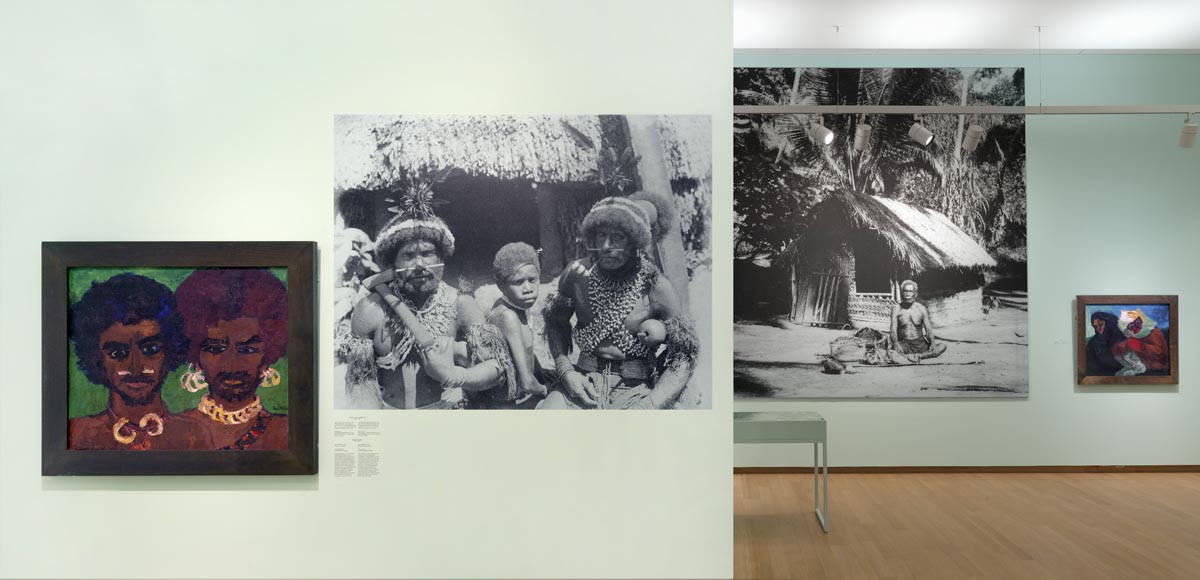
One aspect of the three broadly focused exhibitions was dedicated to Nolde’s travels to the former German colony of New Guinea in 1913-14. With his artist wife Ada, Emil Nolde was one of the few German Die Brücke artists to travel to the Pacific to source inspiration. I was engaged in all three exhibitions in varying capacities. For the National Gallery of Denmark, I shared detailed perspectives of Nolde’s ethno-type water colour depictions of people from Melanesia in a recorded online interview. My interview was edited with Danish subtitles and presented alongside the same problematic artworks I was commenting upon, which made me appear to be another floating disembodied head like the very artworks Nolde had painted a hundred years before.
For the Stedelijk Museum Amsterdam exhibition, I contributed a significant amount of time in the development of content relating to the exhibition and offered a Papua New Guinean cultural and curatorial perspective regarding colonial and indigenous histories connected to the former Protectorate of German New Guinea. Lastly at the Brücke Museum, I created a series of commissioned artworks for an exhibition, guest curated by Paz Guevara in the Kunst Dahlem, a building constructed “at the request of the Führer”[1] in June 1939 opposite the Brücke Museum. The Transitions[2] group exhibition curated by Paz was complementary to the Kirchner and Nolde exhibition in the Brücke Museum. An international group of artists exhibited various responses to German colonial histories and experiences and the art collection of Karl Schmidt-Rottluff, another German expressionism painter who owned and was influenced by various art items from Africa, Papua New Guinea, and New Zealand.
Re-framing the Gallery Space
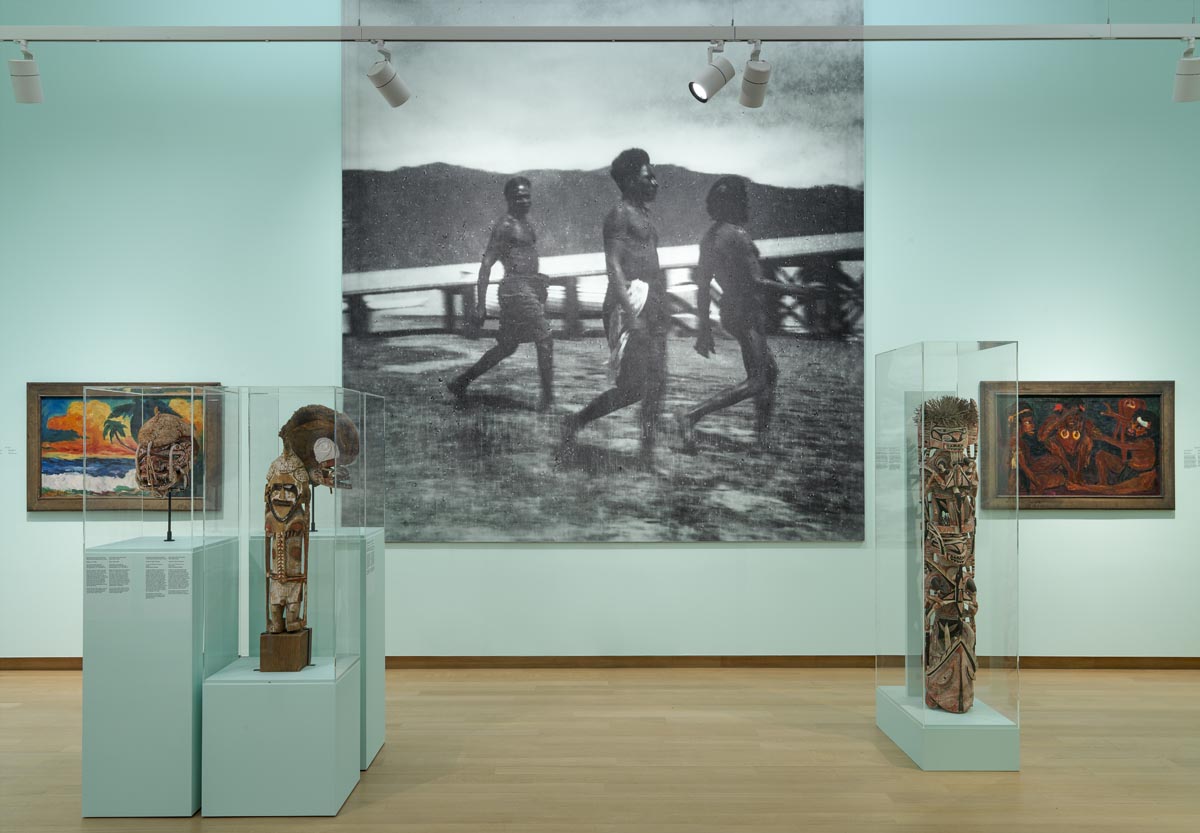
Emil and Ada Nolde’s creative works in relation to their travel to German New Guinea were traced overland via Russia and displayed in one thematic gallery space. Interspersed between and throughout Nolde’s vivid paintings and Ada’s feminine photographs were Papua New Guinean life stories and cultural objects made by Papua New Guinean men and women of the time. In each thematic space across the entire exhibition, architectural portals framed and primed visitors into differing gallery spaces with specific key words printed on the gallery walls. Words such as Perform, Belong, Assume, Show, Reveal, Exploit, Challenge. Entering the dedicated exhibition space relating to German and Papua New Guinea art histories, a large black and white photograph of three Papua New Guinean men holds your gaze. Photographed by Ada Nolde, the men are in motion and move with ease in their bodies. Bordering this photograph are two of Nolde’s paintings, intentionally made small by an enlarged presence of Papua New Guinean bodies. This photographic intervention was replicated among all archival photography with the intention of decentring dominant and problematic art histories embedded with Die Brücke art practices and works.
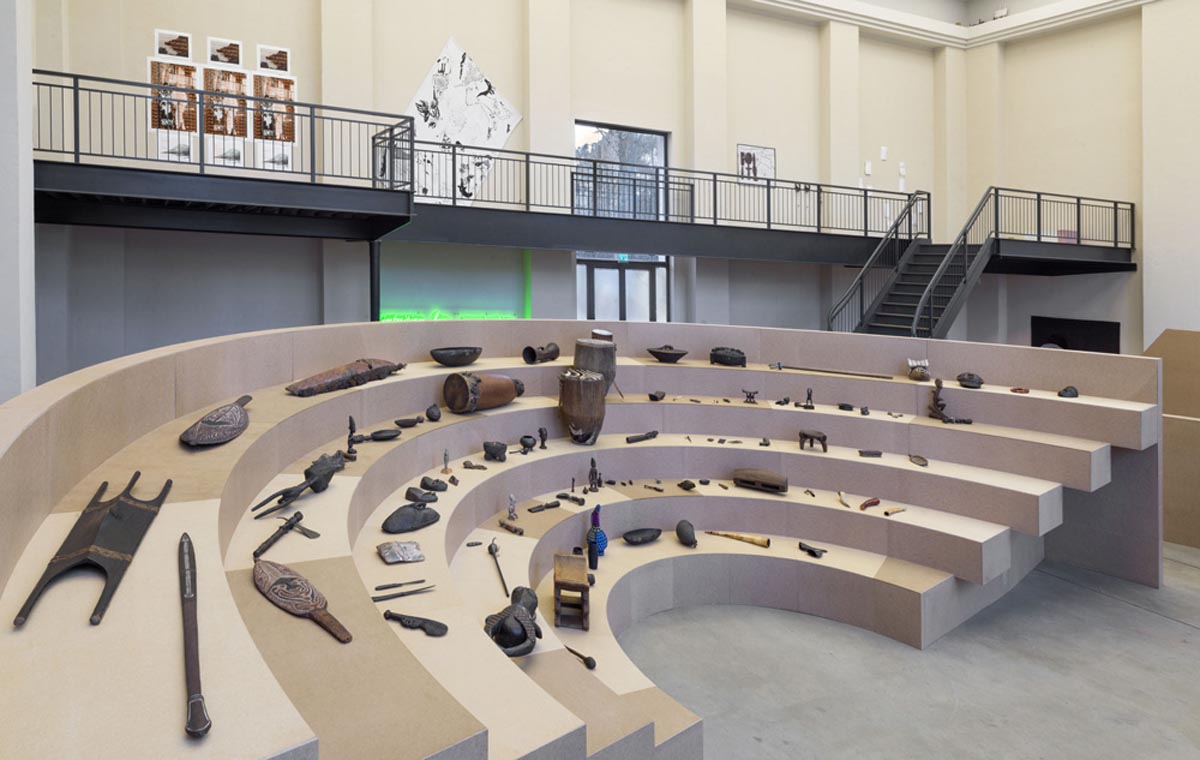
Preceding this are meticulously carved sculptures from Niu Ailan / New Ireland peoples that were collected during the German New Guinea period, on loan from the Tropenmuseum Amsterdam. Some of the curatorial intentions were to show the romanticised views that Nolde painted of Papua New Guinea peoples contrasted by archival photographs depicting the harsh and violent realities of systemic cultural change and imposed labour upon those who were colonised. Photography was an important intervening tool regarding this re-examination of Nolde’s painted works and sketches, countered by his wife’s and many other archival images. The curatorium dedicated to this theme spent hours looking and selecting photographic images as evidence to reveal the truth in contrast to the artists’ impression.
Colonial photography and thematic text were two tools for curatorially intervening, re-examining, and implicating complex art histories and objects relating to Die Brücke art practices. The provenance and display of Papua New Guinean art with Emil and Ada Nolde’s artworks were another tool of intervention. The provenance of cultural objects and the indigenous agency of their makers can powerfully and beautifully illustrate cultural change. Indigenous creative agency of cultural and spiritual change was shown through Tolai carvings incorporating Western religious symbology, for specific dance rituals. Not all objects can be used in such a way, particularly if there are secret or sacred associations. With this intervention, it was important to tread much more carefully, as not a great deal of consultation was done with source communities regarding the display of historical items from the New Guinea Islands region. A Tolai tubuan[3] mask was suggested to be displayed, held in the Tropenmuseum collection, which I declined for public presentation. My reasons for this were that we (essentially me, as the only Tolai person) would need to track down the specific vunatarai (matrilineal clan) that owns / gifted / exchanged this ancestral and spiritual representation, based on the design on the mask itself – which during a global pandemic was near impossible. Also, I did not want to see a sacred ancestral figure dishonoured in a way by presenting a tubuan as lifeless and not how it’s usually seen – full of life – moving, shaking, dancing to the chants of Tolai people and rhythms of kundu and bamboo percussion and simultaneously embodying the land, people and Tolai matrilineal genealogies.

My concern overall with cultural object interventions, is that it’s unfair to use historical materiality out of context imbued with colonial history as a prop to demote the value of another artist’s work. The true origins and intentions of these creative works were not made by Papua New Guinean people for this purpose or to be displayed in a way that encases them behind Perspex. Once works of art from Indigenous people are absorbed into museum collections, the many layers of cultural meaning and context are removed, and we are left with rendered floating objects of beauty or curiosity. The intention with the display of historical Papua New Guinean cultural art in this exhibition was utilised to show objects with provenance linked to German individuals who collected them during the colonial era to implicate Emil Nolde in this history, his inspiration/appropriation of Papua New Guinean people and culture and, to show the artworks of Indigenous agency in their cultural and aesthetic brilliance. I particularly appreciate Tropenmuseum curator Vonu Weys’ words regarding this issue, “we often think that artists like Kirchner and Nolde were kind of geniuses that got their inspiration out of thin air. But what we see is that they are indebted to works of art created by people from non-European countries”.[4]
Rehumanising
It was never going to be possible to name every single person portrayed by Emil and Ada Nolde in the artworks displayed. Several individuals were named across the entire exhibition, including a few people from Papua New Guinea. Beatrice von Bormann’s research in Ada’s journals revealed a young boy named Jupuallo, who assisted Emil and Ada during their travels around several locations in German New Guinea. Jupuallo spoke a creole version of German, which may have been an early form of Tok Pisin (Pidgin English) or what is known today as Unserdeutsche (Our German). Jupuallo’s portrait by Nolde, depicts him with two bright red hibiscuses in his hair, his story was given a historical narrative to highlight the importance of indigenous mediators in the New Guinea colony.
Another key figure was Tolai man, Pero ToKinkin who travelled with a group of Tolai men to be ‘exhibited’ at a recreated village from New Guinea in the Deutsche Kolonia-Austellung, Berlin’s first colonial exhibition at Treptow Park in 1896.[5] A black and white photograph of Pero ToKinkin as an elder man in his village was displayed at a similar upscaled size to give his story and life prominence and a sense of agency as an Indigenous man travelling to Germany from ‘the colony.’ Aspects of Pero’s story were sourced from an interesting historical narrative written by Papua New Guinea Association of Australia member Max Uechtritz. In the case of Jupuallo, we could not confirm his full name, the cultural group or origin of his homeland in the Pacific. At the very least, an attempt was made to confirm his identity via the New Guinea Islands Historical Society Facebook Page, in lieu of the difficulties of travel restrictions and inability to do direct community consultation personally caused by the Coronavirus global health pandemic.
These interventions are by far not perfect nor to be taken as a standard approach. Every re-examination or re-thinking of art and histories needs to be carefully considered. If it concerns Papua New Guinean people, then they need to be either leading or be part of developing and contributing narratives that reflect their experiences and perspectives. The origin of the re-examination of Kirchner and Nolde’s artworks was a collaborative project, initially led by curators Beatrice von Bormann, formerly at the Stedelijk Museum Amsterdam and Dorthe Aagesen at the National Gallery of Denmark in partnership with Lisa Marie-Schmidt Director at the Brücke Museum in Berlin.
Thinking and advising on the art of Kirchner and Nolde and other expressionism artists was a challenging and complex project. The real work was in the difficult conversations that were had between the curatorial leads and curatorium members. It was through these difficult truths and conversations that new understandings and relationships of complex histories were made. Difficult conversations are opportunities to learn and most importantly, essential professional development for those who hold power in hierarchical institutions such as museums and galleries.
This is an edited version of a public presentation given at the OAS forum, South Australia Museum, Kaurna Country 26 November 2022
[1] See Kunst Dahlem History of the Building https://kunsthaus-dahlem.de/en/history-of-the-building/up-to-1945/
[2] Further details can be found here https://www.bruecke-museum.de/de/programm/ausstellungen/1423/transition-exhibition
[3] Tubuan in the Tolai language means old woman and refers to the first woman who landed or was born on the lands connected to each matrilineal clan. Tubuans are evoked during significant cultural events and rituals by initiated Tolai men and women only. It is inappropriate and culturally offensive to represent a Tubuan in any other way.
[4] See Stedlijk Museum Amsterdam mini documentary https://www.stedelijk.nl/en/exhibitions/kirchner-en-nolde-expressionisme-kolonialisme-2
[5] See “Zurückgeschaut” (Looking Back): The first German Colonial Exhibition in Berlin-Treptow 1896 https://www.museumsportal-berlin.de/en/exhibitions/zurueckgeschaut-looking-back