
by Pierre Laffont
When I mentioned in passing that I had attended the Pacific Art Association Europe annual meeting in Chartres, France, mid December 2023, the editor of this Journal immediately asked what were the highlights. My learning from this is never mention a potential article to an editor without expecting a difficult question in return: with more than a dozen lectures, visits to the collection and film, all as fascinating as the next, choosing the highlights is potentially making enemies forever. You will find the detailed program on the PAA Europe website (https://pacificarts.org/wp-content/uploads/2023/11/2023-Programme-PAA-E-Chartres.pdf).
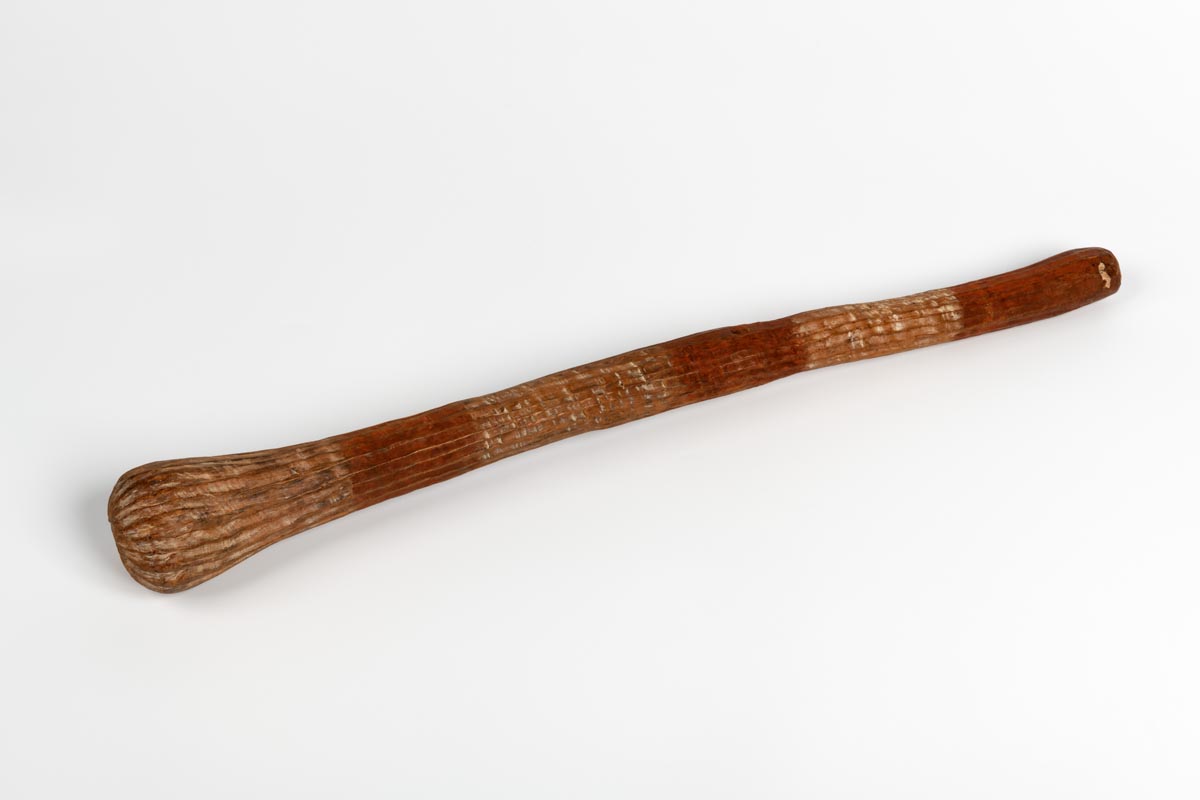
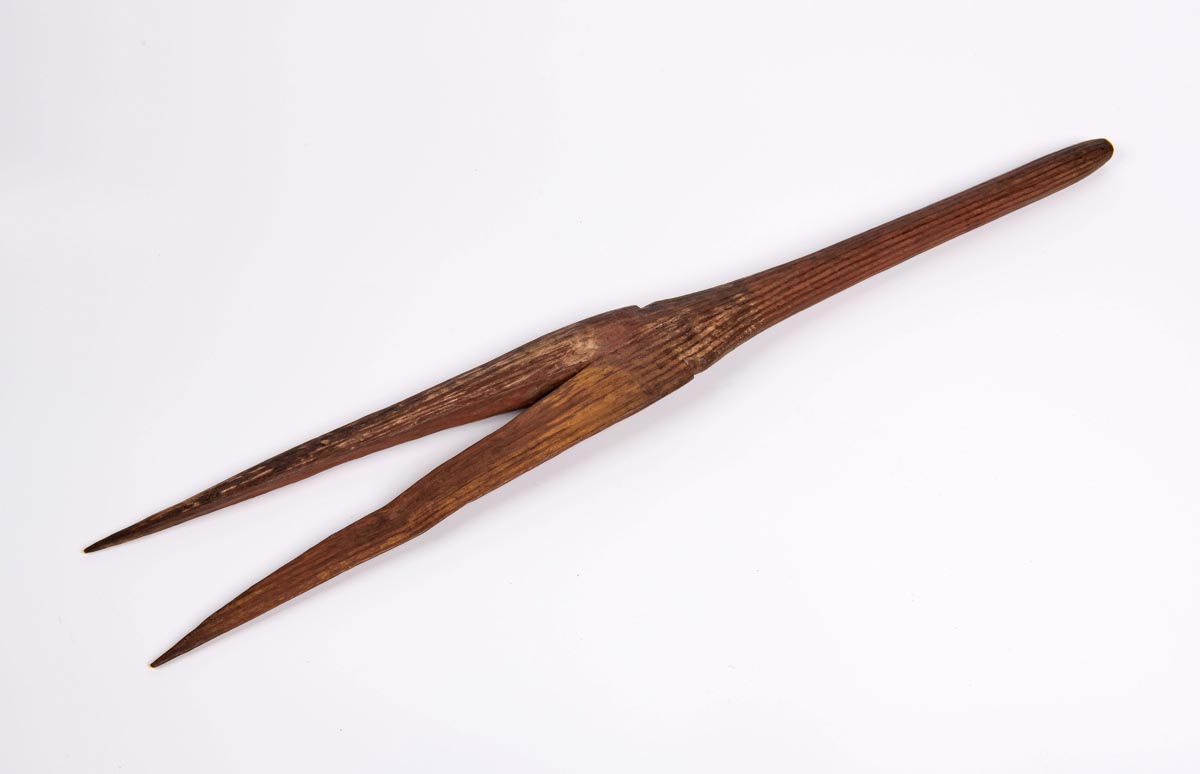
One particular presentation had intrigued me even before I registered. In the Session Abstract in the PAA booklet, Wonu Veys, the Oceanic Art curator of the Wereldmuseum in The Netherlands, and also the chair of PAA Europe, suggested that 20 objects held by this museum could possibly have been collected during a Dutch expedition in June 1705. If that were the case, this would make them the first known items of Australian indigenous material culture to be obtained by Europeans through intercultural exchange, more than sixty years before Cook! These findings were not yet confirmed and Wonu Veys was going to explain the research and the findings so far and what were the next steps.
The expedition led by Maarten van Delft in June 1705, though well documented, is not well known by non-Dutch speakers. European competition had been the trigger for this expedition as Englishman William Dampier had just published A Voyage to New-Holland in 1703 about his journey in 1699 to the west coast of Australia. The Dutch Administration in Batavia concluded that the English hoped to find spices there, with which they could circumvent the monopoly of the Dutch East India Company, the Verenigde Oostindische Compagnie (VOC), writing “The fossicking, spying and writing of the well-known English traveller William Dampier, as well as other considerations, motivated us to undertake another crusade”[i]
The VOC commissioned two expeditions in 1704 to beat the English in the race, one led by Jacob Weyland to the north coast of New Guinea and one to the north coast of Australia, this latter one under Maarten van Delft. It consisted of a flute ship (fluitschip), on which Van Delft was skipper, a sloop and pantsjaling, a Malay vessel shallow in draft for the exploration of coasts and rivers. The expedition was intended to explore the coast of Van Diemen’s land to the east, and then sail via what was then named the Bay of Nova Hollandia (the current Gulf of Carpentaria) to New Guinea. At this point the expedition was required to look for a passage between New Guinea and Australia.
The journals of both expeditions have not been found, but the VOC wrote a report on the basis of the journals, which has been preserved. It contains some detailed description of the exchanges with the Tiwi. Tiwi Islanders went aboard the ships, exchanged fish and crabs for clothing and ornaments and allowed the Dutch to land to obtain fresh water and explore the island’s hinterland. The Dutch documented some of the earliest observations of Indigenous Australians and recorded a collection of some objects. The question remains whether the objects held in the museum today are part of that collection.
Islands Wereld Museum.
Van Delft’s expedition left the coast of Van Diemen’s land on 2 April 1705. On Melville Island and Bathurst Island, contact was made with the residents, the Tiwi. For more than three months, they sailed along the coast and “discovered” a number of islands and rivers that were not yet on the map, and looked for anything deemed interesting enough for trade. Van Delft had also been commissioned to try to take some residents with him back to Batavia and teach them the language to break the language barrier. However, despite handing out gifts, it is not clear whether Van Delft convinced any volunteers. There are accounts of aboriginal people buried in Sulawesi as a result of this expedition, an oral tradition still to be explored.
The crew of the three ships suffered greatly from diseases such as high fever, dropsy (a side effect of scurvy) and eye disorders. Van Delft also became ill. On 12 July, it was therefore decided to return to the Banda Sea. The three ships hardly made it. Of the 42 Europeans who had departed only 24 were still alive on their return and 9 were ‘periculously ill’. Of the 20 Javanese, 4 had died and the others were sick. Van Delft still came ashore at Makassar, Sulawesi. However, four days later, on 8 August 8 1705, he also died. There was no subsequent Dutch expedition until 1756, and most importantly none which landed in the Tiwi Islands, making the Van Deft expedition the most probable source of the 20 Tiwi objects in the Wereldmuseum marked as the “Koninklijk Bataviaasch Genootschap voor Kunsten en Wetenschappen” collection.
The “Koninklijk Bataviaasch Genootschap voor Kunsten en Wetenschappen”, the Royal Batavian Society of Arts and Science, was a Dutch learned society in Batavia founded in 1778. At first, the scope of the Society was very general and included, among others, natural science and ethnography. Over time, the institution has morphed into the National Museum of Indonesia in Jakarta where most of its collections now reside. However, over the centuries of colonial rules, there were exchanges between the Society and other museums, including the Ethnography Museum in Leiden whose collection has been absorbed into the Wereldmuseum. Tracing object trajectories from the Royal Batavian Society of Arts and Sciences to the Wereldmuseum is currently being undertaken through historical catalogues, museum correspondence and catalogue cards. It may not be possible to track all the steps, especially the first 150 years of these potentially more than 300 years old objects.

Over the next coming months, scientific techniques will be used, both non-destructive and destructive analytical techniques, to analyse ochre pigments to link them to cultural ochre sources from the Tiwi Islands and establish object chronologies. The main techniques could be Portable X-Ray Fluorescence (pRF), Fourier Transform Infrared Spectroscopy (FTIR), Near IR (Infra-Red) instrument analysis, X-Ray Diffraction (XRD) (potentially) and/or Neutron Activation Analysis (NAA). Identification of wood sources in the Tiwi Islands will also take place. The purpose of these state-of-the-art technologies will establish, once and for all, age and provenance. These investigations should be completed in the first half of 2025.
While researchers and Tiwi elders alike are awaiting conclusive confirmation that these objects are indeed the markers of these cultural entanglements between Southeast Asians, Europeans and the Indigenous people of northern Australia in the early 1700s, Tiwi elders are planning to travel to Leiden in June 2024 to intimately reconnect with their ancestral objects. A true highlight for more than just Art!!
For further reading on the 1705 Van Delft expedition see Wendy Van Duivenvoorde, Daryl Wesley, Mirani Litster, Fanny Wonu Veys, Widya Nayati, Mark Polzer, John McCarthy, and Lidwien Jansen. “Van Delft before Cook: The earliest record of substantial culture contact between Indigenous Australians and the Dutch East India company prior to 1770.” Australasian Journal of Maritime Archaeology 43 (2019): 27-49.