

by Judy Robinson
Carved anthropomorphic figures of Pacific Oceania are known by the general term of tiki. Their place in protohistoric architecture was first recorded in the accounts of explorers, scientific observers and missionaries between 1769 and the 1800s, as new belief systems were being superimposed on island cultures. The iconoclasm that followed the introduction of Christianity in Oceania made links between tiki and architecture less evident in postcolonial era buildings, as tiki carvings were intentionally erased from structures. In some places, notably Aotearoa New Zealand, the architectural presence of tiki prevailed into the modern era, but in many island cultures tiki often disappeared completely from
local architecture.
A clear example of tiki in the built environment in the era preceding Oceania’s recorded history was a substantial structure on Mangareva, the largest island in the Gambier Archipelago in what is today French Polynesia. Here in 1834 priests established the first permanent Catholic mission in the South Pacific. Described at the time, this timber structure, ‘not less than 100 feet long and 30 feet wide,’ was known to have all its inner sideposts — estimated at 30 in number — carved with tiki figures ‘at the lower end of the rafters.’ The house stood in the Mangareva village of Rikitea. Explorer Jacques-Antoine Moerenhout, who recorded its existence in 1834, noted that the house was enclosed on the north, east and west elevations, and the open face of the house “was the front which was exposed to the southwest” (Hiroa 1938:231).
This house, then known by the locals as ‘are tiki [image house], was so named for the incorporation of tiki figures carved into the houseposts along the enclosed rear and open front rows. Hiroa states that fourteen years after Moerenhout, in 1848, a “picture of the house was drawn by Dumont d’Urville’s artist and reproduced by Mgr. Armand Olichon.” Olichon’s version (Fig.2), shown in Hiroa’s Ethnology of Mangareva, “omits a grotesque image lying on the ground in front of the house.” The figure spans between about 5 of the front columns, spaced at estimated 1800mm centres, in the sketch by d’Urville’s artist (Fig.1), so could have been 9 metres long. A figure of this size could conceivably have been standing vertically within such a vast structure, perhaps as a central supporting post. Olichon’s later sketch of the ‘are tiki — described in 1834 as a ‘temple’ by Moerenhout — depicts the house in 1848 as somewhat of a haystack (Fig.2). Now there is no sign of carving in any of the posts visible in the front row, and ‘a kind of platform or low stone wall running across the open side’ that was noted in Moerenhout’s earlier description, is similarly depicted in the later drawing. Fourteen years later, according to d’Urville, the “gods had been committed to the flames and the interior was encumbered with blocks of coral worked by the natives for the church which was to be erected on the same site” (Hiroa 1938:147).
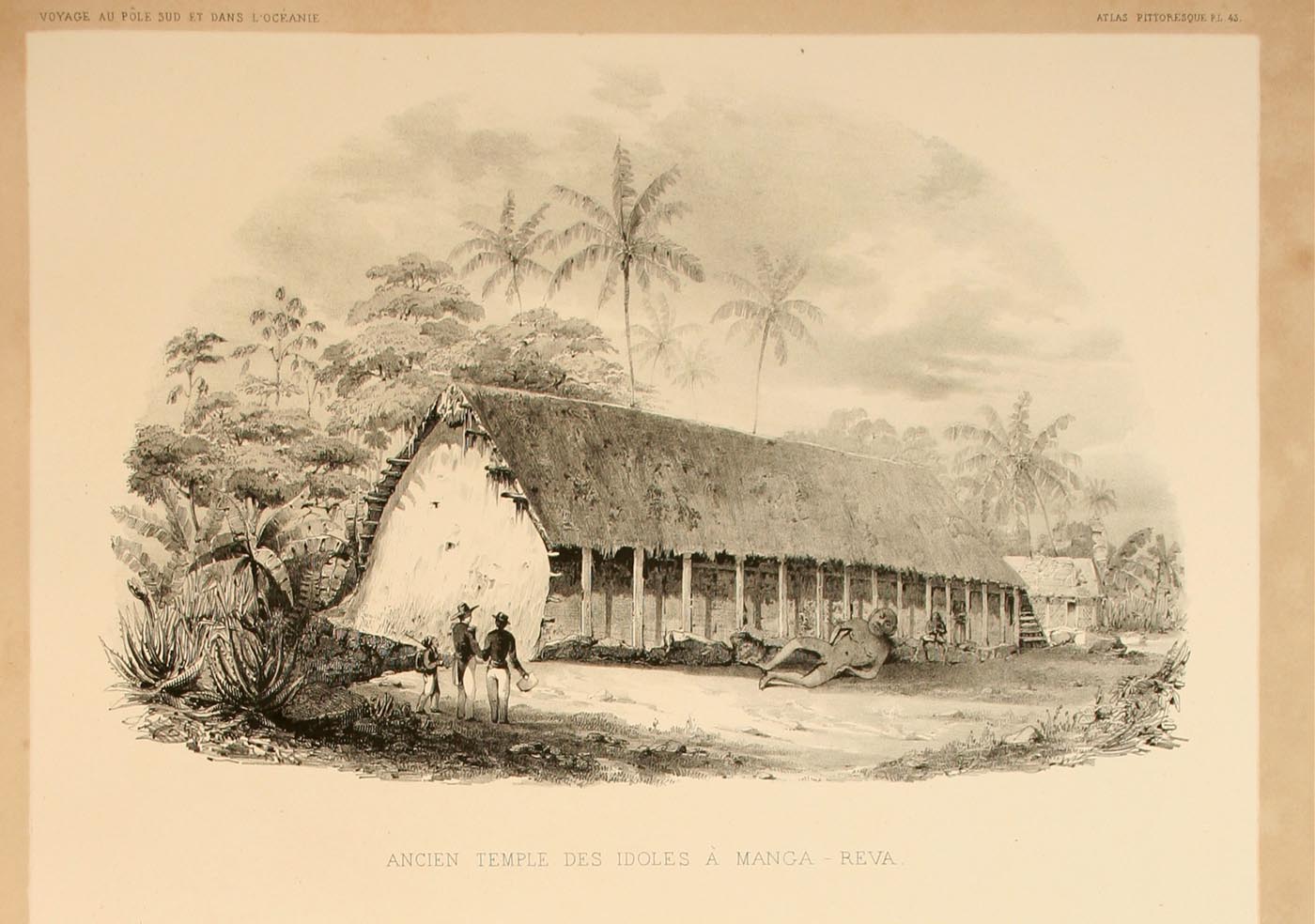
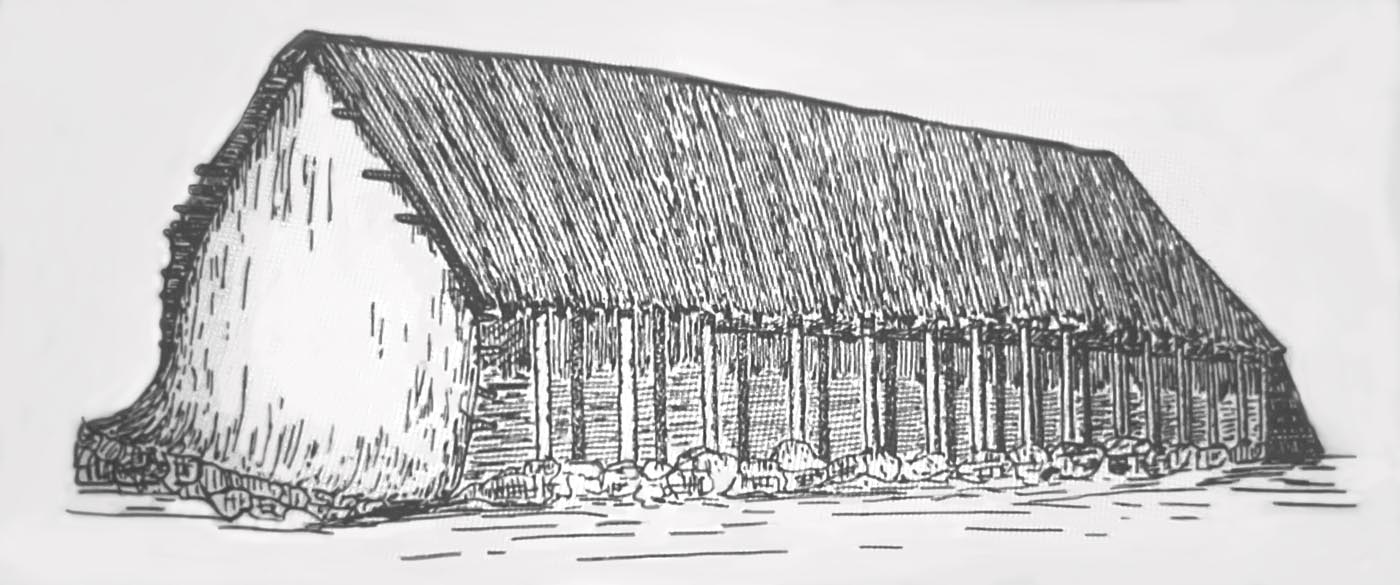
In 1826 British naval officer and explorer Captain Frederick William Beechey described the vertical dimensions of a chief’s house in Rikitea as having a roof pitch: ‘…about 25 feet high, and the perpendicular sides of the house about 10 feet.’ Scaling from the human figures shown in the 1834 sketch by d’Urville’s artist, the ‘are tiki community house at Rikitea looks to be about those proportions. The house had odd numbers of columns in its rows: fifteen front posts, fifteen rear posts, and seven main posts in the centre row, offset with the columns in the front and back rows. The tiki carvings on either side would have been carved within a post ten feet high, but possibly in sections that fitted into the top of the posts, at the foot of the rafters. Because d’Urville stood in the same building fourteen years later and remarked that ‘gods had been committed to the flames’, Hiroa/Buck concluded that, because the building was still standing, the tiki columns “were not carved in one piece with the rafters and that the caryatid effect was apparent and not real” (Hiroa 1938:233). Somehow the tiki carvings were slipped out of the top of the columns without compromising the structural integrity of the building. This seemingly magical feat might have been possible if sinnet bindings were used to bind the separately carved sections of post together.
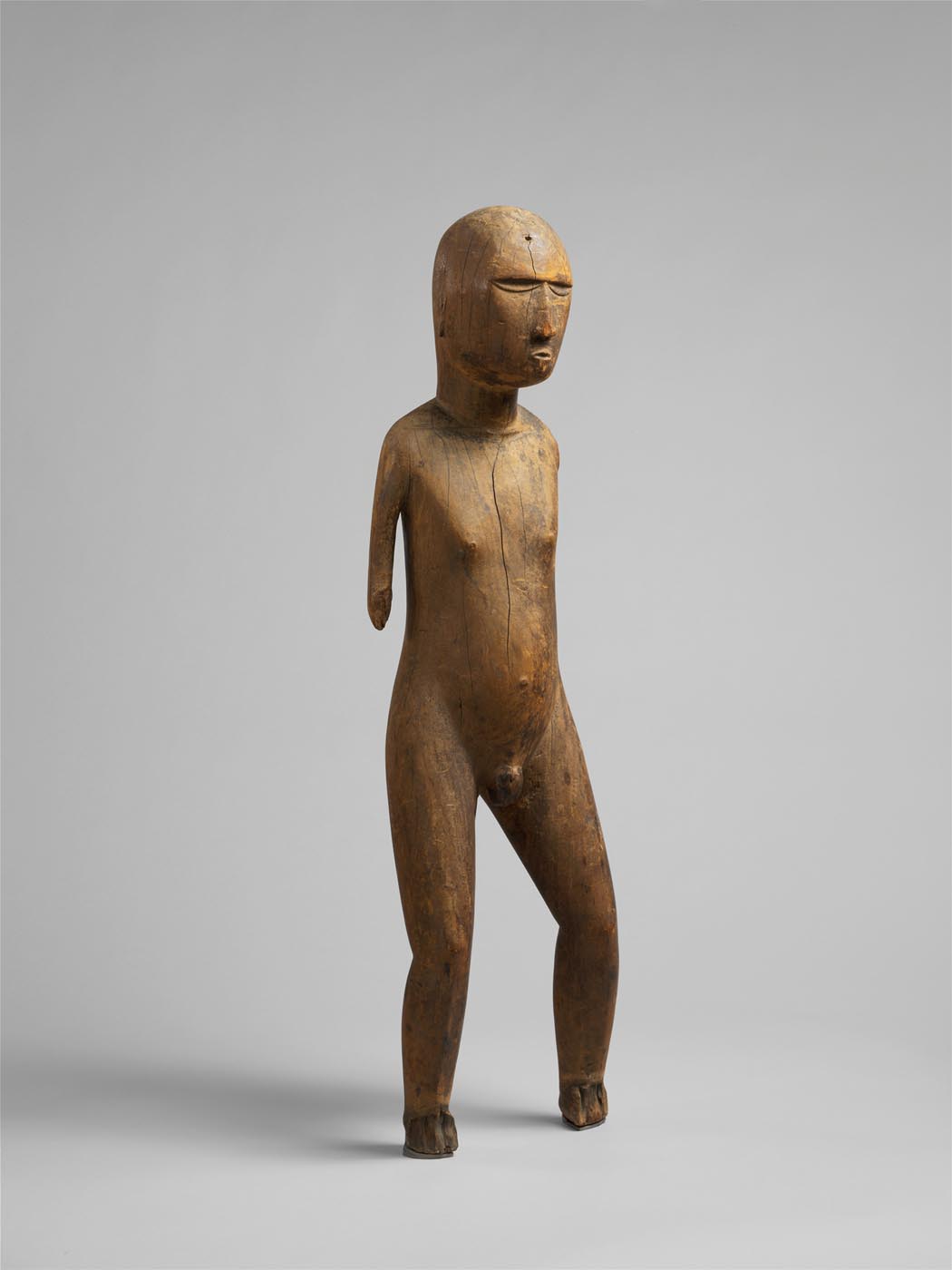
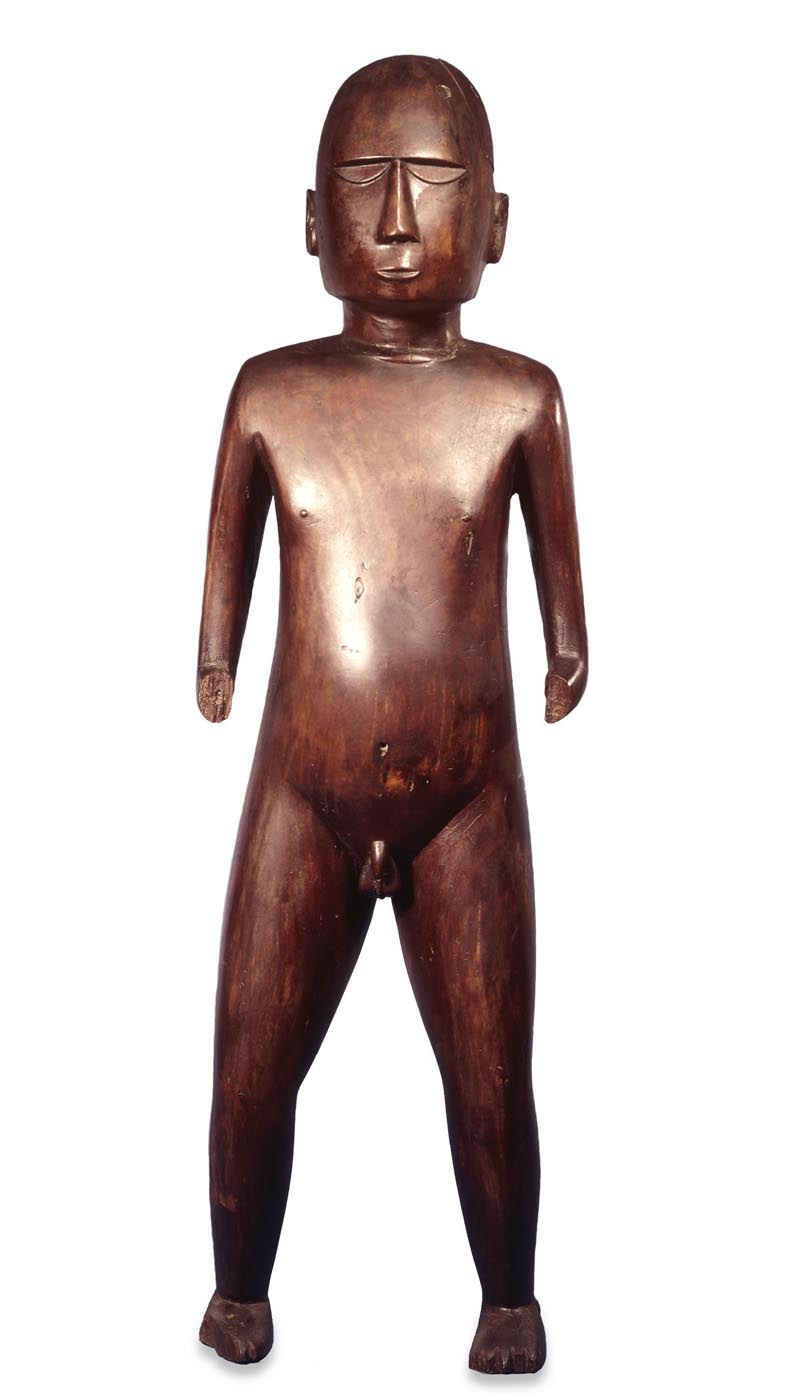
It is not possible from the available evidence to know the exact size of the carved tiki portion of the sideposts, since they have all now vanished, but any tiki carving up to a height of about three metres [10 feet] could have been engaged as a sidepost in the ‘are tiki of Mangareva. Accounts seem to indicate that only the top half of the sideposts were carved in tiki images; however, “the statue figured some god wearing a loin cloth (maro) and supporting the rafter on his head” (Hiroa 1938:233). It is likely that an estimated height of 1500mm would be expected if any of the sidepost carvings had separated from the lower half of their sidepost and have survived the iconoclasm. “A total of only 11 wood figures survived the transition to Christianity, which began in 1834 when protestant missionary George Nobbs instigated the destruction of the first idols by fire. The Picpus Fathers (Roman Catholic priests of the Congregation of the Sacred Hearts of Jesus and Mary) took over the process of conversion and convinced the Mangarevans to burn their images of the god Tu and destroy their marae” (Gunn, 2014:118).
Some of these 11 remaining examples can be found in the Vatican Ethnological Museum, the Metropolitan Museum of Art (Fig.3), the British Museum (Fig.4) and Musee du Quai Branly. In surviving the iconoclasm these carvings sustained damage that is often attributed to a process of deconsecration, whereby a figure was deliberately damaged so that it was converted from a sacred to a secular figure. It is also likely that structural carvings sustained damage while they were being removed from their architectural fixings. If the estimated nine-metre-long carved figure depicted lying outside the ‘are tiki was a centre post in the structure, it was never specifically mentioned in eyewitness accounts and its fate, along with the six other main posts in the structure, is unknown.
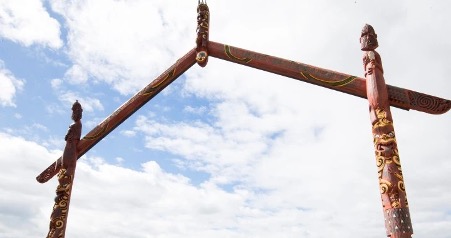
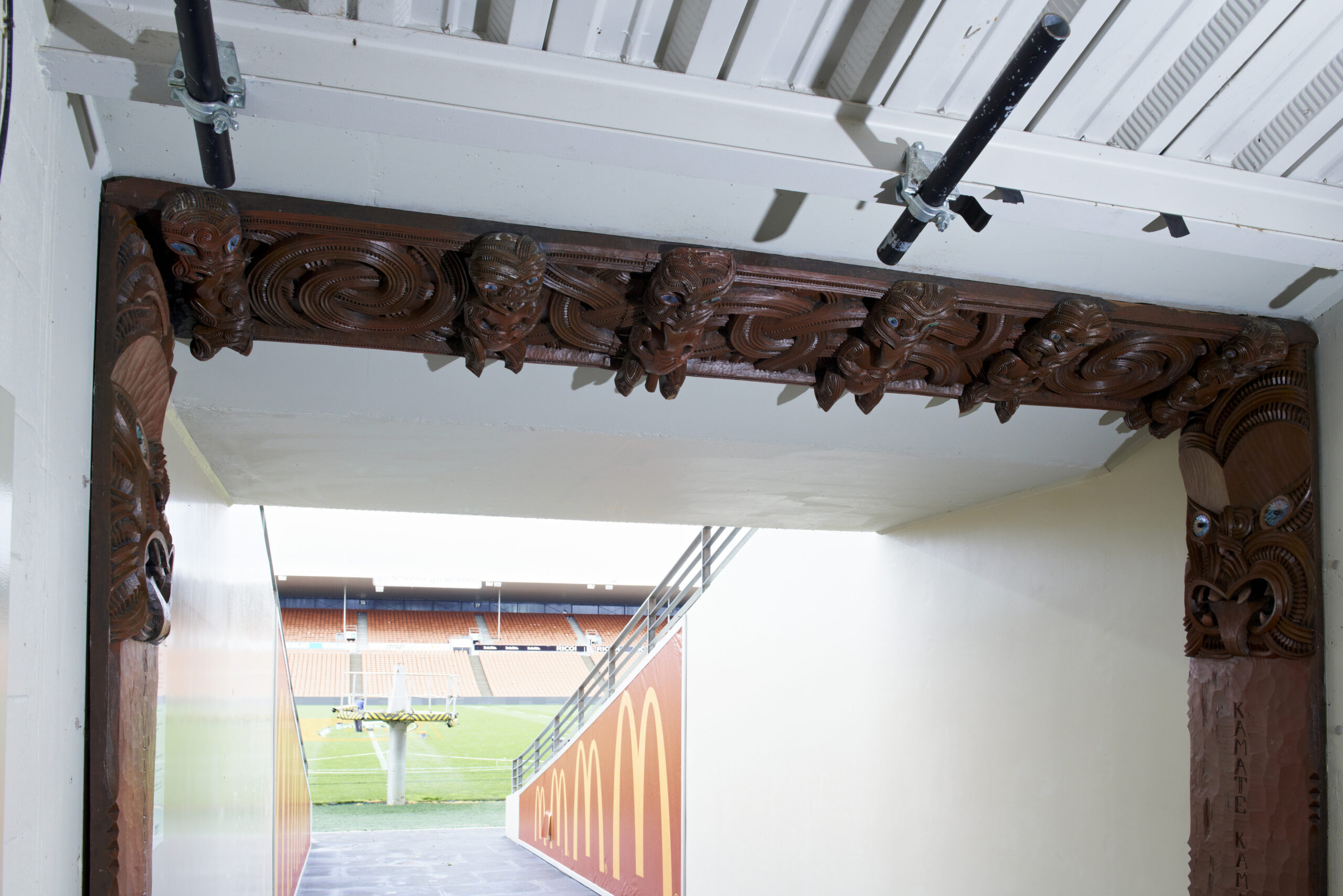
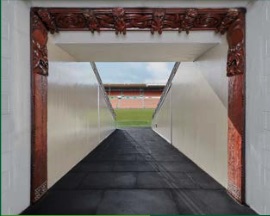
A recent and clear example of how ancestral carvings give orientation and identity to a contemporary cultural landscape by being a cultural marker, monument and symbol can be found at Waikato Stadium in Aotearoa New Zealand. In this example, the cultural landscape is a sports stadium and the carvings forming an archway, or waharoa, on the eastern side of the sports field (Fig.8), with a second arch of carvings lining the interior walls and ceiling of the players’ tunnel onto the field (Fig.9).
The history of lived space on the site can be traced back several hundred years to around the late 1600s, when the land now occupied by the Waikato Stadium was the site of a Māori pa [village], including its urupa [burial ground]. The area became Beetham Park after 1922 when the human remains were exhumed from the burial ground. During reconstruction of the stadium in 2002, carver Wiremu Puke, who is an “advocate for the use of stone tools and traditional methods” (Puke, 2016), gave this evocative description of a waharoa and its significance, thereby securing local support for the gateway project, incorporating a waharoa in the
new stadium:
“A waharoa is traditionally a carved archway which taua, or war party would pass through when heading to war, when they pass through that archway they were completely committed to Tumatauenga (the God of War) and they knew that there was no coming back, they were absolutely committed to warfare. In today’s world we need something like a waharoa to bring a sense of that warrior essence out in our players. They are there to defend that ground in battle. So, we are more or less introducing a very old tikanga, or custom into a modern setting in terms of sports like rugby which is really ritualised warfare” (Puke, 2016).
Puke’s proposal essentially involved creating a monument to the protohistoric lived space by transferring a war arch to the contemporary lived space of a sports stadium.
As a cultural marker and monument Waikato Stadium’s gateway identifies the local tribe, Ngaati Wairere, by portraying three Ngaati Wairere ancestors in the carvings: a local tribal ancestress, Koura, the grandmother of Hotomauea, one of two victorious Waikato fighting chiefs who took control of the pa after defeating Taiko, an earlier chief, in hand-to-hand combat; carvings of Hotomauea; and the other chief, Hanui, are carved atop each upright post on the archway.
The five main elements forming the gateway are the five main house-front elements of a whare [meetinghouse]: two upright posts [amo] supporting two gabled facing boards [maihi] with a tekoteko carving at the highest point of the gable. The tekoteko is carved to represent the god Uenuku (Fig.6), described by Wiremu as being “one of the most supreme of all in the traditional stories of creation within Tainui and rightfully earns his place as the gateway’s figurehead” (Puke, 2016). The god sits at fifteen metres above the ground, at the apex of the gateway. The waharoa is carved on the western side only, “to ensure the structural integrity of the piece” (Puke, 2016), giving carved ancestors and gods westward orientation to the sports field, and toward the Pacific Hawaiki, rather than facing east toward Aotearoa’s ancestral homeland.
Incorporating a waharoa in Waikato Stadium has transferred long-standing behavioural rules of warfare to the behavioural setting of a football game, although it is important for players to have an intimate, physical, connection to the carvings for this to be fully realised. Unlike the waharoa of ancient marae in times of warfare, the Waikato stadium archway does not function for the player/warrior analogy since the players do not run through the archway and on to the field. The players’ tunnel below the grandstand seating is the actual player/warrior portal. The spectators arrive and depart through the waharoa, so the archway is an identifying feature that does not function as a battle portal in the original sense of a waharoa. The players’ tunnel is the portal that delivers players to the sports field: by incorporating another set of ancestral carvings in the tunnel, patterns of behavioural rules, meanings and cultural constructs of space have been incorporated around the cultural activity space of football. Players running through the tunnel “are invited to tap these [carvings] on their way past so that the mauri or life force of successive players can be passed on from one to another” (Puke, 2016, quoted in Robinson 2016:63).
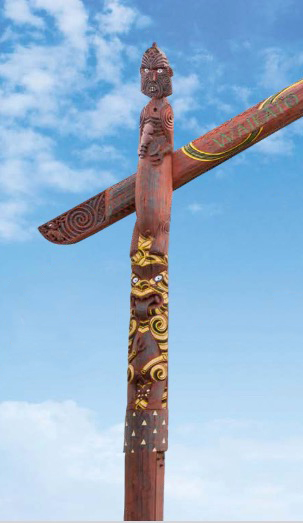
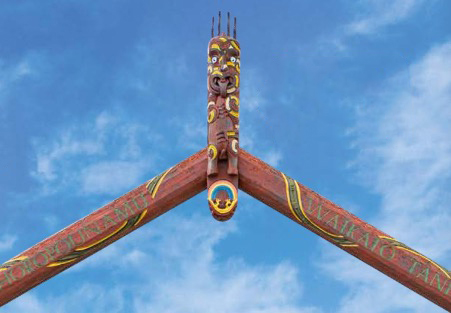

Raparapa, the carved gable on the northern end of the arch, is carved ‘representing Hani, a Tainui war god. The spiral carving represents the life force of Whatanoa Paa and the history of the people who lived in the area.’ Hanui is carved atop the left-hand post (Fig.5). ‘The tekoteko carved at the apex of the archway represents Uenuku, one of the most sacred ancient Māori gods’ (Fig.6). The raparapa on the southern end of the arch (Fig.7) ‘is carved to represent Puna, the female Tainui deity of cultivation and peace offerings. The spiral patterns symbolise hope, expectations and opportunities. Puna is not only associated with women who partake in but support Waikato sports and their teams.’ Hotumauea is carved atop the southern amo (Fig.7).
Carving on the lower face of the northern amo (Fig.5 and Fig.8) ‘depicts Maui, traditionally known to be a trickster who used his cunning, nerve and deception to go beyond the boundaries of luck. He symbolises the need to take risks.’ The image carved on the lower face of the southern amo (Fig.8) ‘depicts Rongo, the ancient deity for sports, pastimes and the harvesting of food. As Māori traditionally held games after the harvest, Rongo is associated with Māori sport.’
FMG Stadium Waikato offers this explanation of the north, south, east and west currents represented in the arch: ‘The figures on the cross beam are: Hurunuku atea, the Northern current representing daring, cunning and determination; Tahumakakanui, the Western current recognising the role of woman in sport as our greatest supporters; Hani, the male presence; Puna, the female presence; Tahumawekenui, the Eastern current representing intelligence of sport and warfare; and Paraweranui, the Southern current representing endurance and survival.’
Interpreting the meaning of the players’ tunnel entrance carvings: ‘This carved entrance represents ancient Māori deities which symbolise the main four winds and the essence of man and woman. The carved figures and patterns denote the journeys and qualities of participants who represent the Waikato province and the nation.’ (mgstadiumwaikato.co.nz). ‘The intimate relationship between the ancestors and the people in the lived space is reinforced by the inclusion of players’ tunnel carvings, providing an opportunity for players to touch the carvings’ (Robinson 2016:66).
References
Gunn, M., 2014. (editor) Atua: Sacred Gods from Polynesia, Canberra: National Gallery of Australia.
Puke, W., 2016. Whatanoa Gateway FMG Stadium Waikato: Interview with Wiremu Puke, http://ketehamilton.peoplesnetworknz.info/site/topics/show/224-whatanoa-gateway-fmg-stadium-waikato. Accessed June 2016.
Robinson, J., 2016. Exploring the orientation of tiki houseposts in protohistoric Pacific Oceania. Thesis, Newcastle: University of Newcastle, Australia.
Hiroa, Te Rangi, (Peter H. Buck), 1938. Ethnology of Mangareva, Bernice P. Bishop Museum Bulletin 157. Honolulu, Hawaii: Bernice P Bishop Museum.
Hiroa, Te Rangi, (Peter H. Buck), 1932. Ethnology of Tongareva. Bernice P. Bishop Museum Bulletin 92. Honolulu, Hawaii: B.P. Bishop Museum.
Hiroa, Te Rangi, (Peter H. Buck), 1938b. Vikings Of The Sunrise, New York: Frederick Stokes.
Notes: Figures 5 – 9 are courtesy Hamilton City Council. More information at https://fmgstadiumwaikato.co.nz/assets/Uploads/Cultural-Heritage-Final.pdf?vid=3