
by Margaret Cassidy
Entering the Tidal Kin: Stories from the Pacific exhibition at the Chau Chak Wing Museum visitors’ eyes are drawn to a giant map presented on the far wall. It demonstrates how during the first century of European settlement at Sydney the port was a central hub for travel across the Pacific with ships coming in from all points. What this fascinating and informative exhibition shows is that Pacific Islanders have been visiting the Sydney area since the days of the Endeavour, sharing their rich cultures and artistic practices. While the curators Jude Philp, Steven Gagau, Ruth Choulai and Leo Tanoi had a very long list of visitors to potentially include in this exhibition, they narrowed it down to share the tales of eight Pacific Islander visitors and their objects. For each Pacific ancestor featured in this exhibition they undertook years of research to connect with descendants and involve them in the curatorial process as well as finding objects associated with their visit.
However, the first image seen upon entering the exhibition is a significantly enlarged reproduction of a skilfully executed watercolour drawing made at Kamay (Botany Bay) in 1770 of three Indigenous Australians fishing from bark canoes. The artist is the first recorded Pacific visitor, Tupaia, a respected Arioi from Rai’iatea, who travelled as a navigator, diplomat and interpreter with James Cook and Joseph Banks aboard the Endeavour. While he acted as an interpreter with the Māori in Aotearoa/New Zealand, he was surprised when the Gweagal clan of the Dharawal nation around Botany Bay and the Georges River did not engage with him.

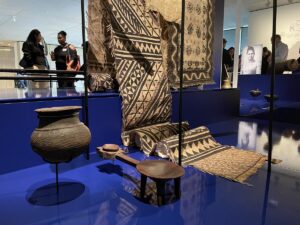
A very fine tiputa, Tahitian barkcloth poncho, made in Tahiti, possibly in the late 1700s or early 1800s is also on display. It is a prestigious gift made by elite practitioners intended to impart mana and to foster good relations. While its construction is the same as those made and worn in Tupaia’s time, the decoration and use of new motifs reflects the changes that are already occurring to traditional practices as the makers were inspired by the foreign cloths exchanged with visiting Europeans. Fern fronds are used as a relief image to create detailed, high resolution and technically challenging decorations from nature.
An aural backdrop of tales spoken by compatriots and direct descendants predominantly in the languages of these early Pacific visitors further enhances the environment and provides an additional cultural richness to the experience of exchange and exploration.
Many of the early tourists to Sydney highlighted in this exhibition came from a noble or chiefly background. The objects displayed to highlight their stories refreshingly cover a wide range of material culture, not just the spears, shields and other objects related to men’s roles.


An early royal visitor to Sydney was King George Tupou I from the Kingdom of Tonga, who attended with a Methodist delegation in 1853. The exhibition includes a very ornate English wooden writing desk used by the King during this period as well as a copy of The Laws of the Kingdoms of Tonga, Haabai and Vavau and a ngatu (barkcloth) that, while made more recently before 1980, is stencilled with the symbols of the Tongan nation that come from King George Tupou I, including the sila o’Tonga – the coat of arms, the Hala Paini, the trees that stand near the palace, the lion which symbolises the British-Tongan relationship, the dove depicting peace, unity and Christianity and the three dots representing the unified Kingdoms of Tonga – Tongatapu, Ha’apai and Vava’u – achieved by King George Tupou I.
Samoan Phebe Parkinson is the only woman in the exhibition. She was 18 when she married and left Samoa to join her sister, Emma Coe at Mioko Island in the Bismarck Archipelago. Emma and Phebe were the daughters of American Jonas Coe and Samoan Le’utu Talerale of the chieflv Malietoa family. Phebe and her husband Richard Parkinson, who was of German origin, and Emma and her companion Thomas Farrell were to play critical roles as traders and collectors, fielding thousands of artefacts to museums and private collectors. In 1882 Phebe travelled to Sydney on a holiday where she found the customs and clothing uncomfortable, having to wear gloves and corsets. Soon after she returned from Sydney, they all moved to Ralum in East New Britain where she worked with the makers of the objects that her sister Emma’s business would sell to the Australian Museum and elsewhere. While Phebe and her family procured many objects related to male roles, the objects in the exhibition reflect how Phebe became close to the cultural lives of Gunantuna (Tolai people), learning the language. In particular, the Gunantuna surgical equipment on display was gifted by Phebe to a visiting doctor from the University of Sydney.
Māori chief Hongi Hika (Ngāpuhi) first visited Port Jackson in 1814 as a guest of the Anglican Reverend Kendell before travelling for an extended stay in England where he met King George IV and returned with guns, power and shot. On display as part of his story, is the self-portrait bust carved by Hongi Hika in Sydney. Hongi Hika’s story has been told in Volume 25 Issue 1 and updated in Volume 27 Issue 3 of this Journal.

Another early tourist to Sydney from an island that was to become part of the nation of Papua New Guinea was GarryGarry, the young son of a Kove chief in West New Britain. He arrived in 1836 after travelling with Captain Morrell, whose whaling ship’s crew had been living with Dako and had learnt the Vitu Islanders’ trade language also spoken by the Kove. Encouraged by the Dako, the chief “Lewie” sent GarryGarry to Sydney to gain intelligence about the Europeans. Over his three week stay he went to the theatre and saw the sights of Sydney but was reported to be most admiring of things related to foods like the fish market, wheelbarrows, a butcher and the coins they used for trade. The objects on show to accompany this story reflect the expeditions of Ancestors travelling for trade, fishing, shell collecting and for staple foods. Cloth, pearl shells, shell wealth, a paddle, club, shield, machete blade and a trumpet made from a triton shell are all on display.

Chief Bwarhat from Yengen or Hienghene, New Caledonia, visited Sydney in 1848 at the invitation of trader Robert Towns. Bwarhat returned home with horses and saddles, guns and ammunition, coats and other clothes, which he shared with his people.
Great chief or Vunivalu of Bau Island in Fiji, Ratu Seru Epenisa Cakobau, visited in 1874 with his two sons and stayed at Government House. Converting to Christianity, he achieved international fame as a warrior, leader and diplomat.
In a contrasting story, Puwal was one of eight young men from Muyua or Woodlark Island in Papua New Guinea who were taken to Sydney in 1851 by the Abbé Montrouzier, a Marist missionary. He was on a trade ship called Gazelle that was shipwrecked at Muyua and he became isolated from his people reporting that the Woodlark Islanders attacked and killed almost all of the survivors. He returned to Sydney, was baptised and took the name Giovani, continuing his mission life abroad and never returning home.
Reclaiming the stories of eight of the many Pacific Islander visitors to Sydney during colonial times, Tidal Kin sheds light on Sydney as a significant Pacific port with the great Ocean witnessing competing quests for power, from commerce to Christianity. This exhibition reminds us of the continuing dialogue and exchange at a human level between Pacific peoples and Australia.
