
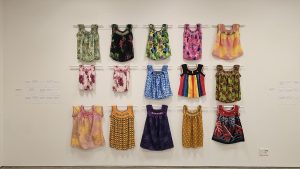
Bottle Creek Gallery, Pātaka art + Museum, Porirua, Aotearoa New Zealand, 7 October – 11 November 2023. Catalogue published by Te Rabakau Press, 2023.
Review by Jacki Leota-Mua, Pātaka Curator Māori/Moana
I-Kiribati heritage artists and master weavers Kaetaeta Watson (Tabiteuea Island) and Louisa Humphry MNZM (Kuria Island) have lived in Aotearoa New Zealand for the best part of 50 years. Together with the Lagi-Maama Academy and Consultancy Toluma‘nave Barbara Makuati-Afitu, Kolokesa Uafā Māhina-Tuai MNZM and Hikule’o Fe‘aomoeako Melaia Māhina, this team has co-curated a ground-breaking exhibition that recognizes the significance of tibuta for I-Kiribati communities in Aotearoa.
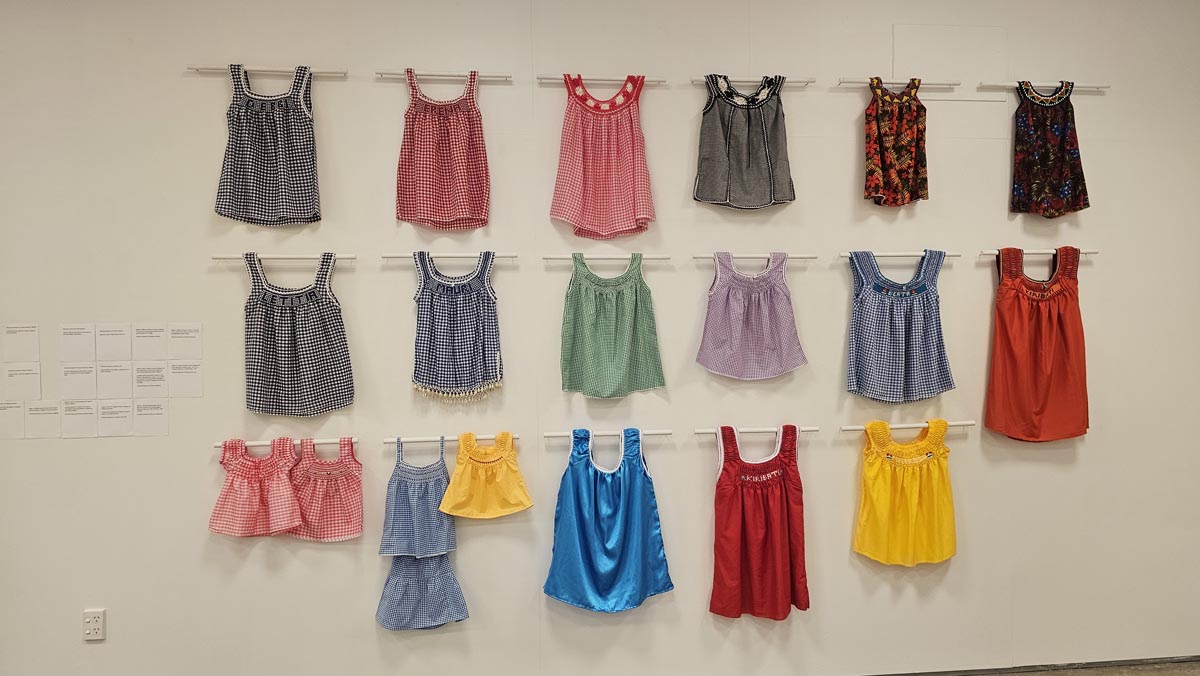
Tibuta (pronounced si-bu-ta) are richly embroidered tops with hand and board smocking stitches emblematic of I-Kiribati women. Resources are scarce on tibuta by I-Kiribati for I-Kiribati, with the exhibition an opportunity for their communities to learn more about the ‘significance as Kiribati’s national tops that are worn by women, as markers of identity and pride as I-Kiribati living in the diaspora.’ (Lagi Maama, 2023:11) This collection has been sourced from Tāmaki Makaurau Auckland, Pārāwai Thames, Waikato, Whiritoa, Te Puke, Tauranga, Porirua, and from the beloved homeland of Kiribati.
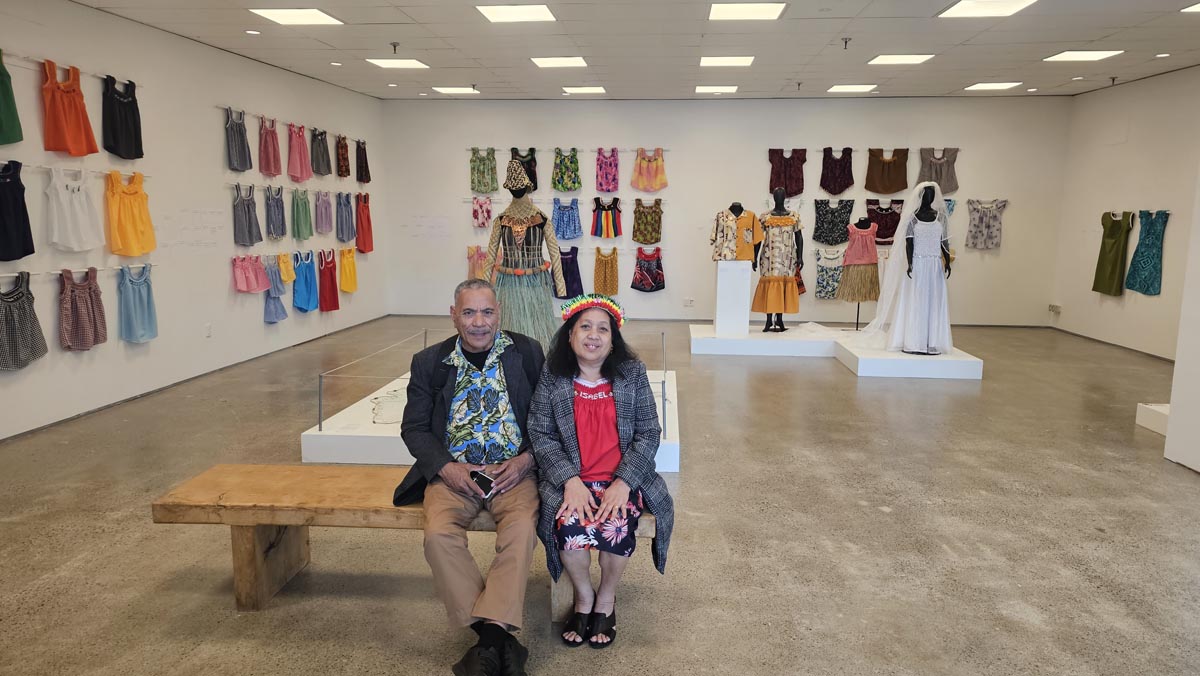
Using te maroro / talanoa methodologies, this collaborative model asserts te utuu family and te kaainga extended family participation using te karinerine respect, particularly through te katei customary practices passed on to new generations. Building capacity for the future, these values could be seen in action at every step of the way providing a clear model for the rest of the museum world, including myself, to follow.
Mana is a foundational touchstone. A spirit and quiet dignity underpin the collaboration. Its essence emanates, I believe, from Otintaai. Otintaai is a female climate change warrior, inspired by te otanga Kiribati male armour. Her top is tibuta-inspired and woven with harakeke flax. She has protective arm, neck, and helmet elements all made from flax, and a breastplate made by Kaetaeta’s husband John Watson out of recycled copper, a piece resurrected from the Watson family home and the old water heater. Inspired by their te taeriri and te ririni buki dance skirts and belts, the processed flax skirt with a recycled fishing net placed on top covers her lower body, and the belt was made by Jack Humphry from recycled wood and plastic floats. Otintaai stands with the rising sea, woven from blue-dyed flax, encircling her ankles.
Otintaai follows a trajectory of spirit ancestors, often female, that have wisdom and power. In Tungaru the language of Kiribati, Nei means “Ms” and are identifiers for women. Like Nei Mangani-buka who taught the art of long-distance canoe navigation, or Nei Nimanoa the voyager from whom we know the navigating stars. Or Paintapu a heroic I-Kiribati woman navigator and chieftainess who led a great war fleet (Lewis 1977 cited in De Ishtar 1994).
Otintaai means sunrise. If a sunrise could be personified during an era of rising seas and climate-related disasters, I believe Kaetaeta and Louisa have done it. Otintaai stands resolute in the gallery space, surrounded on every wall by tibuta. They are the symbol of womanhood, suspended on trimmed, standard-issue broomstick mounts. Otintaai and her unarmed force are there for a peaceful existence. Resisting the trope of victimhood and anonymity, all her women, including children are named, remembered, and celebrated, threading the island/s, the nation, the flag, the sea, shells, and teeth together. This exhibition has teeth. Onotoa, an island whose women still represent te wii ni bakoa design motifs in honour of the shark, is illustrated by repeating triangular-shaped motif borders on tibuta sleeves and necklines. There is a total of 74 tibuta, including mauri wear tibuta style frocks, and one wedding dress with a tibuta inspired bodice. An easy reference to the 75 I-Kiribati who are granted permanent residence through a ballot-based scheme every year, under NZ Immigration’s Pacific Access Category.
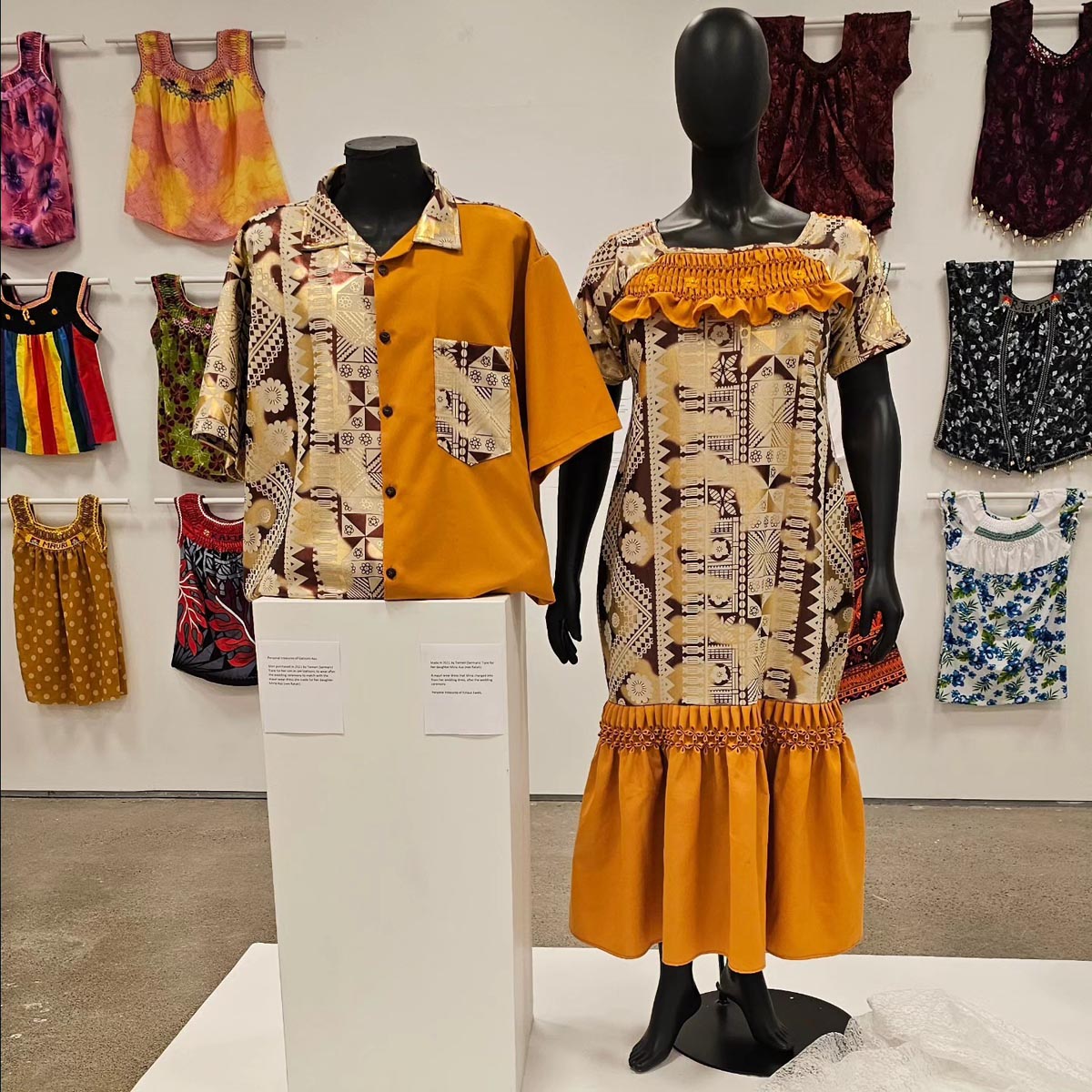
This exhibition documents innovation from the 1960s to the present day. Of particular interest are tibuta-styled mauri wear formal dresses, as illustrated in the two-piece formal mauri wear gifted by the Kiribati First Lady, Madame Teiraeng Maamau, to be included in the exhibition. It was made by Rereiti Garments and featured the distinctive Te Were style, where the adapted neckline and shoulder edges were reminiscent of the giant bivalve mollusk clam with the same name (Tridacna maxima). Madame Teiraeng is a champion of tibuta and tibuta-inspired formal wear as I-Kiribati women’s national wear. The exhibition also honors the creativity and innovation of tibuta makers and features works by Kiribati-based Nei Tereaua Temoku and Auckland-based Nei Tiemeri (Sermary) Tiare. Smocking boards known in Kiribati as te kai n dot are made from perspex, the one in the exhibition, from Sermary’s collection was made by prisoners in Tarawa. Sermary was kind enough to also include six component tibutaparts to illustrate, step by step, the process for our audience to learn from.
Sermary was also integral to the fashion parade finale for closing festivities. The involvement of the local Porirua-based Maneaban Te I-Tungaru Kiribati community, from the very young to the elderly continued the cross-pollination of stories, with Nei Rareti Ataniberu at the front as master of ceremony, guided by the cultural knowledge and expertise of Mwemwetaake Ataniberu, and Denise Kuraem Ratieta, Sailosa Tuen Iotia and Tiiki Kabiriera navigating from the helm.
I had never worn a tibuta before. An admirer of the smocking and embroidery stitchings, so when one of the leaders of the Kiribati community group in Porirua gifted me one, I haven’t stopped wearing it. For its sheer comfort, short sleeves, and intricate smocking, gathering folds around the neckline, accentuates the feminine. Tibuta are a social fabric. In other places in the Pacific, missionary wives introduced the mother Hubbard dresses, and wherever you go, there are local adaptations, but not as revolutionary as the Kiribati tibuta.
If climate change is the greatest threat to the livelihoods, well-being, and security of I-Kiribati people, women remain hopeful, resourceful, and mobile. Threaded by love, standing on the promise each new morning brings. Suitcase ready. And if an exhibition could be packed into one 23kg suitcase, this is the one.


References
● De Ishtar, Zohl (1994) Daughters of the Pacific. Spinifex Press
● George, Marianne “Mimi” (2021) Ancestral Voyaging Knowledge in Oceania – II Pacific Women’s Knowledge. UNESCO publication accessed online https://en.unesco.org/sites/default/files/links_avk_paper1_women_2021.pdf
● Grimble, Arthur (1983) A Pattern of Islands. Penguin Books Accessed Tidal Pools: Digitized texts from Oceania for Samoan and Pacific Studies Accessed online https://nzetc.victoria.ac.nz/tm/scholarly/tei-GriPatt-t1-body1-d9.html
● Hawkins, Koroi (2021) ‘Otintaai – Kiribati warrior armour bears message of hope’ RNZ Pacific. Accessed online https://www.rnz.co.nz/international/pacific-news/441593/otintaai-kiribati-warrior-armour-bears-message-of-hope
● Te Rabakau Press (2023) Tibuta – Kinaakiia Ainen Kiribati. Tibuta Identifies Kiribati Women. Publication produced on the occasion of the exhibition 7Oct-11Nov 2024, Pātaka Art+Museum, Porirua, New Zealand
● Watson, Kaetaeta (2022) ‘People and Blessings’ Pantograph-punch. Accessed online https://www.pantograph-punch.com/posts/people-and-blessings
● World Craft Council Australia (2023) ‘Craft masters from the South Pacific’ Accessed online https://wccaustralia.org.au/craft-masters-from-the-south-pacific-2023/
● Yate, Rachel. (2021) ‘Otintaai: The Rising Sun and the I-Kiribati Climate Change Warrior. Te Papa Blog Accessed online https://blog.tepapa.govt.nz/2021/07/13/otintaai-the-rising-sun-and-the-i-kiribati-climate-change-warrior/
● Yates, Olivia E.T., Groot, Shiloh, Manuela, Sam & Neef Andreas (2022) “There is so much more to those sinking islands!” Restorying migration from Kiribati and Tuvalu to Aotearoa New Zealand. Journal of Community Psychology 51(3):924-944. Accessed online https://onlinelibrary.wiley.com/doi/full/10.1002/jcop.22928