
2023, 222 pages, by Ross Bowden, published by Sean Kingston Publishing, Canon Pyon, Herefordshire, UK.
Review by Barry Craig
Vol. 28,4 of the OAS Journal featured a review by Bill Rathmell of Bowden’s 2022 book, Art and Creativity in a New Guinea Society. Close on the heels of that book on Kwoma creativity is this account of history and warfare of the Yalaku, eastern neighbours of the Kwoma.
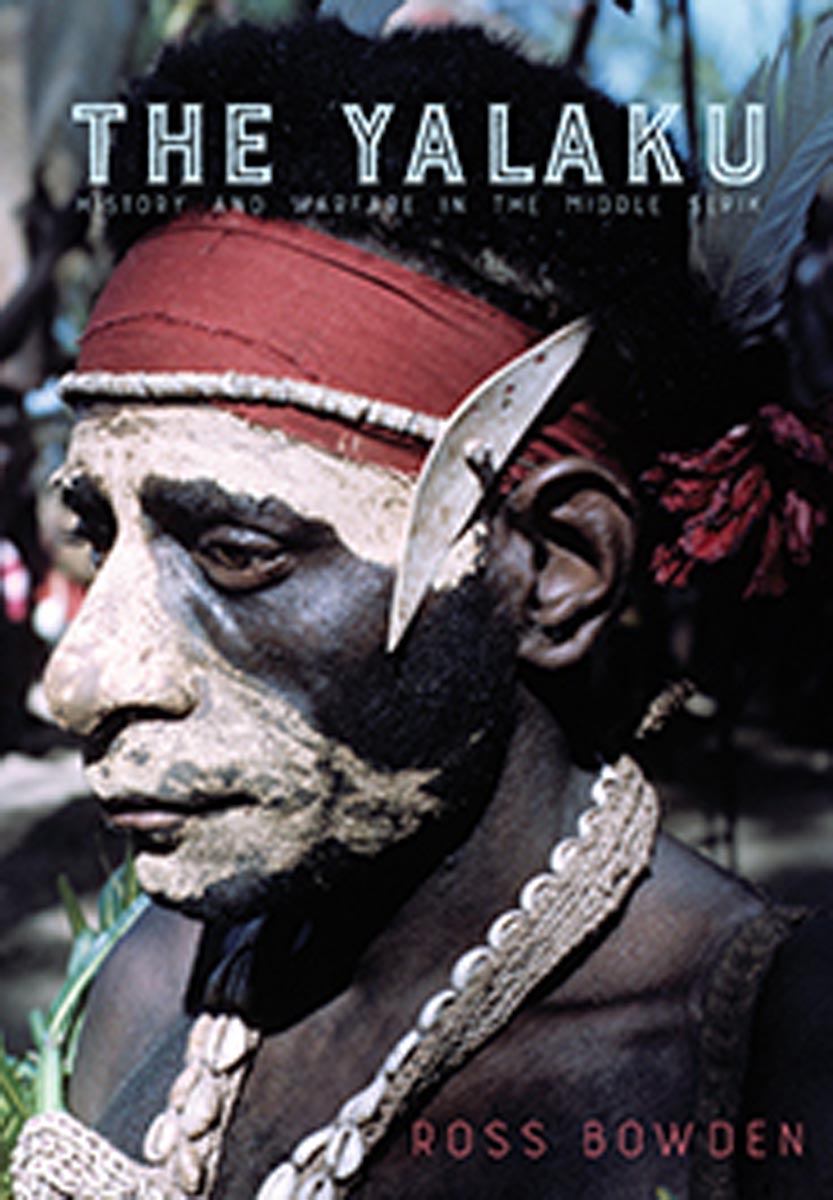
The Yalaku are one of three communities – the Motek and Nowiniyen are the other two – that speak Kaunga, a language more closely related to those of the Iatmul and Abelam than to that of the Kwoma. Nevertheless, as becomes apparent in this book, many Yalaku individuals were able to converse in multiple languages, including Kwoma, and Manambu, the language of their Sepik neighbours at Avatip. This multi-linguistic ability primarily arises from intermarriage, trade relationships and political alliances, all of which feature prominently in the historical accounts provided to Bowden by his principle Yalaku informant, Ayam, with assistance from Kiriyas and other men. Indeed, the book is their book, made accessible to the outside world by Bowden’s skills as documenter and translator.
In his familiar non-nonsense, plain English style (no mention of ‘agency’, ‘gender politics’ or other concepts currently in use among anthropologists), Bowden sets the scene of highly mobile settlements in a largely swampy terrain, constantly at odds with neighbouring communities, even with the Kaunga-speaking Motek and Nowiniyen. Conflict was primarily sparked by competition for resources, such as access to tracts of sago palms, but occasionally over men’s illicit affairs with women and accusations of sorcery (see the ‘sorcery pot’, Fig.3.2). As a consequence of the threat of attack, communities built settlements enclosed by strong palisades surrounded by dense growths of thorny rattan, although the people spent considerable time in scattered bush huts processing sago, hunting and gathering.
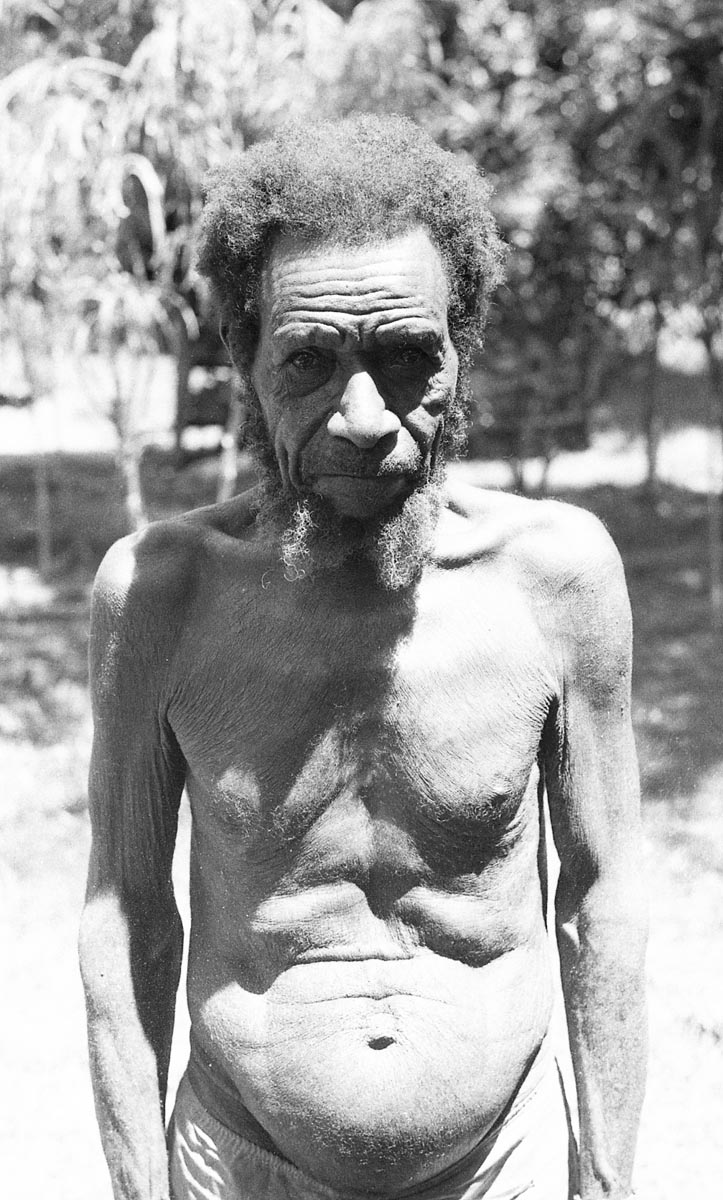
After describing the composition of Yelogu village – family houses inhabited by members of several clans clustered around a men’s house – Bowden presents the histories of the Yalaku clans as recounted by Ayam and other Yalaku men. ‘Each clan traces descent by an unbroken chain of patrilineal ties from a named founding ancestor…. A clan’s human founder (kwul) is thought to be the son or son’s son, of a named anthropomorphic spirit (wari)’ (p.27). The clan histories recounted over pp.29 to 40 constitute the foundation history of the Yalaku.
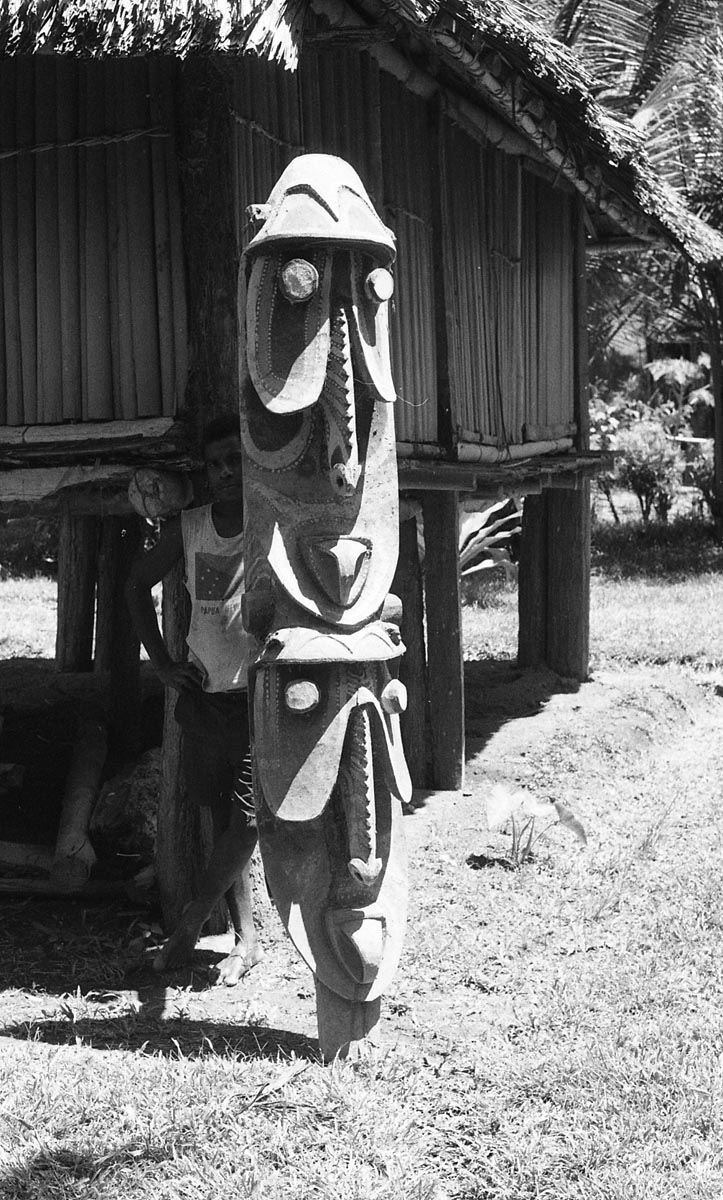
Men’s houses are mentioned throughout this history but almost nothing is known of the carvings or, presumably, paintings which they may have contained, or of the rituals associated with them. One possible example of a Kaunga carving seems to have survived into the 1980s – a carving based on a Masakiina example seen at Ambuken/Motek by the Melawei (Kwoma) carver Kwanggi and attached to a side post of a Bangwis (Kwoma) men’s house (Fig. 1.8). The Masakiina were an immigrant group from the north within the Ambuken/Motek community. Serendipitously, while visiting Bowden in January 1973, I photographed a carving by a Melawei man I recorded as Gwan-gi (=Kwanggi), carved for sale five years previously, which is obviously in the same Masakiina style.
The short chapter on marriage is important for understanding the longer and detailed chapters on warfare. Clans are exogamous; ‘Every Yalaku marriage establishes an obligatory exchange relationship, and wider political alliance, between the wife’s brother (the wife-giver) and her husband (the wife-taker), an exchange relationship that implicates their two clans as wholes’ (p.41). Thus brothers-in-law ‘are also political allies [and] secretly informed each other of impending attacks on their respective settlements’. In addition to these links, totemic divisions ‘link clans within and between tribes on the basis of shared totems’; trade partnerships and friendships also were relevant in situations of conflict. These factors explain why a war party did not always consider all members of a settlement as legitimate targets of an attack.
OAS readers who may be tempted to skip the chapter on marriage as peripheral to their interests would miss the crucial information about marriage rules and the use of garamuts (slit-gongs) as instruments for communication (look for it!).
A twelve-page introduction to the long accounts of warfare are a necessary background of information to appreciate those accounts. It is significant that only men who have killed an enemy have the right to cultivate yams and that leading warriors were typically ritual leaders and often the most prominent painters and carvers. Peace pacts could be established by an exchange of ritual objects, ‘such as sculptures or flutes associated with clan spirits (see Figures 5.4 and 5.5)’.
Chapters 6 to 10 report Ayam’s account of around 150 years of warfare involving the Yalaku. So far as I’m aware, not since Richard Thurnwald’s account (1934) of the adventures of the Tjimundo of the lower Sepik, recorded by him in 1913 and 1915, have such a series of detailed, blow-by-blow accounts of warfare among Sepik peoples been published. These accounts are not just interesting from the point of view of the use of weapons and the mortality involved, but also record the intricacies of marriage, trade and political links activated by conflict and the constant relocation of settlements in attempts to avoid conflict and facilitate assistance from allies if attacked — the amount of labour involved in repeatedly constructing new settlements and palisades with the use of stone tools must have been immense. Particularly valuable as examples of intangible cultural heritage are the sung laments associated with various battles. As Thurnwald put it: ‘ … it is by these very details that we are afforded the particular colour of life’ and, one might add, of death.
A chapter on the cessation of warfare and contact with the Australian administration follows, then a section on myths.
OAS members are of course primarily concerned with the ‘arts’ of Oceania but to fully appreciate the carvings, paintings and other tangible aspects of the cultures of people such as the Yalaku, knowledge of the exigencies of daily life are necessary. Bowden provides this by presenting Ayam’s and Kiriyas’s accounts in detail. ‘With their deaths, the Yalaku lost the last two masters of their oral traditions’.
Thurnwald, R. 1934. Adventures of a Tribe in New Guinea (the Tjimundo). In E. Evans- Pritchard, R. Firth, B. Malinowski and I. Shapera (Eds), Essays presented to C.G. Seligman. London: Kegan Paul, Trench, Trubner & Co.; pp.345-360.