
Museum of Contemporary Art, Sydney, 31 March – 9 July 2023
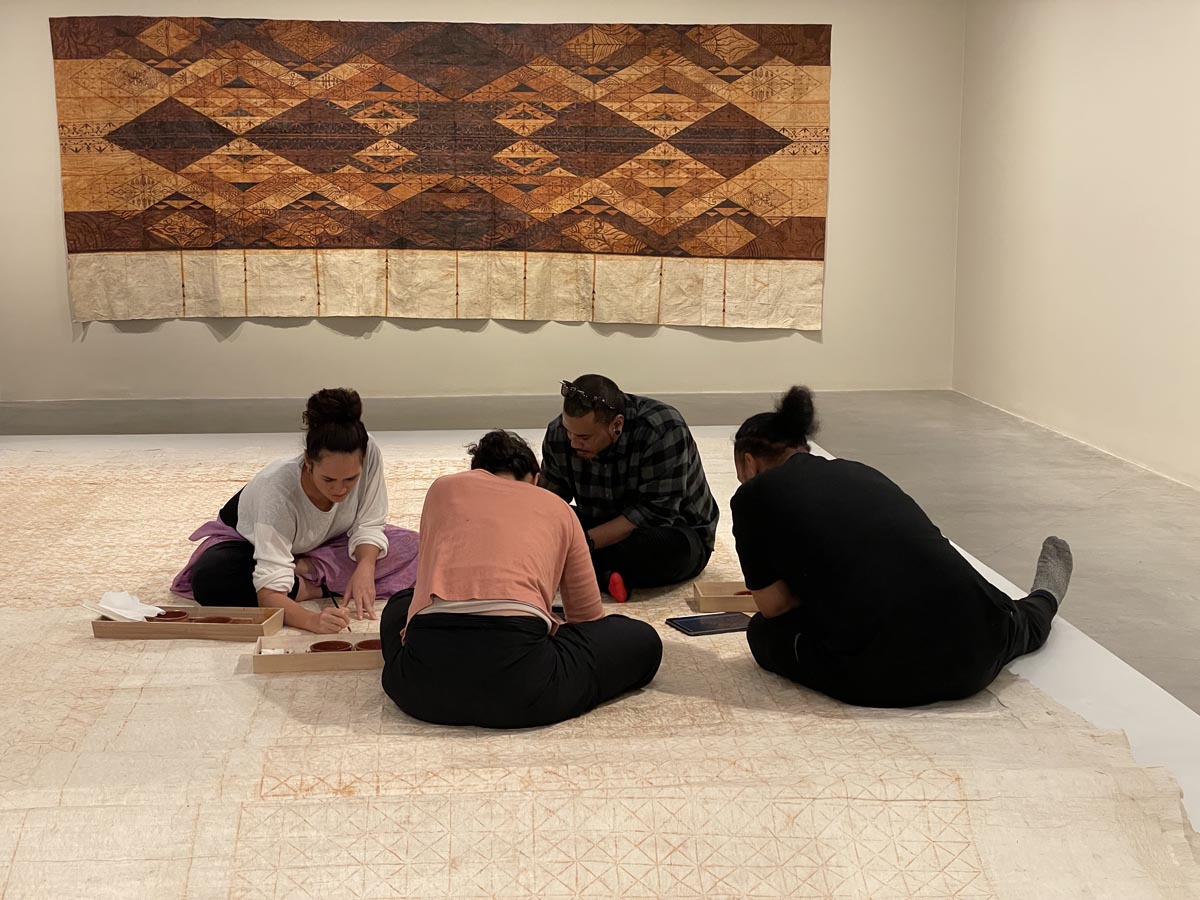
Image caption: Ivi, Kato Kakala (detail), 2022–23. Installation view, The National 4: Australian Art Now, Museum of Contemporary Art Australia, Sydney, 2023. ngatu (barkcloth); single-channel video, HD, colour. Image courtesy and © the artists. photograph: Anna Kučera.
Review by Margaret Cassidy
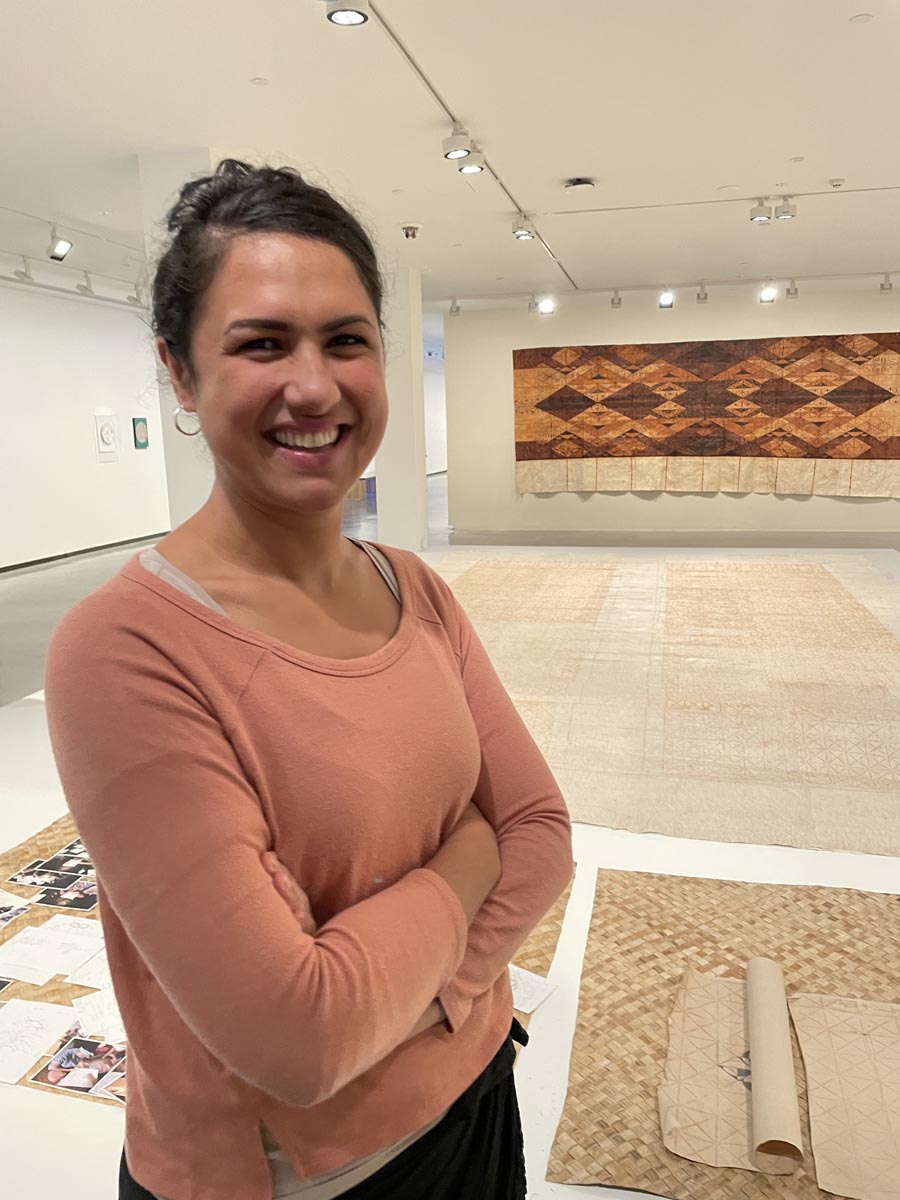
Kato Kakala (woven basket of fragrant blossoms) is a snapshot into the current work of the Ivi Collective, a group of artists of Tongan and Persian ancestry living and working in Logan City in Queensland. If a visitor to this installation is as fortunate as I was on my second visit to fully explore this artwork, members of this artists’ collective will be sitting on the raised platform in the Museum of Contemporary Art painting small shapes and lines onto a massive ngatu or bark cloth that is not completely unfurled. On this particular Saturday members of the Ivi Collective, sisters Ruha and Minaira Fifita were joined in their meticulous and detailed painting by two young artists visiting from Tonga.
Led by artists Ruha Fifita, Minaira Fifita and Sheida Vazirzadeh from the Ivi Collective, the Kato Kakala project (2022–23) is a series of ngatumade in collaboration with communities from Australia, Aotearoa, Hawai’i, Tonga and Fiji. The members of the Collective have worked together on creative, socially-engaged projects in Australia for over ten years. De-emphasising the individual artist, the focus with the creation of this ngatu is on the collective and reminds audiences of what can be made when people come together.
Ruha Fafita explained that presenting the process of creating this ngatu and involving particularly members of the Tongan diaspora from Western Sydney in contributing to the pattern making and pattern painting in workshops is a key objective of this artwork. Encouraging their fellow members of the diaspora to learn more about their culture and learn the skills involved in ngatu making and painting will assist in culture preservation for younger generations growing up away from their country.
The enormity of this project is reflected in the grid created by the very large number of faintly marked out tiny squares that need to be embellished with the lines and shading of amber and golden hues as the complexity of the patterns progress through sequences of two by two to three by three and on to four by four repeated patterns. At the end of the raised plinth are two woven mats covered in the reference photographs that have inspired the pattern-making, working drawings and marked up squares on large sheets of brown paper that have the evolving sequences of repeating patterns.
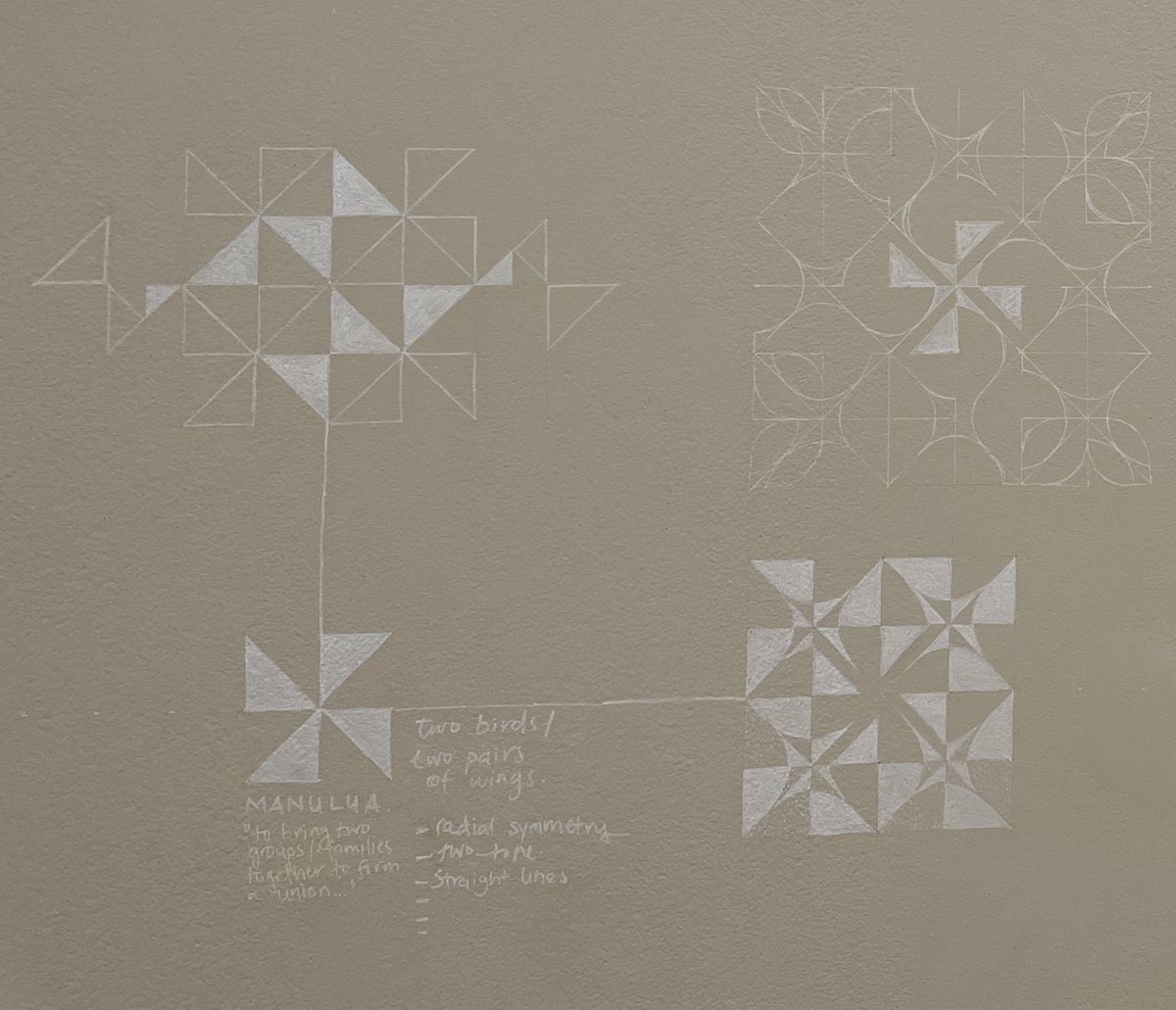
Projected onto one wall is a series of handwritten notes and drawings explaining the philosophy behind the series of works, the origins of the ngatu and all its makers, as well as the meanings behind the evolution of the kupesi (design or motif) that forms the intricate patterns; it all starts with two birds and two pairs of wings.
Producing a single ngatu as a collective involves a process of making and reflection during which relationships between the collective and the communities of makers are strengthened. As a result, while the MCA initially offered to commission the creation of the ngatu as an acquisition to their collection, the Ivi Collective have retained ownership in the resulting piece so that when it is completed it can be used by the involved communities for ceremonies, community gatherings and as a resource for extending the conversation to others.
At the far end of the studio space hanging on the wall is a completed ngatu in this series. This ngatu is a much darker rich reddish-brown in colour and intensely detailed but with at times a free flowing series of dark curved lines moving across and sometimes filling diamond and triangular shapes. The shades of brown move from light ochres to deep reddish-blacks, the result of applying many different layers of paint and using a special Tongan way of catching black smoke with coconut cream from tuitui (candle nut) to create black shades on the bark.
Using natural dyes on ngatu is a “heirloom” technique passed on by members of Ruha and Minaira Fifita’s extended family. In Tonga, the art of working on ngatu, a cloth traditionally made from bark which has been soaked and beaten flat, is a cultural heritage passed down from one generation to the other. It is also an art created by a team as the art of making and working on ngatu is a community affair, the materials used in the work being touched and worked on by many hands. It is a traditional practice that continues to have relevance and meaning for today.
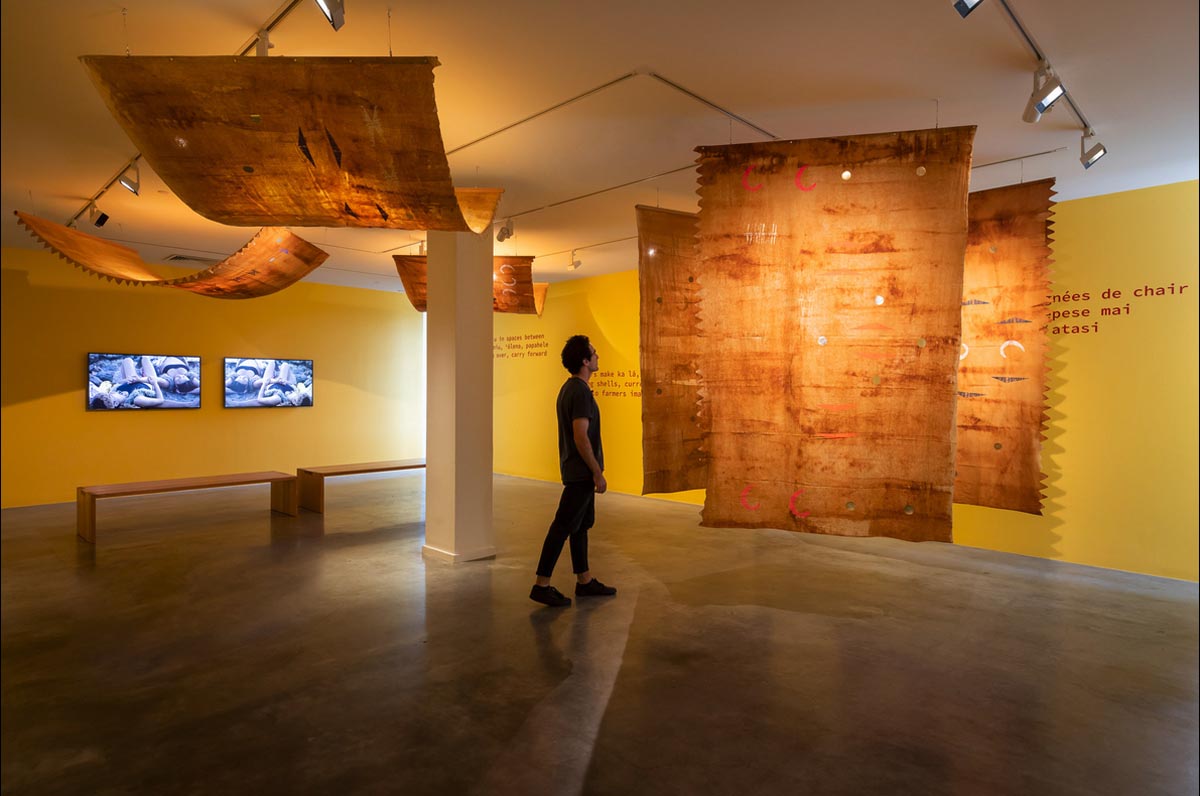
Asserting the continuity of Indigenous cultural memory is the use of imagery from Samoan barkcloth dating from 18th century and 19th century photographs currently held in French, British, German and Australian colonial collections in afiafi, the installation made by Léuli Eshrāghi, currently both a practising artist and also curator. The installation is dominated by ‘ie (sarongs) hanging from the ceiling that have been made with iron powder colouring and using screenprinting and metallic foils and feature hand-drawn motifs. The designs are based on motifs of Indigenous intellectual and cultural property shared across Tonga, Fiji, and Sāmoa.
Eshrāghi’s multilingual approach is to the fore with poems written in Sāmoan, English and French projected onto walls in a range of tropical fruit colours. The poems, collectively titled Lumanaʻiga a motu (Island Traditions) (2022–ongoing), solemnly voice Eshrāghi’s experiences and aspirations as a non-binary/faʻafafine person of Sāmoan, Persian, and Cantonese ancestry, addressing genealogy, sexuality, loss, and the future,
pu’u in spaces between
wai niu, ‘ōlena, papahele
turn over, carry forward
The accompanying five and a half minute video records Eshrāghi and collaborators in ceremony in the dark, bringing present, real-time activation to the embodied ritual of Indigenous storytelling. The video performance reflects the meaning of afiafi, ‘day’, ‘afternoon’ and ‘fire’ in Sāmoan; the group of young Pacifica, dressed in malo (loincloths) made of metallic emergency blankets, belts and jockstraps and adorned with grey-green garlands of tillandsia usneoides (a bromeliad also known as Old Man’s Beard or Spanish Moss and nowadays regarded as something of a weed in Australia) move between scenes of arrival and greeting and receiving on the shoreline through to connecting, feasting, revelling and sweating in the highland forests. This is a vision of a tropical futurist time filled with sensuality, pleasure, sexuality and spirituality in symbiosis with nature, deities, and kin animals.
Eshrāghi is providing a work that can be accessed on many levels, from the sheer golden tones and sense of joy standing in the midst of the installation, through bearing witness to a tropical futurist time and finally presenting, in his own words, “expressions of my Sāmoan faʻafafinegender, queer sexuality, and defence of worlds independent of Christian colonialisms, enforced heteropatriarchies, carceral capitalisms, and illiteracies in Indigenous histories”.
Léuli Eshrāghi’s ‘afiafi‘ is the fourth work in the ‘Siapo viliata o le atumotu’ series (2020–ongoing). It is complex and requires reading and reflection to fully engage, as befits the work of someone who holds a PhD in Curatorial Practice from Monash University and is a Curatorial Researcher at University of Queensland Art Museum, currently Curator of the 8th edition of TarraWarra Biennial and ua usiusi faʻavaʻasavili at TarraWarra Museum of Art.
Other Pacific connected contributions in The National 4: Australian Art Now include Christopher Bassi (of Meriam, Yupungathi, and British descent) and Fijian–Australian artist Shivanjani Lal which are both exhibited at Campbelltown Art Gallery. Works by Zenadth Kes (Torres Strait Islands) artist Glen Mackie (Kei Kalak) are at the Art Gallery of NSW and Teho Ropeyarn’s art is exhibited at Carriageworks. I’ve yet to see these.