by Adrian Newstead
Have you ever wondered how it is that Aboriginal art became an international phenomenon with pieces selling for thousands, even hundreds of thousands of dollars, while indigenous art from other countries in the Pacific, South America and elsewhere is still sold in souvenir shops, or as trinkets by the roadside? Why for instance, does a beautiful design painted on hand made cloth by Amazonian Indians in Brazil sell for one hundred Australian dollars, while an almost identical design by Ronnie Tjampitjinpa in acrylic paint on canvas sells for ten to twenty thousand?
Below is my very potted version of how this occurred.
Aboriginal people arrived in Australia at least 40,000 years ago and by the time Captain Cook arrived in 1770 there were about 750,000 Indigenous people belonging to 250 language groups. Each of these clans/tribes had their own creation stories, mythology, song lines, art, and designs which found stylistic expression on tools, weapons, regalia, body painting, ceremonial grounds, and cave painting.
As Europeans spread and fenced the country the nomadic way of life ended on any land white people wanted. Missionaries spread across the land and Aboriginal people adjusted to a sedentary life resulting in the loss of many traditional cultural practices.
Throughout the 1800s, exploration led to first contact and a treasure trove of pre-contact material and early artefacts were collected as curios which found their way to Europe and into Australian private collections. Many of these were destroyed by fire when the Garden Palace burnt to the ground in Sydney’s Domain in 1882.
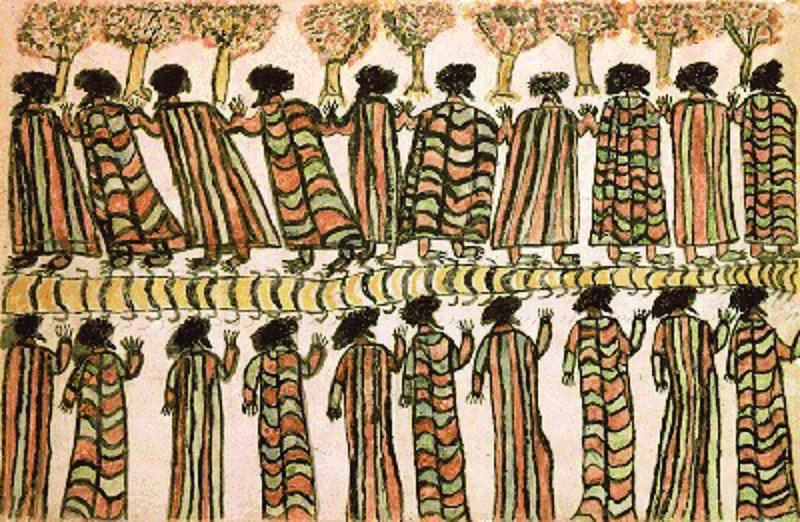
During the colonial period 1880 -1920 there were several early indigenous artists who created works in a European medium (watercolour, figurative drawings etc) including William Barak, Tommy McRae, and Micky of Ulladulla. During the early 1900s the Yorkshire-born polymath, Baldwin Spencer, collected bark paintings in Western Arnhem Land and recorded their myths. In 1911 the legendary buffalo shooter Joe Cooper hosted Spencer on Bathurst and Melville Islands where he collected the first Tiwi artefacts. Later, Spencer and Alice Springs postmaster Frank Gillen recorded ceremonies in Central Australia and witnessed the construction of huge ground paintings.
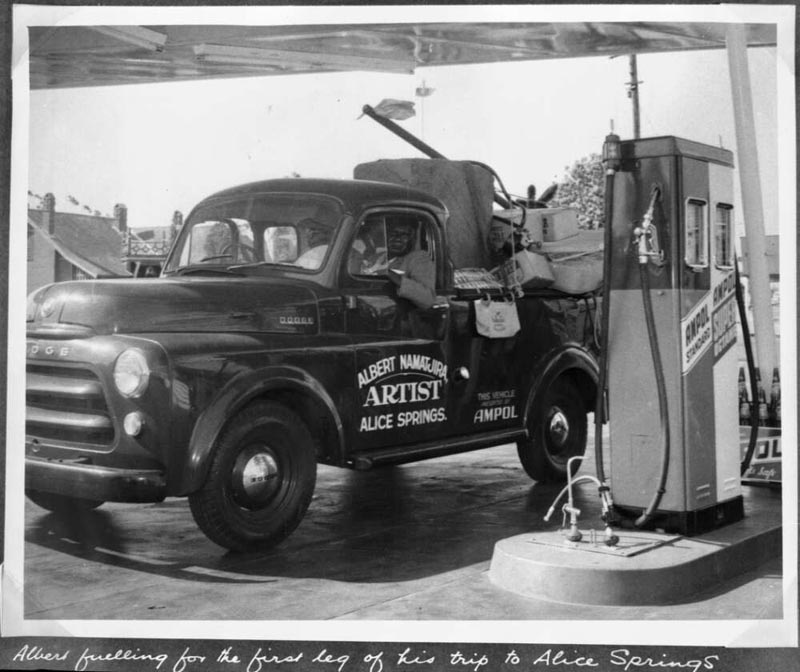
By the mid 1930s, 30-year-old Albert Namatjira had learned the fundamentals of watercolour painting from Rex Battarbee and John Gardner. Soon, his sons, and a breakaway group including Otto Pareroultja and Walter Ebaterinja, had joined the growing Hermannsburg watercolour movement. Meanwhile, missionaries such as Wilbur Chaseling in Oenpelli began commissioning bark paintings in Arnhem Land and sending them to museums and collectors in the south.
Formative influences in the collection of artefacts and bark paintings for study were Prof. Peter Elkin and his students Ronald and Catherine Berndt who met soon after the first seat of Anthropology was established at Sydney University in 1932. They joined the growing number of impassioned amateurs and academics who began collecting in remote regions – amongst them were Charles Mountford, Carl Strehlow and Donald Thompson who gifted most of the material they collected to galleries and museums. In the process Charles Mountford became the first real Aboriginal art collector and art patron.
Like Baldwin Spencer before him, Mountford was a brilliant public speaker. After 15 years in the field, he became the most influential person in the development of the interest and the market for Aboriginal artefacts and art. He spent four years lecturing around the USA and showing movie footage of Aboriginal people and their customs.
This led directly to the 1948 Smithsonian Institution’s American Australian Scientific expedition to Arnhem Land. Two dozen scientists from both countries collected thousands of plant and animal specimens, a thousand or more implements and weapons, hundreds of photographs and drawings of cave paintings, hundreds of barks paintings and string figures, and miles of colour film on Aboriginal life and natural history. This initiated the burgeoning production of material culture. Mountford went on to document art further afield – in Yuendumu and the Tiwi Islands – and gifted much of the material he and his companions collected to State and National institutions.
Throughout the 1940s the Berndts collected bark paintings and other items of material culture and, in 1949, they organised the first known exhibition of bark paintings in Sydney. From that time onward bark paintings and artefacts were sold regularly to collectors in the USA and London. The 1950s saw large numbers of desert nomads brought in by welfare patrols and settled in Papunya, Haasts Bluff and other mission stations and ration depots. These became what we refer to today as remote Aboriginal townships and settlements.
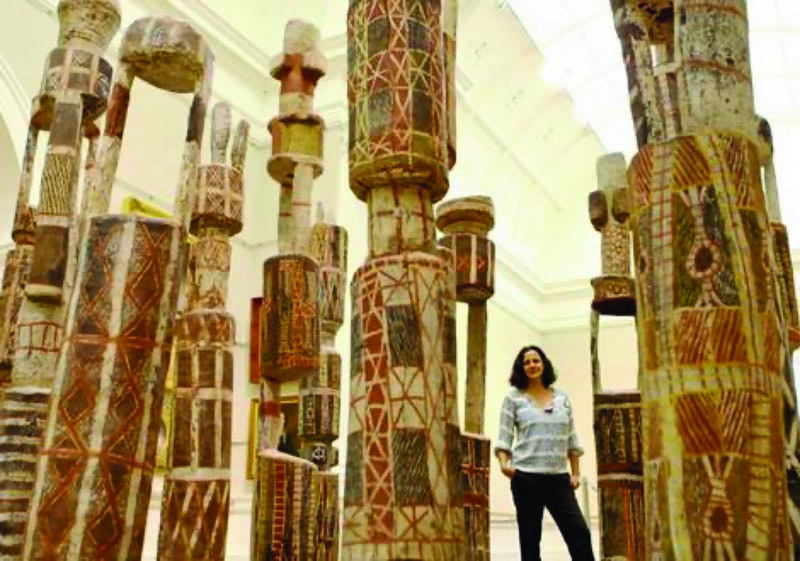
By the 1960s a craft warehouse had opened on Melville Island. Art marketing began at Oenpelli in Western Arnhem Land and the collector/dealer Jim Davidson opened the first Aboriginal and Oceanic Tribal Art Gallery in Melbourne. On a trip to the Tiwi Islands Dr Stuart Scougal, the artist Tony Tuckson and his wife Margaret commissioned a magnificent collection of Tiwi burial poles and the Director of the AGNSW, Hal Massingham, installed these at the entrance of the Art Gallery of New South Wales. Scougal’s young female secretary Dorothy Bennett, who accompanied the party, went on to become a major conduit of important works to institutions and private collectors throughout Australia over the following 30 years. Due to these and other developments during the 1960s, a dynamic marketplace developed with total Aboriginal art sales growing to be worth $900,000.
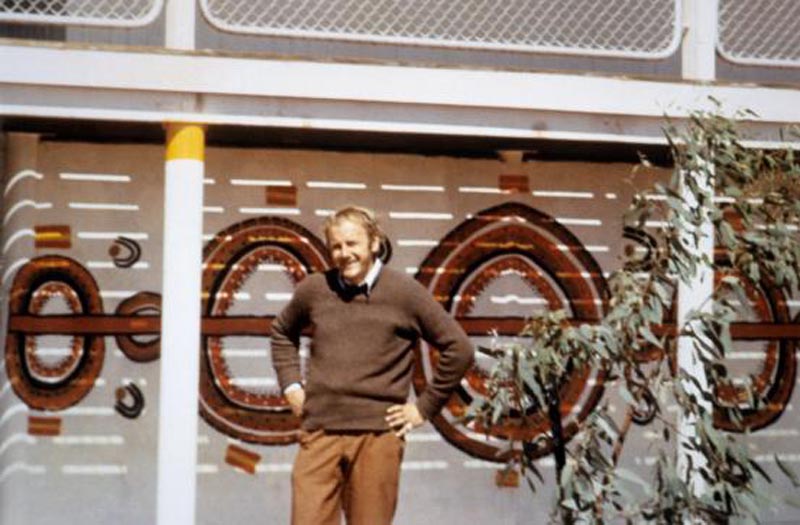
The confluence of several factors turbo charged the emerging art movement at the beginning of the 1970s. The election of the Whitlam government saw the establishment of the Australia Council for the Arts and Bob Edwards (formerly the Director of the South Australian Museum) was installed as the chair of its founding Aboriginal Arts Board. Important influences within government circles, H C ‘Nugget’ Coombs and the anthropologist William H Stanner were prime advocates of the homelands movement that saw Pintupi and other tribal people move back to their clan lands in the Western Desert and the establishment of new settlements such as Kintore and Kiwirrkurra. Though Western Desert art had been drawn onto butchers paper and other mediums during the 1960s it was not until the beginning of the 1970s, when Geoffrey Bardon initiated a mural that was painted onto the school wall in Papunya, that the Western Desert art movement is said to have begun. This period saw the establishment of Papunya Tula Artists. Soon after, founding artist Kaapa Tjampitjinpa became the first Aboriginal artist to win the coveted Alice Springs Art Prize. The early 1990s also saw the Aboriginal Development Commission fund the art craft wholesale and retail distribution company Aboriginal Arts Australia, which had opened galleries in most Australian capital cities by the mid to late 1970s.
By 1975 the first urban artists began emerging from art schools and art collectives, and just as the Pintupi homelands movement gained pace at the start of the 1980s, the first art boards were painted in the Kimberley region of WA, and the first Aboriginal artists were invited to participate in the Sydney Biennale. This period marked the emergence of the first privately owned exhibiting Aboriginal art galleries, such as the Hogarth Gallery and Cooee Art in Sydney’s Paddington arts precinct. Cooee Gallery, established in 1981 is today, 40 years later, the oldest Indigenous exhibiting gallery still operating in Australia.
The Aboriginal art market was now estimated to be worth $2.5 million. As galleries began promoting Aboriginal art from regions around Australia they were able to identify and promote a host of regional styles. It now became widely understood that each artist employed readily identifiable designs that differentiated one region and clan from another and an artist’s personal style enabled endless variety consistent with their particular culture.
In 1983, during the same year the first Warlpiri art centre opened in Yuendumu, Robert Bleakley persuaded Sotheby’s to open an office in York Street, Sydney, and it began selling art and artefacts.
During the 1980s Aboriginal artists were included in Biennales from Sydney to Cape Town, Delhi and Sao Paolo. Americans became the biggest buyers of Aboriginal art and the small number of specialist galleries in Australia sold up to 80% of their art to Americans and other overseas clients as well as Australian art institutions. Private buyers in Australia other than those with an ethnographic interest in Indigenous cultures were yet to materialise.
In 1986 the first National Aboriginal Art Award was held at the Museum and Art Gallery of the Northern Territory. It was won by Michael Nelson Tjakamarra who just three years earlier had painted a BMW M3 racing car alongside Alexander Calder and Robert Rauschenberg and three years later, Nelson designed the forecourt for Australia’s Parliament house in Canberra.
Until this time the art other than regalia, baskets and other crafts was all principally made by Aboriginal men though they were in many cases they were assisted by female family members who were not acknowledged. The late 1980s however marked the emergence of the first female Aboriginal artists in their own right.
Emily Kngwarreye, Gloria Petyarre and other Eastern Desert artists who had begun making batik in the late 1970s began to paint. Other Aboriginal women to emerge at this time were Lynda Syddick and Pansy Napangardi in the Central Desert, Dorothy Djukulul in Arnhem Land, and the urban artists, Phoemi Bostock, Bronwyn Bancroft, Karen Casey, Ellen Jose and Brenda Croft in urban collectives such as Boomali urban Aboriginal artists’ cooperative in Sydney. By the late 1980s Aboriginal contemporary art had been on show at John Webber Gallery and at the Asia Society in New York. The first exhibition of works by 79-year-old Emily Kngwarreye was bought in its entirety by Robert Holmes à Court.
The next major watershed for the Aboriginal arts industry occurred in 1989, when the landmark ‘Dreamings’ exhibition was held at the Asia Society in New York. During the symposium Australian curators were persuaded to abandon their ethnographic presentation of the art in favour of a more contemporary approach. This became standard practice after Rover Thomas and Trevor Nicholls were chosen to represent Australia at the Venice Biennale in 1990. Aboriginal art was now being feted by the contemporary elite and over the following three years Aboriginal ‘contemporary’ art was on show in NYC and Paris, and as part of the Aratjara touring exhibition held in Düsseldorf and London.
The 1990s saw an exponential rise in Australian Aboriginal Art sales. This is exemplified by the fact that at the beginning of the decade Albert Namatjira held 43 of top 50 results for Aboriginal art sales at public auction. Ten years later, as the end of the 20th century approached, only 7 Albert Namatjira artworks remained. Sales of works by Emily Kngwarreye, which now regularly sold for more than $10,000, were credited with single-handedly helping a number of city based galleries get through the high interest rate recession of the early 1990s. By 1994 Sotheby’s, the most powerful of all international art brands, had conferred its imprimatur on Aboriginal ‘contemporary’ art by holding its first specialist painting auction. It generated $600,000 in sales. In that same year, a painting workshop held at a Women’s site near Haasts Bluff marked the emergence of Western Desert Women’s painting.
By 1996, the year of her death, Emily Kngwarreye had created more than 4000 works of art and become the highest paid woman in Australia. Two years later she represented Australia along with the Ngarrindjeri weaver Yvonne Koolmatrie at the Venice Biennale.
During the following five years, the stars of the movement became Rover Thomas, Mick Namarari, Turkey Tolson, and other Pintupi artists, and Emily Kngwarreye. The Aboriginal art market was now said to be worth over $45 million.
Sotheby’s imprimatur on the movement emboldened Australian Contemporary galleries to entice the top artists away from the specialist galleries that had previously been their sole domain. Toward the end of the 1990s collectors were now buying Indigenous artworks in earnest. Competition became fierce. Several journalists largely informed by Sotheby’s and these elite galleries fuelled a series of controversies by portraying several wholesalers, and the specialist galleries they supplied, as being déclassé and implied that their stock was unsafe. This prompted more than 100 dealers, art centres and artists to gather in Alice Springs in 1997, where they ratified a constitution and a code of ethics and business practice of a new industry body – the Australian Indigenous Art Trade Association (now known as the Aboriginal Art Association of Australia) to safeguard the ethical trade in Indigenous art.
The hype around Aboriginal art grew to fever pitch in the lead up to the Sydney Olympic Games. Though it was not true, the Australian Aboriginal Art market was now said to be worth $200 million. The exponential rise in the size of Aboriginal art market was leading the government and tourism sectors to advocate on its behalf, and seek to intervene to ensure greater equity and ownership for its indigenous producers. The biggest development in the primary market over the following decade was that art centres received greater funding and support. The number of communities that benefited doubled as art centres spread across APY lands and tropical far north Queensland. Between 1980 – 2020 the number of remote art centres rose from 10 to more than 100 and spread to every corner of the country.
With greater numbers of indigenous artists studying art management and museum studies Margo Neale, Brenda Croft and Hetti Perkins became the first Indigenous curators to be appointed to major collecting institutions and over the following years people of Indigenous heritage inside and outside institutions gained greater power and agency.
Between 2004 – 2007 no less than 12 Aboriginal fine art auctions were held annually in Australia. Sotheby’s and Christies were joined by Joel’s Fine Art, Bonham’s and Goodman, Lawson~Menzies, Mossgreen, and Shapiro. By 2008, sales of secondary Indigenous art at public auction had reached $28 million.
In 2009, the first Cairns Indigenous Art Fair sparked a push to establish art centres throughout Far North Queensland and octogenarian Sally Gabori emerged as an artist of renown.
Following another bout of scandalous articles, and a Senate Enquiry into the industry during 2006 – 2008 the Indigenous Art Code was established to oversee industry ethics in 2010.
The rapid market decline after the Global Financial Crisis (2008 – 2014) had seen a mass closure of retail and exhibiting galleries in Australia, and specialist sales dropped by 80%. First Christies departed Australia, and it was then followed by Sotheby’s in 2010 (though it operated under a licence agreement, until it was revoked in 2020). Yet over the following decade, major commercial and touring exhibitions of Aboriginal art spread across North and South America, Europe, China and Asia and its exponentially rising exposure made it an international phenomenon.
In 2008 the NMA curated the Emily Kngwarreye Retrospective Exhibition for the National Gallery in Japan. With a number of major commercial and touring exhibitions spreading across North and South America, Europe, China and Asia, the exponentially rising exposure and status of Aboriginal art made Aboriginal art an international phenomenon. Its trajectory of success was nothing short of sensational after the Global Financial Crisis ended. In 2001 Rover Thomas’s All that Big Rain Coming Down Topside had set a record when it sold for $775,000. Three years later, Clifford Possum’s Warlurkulong sold for $2.4 million. In 2006 Emily Kngwarreye’s Earth’s Creation I sold for $1.056 million setting the highest price ever achieved for any artwork by an Australian female artist. A decade later in 2017, the same painting sold for $2.1 million.
Despite the Covid Pandemic 2019 – 2022 the market has gone from strength to strength. During this period, Gagosian Gallery held exhibitions for Emily Kngwarreye in NYC and Hong Kong, and Sally Gabori had a major retrospective in Paris. The sale of the major works in the American Kelton Collection netted $USD 16 million. One single work, the painting by Clifford Possum that adorned the front cover of Vivien Johnson’s monograph on the artist in 1994, is reputed to have sold for $USD 5 million. During the past decade, no less than 10 works by Emily Kngwarreye have sold privately for more than $AUD 1 million.
This international success is matched by primary market sales here in Australia. At the Darwin Aboriginal Art Fair (DAAF) held in conjunction with the Telstra National Aboriginal Art Awards in Darwin in August 2022, the 77 top end art centres represented sold no less than 8,350 individual works of art and craft for a total of $4.33 million. That made a total of $21.7 million generated by DAAF since its inception 8 years earlier in 2014.
The total market for Aboriginal art today has been estimated at more than $200 million. Yet much of the art that is made and promoted as being collectable, is clearly not. It ranges from pieces made with great integrity and cultural knowledge, to tourist product with appropriated imagery made by people who are no longer profoundly connected to their culture.
If this short history teaches us anything, it is that, as convenient as it may be for Indigenous commentators to seek to own the history of the modern Aboriginal art movement and the industry that has grown around it, it is truly a result of a unique collaboration between black and white culture and a collector base that is essentially white.
However, a far more profound truth lies in the fact that over the last two centuries Aboriginal artists have created Australia’s greatest cultural asset and bequeathed a vital legacy that sits at the very heart of our cultural landscape. Today, it is hard to imagine what sort of Australia we would be living in without it.