
Baining collection with field notes and photographs from East New Britain, continued from last issue.
By Harold Gallasch
Years of witnessing the Engini fire dance ceremonies of the Central Baining have made me appreciate the wonderful theatricality that is brought to bear to produce performances, using the tension of anticipation, dramatic juxtaposition of dark and light, the wild movement to the accompanying drumming, etc. In this context the term ‘Grand Opera’ springs to mind.
Like for all magnificent performances, much preparation and much work over many months, precedes the staging of a ‘Fire Dance’.
Mask Making
Tapa bark, malu, used in the masks is obtained principally from two different species of trees. One (Ficus sp.) has a bark which produces a fairly coarse, loose mash of fibre; the other (Ficus sp.), producing a finer-textured, even, cloth-like tapa. Sheets of bark are beaten and teased out over the tree trunk, then washed repeatedly in a stream before being hung out in the sun to dry.
The frame of the mask is fashioned from slivers of saplings or slices of the giant bamboo, twisted into shape, then bound with bark fibre. The frame of the mask is covered with large leaves from a jungle tree. This will reduce the glare of the fire, acting like sunglasses. Long swathes of tapa cloth are soaked in water and, while still wet, laid over the frame and stitched together with fine strands of fibre. The drying of the bark then stretches the cloth taut over the formwork of the mask.

Mask Painting
The design is sketched in outline over the mask and the paints readied. Painting of the mask will only commence several days prior to the dance, so that the mask when revealed will look fresh and new.
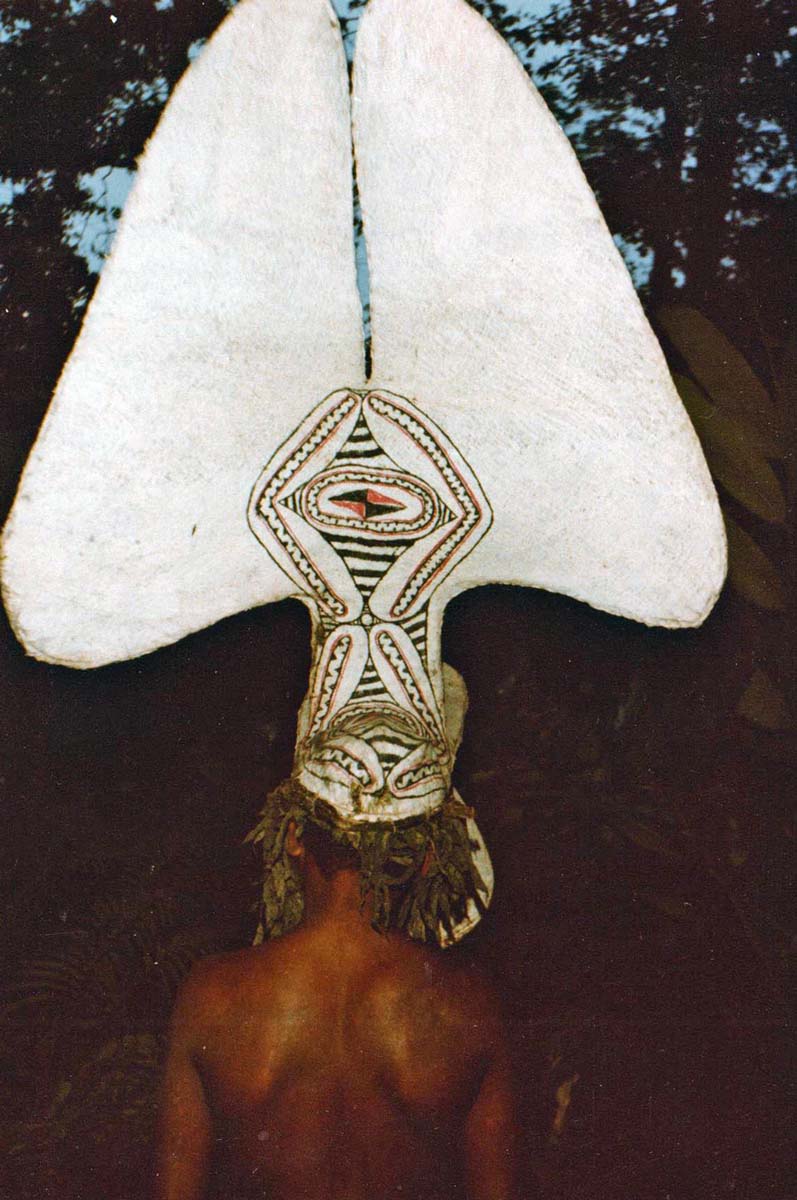
The main colours used are white, black and red. The white background is usually provided by the natural white of the sun-bleached tapa cloth. Upon this is delineated the outline of the design in black. The source of the black colour can vary, but it usually has a fine-grained carbon base.
In several areas this is obtained from the soft wood of ancient trees that has been carbonised by past volcanic eruptions. Mixing this with a little water and plant sap to act as fixative makes a very effective black paint.
In other areas, and in the mountains, the resin like gum of several trees is burnt, with the heavy, sooty smoke being collected on the underside of leaves or pieces of metal. If time is short, charcoal from a special rainforest tree can be used.
The traditional red results from the gum of a particular bush tree being chewed. A little lime is then added to the mouth for further chewing before the resulting red spittle is ejected into a half coconut.
Sometimes I saw blood being used. Blood was being applied to sections of the pandanus leaf design used as a screen to mask the vung vung. With his head near to the screen, a young lad used a bush leaf having the texture of coarse sandpaper to scrape his tongue. The ensuing blood was swirled around in his mouth, then spat out onto the pandanus design, to coat it red.
When available, the seeds of the bixa orellana shrub could also be crushed, mixed with a little water, or sap, to produce a red paint for the tapa masks. In more recent years, with the arrival of trade stores in the region, it is now more common to buy the easy-to-use red marker pens or Textas. They also provide a brighter colour. However, in contrast, the traditional black ‘paint’ continues to be used.
An effective brush is usually made by chewing the end of a fibrous twig.
Other Masks
During one of my forays into the Kairak Baining village of Iveri I was taken out into the ‘bush’ and was surprised and enthralled to see some new masks on which Marsang, an elder of Kynagunan Village, was working, together with several women from Iveri.
Marsang explained to me that his father had told him about the Siviritki mask, which only women wore, and danced as a prelude to the men’s enginior fire dance. Although now an elder in the village, he had never seen these masks. They were made, his father said, many years ago when the area was under German administration. After the first missionaries arrived late in the 19th century, they had discouraged the performance of some of their celebratory dances. The women had been more responsive to mission sensibilities than the men and their Siviritki dance had not been performed for some 70 years: it was to all intents forgotten. Marsang was hopeful of reviving this dance and, with his chosen group of six interested women, had fashioned head pieces from kanda vine. Bark cloth had been prepared and Marsang was helping the women to stretch it over the framework of the mask. This was done when the tapa was wet. It was then sewn onto the frame with slivers of supple vine, the whole then being allowed to dry in a bush shelter in the rainforest.
On a subsequent trip to the area I saw how Marsang was instructing the women on how to paint the face on the front with the traditional iconography on the rear of the mask. While the tapa had been drying, the women had been collecting long lengths of the aerial roots of the pandanus palm. These had been beaten over a log in a flowing stream, to tease out the fibrous tissue of the roots. Large bundles of these teased-out fibre parcels were drying in the sun. A 60cm long skirt of these white fibres was hung around the base of each face mask. The great bulk of the fibre was hung from a 2m long rope which was later wound to form a circle of approx. 24cm diameter, the fibre hanging down some 1.2m. When dressing for the dance the women poked their head through the rope circle, allowing the large, voluminous fibrous skirt to hang from their shoulders.
Often, after the mask is fitted over the head, no portion of the body can be seen.
When the first performance of the women’s Siviritki dance was enacted, prior to the men’s fire dance, on an evening in March, 1971, it created quite a sensation, and a lot of subsequent interest. Many more women became interested and were schooled by Marsang. While the first masks were simple head coverings, masks prepared for subsequent occasions became larger and more decorative. However, for each Siviritki performance there was a consistency of style between all the masks participating.
Mask Designs
So what do some of the shapes represent? In essence, many Baining believe that within all living things, even some inanimate ones, there resides a spirit force. During the fire dance there is the reincarnation of these spirits. And the shape of the mask can be indicative of some spirit, often from the jungle but also sometimes from daily village life. While some are quite obvious, e.g. a turtle, bird or dog, others can leave much to interpretation for the uninitiated. For it is when the young boys are secluded in the temporary shelter in the jungle with the men, that they learn about the spirits which exist all about them and have influence on their lives. Initially they will assist in the preparation of masks for the dance, but when it comes their turn to participate in the engini they will be responsible for preparing their own costume. They can then determine what spirit they wish to represent, and hence the shape of the mask, and also what design will be used to enhance the effectiveness of the embodied spirit.
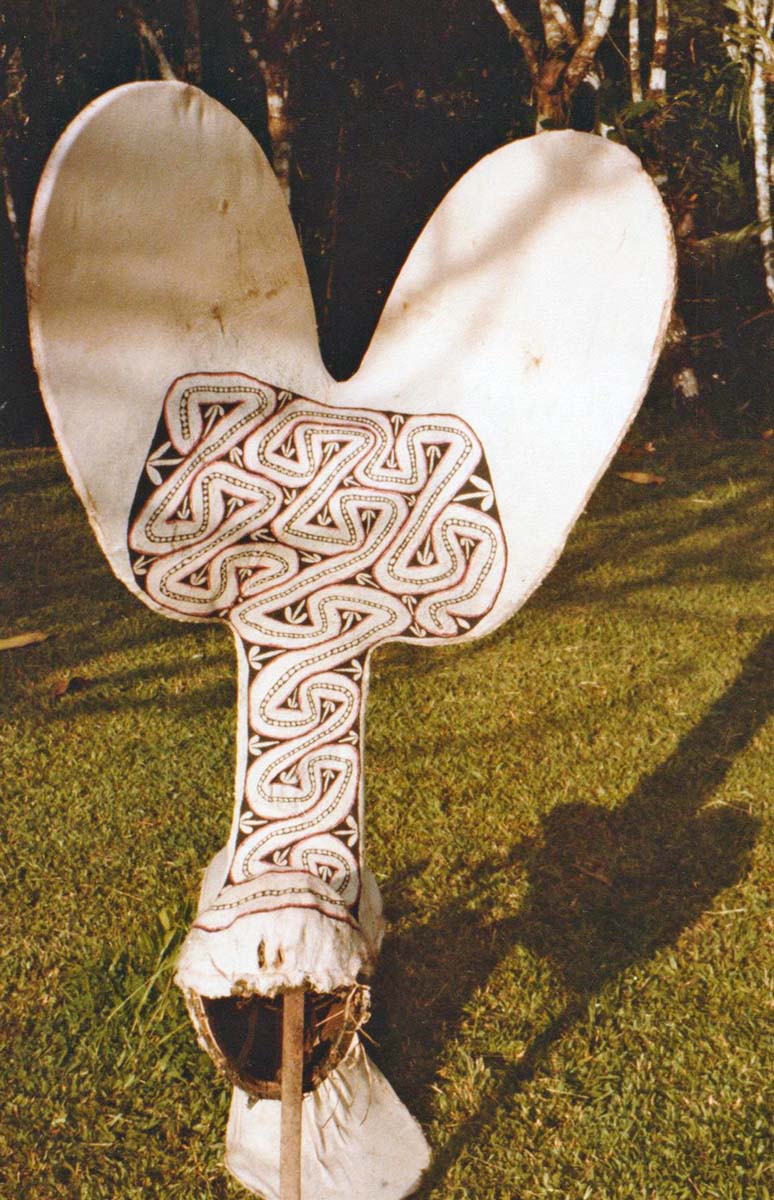
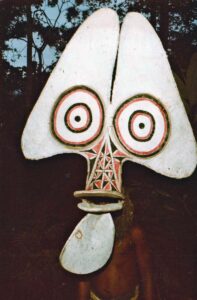
Masks include those with flat faces, which vary in shape, and often represent the leaves of different rainforest trees. An obtuse shaped mask, in one plane, with one eye on each side, can represent the shoulder blade of a pig, while a three-dimensional mask with an oval head and raised ‘nose’ usually represents a grasshopper, being known as dung-dung-mut-pas. The variety of design is almost endless.
The most prominent feature is always the large eyes. As the embodied spirits are most active during darkness – they come out during the night – the large eyes are more or less a prerequisite for night vision. However, some of the day masks also have quite prominent eyes. The often ‘duck like’ mouth is also well featured, particularly by the Kairak, Uramot and Sibali Baining, but less so amongst the Chachet Baining. It is through this open mouth that the dancer is able to see where he is going.
The back of each mask is usually covered, wholly or in part, by a repetitive design that is geometric or curvilinear in style. Some of the geometric designs are purely decorative, while hooked, curvilinear ones, can be representative of vines in the jungle, or the intestines of a pig, etc. There are a plethora of designs and the artist himself can determine what he would like on his mask. These different designs can also be used to enhance the face of the mask, around the eyes or on the neck of the mask.
The iconography is a story in itself.
Night Dances
An evening celebration amongst the Baining can take many forms.
The simplest being a single engini, usually commencing around 8pm when it can be pitch black in the tropics, if there is no moon. After all the excitement of the entry of the masked dances, and the cacophony of the band, mesmerising and addictive, dancing may continue for 2 to 3 hours.
A more serious celebration occurs when there is a feast in the afternoon, often associated with the opening of mumu ovens of food prepared the previous day. The first engini is staged by visiting participants from another village.
This could consist of around approximately 20 fire dancers who would perform until around 11pm. Remnants of the large fire would by then be scattered around the square, but teenagers would gather enough smouldering sticks together to keep a small fire consistently alight. The children would sleep on pandanus mats under the village houses, while their elders chatted or dozed.
Sometime around 1.30 am there would be stirrings in the village. Young boys would appear with bundles of kindling and start to build up the fire. Even girls would be helping to drag in sticks and wood, building up a supply.
One or two men would drowsily wander across to where the large slabs of timber lay; the orchestra pit. Shifting their buttocks to obtain a more comfortable seat, a hollow section of bamboo is chosen, and grasped in the hand. When the open end is struck, end on, to a flat, hard surface, such as the timber slab, there is a loud reverberating beat, as from a drum. A few tentative drum beats are heard. Those who had fallen asleep are awakened. The fire grows bigger. More men join the orchestre and strike up. The tension and expectation grows. Soon a regular, urgent chorus of drum beats is heard calling in the ‘spirits from the bush’. The next engini has commenced.
On this second event of the evening, usually commencing around 2 am, it is the turn of the men and young initiates of the host village to perform. This is usually a much larger group than that earlier in the night, comprising Kavat, Vungvung and Lingan dancers.
The dance spectacle will usually continue until ‘pikinini light’, those few moments before dawn when it first becomes possible to make out shapes. The last of the dancers then weave across the wood-charred, ash-strewn square to disappear into the jungle.
Participation of Women
On some occasions there is an even greater repertoire which could involve the women’s participating in the dancing celebration.
In the early evening, following the build-up of the centrally placed fire, a line of women are enticed to ‘central stage’ by a specific ‘drum beat’ that the orchestra takes up. One behind the other they come, with downcast eyes, their feet shuffling rapidly in time with the beating of the bamboo. Sometimes the women will be wearing the ubiquitous cotton ‘meri blouse’ with lap lap around their waist. On other occasions they will emerge from the crowd in full traditional dress. This comprises two large, fibre bilum bags, each hung cross ways from the shoulder, together with a fibrous belt supporting a mini skirt in front with a large leafy ‘bustle’ resting over the rear buttocks. With one, two or more stalks of sugarcane held over the shoulders, the women circle the fire a number of times. With a change in tempo of the beat, the women break off, deposit the sugar cane before those playing in the band, then discreetly shy away through the gathered audience, to anonymity amongst the houses.
The men wielding the bamboo instruments will, as needed, cut off lengths of cane to chew the sugar-laden fibres of the stalks to reinvigorate and regain their energy.
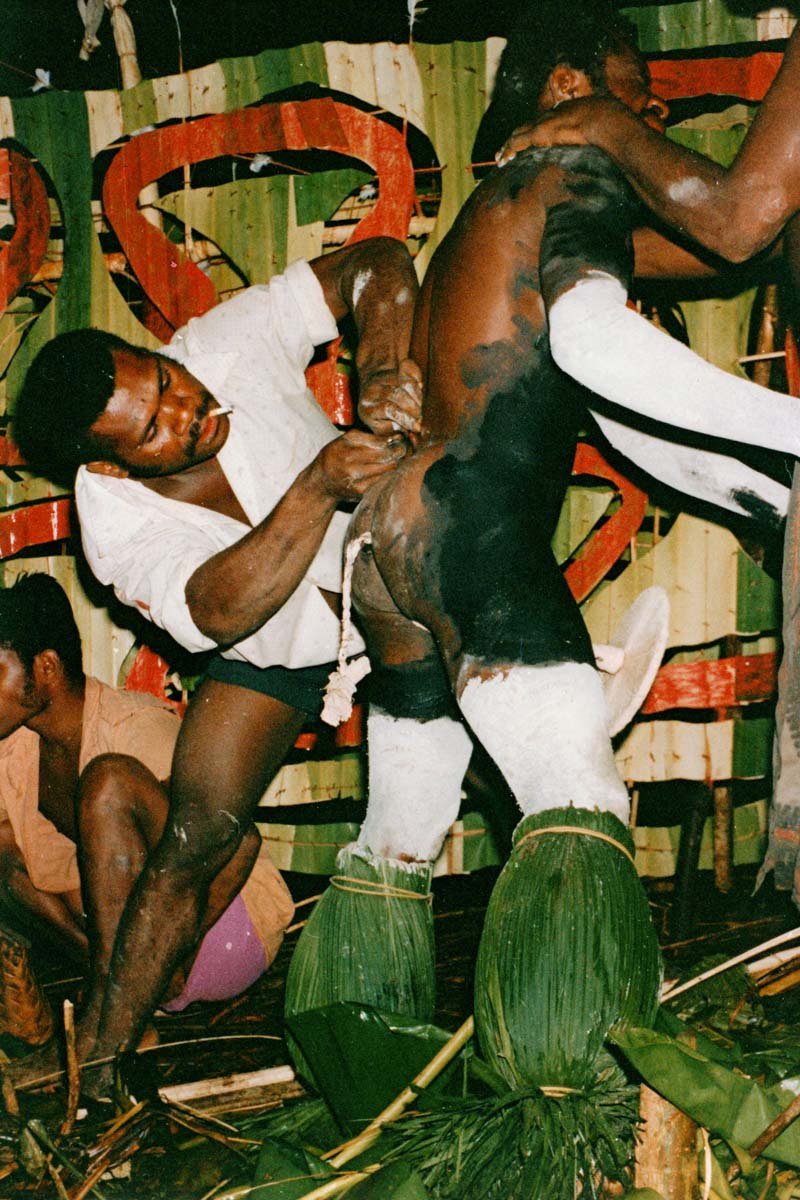
On still yet other occasions, amongst the Kairak Baining, the evening’s celebration will begin with a group of women filing into the firelight, each carrying her section of bamboo, and then sitting next to the logs or wooden slabs in what could be called the ‘orchestra pit’. After some casual chatter, one then another will start beating a rapid tempo of bamboo against slab. Once all are ready, there is a barely noticeable change in tune to one which calls in the Siviritki dancers. In a long line they enter. The masked figures, with a rapid shuffling of feet, backward and forwards, form a circle around the central fire. There is no evidence that these are women. The fibrous pandanus skirt swishes along the ground with no legs or arms visible. The tapa cloth head piece appears to float above the amorphous, swaying body. In contrast to the men’s Kavat masks, where each is individually different, the Siviritki masks, at any one performance, were always almost identical.
Since being reintroduced in 1971 to Baining culture by the elder, Marsang, it is still only on rare occasions that the Siviritki dance is performed.
Other Visitations
Even after visiting scores of Baining festivals, thinking I’d seen it all, I’ve often been surprised to see a new apparition emerge from the blackness of deep night and drift towards the fire, newly ablaze and shooting sparks from a recent addition of brush. Such was the occasion late one evening at Vunga village of the Sibali Baining. After the first fire dance of the evening had been completed there had been a lull in the proceedings. Then, after the percussion tubes started beating again, it was not a Kavat dancer who entered the firelight but a painted man, dressed as a woman, with tangket and croton leaves and swathed in two large bilums. A long, attenuated snout protruded from the tapa mask of this Rongari figure. Several of these masked figures had emerged to circle the fire and race to and thro across the clearing, before being absorbed back into the darkness.
Sarlek, however, made more regular appearances. He represented a male spirit who lived around Mount Sinewit, the tallest mountain of the rugged Baining ranges, centrally located on the Gazelle Peninsula. It was not unusual for him to show up, during a lull in a fire dance, as a decrepit looking, dirty, old man with a heavily bearded mask, limping around with the aid of a walking stick, poking at the fire with his stick, sometimes even falling into it, or trying to climb a coconut palm. He is essentially seen as a clown. Often the village children are left rolling on the ground in laughter at his antics. He may then grasp a burning ember from the fire and chase after the children, or hurl the glowing fire stick into the crowd.
Another member of the family of spirit personages that sometimes made an appearance at Sibali celebrations is A-Gioracha. Like Rongari, these spirits only rarely appear, sometimes coming to dance around the fire after the first group of Kavat dancers have retired, morphing back into the blackness of the jungle. A- Giorachka masks comprise a tall cylindrical section, usually 1.0 to 1.5m in height, which acts as a neck for a bird-like head. This head, which incorporates two large eyes, has a beak and a number of feather adorned crests radiating out in different directions. They are constructed in a similar manner as Kavat masks, with an additional skirt of pandanus root fibre or of pandanus leaf, to the extent that while the mask rests on the shoulders, the skirt hides most of the body
The Aftermath
As the Baining people in many villages knew me well, I was always welcomed when I visited. The men often invited me to go with them to their ‘bush house’, where the masks were made. They explained all the steps of manufacture and the meanings of the iconography used on the masks. They were also quite happy to sell their masks after completion of the festivities, the only prerequisite being that it be done in secret, so that the women and young children were not aware. This usually meant arriving at the village, or some predetermined location, just on dusk. Somebody would be waiting to lead me along a barely detectable track through regrowth gardens, and into the virgin rainforest. Sometimes this took 20 minutes, other times much longer, being led to I didn\’t know where, along a slippery, rain drenched pathway.
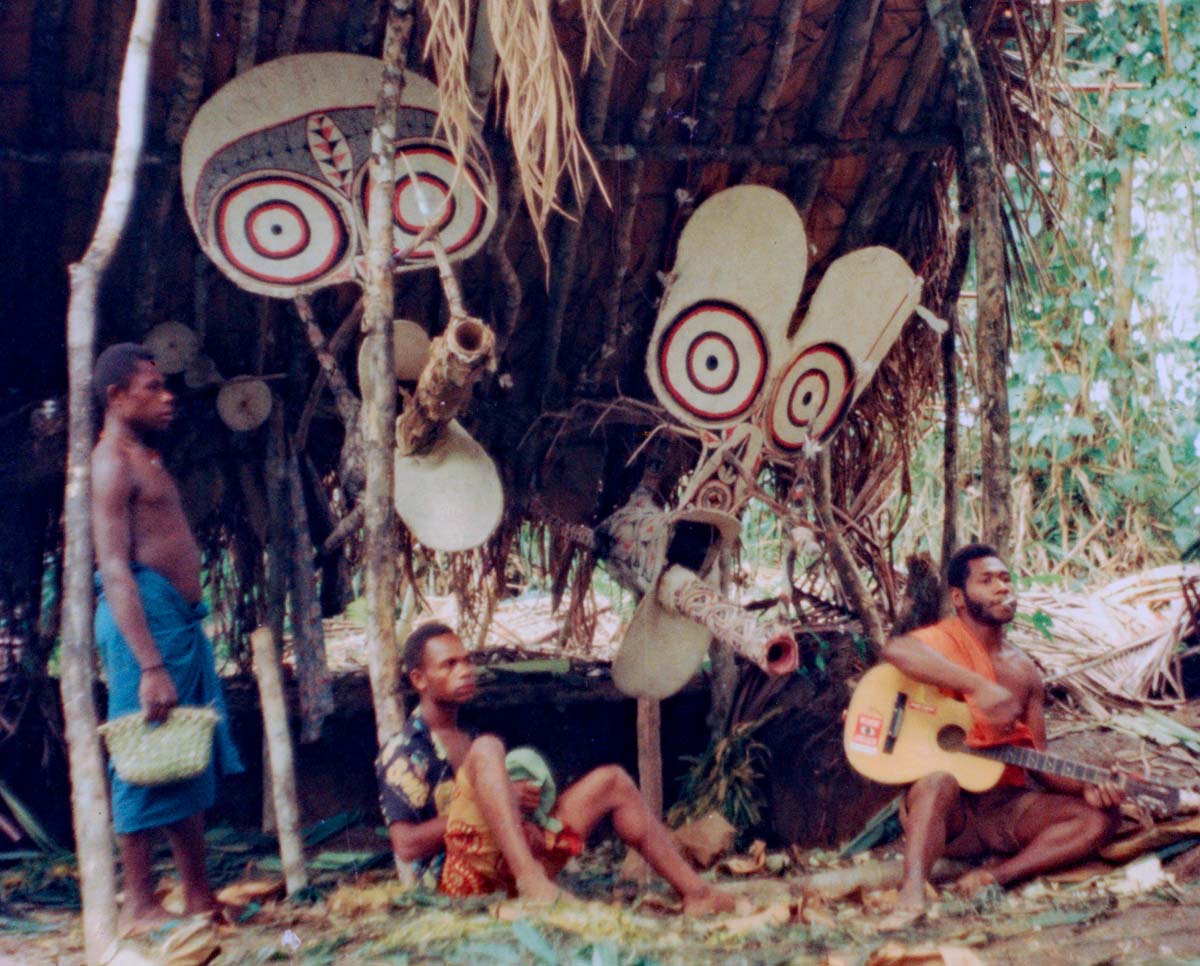
There would be several young men resting around the ‘men’s shelter’, with the debris of the previous night scattered on all sides; bunches of croton leaves from around the head pieces, tangket leaves from the legs and hands, now discarded. The side panels of the Vung Vung would have been cut off the drone pipe and be now lying forlorn and crumpled.
Any purchase would be wrapped securely in black plastic sheeting to protect it and also to hide it. Back at Kerevat, sometimes involving a long walk to a waiting vehicle with willing helpers, the masks were photographed and documented.
They were carefully re-wrapped, away from women’s eyes. For, according to Baining tradition, after seeing a mask, a woman risks bearing a child that may take on the form of the spirit in the mask.


