
by Krisztina Turza
The Ainu (meaning ‘human’ in their native language) are Japan’s oldest indigenous people, and they have survived and maintained their culture from the Late Palaeolithic period through today; however, the Japanese government did not formally recognize them until 2008. The Ainu lifestyle has only partially survived due to difficulties caused by their patriarchal suppression in Japan where the Ainu were racially excluded and forced by the government to assimilate to Japanese language and culture[1].
The Ainu resided on the islands of Sakhalin, Russia and Hokkaido, Japan; however, a few centuries ago, Ainu was spoken widely in the north-western regions of the Pacific Rim with Hokkaido as the centre. From Russian explorers we have sporadic references to Ainu residents on the southern tip of the Kamchatka Peninsula, and the Kuril archipelago had a small number of Ainu inhabitants until the end of the Second World War. Late in the nineteenth century the Japanese had deported most of the Kuril Ainu to the southern islands, where their numbers were drastically reduced by deplorable living conditions, poverty, and disease.
Their language has been recorded and described to some extent by Russian, Polish, and Japanese explorers, and scholars. Southern Sakhalin had a relatively large Ainu population, but after the Second World War almost all were repatriated to Hokkaido together with the Japanese, who had been living in Sakhalin. They settled mainly along the northern coast of Hokkaido, and thus by the late 1940s, all remaining speakers of Ainu were concentrated on the island of Hokkaido. The world knew next to nothing about the Ainu language before the 17th century, the earliest source being a manuscript by Father Jeronymo de Angelis, a Jesuit priest who visited Hokkaido in the early 1600’s. He wrote a brief description of Yezo (or Ezo, the old name for Hokkaido), which included 54 Ainu words, 36 of which were numerals[2].
The Ainu believe that gods or their incarnations are found in every object or phenomena from the sun, moon, thunder, wind, water, fire, to animals, plants. There is also a house guardian, the god of fire, the god of windows, the god of entrances, the mountain god, the sea god, the lake god, animal gods, however these gods are not absolute beings as in humans are able to argue with them when they make mistakes. In the frame of the above, the worship of bears and the performance of rituals for hunted bears were universally observed among indigenous peoples living in the northern parts of the world but traditions involving festivals with raised bear cubs only occurred among peoples that lived in the Far East: along the Amur River, in the Russian Maritime Provinces, in Sakhalin, and in Hokkaido.

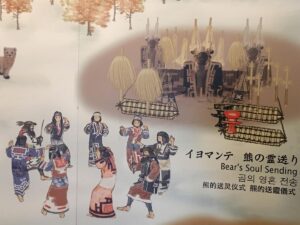
The traditional Ainu dance is also unique and protected by UNESCO as Intangible Cultural Heritage of Humanity. The traditional style involves a large circle of dancers, imitating the calls and movements of animals or insects; others, like the sword and bow dances, are rituals. Believing that deities can be found in their surroundings, including the animals they hunted, the Ainu frequently used dance to worship and gave thanks for nature and the divine beings (kamuy or kamui) that inhabit the earth. For the Ainu, dance reinforces their connection to the natural and religious world and provides a link to other Arctic cultures in Russia and North America. They performed “soul-sending” ceremony for most of the animals they hunted, especially captured and/or raised brown bears, by adding many offerings for the deities.
The earliest bear remains were found at Otafuku-iwa Cave in Hokkaido, which contains several cultural layers from the Epi-Jomon (400 BCE to 700 CE) culture to the Ainu cultural periods (1400–1900 CE). From these findings, it is evident that bear cubs had been highly valued by the people of the Epi-Jomon culture and the Okhotsk culture (6th–9th century CE) and that the bear-sending (bear-sacrifice) ceremony was already formed by the end of the Satsumon culture (12th or 13th century CE)[3]. But what is a “Bear-sending Ceremony”? The Ainu have traditionally regarded the animals they hunt as embodiments of deities usually living in heaven and occasionally visiting the human world to undertake certain roles. They also believed that when those deities visited the human world, each disguised him or herself as a certain figure. As hunters, they naturally attributed special importance to those deities who appeared in the guises of various animals. Deities can uphold their honour in heaven by bringing back many souvenirs from the human world.
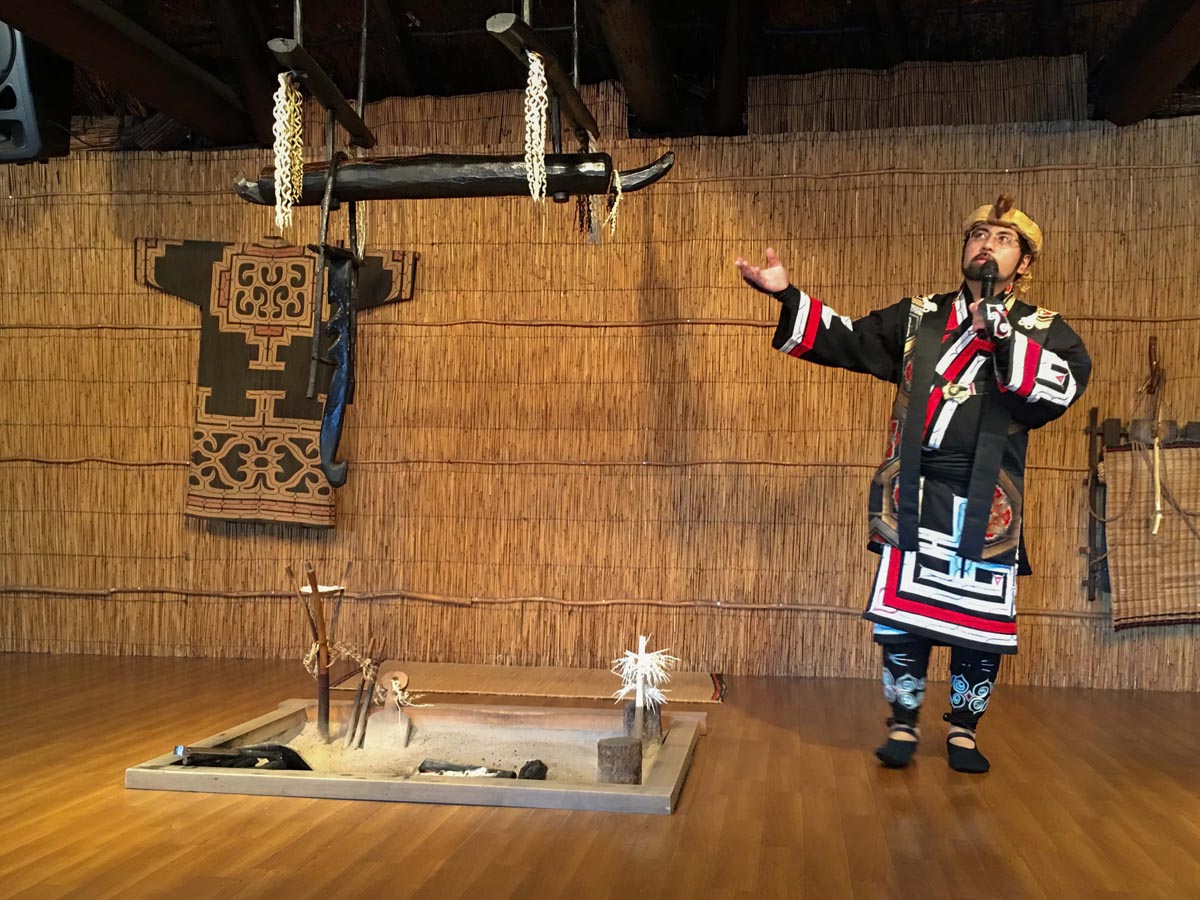


Recreation of the bear-sending ceremony at the Upopoy National Ainu Museum and Park. Image: Krisztina Turza.
On the basis of this belief, the Ainu performed a soul-sending ceremony for most of the animals they hunted, carefully placing their remains, especially the crania, on a sacred altar and adding many offerings for the deities in acknowledgment of the meat, furs, and so on that they had provided. Although various such soul-sending ceremonies originally existed, today the ceremonies for raised bears are best known as it was performed on a large scale even up to the beginning of the 20th century.
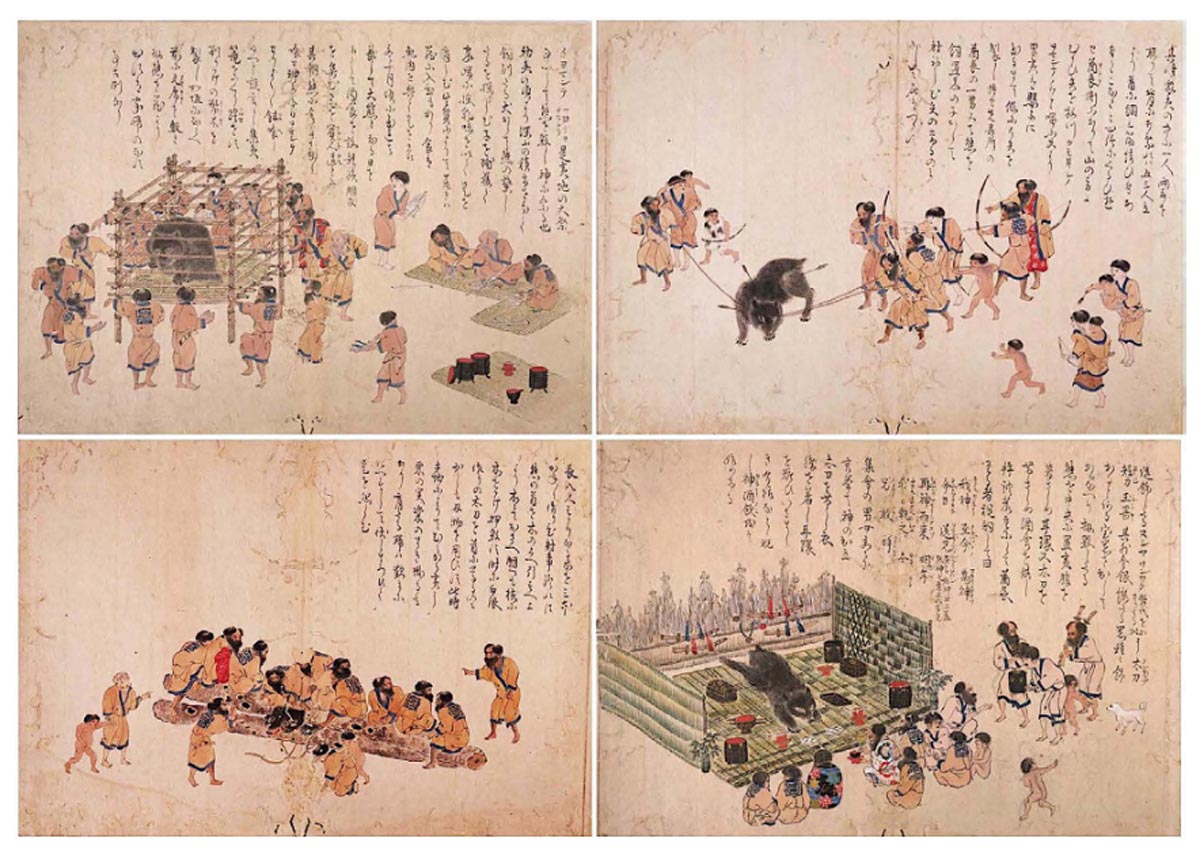
Until the beginning of the 20th century, the Hokkaido Ainu and the Sakhalin Ainu would capture newborn bear cubs found in the mountains in early spring and bring them back to their settlement. The person who captured the bear cub or acquired it from someone else placed it in a cage when it grew a little older, raised it for one or two years usually (in the case of the Hokkaido Ainu), and then performed a “sending ceremony”, which as a rule took place in the winter. In the ceremony, which was conducted over a few days regardless of the area, the bear cub was taken out of the cage, squeezed to death, and dismembered on the first day of the main festival; then its skull was decorated and placed on the sacred altar.
Such bear-sending ceremonies for raised cubs had social and economic significance, which were annual events, acting as a “time marker” for the change of season and a “pacemaker” to give rhythm to people’s daily work. However, not all bears used for the bear-sending ceremony were raised cubs: the Hokkaido Ainu also performed sending ceremonies for adult and sub-adult bears killed by hunting[4]. Another ceremony that involved Ainu dance is the Iomante, performed during “bear-sending” ceremonies, in which participants send the deity embodied in a bear they have eaten back to heaven by mimicking the movements of a living bear, and perform a spiritual release of a captive bear’s spirit.
[1] Sung, Y.K. & Sakoi, J. (2017): Stories of the Ainu: The Oldest Indigenous People in Japanese Children’s Literature
[2] Kirsten Refsing, K.: From Collecting Words to Writing Grammars – A Brief History of Ainu Linguistics
[3] Mattila, R. & Ito, S. & Fink, S.: Animals and their Relation to Gods, Humans and Things in the Ancient World (http://www.springer.com/series/15609)
[4] Sato, T.: A Zooarchaeological Study of the Formation Process of the Ainu Bear-sending CeremonyRecreation of the bear-sending ceremony at the Upopoy National Ainu Museum and Park.