
Tāmaki Paenga Hira Auckland War Memorial Museum, until Sunday 17 August 2025.
Review by Margaret Cassidy
Navigating Home is definitely the right title for this exhibition of cultural homecoming tucked into a nook near the northern entrance to the Museum. Nestled in front of the entrance to the large Te Marae Ātea Māori Court is Te Rā, the large woven sail, the only one of its kind now in existence, woven from harakeke by Māori crafts people before European settlement, now returned home on loan from the British Museum and on exhibition. Regrettably it is only the second time that it has been on exhibition in over 200 years (the first was in the British Museum’s Māori exhibition in 1998) and the first time that it has returned to Aotearoa New Zealand. At nearly four and a half metres long, Te Rā brings a wealth of historical and cultural significance to Aotearoa and international audiences.
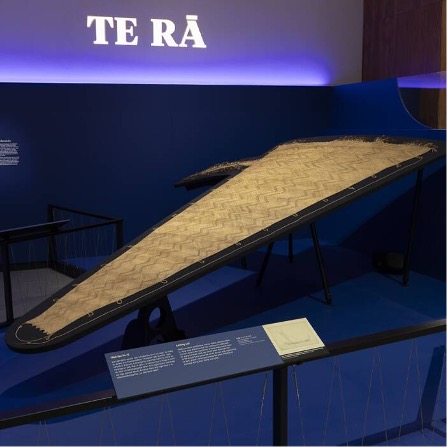
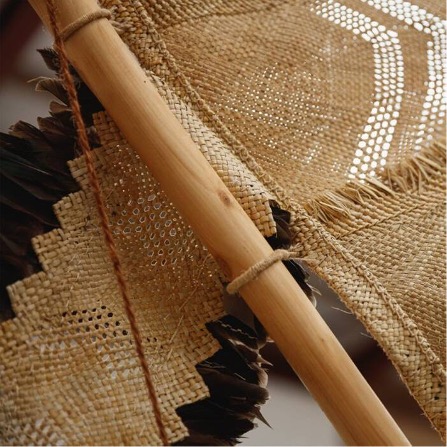
Te Rā (ca. 1785), or The Sail, is primarily made from harakeke (Phormium tenax), feathers of kāhu (swamp harrier), kererū (native pigeon) and kākā(native parrot), and remnants of dogskin. Te Rā is on loan to Tāmaki Paenga Hira Auckland War Memorial Museum by the Trustees of the British Museum as the centrepiece of the Te Rā: Navigating Home exhibition. It was exhibited earlier in 2023 at Te Puna o Waiwhetū Christchurch Art Gallery.
Besides the display of Te Rā for the first time since the time of Cook in Aotearoa New Zealand, there are also two similar sails made recently by Te Rā Ringa Raupā, a group of highly skilled weavers mentored by weaver, installation artist and researcher, Dr Maureen Lander, (Ngāpuhi, Te Roroa). Dr Lander is an academic and artist whose work has contributed significantly to knowledge recovery of traditional Māori fibre arts and to the use and recognition of customary weaving materials and techniques in a contemporary art context. Te Rā Ringa Raupā is a group of dedicated Northland weavers who took up the challenge to recreate Te Rā, firstly inspired by Te Rā herself and reinforced by Te Wero o Te Rangihīroa.
Across the display space near the entrance to the Grand Foyer is Māhere Tū ki te Rangi, a stunning full-sized recreation of Te Rā. Hine Mārama, a small-scale model that shows the meticulous thought process, innovative techniques and challenges encountered in the pursuit of recreating Te Rā, can be found in the Te Taunga Community Hub accessed off the Grand Foyer. Surrounding Hine Mārama are a series of visual storylines, one being a series of large photographs showing the growing of the harakeke flax fibre and the treatment of the whenu to reveal the muka which is used in another a detailed display showing each stage of the weaving of a talaore (cringle) as part of the creation of the sail as well as historical drawings of similar Māori sails by early European visitors.
A further display of videos reveals the detailed and lengthy research undertaken by members of Te Rā Ringa Raupā. In 2010 weavers Ruth and Mandy invited traditional Tahitian sailor Tahiarii Pariente to accompany them on their first viewing of Te Rā in the storage facility of the British Museum. Utilising his knowledge, the weavers conclude that Te Rā is thought to have been used to add sailing/wind power to a paddling waka, Māori/Polynesian sailors did not fix their sails like Western Pakeha boats, Te Rā was designed to adapt, with the ability to tack to different winds, and that the Māori sailors likely co-designed Te Rā with their weavers to achieve such strength and its incredible ability to disperse the force of gusting winds.
I currently see lots of activity that involves contemporary Pacific artists and entrepreneurs engaging with traditional artefacts and critiquing, explaining, learning from and sometimes marvelling at that knowledge. This recreation of Te Rā is such a magnificent example of this relearning of pre-contact cultural skills.
In Sydney, events have been hosted by the Chau Chak Wing Museum exploring this interchange between traditional artefacts and contemporary practice through the eyes of First Nations entrepreneurs and artists. Tidal Kin co-curator and entrepreneur Ruth Choulai led a discussion between three traditional Papua New Guinea three bilum (woven bag) makers from the Papua New Guinea highlands and Sepik regions about the histories and meanings of bilum bags using a number of examples from the Museum as the basis for the discussion of local patterns, the concept of pattern ownership, trading routes and different weaving techniques. Florence Jaukae, also known as ‘Bilum Meri’, is an advocate and connector of bilummakers in different communities. Lina Singu connects women living in remote villages along the Sepik River in Papua New Guinea by training them to become independent and highly-skilled bilum weavers. Artisan weaver Barbara Pagasa lives with her husband, Michael, in Mount Hagen in the Highlands. As part of the recent Kānawapātāhmōwin: A Symposium on Indigenous Visual Knowledge, Māori artist Nikau Hindin talked about the relearning of Māori bark cloth making for the construction of her “sails” which are on exhibition as part of the current Biennale of Sydney.
The sail known as Te Rā was presented to the British Museum by the Royal Navy and there is some suggestion that the sail was collected during one of Cook’s voyages around New Zealand. With its size and intricate, delicate and sophisticated weaving, Te Rā is awe-inspiring evidence of Māori knowledge and innovation drawn from their Polynesian heritage. Now that the British have allowed Te Rā to navigate home for the first time, it is to be hoped that it has many further opportunities to be displayed and inspire further generations of sailors and sail makers.
Further information
‘Imaging Te Rā, the Māori sail’ Te Rā, the Māori Sail Facebook page 21 September 2020, 13:30” https://www.facebook.com/watch/?v=3181431885307407
‘Last known Māori seagoing sail to return home’, Te Ao News YouTube Channel, 12 June 2023. https://www.youtube.com/watch?v=pbce2Hu5wpI 2:19”
Low, Andrea, 2024. In a room, in a house, on an island, in an ocean. Waka Kuaka: The Journal of the Polynesian Society 133 (1): 9–14. | https://doi.org/10.15286/jps.133.1.9-14
‘Recreation of 200-year-old traditional sail to be gifted to Waitangi | Te Ao Mārama’, Te Ao News YouTube Channel, 8 November 2022, 2:46”. https://www.youtube.com/watch?v=HcohHuFs0K8
Te Rā, the Māori Sail website https://teraa.co.nz/
Te Rina Kowhai, ‘Kairaranga recreate traditional Māori woven sail’, Te Karere TVNZ, 18 March 2021, 2:20”. https://www.youtube.com/watch?v=32T7ctlOh_k