
by Stéphane Duckett
Stone artefacts in Oceanic Art are relatively uncommon and almost wholly limited to axe or club heads. It is perhaps not surprising that in the Massim area, given the relative scarcity of this material, axe heads were used as the basis for currency in the late nineteenth century. To find a stone implement other than an axe or club head is unusual. As is the case for much of pre-contact Oceanic culture where there is no historical written record, such objects, when they do emerge, frequently can only be interpreted or understood from supposition based on current practice or by interviewing elderly informants on past practice where possible.
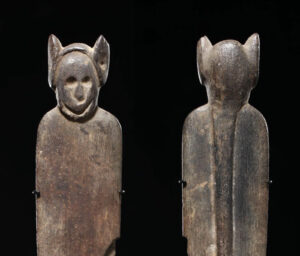
This essay concerns a stone lime spatula now in the possession of Patrick Vincent, collected by Abel Abel from Awaiama village near Bartle Bay (Milne Bay Province) in 2009. It is twenty-two centimetres in height and weighs ninety-nine grams. Richard Aldridge, at the time of its purchase, was told that the ‘bat’ motif on this spatula was associated with witchcraft.
Betel nut chewing and the classification of spatulas
Betel nut is consumed as a mild stimulant by about a tenth of the world’s population. In the Massim area of Eastern New Guinea the utensils associated with its consumption have proven to be some of the finest carving from the island as a whole and have caught the attention of Western collectors since the mid-nineteenth century.
The basic utensils associated with betel nut consumption are lime pots (the crushed betel nut is slaked with lime), lime spatulas (as a ‘spoon’ with which to consume the lime), and a pestle and mortar to crush the betel nut. These utensils were stored in a small woven bag. Lime pots from this region are often made from coconuts but can also be made from bamboo or gourds. All can be decorated, although spatulas tend to be the more elaborate, hence more commonplace in collections.
There have been various attempts to classify these spatulas by design starting with the work of A. C. Haddon at the end of the nineteenth century. Beran (1988) has suggested a typology of forty-five types of spatula which can be divided in six large groupings. These include human figure motif handles, animal motif handles, plant motif handles, artefact motif handles, representational and non-representational double-purpose spatulas. However, it should be noted that Beran in his study of the nineteenth century carver Mutuaga (1996) went on to further identify what he terms ‘sub-styles’. These sub-styles are largely the work of individual carvers and their contemporaries.
The Awaiama Stone ‘Spatula’
This object is highly unusual on two counts. Firstly, it is made of stone; whilst the vast majority of spatulas in Western collections are made of wood, ebony in particular, some have been made from turtle shell, human, whale and dugong bone. This spatula may very well be unique in its use of stone.
Secondly, the blade is not tapered into a bracket or platform for the handle, but rather the figurative element sits directly on top of the blade. This could reflect an older design configuration (see Fig. B p.45 Bourgoin 1994) or simply be a function of the material used. If the stone were to be cut in to form the hilt it would be far too delicate to withstand any use.
The most striking feature of this artefact is, without doubt, the grinning head with elongated ears. Grinning faces are not unusual on human faces for spatulas (possibly a reflection of the feeling of well-being generated by the consumption of betel nut), but are not to be found on animal heads.
Given the prominence of magic within Massim culture, it is perhaps not surprising that such objects may have taken on a spiritual dimension which is reflected in some aspects of their design; attributions of power to objects associated with the consumption of psychoactive substances are not uncommon for all cultures.
Aldridge et al (2014), in his article ‘Massim Sorcery Figures’, singles out the following design elements from nine exemplars that are associated with the practice of sorcery, namely those with the exaggerated facial features of an extended snout and elongated ears.
At first glance it would be reasonable to suppose that these unusual looking figures represent an animal of some form such as a giant bandicoot, as suggested by Barry Craig. The Awaiama spatula was initially identified as a bat, as noted. However, both Aldridge and co-author Beran question whether an animal is represented with their nine spatulas. Beran recounts how, in 1989, he showed pictures of a long eared/long snouted spatula to villagers in the Buhutu Valley. Three recognized the figure, with one (Waiba of Siasiada village) attributing the personal name Sinofo to it. The long ears and the long snout developed as Sinofo’s magical powers grew, as was explained.
Lagesana from the Buhutu Valley, also knew of such a man whose ears and snout became elongated as his magical powers grew. Furthermore, perhaps significantly with respect to the Awaiama spatula, the long eared man was so full of magic that he turned to stone upon his death. Could this have been suggested to this informant by the epic of Tauhau (as cited in Beran 1996)? All of these events took place in a village named Bulubulu which has since been abandoned. Lagesana did not know the name of the long-eared man, but recognized him when presented with the photograph of the spatula. These distended facial features may have been suggested by the not uncommon enlargement of facial features seen in elderly men which has been reinterpreted by the carver as animal-like.
Jerricho from Savaia village further south confirmed the name Seinofo, adding that he wore a strand of ginger-stem around his neck. Jerricho went on to tell Beran of a story recounted to him by his grandparents that a long-eared spatula had been left above a fireplace when the parents were away, whilst their children were at play. The spatula fell to the floor killing the children and, as a consequence, the parents burnt it to destroy its malevolent power.
It would be tempting to speculate that the break in the Awaiama spatula was deliberate to dispel the magical powers since stone cannot be destroyed through fire alone. Aldridge in his own field work suggests that some of these figures may be used for good as well as evil, for example in protecting a household by warning its occupants of the presence of evil. Beran notes how this protective function for some spatulas extends to when its owner is asleep and hence most vulnerable.
In Milne Bay, long-eared, long-snouted small carvings have also decorated pegs used to fasten netting to the ground. Intriguingly a rather similar stone anthropomorphic peg is to be found on display at the Pitt-Rivers collection which originates from the Solomon Islands. Collected in 1895 by Lieutenant B. T. Somerville, it was described as having been found embedded in the rafters of an old house, one would assume as a protective amulet?
Beran suggests that about twenty percent of all spatulas do not fall into any definable grouping and can be viewed as ‘one offs’. Both Beran and Aldridge have also pointed to the fact that some, despite their clear antiquity, show very little, if any, signs of use as lime spatulas. Whilst lime spatulas are wiped clean after use, repeated use shows up as discolouring from saliva. Showing little use may come from the fact that they may serve a function other than their initial purpose. As an example Aldridge has spoken of their use as heritage items, brought out during solemn events which require the formalising of a transaction or property claim (2021). However a simpler explanation may also come from Ellis Silas’s observation in his memoir that some carvers kept as decorative objects those carvings they were particularly pleased with.


Awaiama Spatula courtesy Patrick Vincent. Image: Brian Forrest with thanks Michael Hamson.
Identifying objects through use
This ‘fluid’ use of objects should not surprise us. Dorothy Lee in her seminal paper (1950) reassessing the field work of Bronislav Malinowski on the Trobriand Islands during the early part of the twentieth century, has described the ways in which objects are identified by function or, more accurately, context of use and how, as a consequence language changes accordingly.
Malinowski had attempted to create a glossary of terms during his stay in the Trobriand Islands. He had, in his correspondence, expressed frustration that words for the same object appeared to change and had suggested in private correspondence with his wife that Trobrianders had an imprecise grasp of their own language. Lee argued that the problem for Malinowski rested in the assumption that the underlying understanding of reality was shared across all languages. Therefore words, for Malinowski, are simply different sounds from different languages attached to the same object. Lee argued that with this interpretation, what may have appeared to be an imprecise use of words, in fact spoke to a more profound underlying difference:
“The assumption is not that reality itself is relative, rather that it is differently punctuated and categorised and that different aspects of it are noticed by or presented to the participants of different cultures [through language].”
Thus Lee gives the example of an apple that when ripe and can be consumed, will carry a different name from one that is unripe. Being unripe is not a quality of a particular apple, but renders it a different kind of object altogether. This perhaps makes sense in a world where fruit grows largely year-round and where it can be simply plucked from a tree. In Europe we have far more distinctively differentiated growing seasons and therefore know to retain an unripe fruit until it matures. An apple for us remains an apple until it is consumed, but that reflects our seasonal patterns of growth. Lee described this as the difference between a ‘lineal and non-lineal codification of reality’.
Consequently, a spatula is identified not by what it is, but by its use (or the context of its use), whether to serve in legitimising a transaction, witchcraft, protection against witchcraft or indeed the consumption of lime.
The second point to be emphasised is that whereas, as Westerners, we see what we term ‘magic’ (the power to influence outcomes without any discernible causal link) and its expression as a distinct category of human activity with its underlying world-view, no such distinction exists for many non-Western cultures. What we understand as magic is for many embedded in all human activity, and therefore objects that facilitate (whether for good or evil) such activity do not necessarily distinguish themselves by virtue of those properties alone.
Similarly, categorising objects just by their formal (stylistic) properties alone will make sense for us, but may not reflect the reality of these objects for their makers. Added to this, as with Lee’s apple, the use of objects (and hence ‘essence’) can evolve over time. Aldridge has, as already illustrated, described a spatula that because of its age was seen as a link to the past and ancestry, therefore serving as an imprimatur much as a wax-seal would have at an earlier point in our own history.
This may help explain the very features that we, as students in our appreciation of these objects, so admire about them, namely quite how decoratively inventive and varied they are. However, their inventiveness may not just reflect decorative flair, but may speak to their varied function and a way of life where the link between the spirit world and the world about us is inseparable.
Concluding remarks
Anthony Forge in his introduction to Primitive Art and Society writes:
“The place of the arts in anthropology has a curious history. For the pioneers [such as Haddon and Boas]… the plastic arts had a substantial place in their reports… and yet within the next generation of anthropologists the study of art virtually ceased, the development and intensification of fieldwork techniques, particularly associated with Malinowski, led paradoxically to a narrowing of the field considered suitable for investigation.”
He goes on to say: “the assumptions behind these… studies were, of course, that the motifs and styles of an art were enshrined in ancestral practice and were somehow unchanging.” (p.xiv).
What this volume of essays forcefully argues is that the apparent relative uniformity which seems to characterise so much of ‘tribal art’ may, in part, be a function of our collecting habits and our lineal study approach. Individual expression clearly does exist in ‘tribal art’, despite being embedded in cultural practices and tradition. Furthermore, individual artistic expression may follow from the fact that objects may not be stable in their function or meaning which is, on occasion, reflected in how they are named or spoken of.
We believe the Awaiama spatula is just such an object. Whereas some spatulas, as Aldridge has illustrated, may evolve into their supernatural roles, this particular artefact has emerged fully-formed from the carver’s imagination to reflect its purpose. It remains a ‘spatula’ in its designation, but is to our minds, clearly conceived for a different purpose than the consumption of lime.
The Awaiama spatula may not be a spatula at all, despite its bladed design and how it was identified. Bourgoin in his informative essay (1994) may offer an explanation to this apparent contradiction:
“Magical powers reside in the words used by the ritual expert. If the breadth of the magician responsible for the power of the words came towards the object (or person) at the same time that the spatula was put into contact with certain substances, it acquired the power to bring about death or illness.” (p.41)
Therefore the spatula serves as a conduit or vessel for the power of those words whilst remaining a spatula.
Are there other similar, as yet unclassified, bladed stone objects resting in relative anonymity within either private or public collections?
We would very much like to hear from readers who have either similar pieces in their collection or the collections they work with or indeed information relating to these enigmatic and atypical carvings.
Acknowledgement: I would like to thank Patrick Vincent for providing access to the Awaiama Spatula and Michael Hamson for the photographs (taken by Brian Forrest), as well as Bryony Smerdon of the Pitt-Rivers museum for her kind assistance.
Dr Stéphane Duckett is a recently retired clinical psychologist whose PhD dissertation was about Rites of Passage and cross-cultural methodologies in psychological research. He is also an avid collector and admirer of Oceanic arts.
Citations
Aldridge, R., 2021. “Life History of a Spatula” In M. Hamson, R. Aldridge & J-P. Beaulieu (eds) Oceanic Art, Provenance and History, California: Michael Hamson.
Aldridge, R. and Beran, H. with Abel Abel, 2014. “Massim Sorcery Figures: Figures with long ears and long snouts from the Massim region of Papua New Guinea.” Tribal Art (Spring) pp.120-125.
Bourgoin, P., 1994. “Lime spatulas from the Massim” Tribal Art (Winter) pp.35-46
Beran, H., 1988. Betel Chewing Equipment of East New Guinea Aylesbury, UK: Shire Ethnography.
Beran, H., 1996. Mutuaga, Wollongong: University of Wollongong Press.
Forge, A., 1973. (Editor), Primitive Art & Society, Oxford: Oxford University Press.
Lee, D., 1950. “Lineal and Non-lineal Codification of Reality” Psychosomatic Medicine, no 12, pp.89-97
Malinowski, B., 1922. The Argonauts of the Western Pacific: an account of native enterprise and adventure in the Archipelagoes of Melanesian New Guinea London: Routledge & Kegan (re-issue 2013).
Silas, E., 1926. A Primitive Arcadia, Boston: Little, Brown & Company
Wayne, H., 1995. (Editor). The Story of a Marriage: the Letters of Bronislaw Malinowski and Elsie Masson Volume 1 1916-20, London: Routledge.