
By Philip Jones
‘Provenance’ is a flexible term. Its meaning and its relevance may shift from one context or another. In the art and artefact market it usually refers to links in the chain of ownership, exhibition and publication. In the museum field such links are only the most recent in a longer sequence extending back to original contexts of manufacture, use or trade within Aboriginal Australia or at the frontier of European contact.
Provenance research is less of a priority these days, particularly as museums shift away from a focus on the ‘classical past’ of indigenous cultures to more vibrant themes such as contemporary art movements or identity politics. Australian ethnographic research these days is as likely to concern the trajectories of artefacts within the European domain, as within past Aboriginal societies. Since the 1980s anecdotal or ‘biographical’ associations of objects and collections (reflecting the varying contexts influencing a collector’s actions and associations) have become popular fields of academic research. This tendency first became evident during the early twentieth century, partly as a consequence of the decoupling of social anthropology from museum ethnography. Before that rift, and particularly during the half-century following the establishment of ethnographic museums during the 1870s and 1880s, provenance research involved concerted attempts by museum curators to comprehend regional and continental patterns and variations in material culture, taking into account sources of supply, the effects of trade on the dispersal of traits, and so on. Indeed, museums with substantial ethnographic collections recognised their responsibility to undertake provenance research of this kind, understanding the additional value such research brings to the collections in their care. This is partly why, as a curator at the South Australian Museum, I accepted an invitation in 2021 from the collector and scholar Bill Evans, to join him and two colleagues, to contribute to one of the first detailed surveys of north-eastern Australian shields.[1]
The difficulty of ascribing provenance to Central Australian shields was noted by the pioneer field anthropologists W.B. Spencer and F.J. during their 1901-1902 expedition northwards through the Northern Territory, it was, they wrote, ‘by no means easy to determine the exact locality which was the home of any weapon or implement, owing to the fact that most of them were traded over great distances’[2]. Trade was the engine of distribution across Aboriginal Australia, so that shields, for example, could be ‘distributed over a very wide area, and in the possession of natives living hundreds of miles away from the spot at which they were manufactured’[3]. Even so, when the distribution of shield types is mapped, a discernible pattern emerges. Reciprocity and trade were not unrestrained forces. Particular shield types circulated within cultural areas broadly coinciding with linguistic provinces, and localised affinities in language, kinship and cosmology were expressed in affinities in material culture. As this paper argues, in north-eastern Australia shields may have been among the most mobile objects, but not so mobile as to transcend the boundaries of those affinities.
The question of meaning
In her landmark study of Queensland material culture, Anne Best (2003) identified five main shield types in Queensland; these are consistent with our own research findings.[4] Her division was made primarily on morphological characteristics, with some adjustments to take account of the principal drainage systems, flowing to the Gulf of Carpentaria, to Lake Eyre and to the Darling River system. This variation in north-eastern shield types contrasts strikingly with the Central Australian situation. There a single shield type was distributed throughout the Northern Territory’s sub-tropical and arid regions, from its southern borders with South Australia to the Barkly Tableland. Pioneer field anthropologists Baldwin Spencer and Francis Gillen noted the ubiquity of this shield type (and of the classic hunting boomerang, which was similarly distributed), and were confronted by the consequent challenge of ascribing provenance.
They wrote:
These two important weapons are, so far as their form is concerned, precisely similar in all of the tribes mentioned. It would be absolutely impossible from the appearance of a boomerang or shield to tell in which special tribe it had been collected, and moreover they are constantly being traded from one part of the country to another and from one tribe to the other.[5]
Spencer and Gillen further noted that Central Australian shields were undecorated in daily life but assumed a prominent totemic profile in ritual. ‘Painted up’ with totemic motifs, a shield became a charged, sacred object for the duration of a ceremony. Central Australian shields also played a key role as a prop in initiation ceremonies, serving as sacred head rests as the initiates lay prone. The shields’ painted designs (never engraved) evoked particular totemic ancestors from the panoply of altyerrenge beings to which each Arrernte man, woman or child traced their identities. When these rituals were complete, the sacred designs on the shield’s face were erased or blurred, enabling its return to the secular domain.[6]
Given the primacy attached to Central and Western Desert iconography today, it may seem reasonable to assume that the engraved and painted designs on Eastern Australian shields also represent totemic affiliations. Here though, we encounter conflicting evidence and opinion. During the 1890s the surgeon and anthropologist Walter Roth made concerted efforts to discover the meaning of shield designs and motifs, both in far western Queensland and in the rainforest inland from Cairns. From his base at the Boulia hospital Roth traced the source of the large bean-tree shields characteristic of that western region. These shields were traded southwards as far as Lake Eyre, almost 1,000 kilometres to the south-west. Roth enquired as the meaning of the characteristic opposed-arc motif on the shield face, but no ‘interpretation as to the significance of the design was obtainable’.[7] Twenty years later the Birdsville Track storekeeper and ethnographer George Aiston reached a similar conclusion:
Before a ceremonial fight the shields are painted with various designs, but I do not think they have any significance. I think they are only for decorative purposes, as possibly the fresh scars will show up. The man showing most marks on his shield after a fight was very popular with the women.[8]
Following his 1898 appointment as Queensland’s Northern Protector of Aboriginals, Roth pursued the question of shield symbolism. This brought him into contact with the last generation of Aboriginal men to use shields as defensive weapons. He published his opinion three years later, writing of the large, strikingly embellished rainforest shields used by the Yidinji and Kukandji peoples, west of Cairns:
… In the designs of the patterns … there is no meaning or interpretation, and on this subject very careful enquiries have been made, both by myself and on my behalf throughout the district: there may be some three or four typical styles, but as a rule, one man copies another’s, the copy being either a travesty or an improvement, according to the light in which it is regarded.[9]
Roth ordinarily had no difficulty in eliciting the meaning of Aboriginal designs, such as the engraved motifs on western Queensland boomerang.[10] He was certainly aware of the totemic symbolism of Central Australian shields. Did his inability to document Queensland shield designs indicate a failure on his part, or could it be that eastern Australian shield designs had no connection to a particular ancestor, animal or place? If so, the question of provenance becomes a good deal more complex.
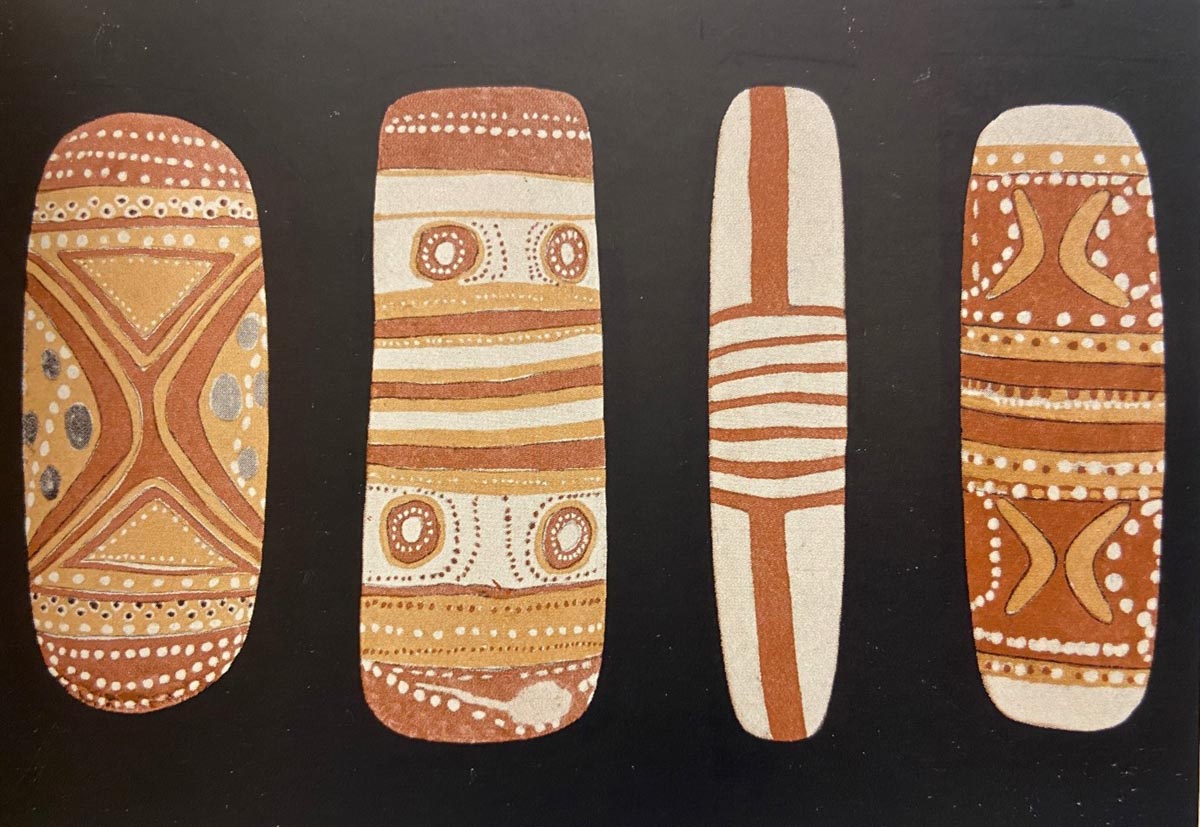
Almost twenty-five years after Roth departed Australia in 1906, the young anthropology graduate Ursula McConnel carried out detailed research at Yarrabah Mission, south of Cairns. Stimulated by her enquiries, several of the older men made a series of shields which she purchased and described. Most of these shields reside in the South Australian Museum, where McConnel’s careful documentation provides the meaning of their designs, which ‘might [otherwise] have vanished forever unrecorded’[11] She recorded that seven small decorated shields were deployed in secular ‘corroborees’, reenacting battles in which the shields were held aloft against a rain of barbed spears. Four larger decorated shields were for actual fighting, used in combination with heavy clubs.
McConnel understood that these shield designs derived from everyday objects – a tomahawk, boomerang, bark waterbag, fish, or leaves from particular trees. She reasoned that these could be regarded as ancestral designs. While they appeared entirely secular, McConnel noted two additional strands of evidence suggesting a link to the totemic ancestors, known as bǔlerǔ.[12] In former times, when a ‘graduating’ Gungganyji initiate received his initiation ‘marks’ (cicatrices), a new name and a shield, his father also ‘put him along some story’ (aligned him with the bǔlerǔancestor). It was then, McConnel wrote, ‘that he thinks what he is going to put on his shield’.[13] This insight was bolstered by further data. During her Yarrabah fieldwork McConnel also commissioned shields from three Kokopera men who had arrived at the mission from the Mitchell River on the Gulf of Carpentaria – the northern limit of shield use. Malcolm, Claude and George Wilson made four shields for McConnel. One was a long, narrow parrying shield, typical of those used throughout the south-eastern Gulf of Carpentaria to defend against clubs (known in this region as kuntjur, as discussed below). Its face was painted white with a vertical red-ochre stripe, crossed at the centre with red horizontal bars. McConnel was told by the Kokopera men that these bars represented the ‘marks’ made on a man at initiation.[14]
McConnel’s observations suggest that shield designs in north-eastern Australia may, after all, be associated with that crucial rite of passage, initiation – even if this link was all but subsumed or taken for granted in daily life. Roth and Aiston had been unable to unearth it, and it took a young female anthropologist to do so. In contrast to Central Australia though, where shields were transformed in ritual to become sacred objects, the motifs on eastern Australian shields were neither obviously sacred nor kept apart. The connection between totemic ancestors and the motifs seems to have been implicit rather than explicit. Shields barely figure in the body of literature relating to ritual and ceremony in eastern Australia, as in the bora initiation ceremonies documented by Howitt, Matthews, Roth or Curr. Without the ongoing stimulation for creative expression which ceremony and ritual provided, the question arises as to how shields of eastern Australia came to be so richly embellished with engraved and painted designs?
The answer lies partly in the ceremonial character of the choreographed battles which were the principal occasions for dispute-settling throughout eastern Australia. These events provided the primary context in which shield designs were seen and appreciated by large audiences. Recently initiated young men took these opportunities to parade their skills and to garner prestige through their fighting prowess, armed with spears, boomerangs, clubs and knives, and bearing gulmari shields with unspecified designs. In 1859 the journalist Eugene Ruttger witnessed a battle between 60 Mary River and 60 K’gari (Fraser Island) men, each bearing distinctively decorated gulmari shields. Their contest at Marlborough was observed by more than 1400 Aboriginal men, women and children. Ruttger wrote that it was ‘intensely interesting to watch the men on both sides trying to catch the point of a spear on their shields … the marks of a spear in a shield were highly prized’.[15] The decorative complexity of Queensland shields increases to the eastward, and perhaps it is not coincidental that the frequency and size of these set-piece battles with spears, clubs, boomerangs and shields also increased to the east of the Dividing Range.
Shield embellishment in north-eastern Australia may be best understood within this secular context of conspicuous display and self-conscious competition. It stands in stark contrast to the Central Australian situation. How to explain this? Differing cosmologies provide the biggest clue. The major shift in the role of shields within Central and Eastern Australian societies matches the fundamental contrast in those societies’ ways of accounting for the worlds they inhabited. That transition was first mapped by E.H. Curr during the 1880s, but only reached a broad audience during the mid to late twentieth century through Norman Tindale’s map of ‘Aboriginal tribal boundaries’[16] As with Curr’s map, Tindale’s map included additional lines of demarcation, dividing those Aboriginal groups practising circumcision and subincision as their key initiatory rites, from those groups in eastern, far western and northern Australia who relied on other initiatory practices.
These circumcision and subincision lines not only marked an ecological transition – from the arid inland to more temperate or tropical regions – they also marked a fundamental cosmological shift. To the west of the line running north-south from the Gulf of Carpentaria to the Mount Lofty Ranges bordering the Adelaide Plains, circumcision was (and in Central Australia still remains) the defining rite of passage for the initiation of boys as men. Bean-tree shields figured strongly in these ceremonies, decorated with the initiates’ totemic motifs, integral to the totemic ceremonies they would later perform and manage. To the east of the line the initiatory rites of passage involved significant ordeals and a symbolic rebirth of boys as men, but did not include the circumcision rite and did not involve shields.[17]
Circulating objects and ‘loose provenance’
While north-eastern shields can be seen as essentially secular objects, their designs derive from the enhanced knowledge received by young men on their initiation. McConnel’s insights suggest that with this status and knowledge came the right to bear a shield and to decorate it with designs in preparation for battle. McConnel was prepared to speculate that the warrior’s reliance upon ‘the protective power of the bǔlerǔ’ meant that those designs necessarily emerged from that connection.[18] ‘It seems likely’, she wrote, ‘that the inspiration of the artist’s choice of design on the shields … was originally drawn not merely from an intimacy with the ‘common’ objects of every-day life but from a belief in the bǔlerǔ’, who were responsible for the creation of these objects … and who impregnated them with their spirit…’[19]
A key question is whether it is possible to classify the bewildering variety of shield designs – particularly among the gulmari shields of eastern Queensland. These designs seem chaotically varied, but resemblances and discernible ‘sets’ of motifs do become evident. Even so, while analysis of gulmari shields suggests recognisable categories among the plethora of variant designs, available provenance data suggests that these recognisable designs are not readily or dependably linked to locales.
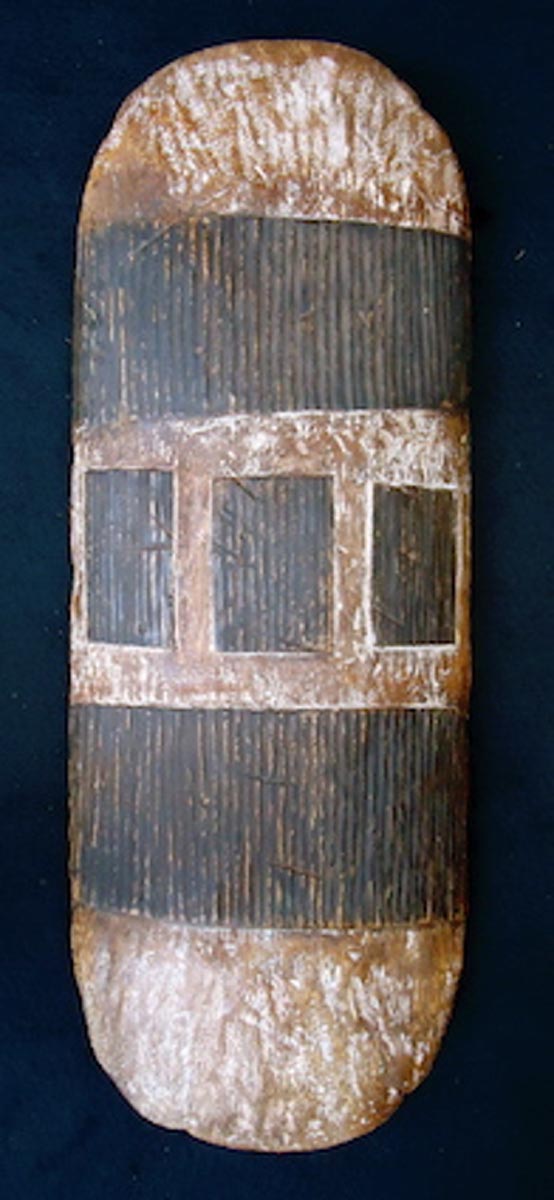
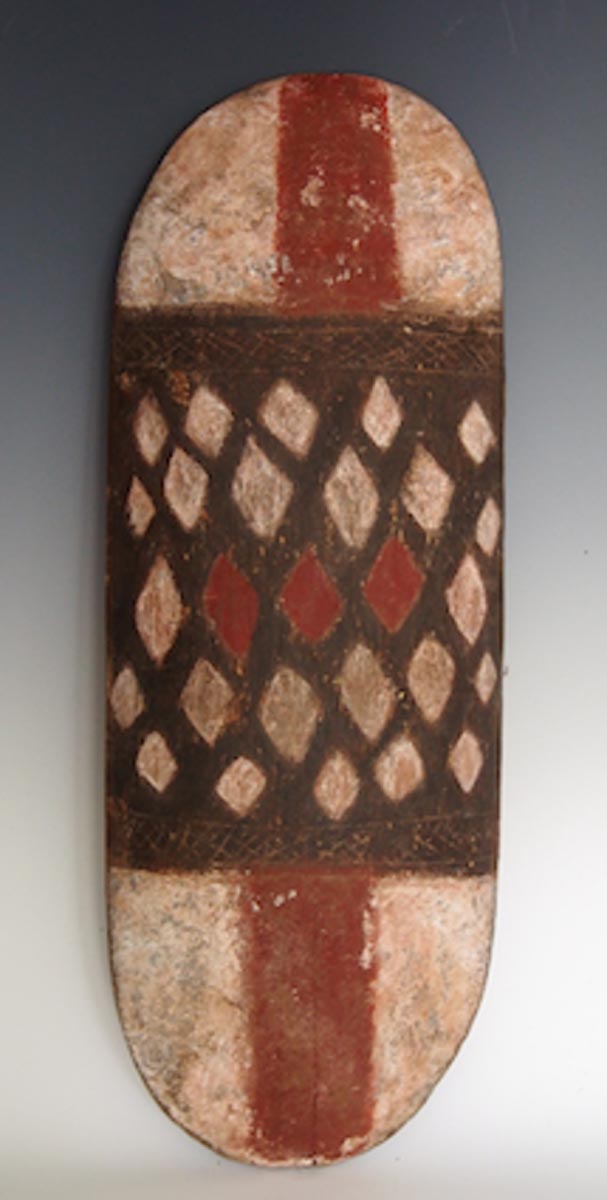
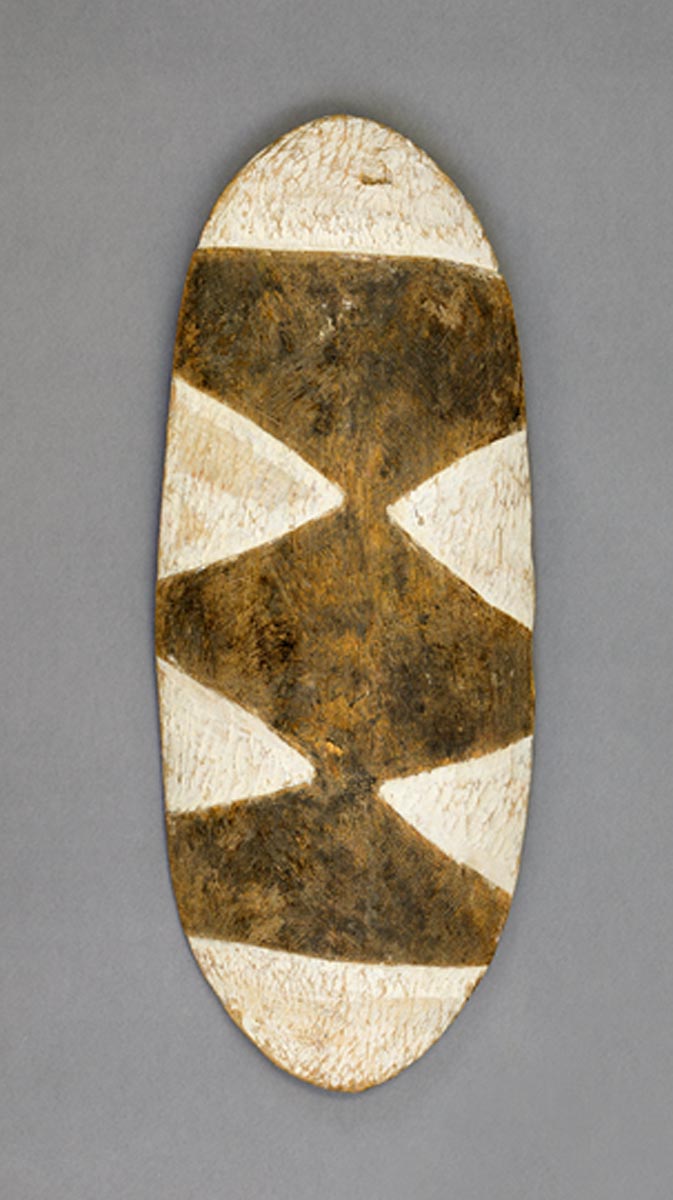
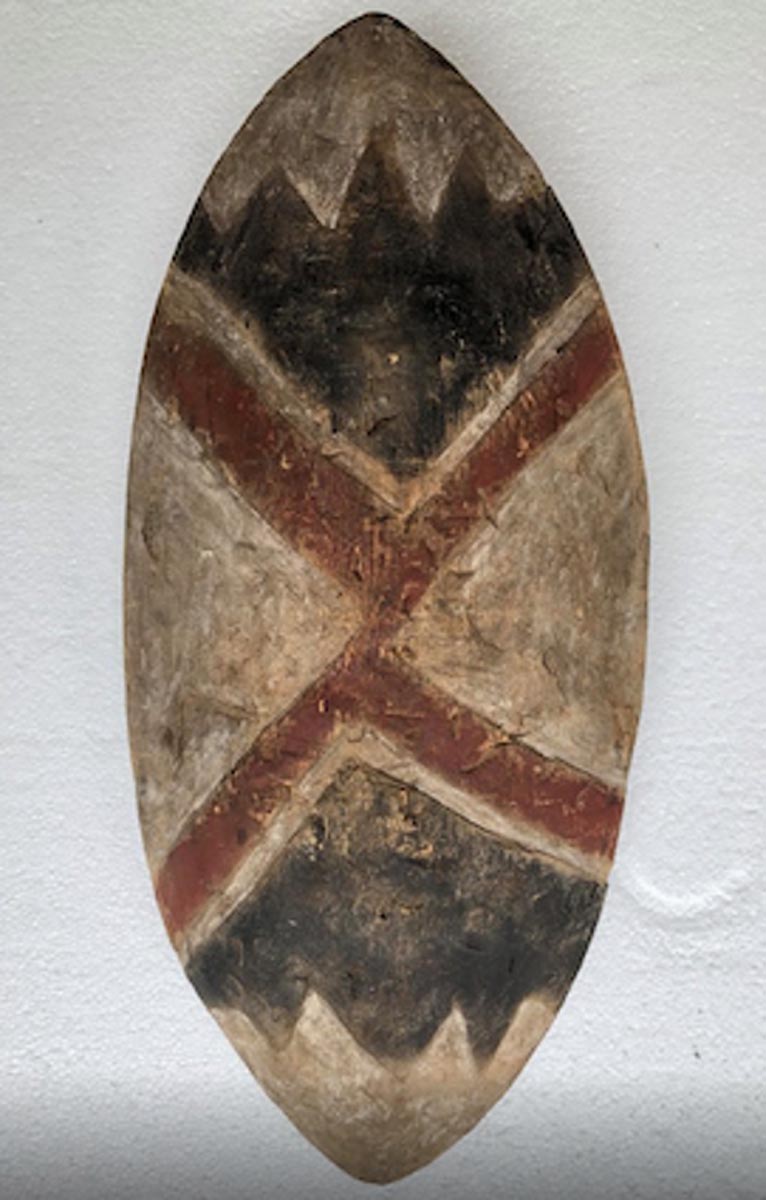
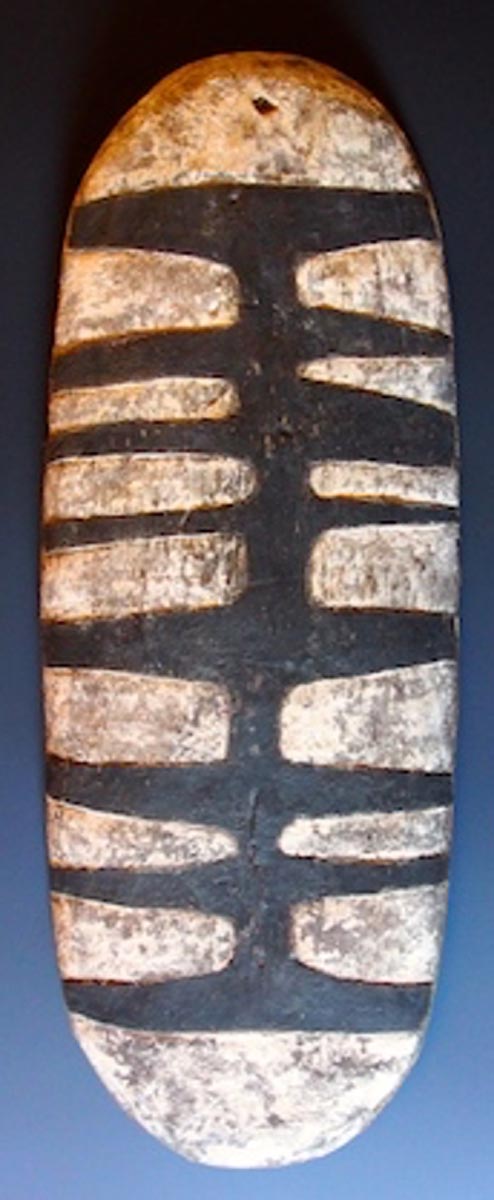
A century ago, of course, this task would have been much easier, but few ethnographers rose to the challenge. Walter Roth was the main early exception. Working between Rockhampton and Brisbane during the 1890s he noted characteristic local variations in gulmari shield designs. He proposed a classification according to engraved and painted designs specific to six localities. His view was that each ‘main encampment used separate characteristic gravings on the anterior surface’.[20] This may well have been the case, but how should we account for the fact that gulmari shields with those ‘characteristic’ designs are documented at localities well beyond the particular encampments observed by Roth? With his detailed accounts of trading and exchange between and within allied groups, Roth himself provides part of the answer. Shields were among the most traded items of material culture – whether men travelled to the sources of shield production or whether the shields circulated along ‘chains of connection’ to their new owners.
Fig.2 A selection of unprovenanced gulmari shields from eastern Queensland (private collections)
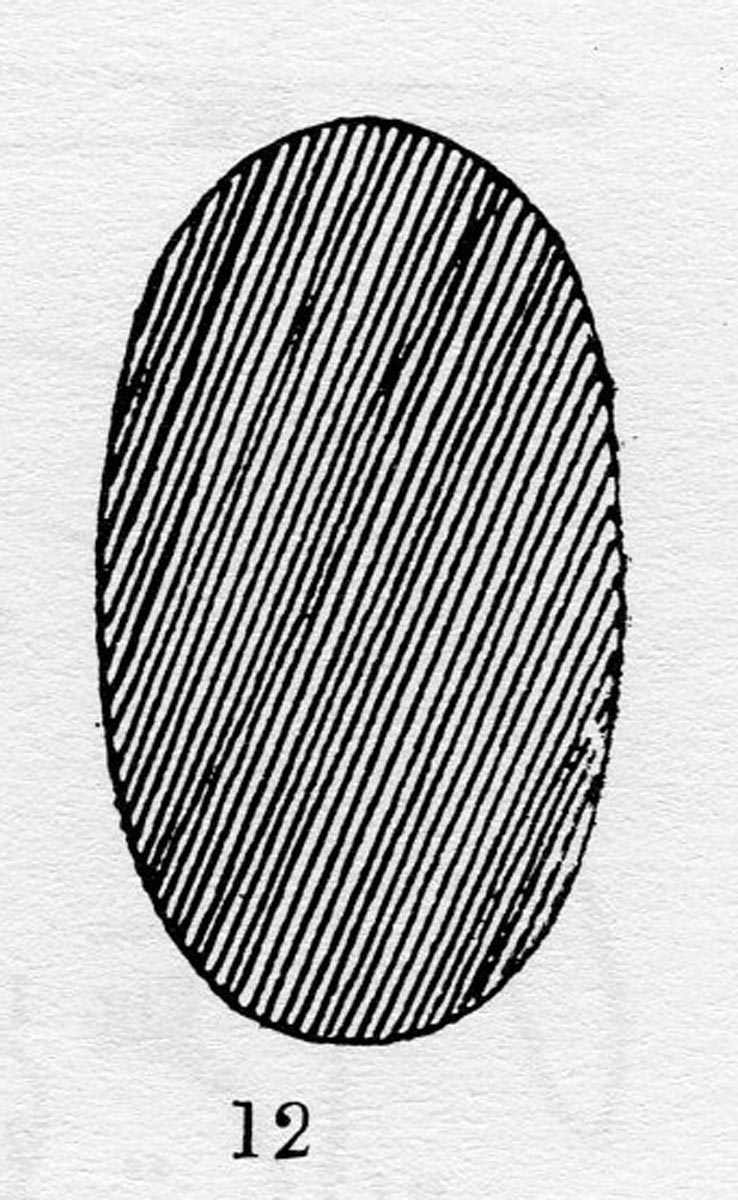
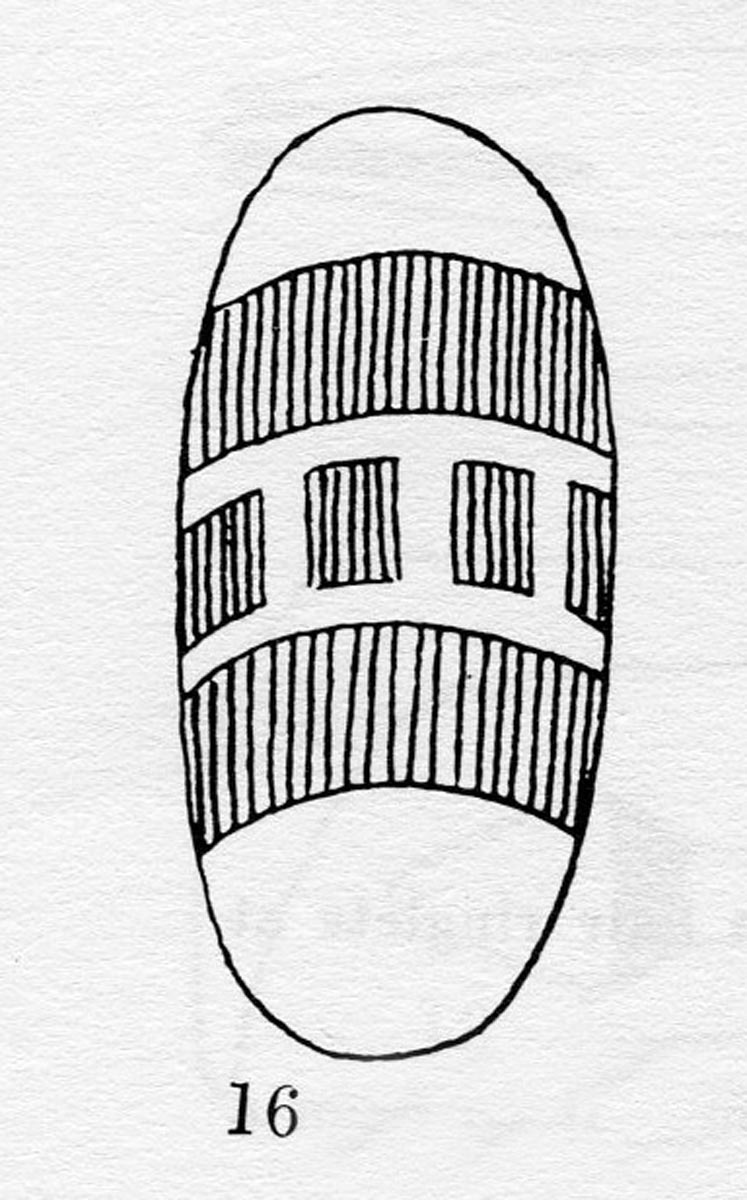
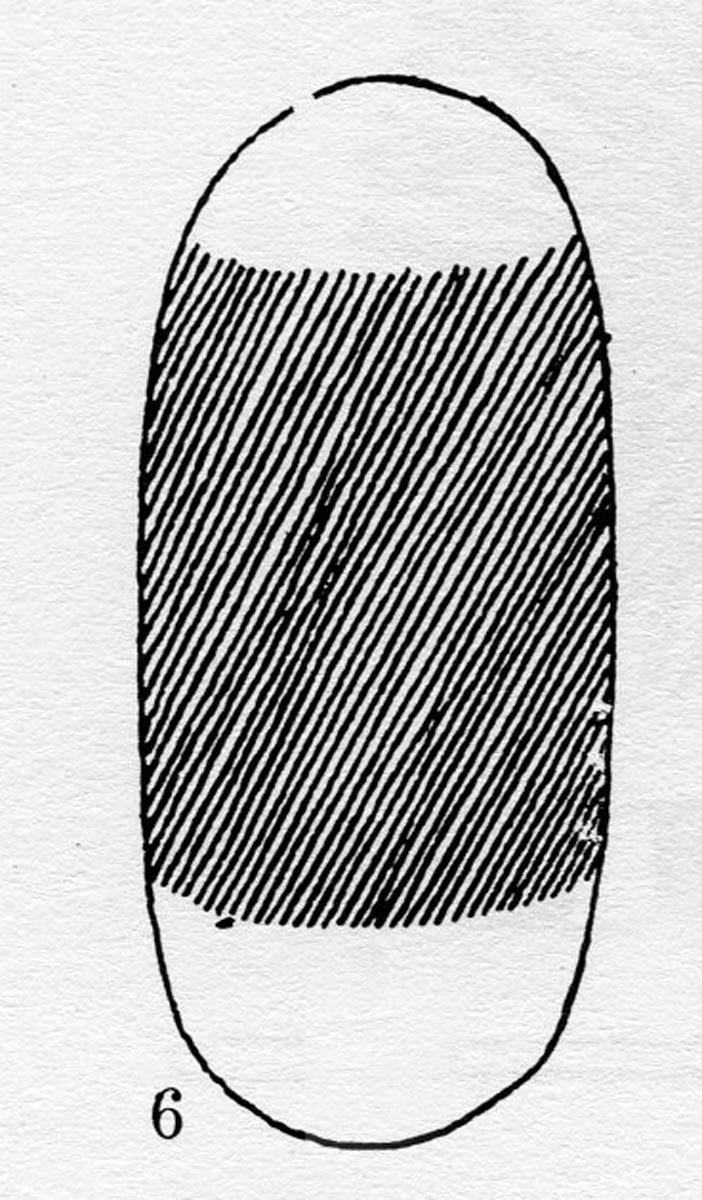
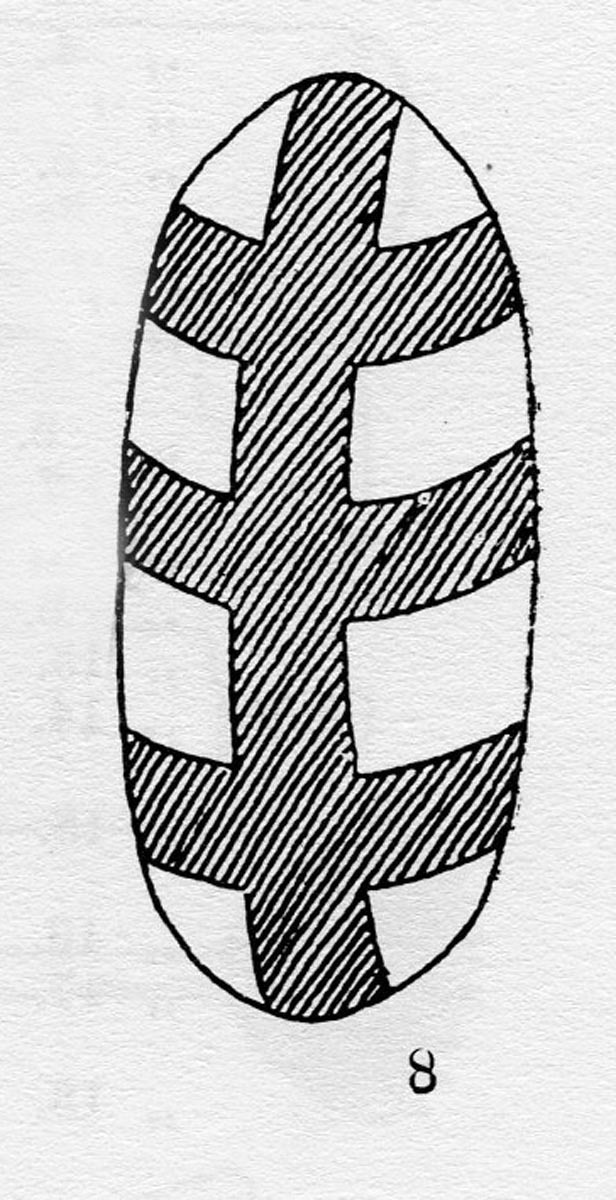
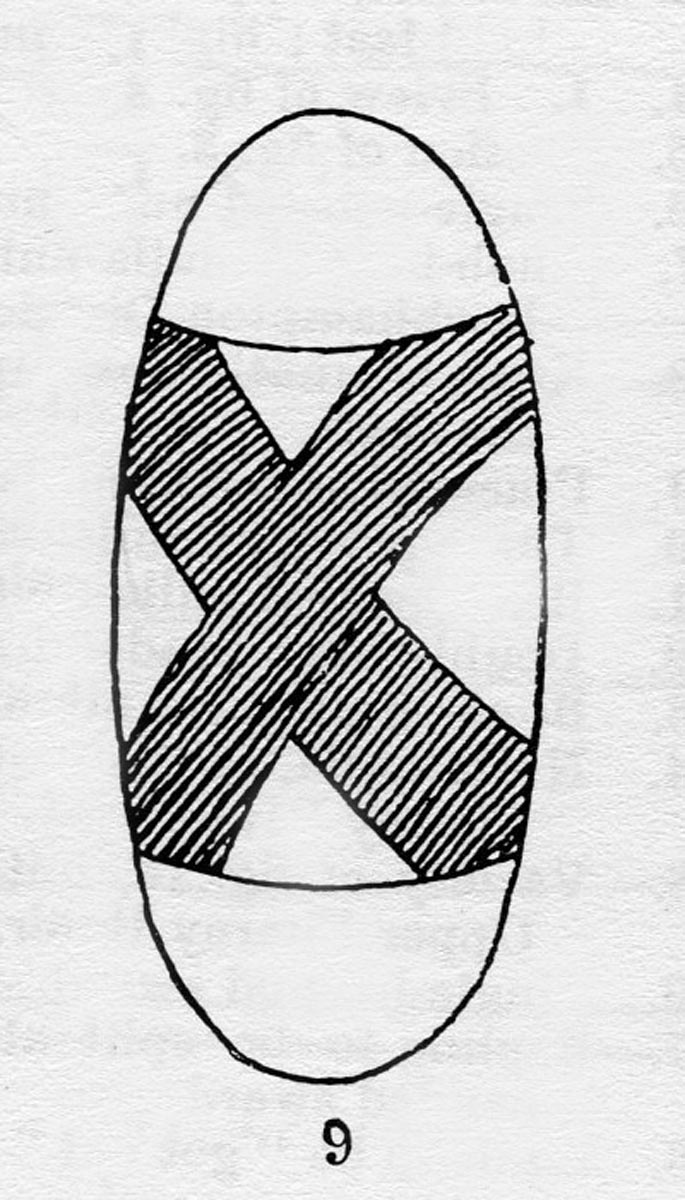
Fig.3 Five gulmari shield designs, provenanced by W.E. Roth (l. to r.) as follows: #6: Rockhampton; #8: Yeppoon; 9: Marlborough; 16: Brisbane; 12: Tilpal, Torilla.
What set the limits to this trade and to the potential distance of a ‘provenanced’ shield from its point of origin? While we must accept that every shield was made at a particular, defined locality, it seems that many shields were traded or taken to other localities, sometimes over great distances. This question has hardly been explored within Australian material culture studies. It is fortunate that nineteenth and early twentieth-century ethnographers such as Roth, Spencer and Gillen, Matthews and Tindale noted the phenomenon and attempted to account for it. Their ethnographic data suggests that Aboriginal groups which traded together were also likely to be linked by shared language and by ‘bonds of consanguinity’. Those bonds might apply across a thousand kilometres and ‘provenance’ necessarily becomes a looser concept. Allied groups used similar material culture, both in daily life and in their conflicts with each other. We might expect then, to find that if language terms for shields are localised and mapped, this distribution might correspond to those broader patterns of circulation.
The linguistic turn
Enter linguistics, with the assumption that shared terms for ‘shield’ might suggest a new way of investigating or tracing their provenance. The accompanying map of 168 Aboriginal language terms for shields in north-eastern Australia is based primarily on two important sources. The Australian Race, published in 1886-1887 by the ethnographer E.M. Curr, surveyed more than 200 pastoralists or officials who were able to gather details and vocabularies from Aboriginal groups. Curr’s survey includes more than 100 shield terms recorded from north-eastern localities, where shields were largely still in use. Fifty years later, particularly during his 1938-1939 Harvard-Adelaide Universities Expedition undertaken with Jo Birdsell, Norman Tindale gathered additional Queensland vocabularies, expanding Curr’s listing by 40 more terms.[21] The resultant mosaic of names overlaps here and there, but is defined enough to create an impression of identifiable ranges for the main shield types of north-eastern Australia.
Museum examples of Queensland gulmari shields provide the leading example. These shields, relatively small and of similar form, but decorated with variant motifs, were collected and described (in text and imagery) throughout a broad area of eastern Queensland. Despite the extent of this distribution, spanning perhaps a dozen distinct Aboriginal countries, these shields were known by the same term, gulmari. Map 3 shows 40 of those terms using the early spellings. Their distribution correlates with the Maric linguistic sub-group in eastern Queensland, a group distinguished by ‘very similar grammatical forms … indicating that they make up a small genetic subgroup’. This may help to account for the appearance of similarly embellished gulmari, hundreds of kilometres apart.[22]
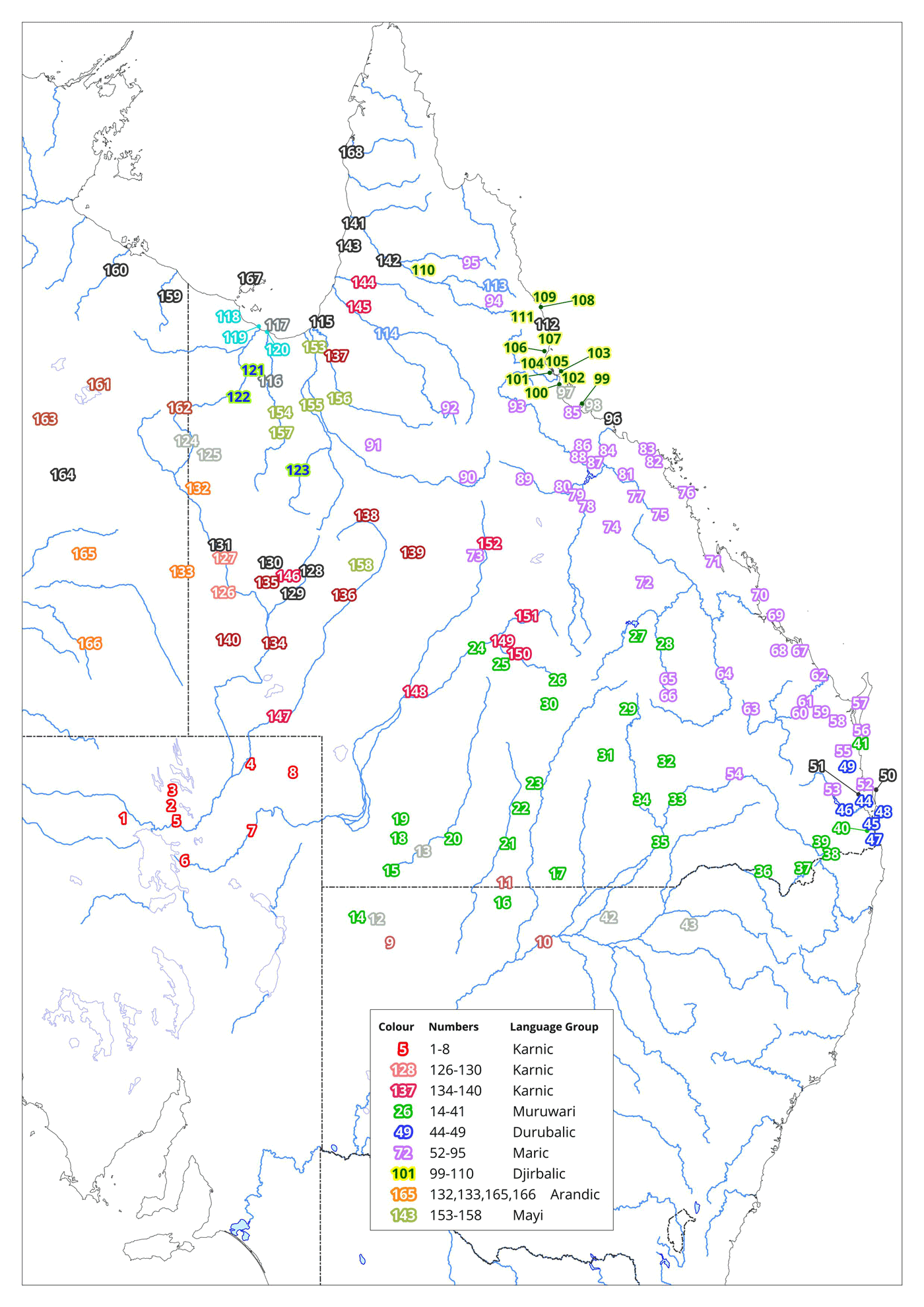
The map’s linguistic evidence supports the proposition that while shield designs may have had their original locus in particular ‘encampments’, as Roth maintained, they could be traded to the limits of reciprocal exchange and linguistic intelligibility. At ceremonial battles throughout the Maric region it is likely that warriors fought with gulmari shields of similar form and shape, albeit with differing decoration. As observed elsewhere in Aboriginal Australia, groups that traded together, spoke the same or cognate languages and shared similar cosmology, also fought together with similar weapons, part of an ‘ancestral kit’ mandated by shared totemic ancestors.
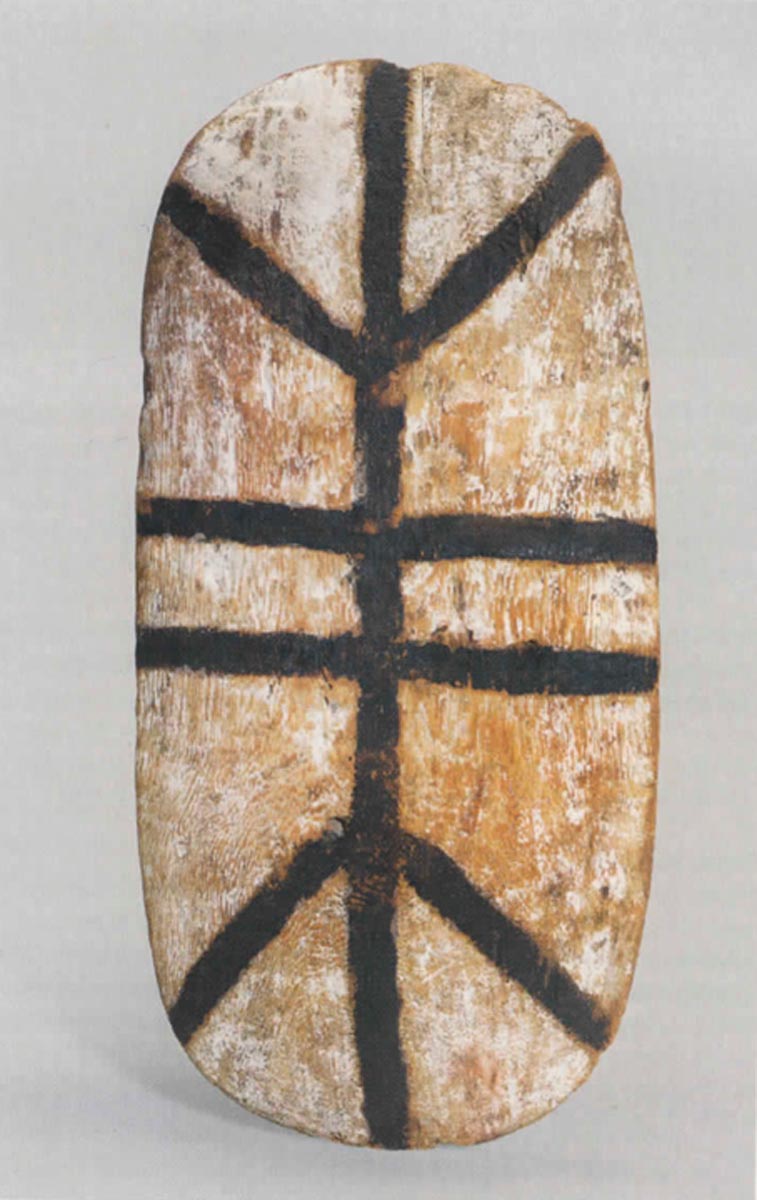
While the correlation between single shield terms (gulmari, burrgu, pik:in) and linguistic sub-groups clearly applies to shield types in the east of the study area, such a correlation is less evident in western Queensland and in the Gulf country. Throughout the Karnic language sub-group of south-western Queensland and north-eastern South Australia a single shield type was used, but was known by several different names. In the southern part of this Karnic region Walter Roth concluded that these large bean-tree shields were derived from a particular stand of bean-tree found on Old Noranside station, about 100 kilometres to the north of Boulia. During the 1890s Roth had no means of determining the southern extent of trade in these ‘Noranside’ shields, but other ethnographic evidence confirms that they were traded as far south as Lake Eyre South, 1000 kilometres distant. In their general form these shields resembled Central Australian bean-tree shields, but whereas Central shields were undecorated in secular life, ‘Noranside’ shields’ were permanently embellished with a limited suite of distinctive designs (such as an elaborated )( or X motif), drawn in pigment and/or finely engraved.
One might expect that these shields would retain a single language term as they were traded throughout the same language sub-group, the Karnic. In contrast to the Arandic language sub-group region to the west, and the Maric sub-group to the east, where a single shield term was used in each case (alkwert; gulmari) ‘Noranside’ shields were defined by at least eleven different Karnic terms. The explanation may lie in the fact that the Karnic ‘is an older group with a longer time depth, within which lexical diversification and development of multiple terms has taken place’.[23]
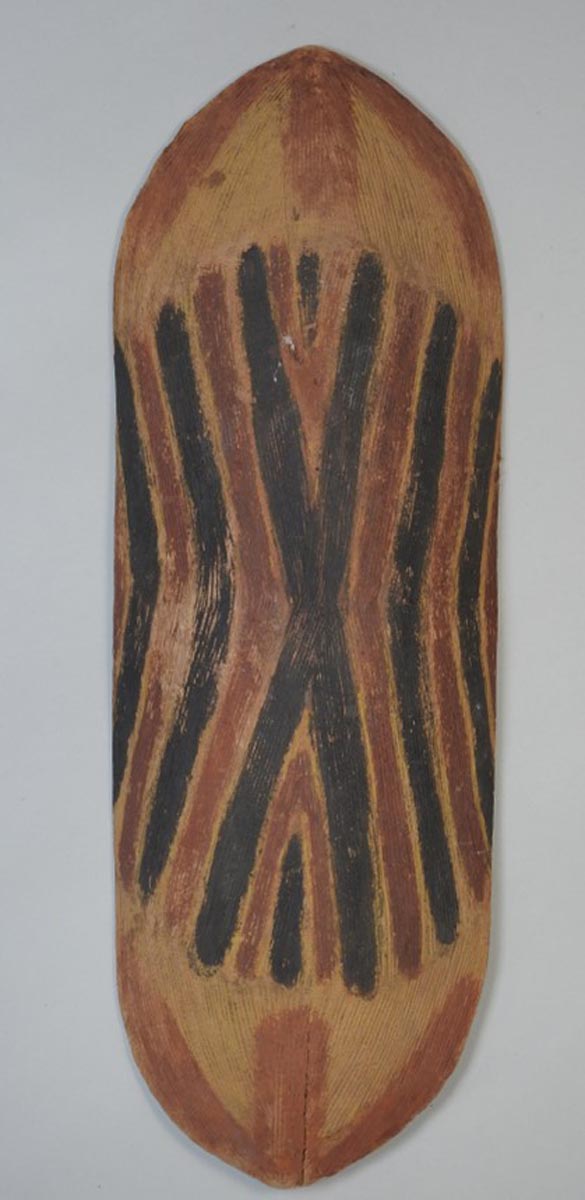
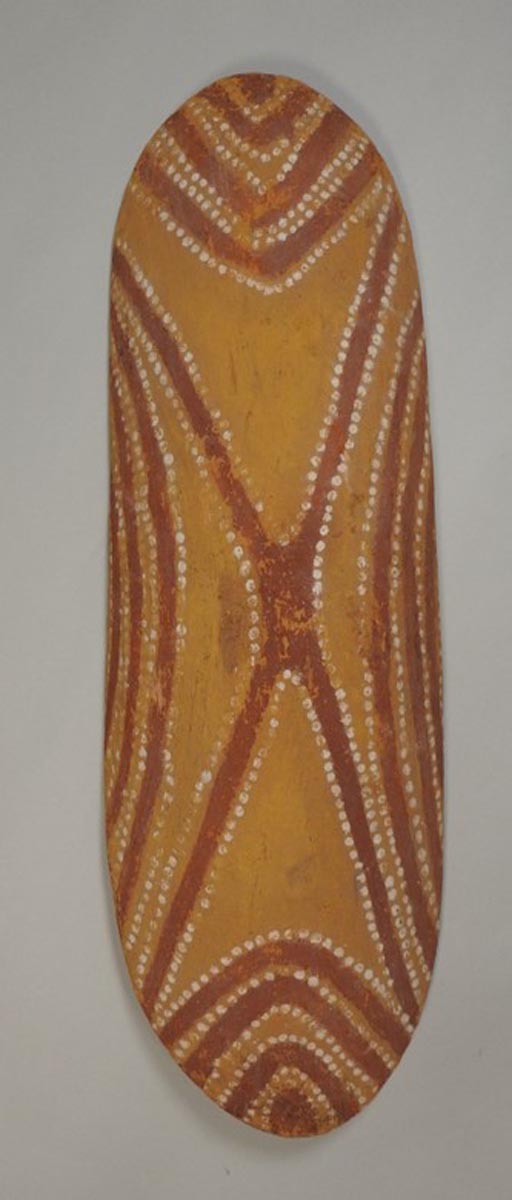
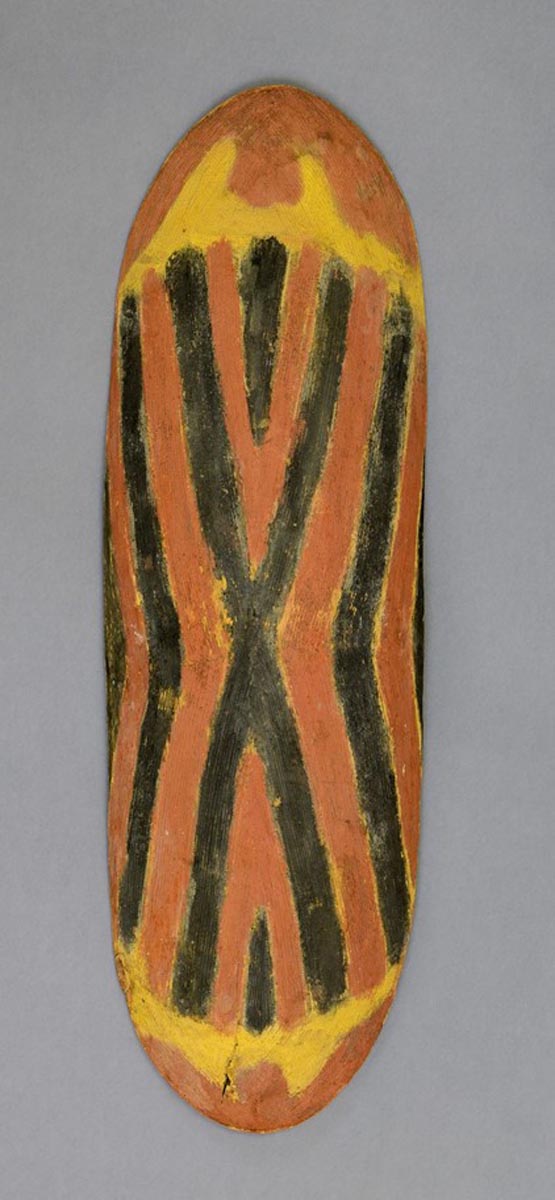
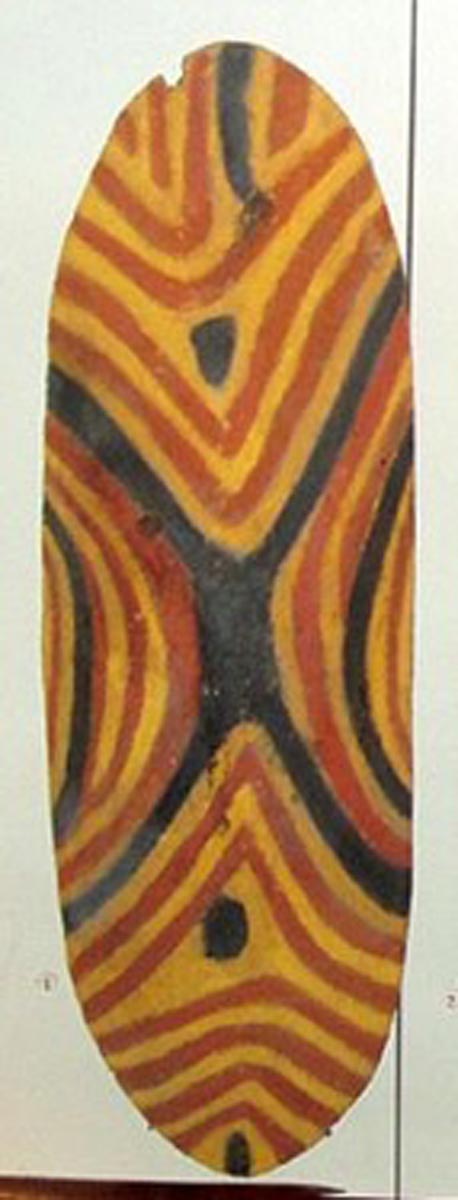
Fig.5 Four ‘Noranside’ shields, with variations on a principal design distributed across south-west Queensland and north-east South Australia. Left to right: A2233 (Birdsville); A2236 (Cooper Creek); A2235 (Diamantina); A32426 (s-w Qld). S.A. Museum.
Similarly, while several different terms were applied to the Riverine shields of southern Queensland (south-west of the Maric and south-east of the Karnic linguistic sub-groups), the dominant term was burrgu. That term can be traced to the Muruwari language, an ‘isolate’ language spanning the Queensland-New South Wales border.[24] The burrgu term seems to have expanded north though, well beyond the Muruwari region itself into language areas classified within the Maric and Karnic sub-groups. Given that the Riverine shield-type is difficult to distinguish from shields used by both the Maric and Karnic people, it is not easy to account for this broad distribution of the burrgu term.
Problems of a different order arise in the Gulf country, close to the northern limits of shield use. The museum sample of well-documented shields for this region is rather small and the linguistic data is thin, but it indicates that shield terms were more varied and were applied more locally than elsewhere in the region. The most distinctive and recognisable shield type in the Gulf region was the tall, thin shield, kuntjur, used mainly in fighting with clubs, and decorated with red stripes against a white ground. The kuntjur term was applied to shields in the region from Normanton north-east to the Mitchell River, acknowledged as the extreme northern limit of shield use. On the western side of the Gulf similarly tall and thin shields were also recorded, perhaps as far north as Ngukurr (Roper River), where examples of these shields were collected during the 1890s. It is possible that these shields had been brought north in post-contact times by Aboriginal men from further south, for example at Borroloola on the MacArthur River.
The linguistic map also contains several intriguing distribution patterns. We see terms such as mida and other spellings in the south-western Gulf area; that term is cognate with shield terms in the north-eastern Northern Territory.[25] It is also possible to discern a band of instances of the variant terms tumburu and yamboru, extending south from the Gulf almost to the New South Wales border. Like most of those mapped terms, these represent records obtained from Curr’s and Tindale’s Aboriginal and European informants and are not associated with actual shields; unless collectors documented the terms applying to their shields at the time of collection, it will be difficult to draw conclusions from this data.
Conclusion
‘Provenance’ is not a straightforward term, even if we push the discussion well beyond the auction-house chain of recent possession. While it is often possible to ascribe provenance to the place of collection, it is important to take into account the mobility of European collectors themselves and the inaccuracy of their own attributions. Most importantly though, we need to take into account the dominant principle of reciprocity within Aboriginal societies, which can account for the appearance of artefacts hundreds of kilometres from their source. Artefacts such as shields and boomerangs were participants in the constant interplay of reciprocity across Aboriginal space. It seems clear that ‘provenance’ in Aboriginal material culture must extend beyond a simple correlation between an artefact, its ‘biography’ and its source. Shields were the epitome of mobile objects, in the hands of mobile people who were nevertheless bound to their countries, their traditions and their languages. Examining the recorded language terms for these mobile objects may offer another tool for understanding a ‘looser’ provenance, within an expanded context of circulation. The map of shield terms presented here suggests that despite naming variations, the main shield types circulated within language group clusters composed of peoples who traded together, fought together, spoke similar languages and shared cosmology. Objects, like their owners, circulated along lines of consanguinity and affection. A map of shield names can provide new insights, both from a linguistic angle and by constructing a revealing mosaic of shield terms – a ‘figure in the carpet’.
Philip Jones is Senior Curator, Anthropology, South Australian Museum
[1] War, Art and Ritual: Shields of North-Eastern Australia, edited by Bill Evans with contributions from Bill Evans, Michael Aird, Wally Caruana and Philip Jones, will be published in 2024. It will feature 120 shields from public and private collections in Australia, Britain, Netherlands, and the United States.
[2] Spencer, W.B. and Gillen, F.J. 1904. The Northern Tribes of Central Australia. London, MacMillan, p.633.
[3] Ibid, p.633.
[4] Best, A. Regional variation in the material culture of hunter-gatherers. Social and ecological approaches to ethnographic objects from Queensland, Australia.Oxford, BAR International Series.
[5] Spencer, W.B. and Gillen, F.J. 1904, p.12.
[6] Among the Central Australian Warlpiri and their congeners, kurdiji is not only the term for shield; it is also applied to the initiation ground (apparently as the ground is shield-shaped). This broader usage may well have assisted in the promotion of kurdiji as a regional term (pers. comm. D.G. Nash, 4 September 2023).
[7] Roth, W.E. 1897. Ethnological Studies among the North-West-Central Queensland Aborigines. Brisbane and London, p.150
[8] Horne, G. and Aiston, G. 1924. Savage Life in Central Australia. London, MacMillan, p.81.
[9] Roth 1897, p.204.
[10] Roth 1897, plate XIX, and discussion, pp.144-145.
[11] McConnel, U. 1935, ‘Inspiration and Design in Aboriginal Art’, pp. 49-68 in Art in Australia. May 1935, p.56.
[12] Ibid, p.56.
[13] Ibid, p.56.
[14] Ibid, p.50.
[15] The Northern Champion, 6 June 1931, p.2. Ruttger’s name was misspelt in this article.
[16] Curr, E.M. 1887. Continental Australia: showing the routes by which the Aboriginal race spread itself throughout the continent. Vol IV. The Australian Race: its origins, languages, customs, place of landing in Australia, and the routes by which it spread itself over the continent. Melbourne, Government Printer; Tindale, N.B. 1940. Map showing the distribution of the Aboriginal tribes of Australia. AA338, South Australian Museum Archives; Tindale, N.B. 1974. Tribal boundaries in Aboriginal Australia [map]. University of California Press.
[17] Variously known as Baiame, Ngurunderi, Daruwal and other terms.
[18] Indeed, there is no evidence that any Aboriginal group, prior to European arrival and impact, produced ‘art’ which was not cosmologically relevant and meaningful.
[19] McConnel 1935, p.56.
[20] Roth 1897, pp.205-206.
[21] Tindale, N.B. 1938-1939. Parallel Vocabularies, AA338-8, South Australian Museum Archives.
[22] Dixon, R.M.W. 2002. Australian Languages. Their Nature and Development. Cambridge, Cambridge University Press, pp.660-661.
[23] Pers. comm. Peter Austin and David Nash, 5 September; 7 September 2023.
[24] Bowern:
[25] Nash, pers. comm.