Cairns Art Gallery, 8 October-11 December 2022.
Review by Margaret Cassidy
This comprehensive retrospective of Torres Strait Islander artist Segar Passi was an unexpected discovery on a recent visit to the Cairns Art Gallery and a wonderful exhibition of the respected Zenadth Kes artist who turns 80 this year. 2022 is also the 30th anniversary of the Mabo case where the High Court of Australia ruled in favour of Meriam Mir Elder Eddie Mabo and the Meriam Plaintiffs that returned their land rights to them after 200 years of Anglo-Saxon colonisation.
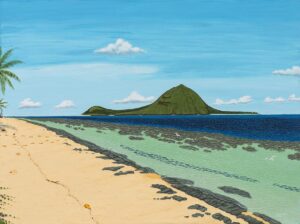
The exhibition is a feast of colour, centred on his large acrylic painting of his home island, Mer, one of the three volcanic islands along with Dauar and Waier which make up the Murray Islands, the most easterly group of islands in the Torres Strait.
Curated by Peggy Kasabad Lane also from the Torres Strait, this exhibition features art from across Passi’s lifetime from the now fragile luminescent watercolours of his youth through to his recently commissioned large acrylic works. As his eyesight is failing, these are his last paintings.
A nephew of Eddie Mabo, Segar Passi was born in 1942. He displayed a precocious drawing ability as a child and is self-taught and very observant of the natural world around him. Growing up on the remote island of Mer, he would make pigments by grinding up local coloured stones and mixing them with seawater and used dried pandanus as brushes to paint on large flat rocks. Later his mother bought him water colours.
In 1967 the Queensland Government sent young teacher Margaret Lawrie to report on the health needs of the local community. Local people invited her to record their stories and she encouraged Segar Passi to create watercolours of Mer’s birds and marine life, together with pencil drawings of children and island life. These and other drawings by other local islanders were reproduced in two books, Myths and Legends of the Torres Strait (1970) and Tales from the Torres Strait (1972) with the original paintings now held by the State Library of Queensland and included in UNESCO’s Australian Memory of the World Register.
The works in this exhibition cover the five key themes of Passi’s lifetime of painting – our land and sea; Ailan (island) life; cultural stories and customs; weather patterns; and nature which includes detailed watercolours of birds, fish and plants. The colourful and somewhat magical weather patterns capture the meaning of different cloud formations for predicting the suitability of the weather to go boating, fishing and planting crops on Mer.
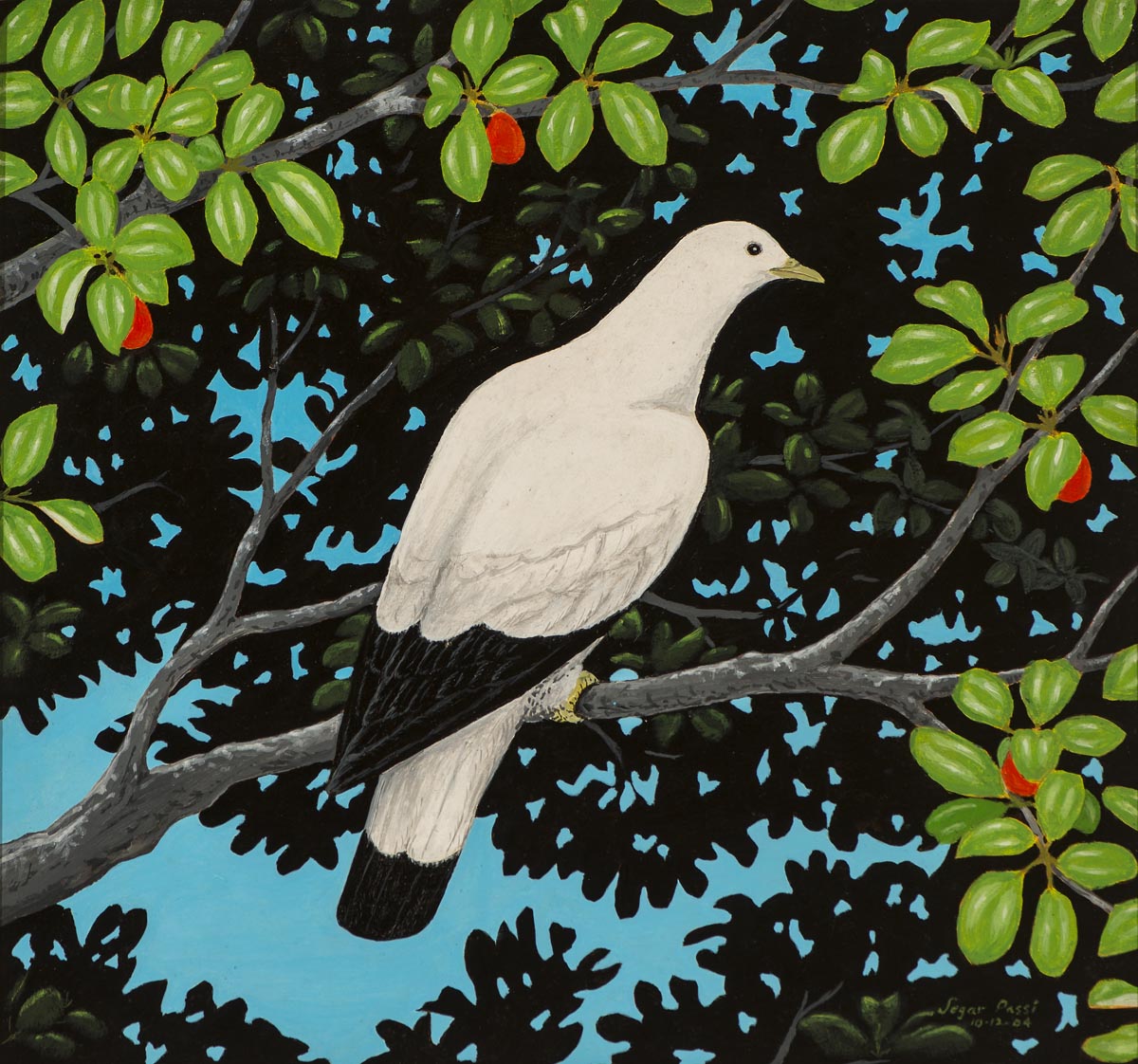
Other highlights include Passi’s detailed and accurate capturing of the colourful Torres Strait Island pigeon eating the local wongai wild fruit plum. The symbolism incorporates both elements of his Christian faith and the local belief that those who eat the wongai will return to Zenadth Kes. Passi studied at the Theological College of St Paul’s on Moa Island as well as textiles at Darwin TAFE. The people of Zenadth Kes have adopted Christianity Ailan way since the arrival of members of the London Missionary Society in 1871. Passi’s paintings incorporate both information from Christian belief systems and ancestral beliefs that uphold connections to land, sea and sky.
Segar Passi’s paintings are not meant to be just pleasing to the eye (though they certainly are that). The detail in them is included so as to pass on to future generations the history and cultural knowledge of Zenadth Kes.


