
By Krisztina Turza
When I boarded the plane from Brisbane to San Francisco in February as a last minute decision, I could not have imagined that rather than the first, it could potentially be the last tribal art show of the year.
To a first timer at the San Francisco Tribal & Textile Art Show and to the city itself, the event held in the Fort Mason Centre with its majestic view of the Golden Gate Bridge in the background looked very familiar on the opening Friday afternoon. This year, two art fairs, the Tribal & Textile Art Fair and the Native American Art Show, were combined into one event and I understand this had a detrimental impact on the number of tribal art dealers who usually frequent the show. While this was disappointing, I was keen to focus on those familiar faces and get immersed in the Native American art selection as well.
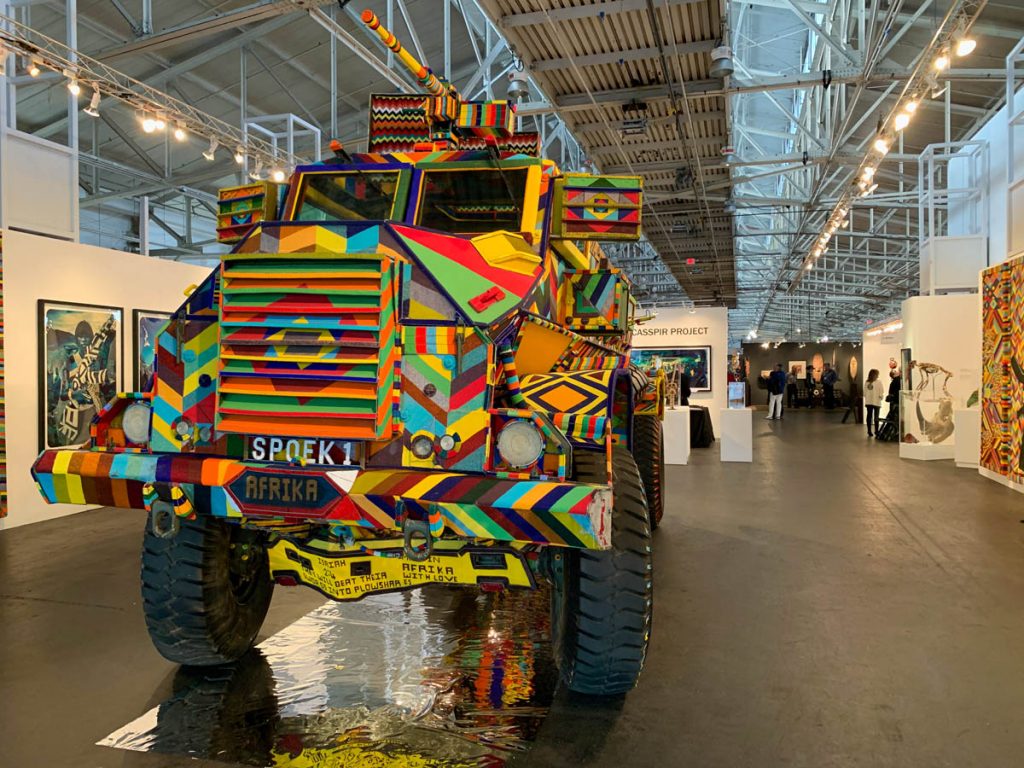
Entering the warehouse-looking space, I encountered the special exhibition ‘The Casspir Project’. Ralph Ziman’s captivating collection, comprising the installation and photography of glass-beaded weapons, was unique in many ways. Casspir is an anagram of the acronyms SAP (South African Police) and CSIR (Council for Scientific and Industrial Research), designed in South Africa in the late 1970s apartheid era and used extensively by the South African Police and Defence Force. It was bulletproof, mine-resistant, and as a military vehicle, it was extensively used in urban, township areas against the civilian population. Post-apartheid, the Casspir were decommissioned in South Africa, left to rust, with the few exceptions that were sold to the US during the Iraq invasion. The military vehicle in the middle of the foyer was a surviving example, that contained no less than 70 million glass beads! The colourful and vibrant images with beaded weapons and rifles provided a contrast between destruction and beauty, between utility and l’art pour l’art, leaving the audience pondering for a long time.
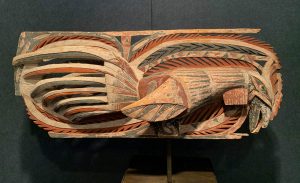
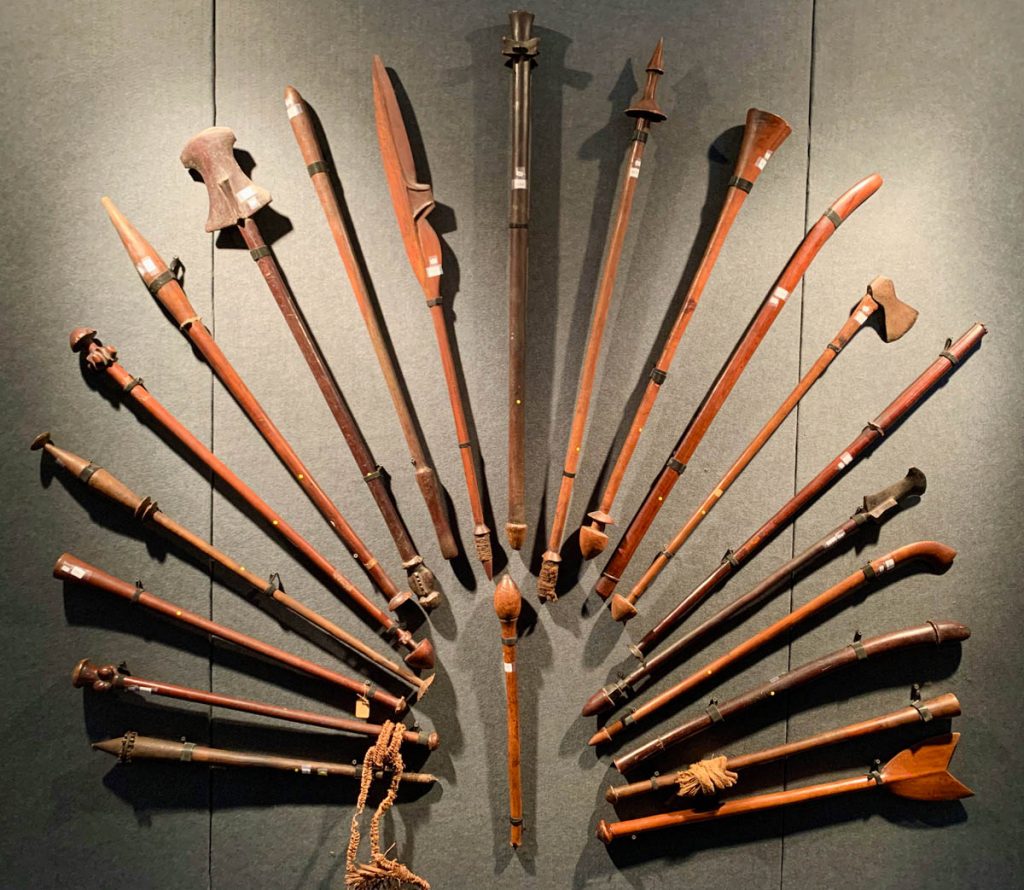
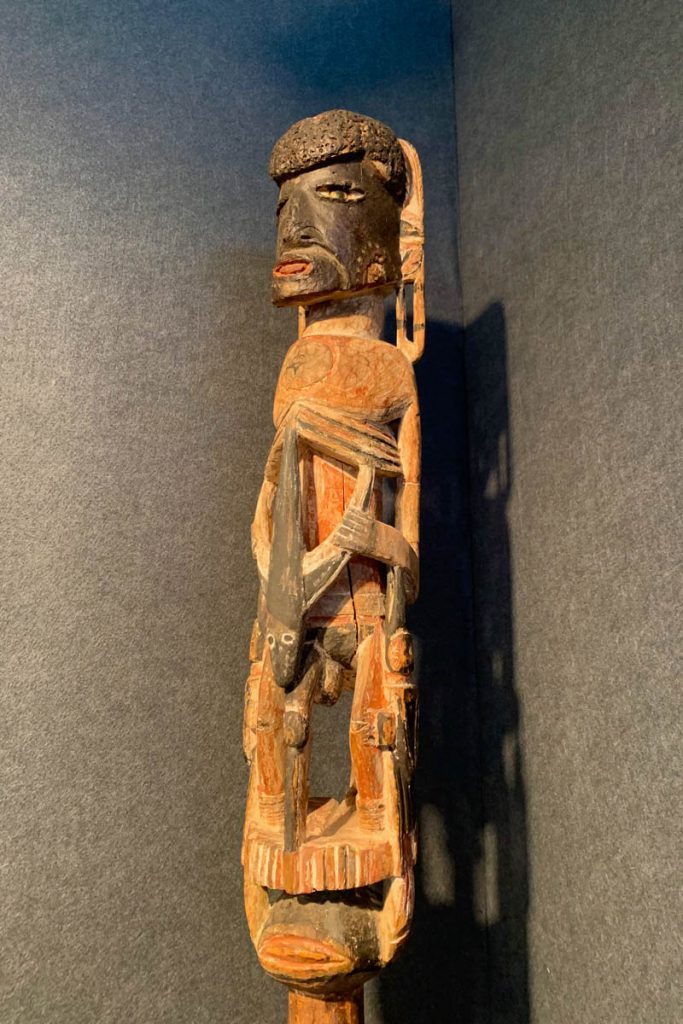
After leaving the bead-assembly, Michael Hamson’s was the first booth in the main area. Across the walls, there were neat exhibits from Vanuatu and various Polynesian war clubs, whilst within the exhibition space, a number of great New Ireland pieces welcomed the audience.
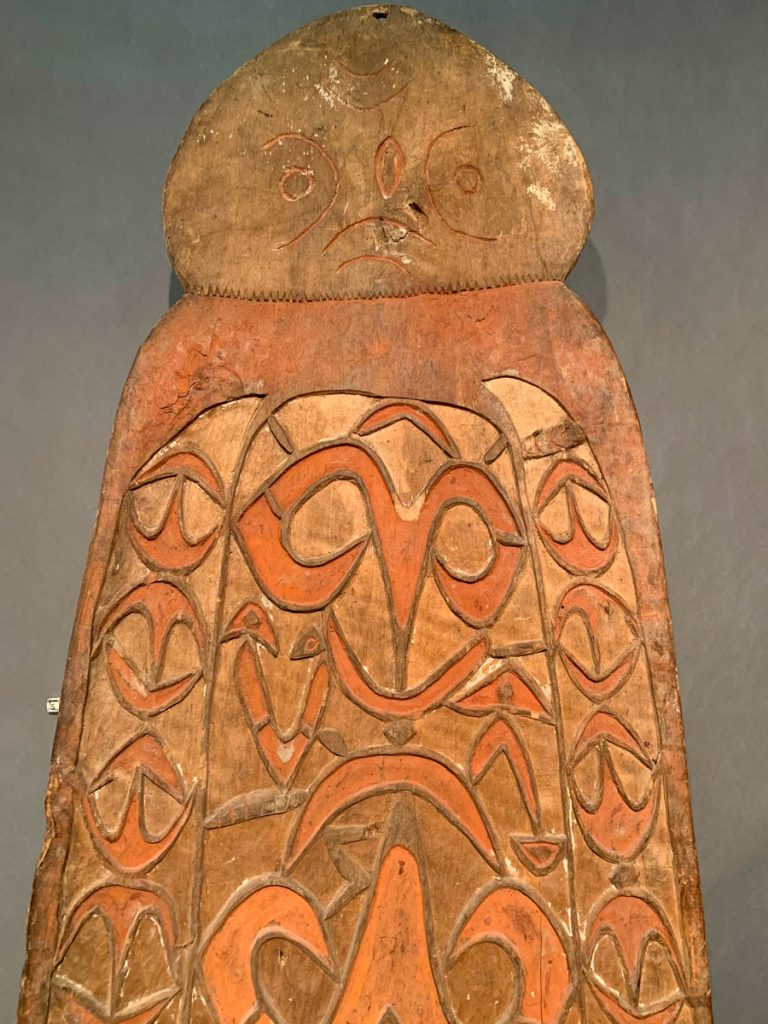
Marc Assayag’s exhibition comprised Abelam yam masks in conjunction with his recent book, ‘The Stars Are Eyes, A New Perspective on the Art of Abelam’, accordingly to which – as I understand – the novelty in interpretation of Abelam masks lies within a new approach that highlights the blind spot of Abelam art, which has remained hidden to the Western world (spoiler: turn your Abelam baba masks upside down, and you’ll get the picture).
The few gallerists from Europe included the London-based Bryan Reeves with some great African pieces; Marcus Raccanello with three Aboriginal churingas from the Mount Gambier region, and a pair of Ojibawa leggings from the James Hooper collection, and Louis Nierjing from the Netherlands with excellent material from the Himalayas.
There was a strong presence from other American galleries. It was Mark & Carolyn Blackburn’s debut as dealers at the San Francisco Art Fair with unique and adorable Oceanic and Eskimo pieces to show. Thomas Murray’s booth was also very impressive; it was adorned with a good mix of Asian masks. He also gave a lecture on the last day of the art fair on his book entitled ‘Rarities, The Himalayas to Hawaii’.
There was another noteworthy presentation at the art fair: Robert & Annie Smith’s’ ‘Variations on A Loom: The J.B. Moore Collection’, which featured superb examples of Navajo weavings dating back to the 1900s. While I am somewhat new to Navajo art, the vibrancy and simplified geometric forms really spoke to me. My all-time personal Navajo favourites still remain the kachina dolls and, to my delight, there was no shortage of supply, ranging from old to contemporary pieces.
On the opening night there was a modest but complimentary dinner including a choice of alcoholic beverage. While the entry price of US$75 for three days was a bit more than a symbolic donation, the meal and some friendly chat with dealers and new friends, combined with the excitement of the opening night, was a really nice way to finish the first day of the art fair.
I repeated my first day itinerary on the second day of the show and picked up on so many new and exciting things that I had missed the day before. The art fair hosted another great talk on Saturday: Anthony Meyer’s highly anticipated presentation on, ‘Tribal Art: Past, Present and Future’ which recalled his impressive and informative talk at the OAS’s Melbourne Forum in 2018 but with a new light and much additional information on the history of tribal art collecting from an institutional, private collector and art gallerists’ point of view. The presentation was captivating and truly engaging, especially the ‘future’ of tribal art. To me, and many of the audience, the connotation was not rosy. My subjective take on the presentation and the following discussion, without quoting Anthony Meyer word by word, was mixed and somewhat pessimistic.
Starting from the observation that attendees to the San Francisco Art Fair were mostly elderly folk, the gist of it can be boiled down to the fact that younger generations do not collect. They are quite happy to visit exhibitions and museums, take tons of photos, which, for them, may be the equivalent of actually ‘owning the artwork’, and then publishing them on social media sites. Maybe collecting art is also seen by the millennials and younger generations as part of the downward spiral of consumerism and overconsumption that they may not find attractive? In summary, I see three future trends regarding art collection:
- internet and social media will be more and more prominent in terms of exhibitions and sales (a trend accelerated in the current COVID-19 environment).
- millennials remain a hard nut to crack as, at the moment, they do not exhibit any sign of becoming art collectors en masse. However, there is hope that this may change, and I personally think that contemporary art will have a much stronger influence going forward, partly because of its affordability and partly due to the fact that the young generation think differently, they may not want to hang a canvas on their wall, but would be happy to ‘wear it’ via high fashion garment items.
- new legislative environment all over the world (with more aligned legislation in terms of cultural heritage protection) will certainly have a massive impact on how we live, how we collect, and where we travel.
We live in challenging times, times which surely will change how we encounter tribal art in its many forms. I would like to believe that this period of global pandemic will involve a positive shift in the way we think about our environment, our consumer habits, the choices we make every day. Tribal art will be no exception. Trends will shift, collecting habits will change and we will just have to adapt accordingly if not leading these changes. Quality art and beautiful craftsmanship will always have a market and if the younger generations find little interest in collecting, but otherwise find art rather enjoyable, then it could be perfect timing for global art institutions to widen their collections, and hopefully they will change their habit of keeping artwork wrapped up in storages, and display them for people to see. Why not allow audiences to visit exhibitions interactively online, without the need to occupy floor space? What a marvellous change it would be to visit the world’s collections and humanity’s treasures of thousands of years in the comfort of our bedrooms, without burning fossil fuel and paying for the parking? I can’t help but think that something good will have to come out of this change.