
by Ross Bowden
The documentary Cannibal Tours, by the self-described ‘existential anarchist’ Australian film maker Dennis O’Rourke (Lutkehaus and O’Rourke 1989:435), has had a significant impact on the anthropological world since it was released almost forty years ago in 1988. It is widely regarded as a ‘classic’ in the field of visual anthropology, especially in the sub-field of the ethnography of tourism, and has been the subject of a substantial commentary in the literature.[2]
Running to a little over an hour, the film’s ostensible purpose is to follow a group of European and American tourists travelling on a luxury ocean-going vessel along the central or ‘middle’ section of the Sepik River in northern Papua New Guinea (Fig. 1).
This part of the river is the source of some of the Pacific’s most distinctive visual art, and the bulk of ‘Sepik’ art in international collections. The largest language group in the area is Iatmul. The film shows the tourists exploring different villages and buying carvings and other artefacts on offer for sale. On one occasion they are entertained by traditional-style dancing and singing. When not onshore, they relax on their luxury vessel.

Although the overt purpose of the film is to document a group of tourists and their interactions with the local people, the unstated purpose is to suggest that a century of European contact has effectively destroyed the great artistic cultures of this region, the people having been reduced to little more than beggars peddling crude imitations of their traditional art to passers-by. Tourism, the film suggests, is just the latest phase in this century of cultural destruction. Echoing its unmistakable message, one anthropologist who has worked in this region even describes tourism as a form of cultural ‘violence’ (Silverman 2013:222; see also 2012:116).
I saw this film twice soon after it was released. On both occasions O’Rourke introduced it and took questions at the end. The second occasion was at the Margaret Mead Film Festival in New York, held at the Museum of Natural History, Margaret Mead’s old institution. There were about a thousand people in the audience. The film had precisely the impact that O’Rourke clearly intended it to have. By the end of the screening the audience was palpably enraged by what it saw as the heavy-handed destruction of some of the Pacific’s greatest art-producing cultures – initially by the Germans before the First World War, when the region was a Germany Pacific colony, and later by an Australian administration. In fact, it had become so agitated that I decided that if I put my hand up to ask questions during the discussion period, my Australian accent would be immediately detected and I would be lucky to get out of the auditorium alive.
The film conveys its message in several ways. One is by repeatedly showing images of decaying ceremonial houses (Fig. 2) – the buildings that were formerly the focus of each community’s ritual activities and the main venue in which their art was displayed. O’Rourke shows one intact men’s house (@44.31 min) but this is from a distance and no comment is made about it.
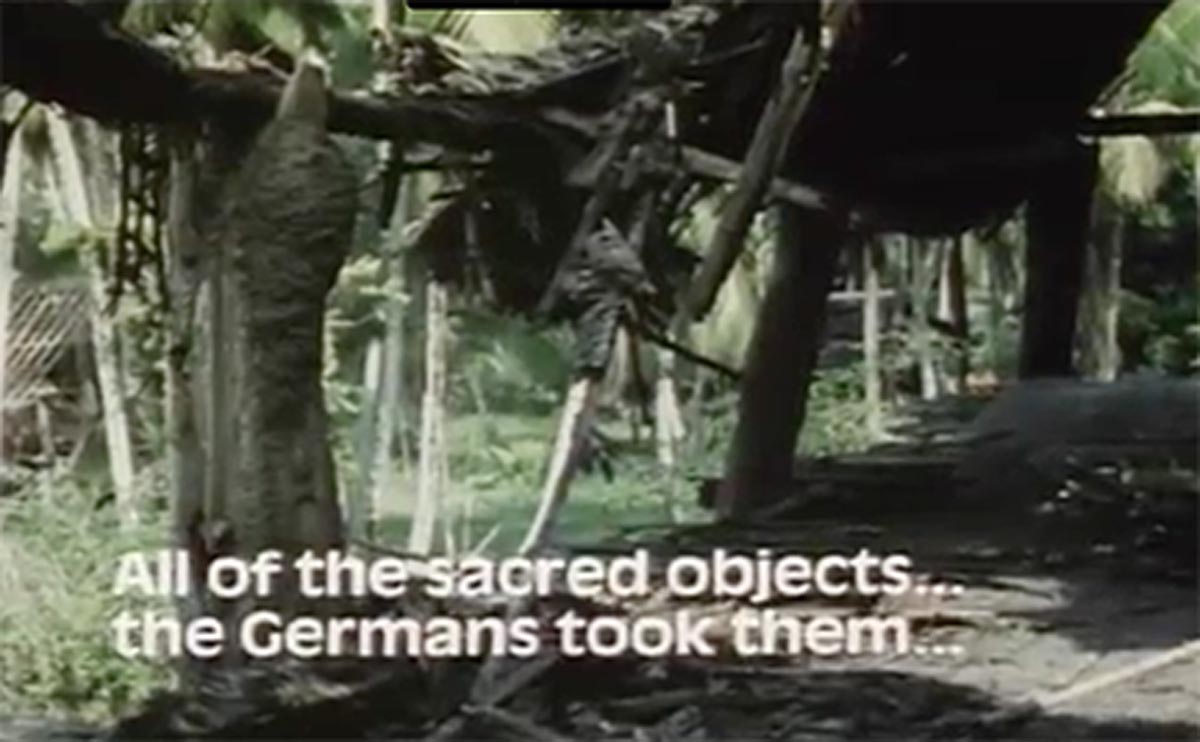
A second is by playing statements by two village men that their communities retain none of their oldest art, this having been sold, or relinquished at the insistence of missionaries, during the early years of European contact (Fig. 2).
Technically, the film is interesting in several ways. For one, there is no overarching authorial commentary. The commentary, or dialogue, that does occur is of two kinds. One consists of comments made by tourists to, or about, village people and to each other. Some of the latter take the form of conversations staged for the benefit of the camera (Fig. 3).
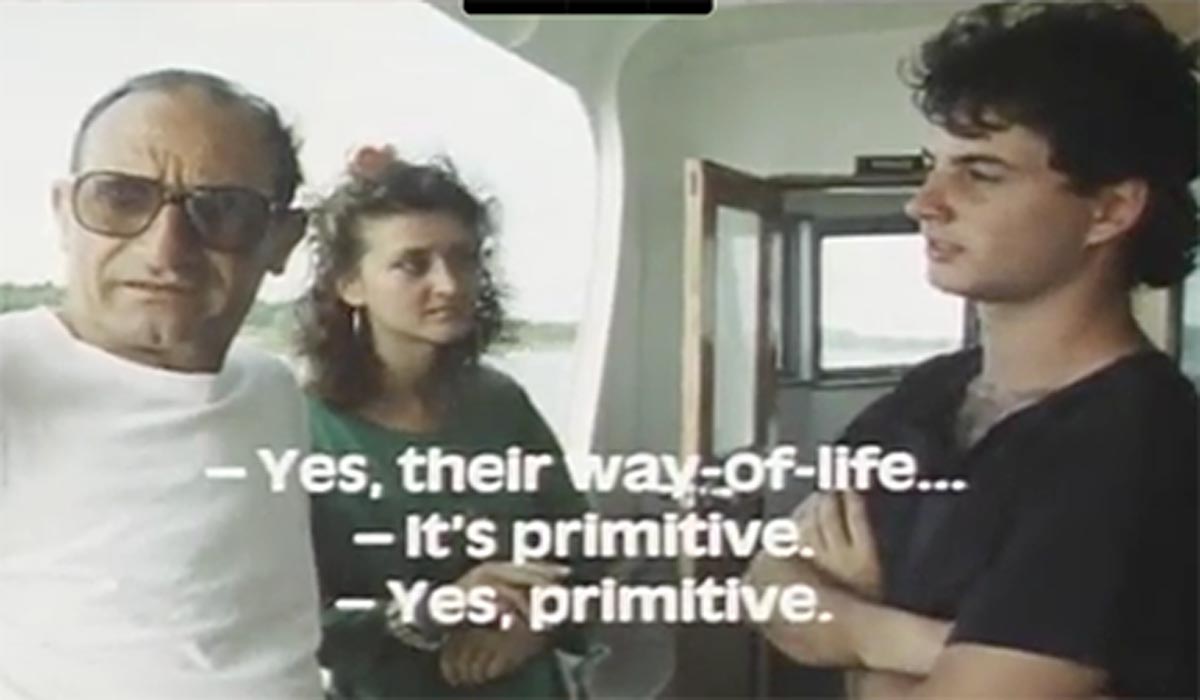
The other consists of answers that two men in particular, and one woman, give to questions put to them by persons off-screen. The questions for the most part are not recorded. None of the people interviewed speaks English and their responses, given in Tok Pisin (New Guinea Pidgin), are translated in the form of English subtitles.
Apart from the spoken dialogue, the sound track consists of haunting flute music (never identified as such), environmental sounds, and, most surprisingly, the gentle strains of Mozart’s chamber music. The overall tone is unmistakably elegiac. Here is a world of great beauty, the film is suggesting, that has been reduced to a parody of its former self by Western intrusion.
One of the most unusual aspects of the film is that none of the people and only one of the places shown are identified.[3] The reason is fairly obvious. O’Rourke clearly wanted this film to be a representation not just of a particular group of peoples and a particular area but of indigenous people in general in the context of their dealings with tourists and the impact of colonisation.
My interest in this film is twofold. First, this is the region in which I conducted field research as an anthropologist over a thirty-six-year period. This began in the early 1970s, fifteen years before O’Rourke made his film, and ended in 2008, twenty years after. With one exception, I visited all of the villages depicted, in some cases several times and for extended periods.
Second, the film raises a whole series of questions about how art is to be studied in a cross-cultural context. More particularly, it raises the question of what the artistic culture of a region (such as the Sepik) actually consists in.
Here I focus on one main issue. This concerns the way O’Rourke represents – or, rather, radically misrepresents – the way in which people in this region understand art as a cultural phenomenon.
In the film O’Rourke infers from the fact that the great bulk of the oldest sculptures in the villages he visited had been removed, and that most of the ceremonial houses he saw were in a state of decay, that the once-great artistic traditions of this region had been irretrievably lost.
But the situation is actually much more complex than this. My research indicated that a people can possess a very rich artistic culture even though the oldest examples of their art were long ago disposed of, and individual men’s houses might be decaying.
O’Rourke’s mistake derives from the fact is that he uncritically imposes a modern Western understanding of art on peoples for whom this understanding was completely irrelevant traditionally – and for whom, the evidence suggests, is still largely irrelevant today at the village level.[4]
Let me explain in a little more detail what I mean. In the modern West all works of art, and especially the greatest, are thought to be:
(1) unique objects (whatever form they take) and
(2) to be the product of creative individuals with unique talents.
The loss of a great work of art, furthermore, would be regarded as a major loss culturally both to the community from which it originated, and to the artworld more generally.
Sepik village peoples, in contrast, took the view traditionally, and largely still do today – that individual sculptures and other artworks are not the unique products of uniquely creative individuals but are based on prototypes of supernatural origin – either objects that spirits created at the beginning of history or the forms of the spirits themselves.
This view entails that if a sculpture or other artwork:
(1) decays to the point where it can no longer be used,
(2) is stolen or otherwise confiscated (as some certainly were during the early colonial period),
(3) destroyed during warfare (as many were in the past),
(4) or sold to an art collector,
a new work based on the same prototype can be made by anyone with the relevant technical skill and the authority to do so.
The only requirement is that the work reproduces the prototype ‘correctly’. Such a work, furthermore, is regarded as just as authentic culturally and just as valuable artistically as older manifestations of the same prototype – including those made before contact.
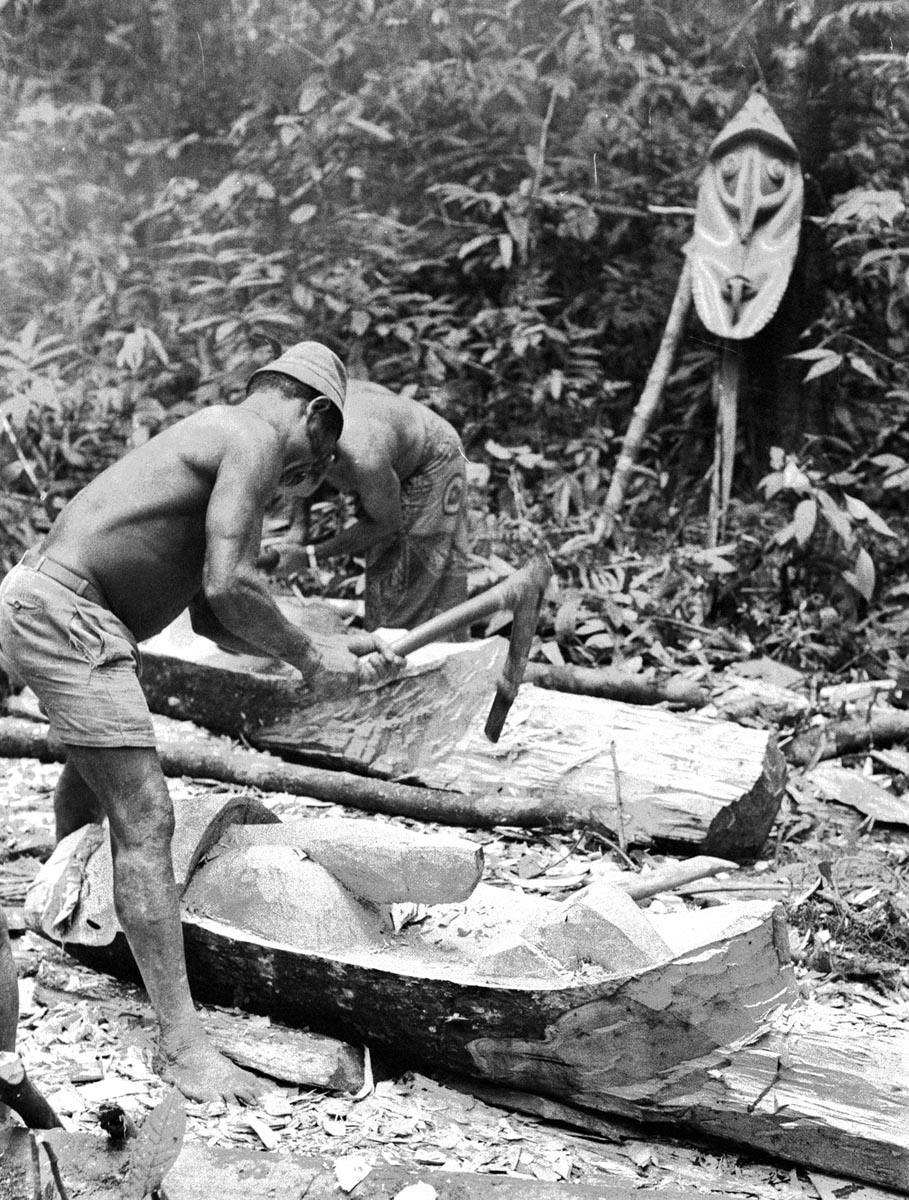
To give an example from my own fieldwork, Fig. 4 shows men in one Kwoma-speaking village in 1973 carving a new set of ritual figures for ceremonies they performed later the same year (see Bowden 1983; 2022). The members of this village had not performed the ceremonies for some years and when they inspected their existing stock of ritual figures they decided that all had decayed to the point where they could no longer be used and had to be replaced After completing the new set, the old pieces were sold to visiting art dealers. The members of this community displayed their new set of figures many times over the following years, including during the late 1980s when O’Rourke was making his film. But the rituals were not open to tourists and only a few outsiders witnessed them.
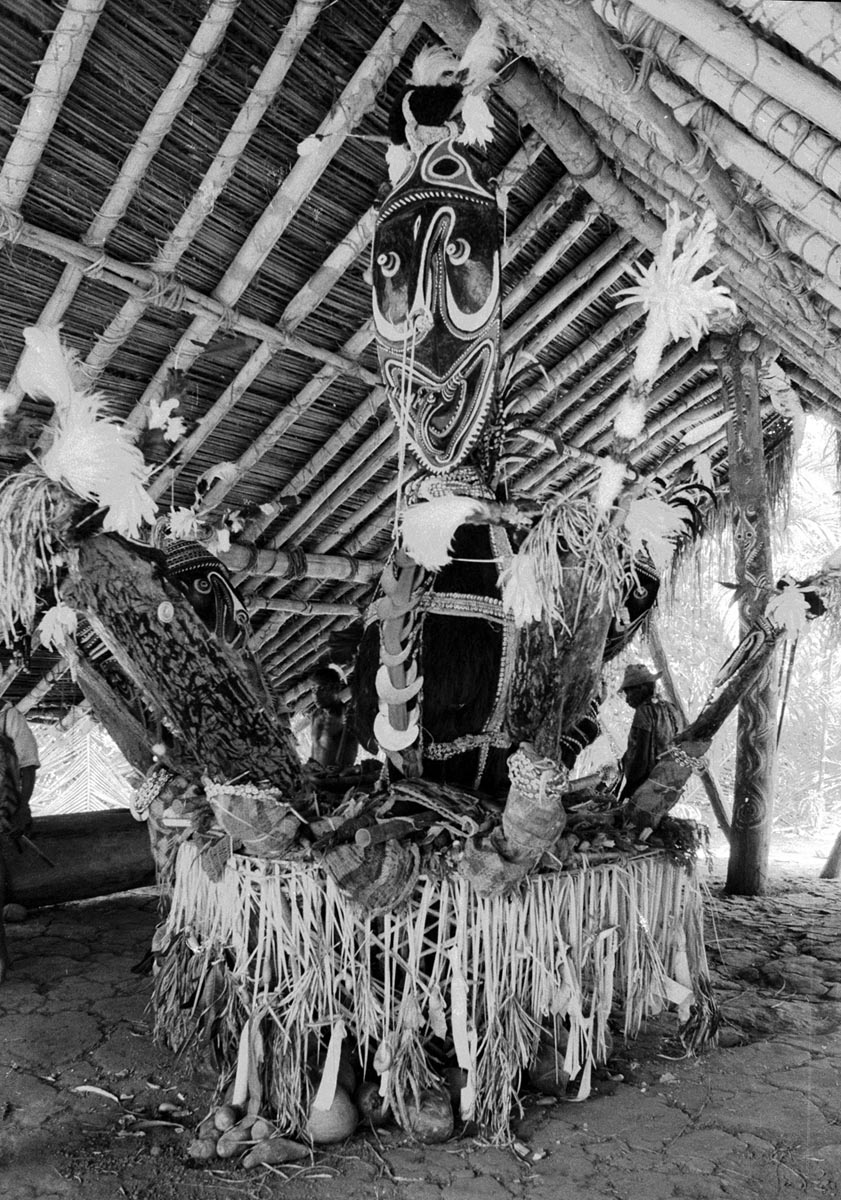
Throughout this region, the same understanding of art applies to men’s houses as well as portable ritual figures of the type illustrated.
Like ritual figures, men’s houses are thought to be based on supernatural prototypes. Despite the fact that it takes several years to construct and fully decorate one of these buildings, they have a life expectancy of only a few decades. Minor repairs will be made to stop a leak in the thatched roof, but when the thatch eventually decays and structural timbers begin to rot, the building will either be abandoned and allowed to slowly disintegrate, or demolished. Should the community choose to do so, a replacement men’s house will then be constructed.
This understanding of art is actually expressed in the film by one of the men O’Rourke interviews. But he, or his Tok Pisin interpreter, either failed to understand what he was saying or chose to ignore it (Fig. 6).
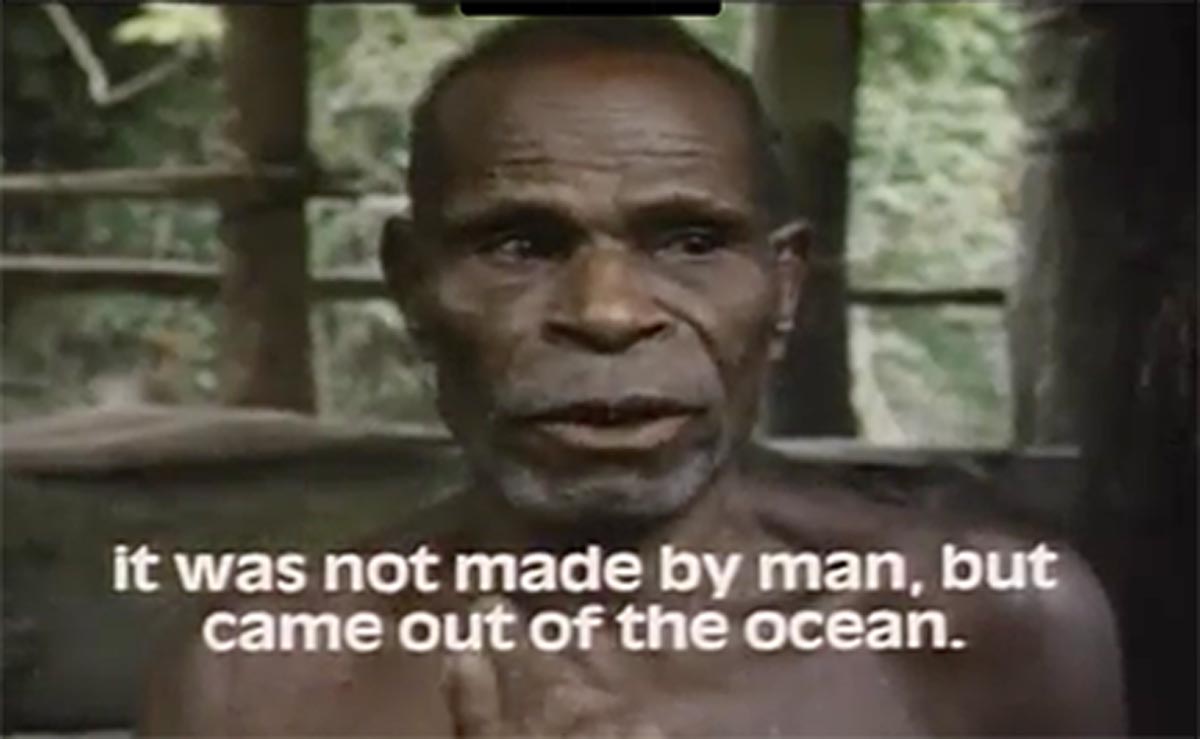
The man (clearly a Iatmul speaker) makes the point that the decaying building in which he is sitting was not of human origin but emerged fully formed from the supernatural world – beneath a vast expanse of water (not the ‘ocean’ as he is misleadingly translated as saying).[5]
The man does not make the point explicitly but if he had been asked he would have explained that he was not talking about the physical structure in which he was sitting, which was probably built during his lifetime, but the supernatural prototype on which it was based.
The key point here is that the fact that a men’s house might be decaying entails nothing necessarily about the state of the artistic traditions of the community in which it is located. All it demonstrates is how rapidly these great buildings decay.
The same point can be illustrated with reference to a Kwoma-speaking village the tourists visit.
O’Rourke does not identify the village but it is named Washkuk. It is located on the northern edge of a vast lagoon named Napu on the western side of the Washkuk Hills (see map in Bowden 1922:65). At one point the tourists are shown travelling through this lagoon in a speedboat, the means used to gain access to villages beyond the reach of their main vessel.
In the second half of the film, O’Rourke interviews an elderly Kwoma man who is standing in front of a men’s house (Fig. 7). O’Rourke does not name him and actually makes him look a bit of a buffoon. He is shown wearing a tight-fitting T-shirt with writing on the front. The man was named Marak. In all the years I knew him Marak never wore anything on his upper body except traditional warrior insignia, such as shell-encrusted armbands, during ceremonies or major inter-village meetings.
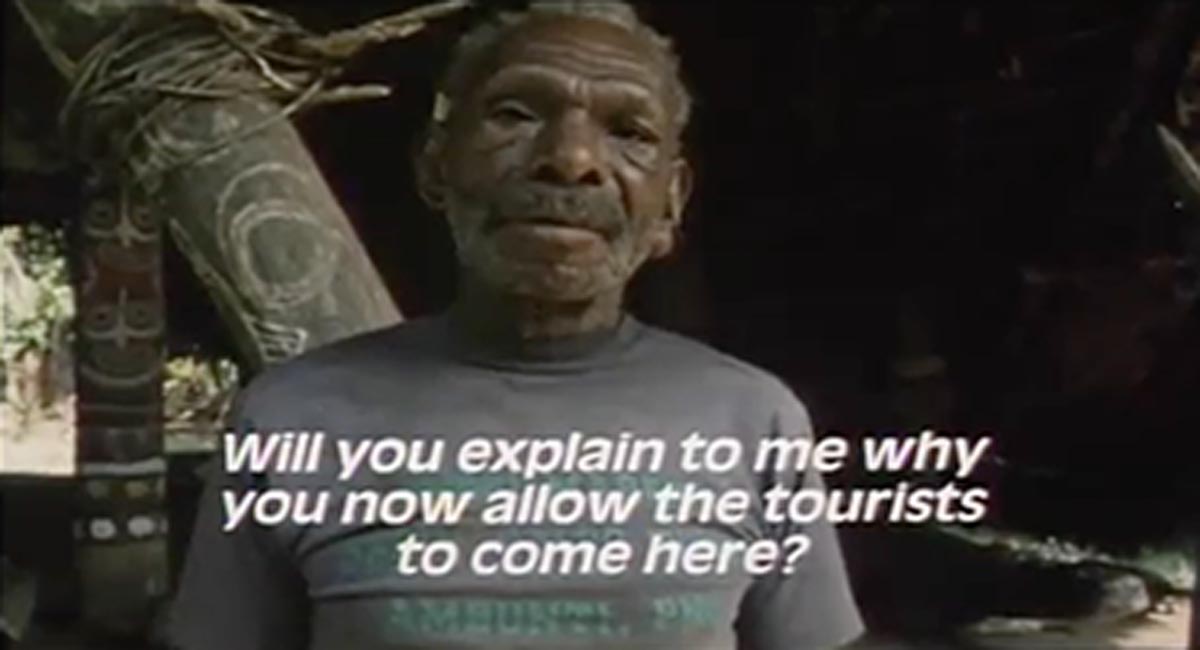
The film shows one of the tourists sarcastically asking Marak, in English, if he really had twenty wives, which he didn’t. Marak didn’t speak English and fails to understand the question. The film then cuts to other scenes. Later O’Rourke comes back to this man and an off-screen questioner asks why he allows tourists to enter the men’s house behind him. He responds that they want to see what he and other members of his community have produced and that he charges two kina (the local currency) for each camera they bring into the building. Two kina is the equivalent of about U.S. 50 cents. (The subtitles incorrectly translate him as saying he charges ‘two dollars’ a camera.)
Far from being a doddery old buffoon this man was actually an exceptionally talented painter, sculptor and builder of ceremonial houses – including the one behind him. He was also a major political leader.
Part 2 of this article will appear in the next edition of the Journal of the Oceanic Art Society
[1] This article is an expanded version of a talk given, via Zoom, at the Royal Anthropological Institute’s Online Film Festival Conference in the U.K. in March this year (2023).
[2] It can be viewed on YouTube. For an extensive list of articles on the film, and a discussion of issues not raised here, see Hamel 2020.
[3] The villages are identified in the credits, but their names are not keyed to particular scenes.
[4] I have explored this subject in much greater detail in Art and Creativity (Bowden 2022).
[5] See also Silverman 2018:153.
Bibliography
Bowden, Ross. 1983. Yena: Art and Ceremony in a Sepik Society. Oxford: Pitt Rivers Museum.
Bowden, Ross. 2006. Creative Spirits: bark painting in the Washkuk Hills of north New Guinea. Melbourne: Oceanic Art Pty Ltd.
Bowden, Ross. 2022. Art and Creativity in a New Guinea Society: The Kwoma in Cross-Cultural Perspective. Lanham (MD): Lexington Books.
Hamel, Enzo. 2020. “Cannibal Tours”: cannibalisme, tourisme et capitalisme. Website Casoar.org: ‘Océanie en scène’. https://casoar.org/2020/10/28/cannibal-tours-cannibalisme-tourisme-et-capitalisme/
Lutkehaus, Nancy Christine, and Dennis O’Rourke. 1989. “Excuse me, everything is not all right”: on ethnography, film, and representation: an interview with filmmaker Dennis O’Rourke. Cultural Anthropology, vol. 4, No. 4, pp. 422-437.
Mihalic, F. 1971. The Jacaranda Dictionary and Grammar of Melanesian Pidgin. Milton (Qld.): The Jacaranda Press.
O’Rourke, Dennis. 1987. Cannibal Tours. Cairns: O’Rourke and Associates/CameraWork. 72 min.
Silverman, Eric K. 2012. From Cannibal Tours to cargo cult: on the aftermath of tourism in the Sepik River, Papua New Guinea. Tourist Studies, vol. 12, no. 2, pp. 109-130.
Silverman, Eric K. 2013. After Cannibal Tours: cargoism and marginality in a post-touristic Sepik River society. The Contemporary Pacific, vol. 25, no. 2, pp. 221-257.
Silverman, Eric K. 2018. Totemism, tourism, and trucks: the changing meanings of paint and colors in a Sepik River society. Journal de la Société des Océanistes, no. 146, pp. 151-163.
Townsend, G.W.L. 1968. District officer. Sydney: Pacific Publications.
Ross Bowden taught anthropology at Monash and La Trobe universities in Melbourne for many years and is now an independent researcher. He lives on a farm outside Melbourne. He can be contacted at
[email protected].
caption: Fig. 1 The Melanesian Explorer at anchor in the Sepik. From Cannibal Tours, @ 6.27 min.
caption: Fig. 2 Cannibal Tours, @ 22.00 min
caption: Fig. 3 Cannibal Tours, @ 8.33 min
caption: Fig. 4 Bangwis village men carving a new set of Yena ceremonial figures, 1973. © Ross Bowden 2023.
caption: Fig. 5. A Kwoma Yena ceremony display, Washkuk village, 1973. © Ross Bowden 2023.
caption: Fig. 6 Cannibal Tours, @ 21.27 min
caption: Fig. 7 Cannibal Tours, @ 40.40 min