
by Ross Bowden
The documentary Cannibal Tours, by the self-described ‘existential anarchist’ Australian film maker Dennis O’Rourke, has had a significant impact on the anthropological world since it was released almost forty years ago in 1988. It is widely regarded as a ‘classic’ in the field of visual anthropology, especially in the sub-field of the ethnography of tourism, and has been the subject of a substantial commentary in the literature.
In the second half of the film, O’Rourke interviews an elderly Kwoma man who is standing in front of a men’s house. While not named in the film, this man called Marak didn’t speak English but was an exceptionally talented painter, sculptor and builder of ceremonial houses – including the one behind him. He was also a major political leader.
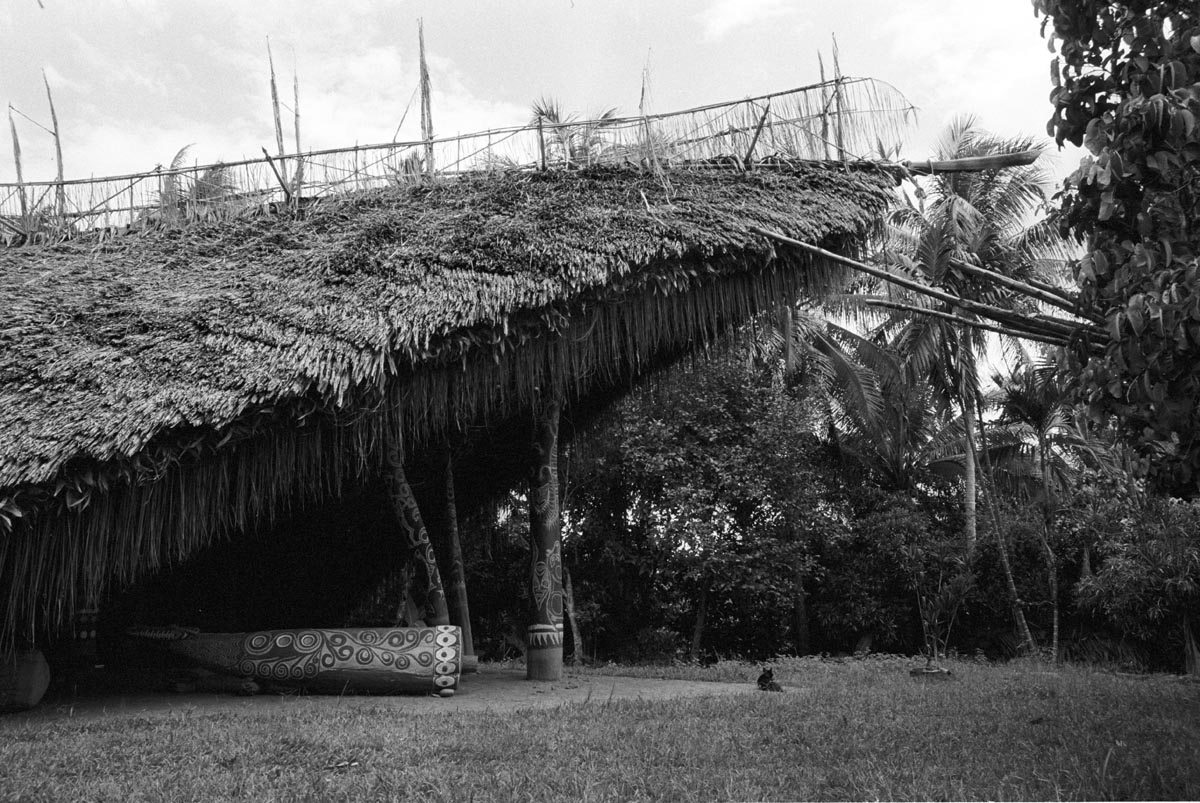
The film reveals nothing about this man’s background or the building behind him. But at the beginning of the 1980s – only five years or so before O’Rourke visited his village – Marak decided to demolish the undecorated ceremonial house that was then standing in his community, even though it was still in good condition, and replace it with the one that can be glimpsed behind him. The new building was a masterpiece of vernacular architecture. At the time of O’Rourke’s interview with him this building was in near-new condition.[1]
Fig. 8 shows the rear of the new building. Kwoma men’s houses have very pronounced overhanging gables at both ends. Fig. 9 shows the interior of the same building viewed from the rear left corner. This photograph was taken in 1988, the year O’Rourke’s film was released.
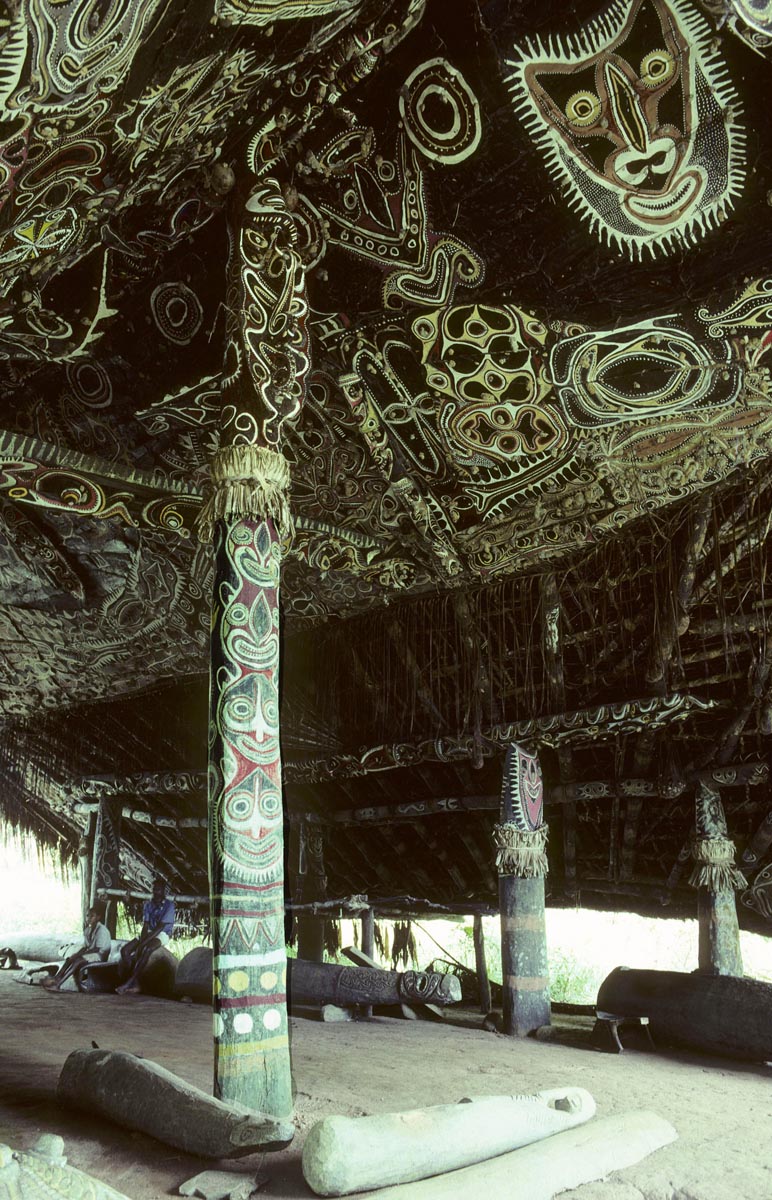
In the course of an extended interview I conducted with Marak in 1982, shortly after the building had been completed, he told me that he based the layout of the bark paintings and carvings in this building on one he saw in a dream. In his dream, he visited the underworld, the ultimate abode of all spirits and ghosts of the dead. There he found himself in the middle of a village occupied by ghosts of former members of his clan. He recognised several of its occupants, deceased men who he had personally known. In the centre of the village he found a huge men’s house decorated with bark paintings and sculptures in a way that he had never seen before. He walked inside and carefully inspected the artwork on display.
Marak told me that when he woke up he realised that the building he had seen must have been the spirit prototype of the main men’s house his clan owned, named Wambon. He said that he was so impressed by its decorative artwork that he decided on the spot to construct an exact replica. Unlike most men, Marak had the political influence to mobilise the massive workforce required. The building took several years to complete and for two decades or so was his village’s main meeting house and venue for their rituals.
The extraordinary thing about O’Rourke’s film, however, is that despite the fact that this building was a genuine masterpiece of vernacular architecture, and in near-new condition, at no point does O’Rourke take the viewer inside to reveal what an astonishing structure it was.
Why not? Clearly it would have contradicted the message he was trying to convey that a century of European contact had destroyed the once-great cultural heritage of this region.
There can be no doubt that this building is the same as the one in the film, for the paintings on the centre post that can be seen dimly in the background on the left side of Fig. 7 are the same as those that can be seen more clearly in Fig. 9.
By failing to take the viewer inside this building O’Rourke was effectively engaging in ethnographic fraud.
The film’s message that the great art traditions of this region have been destroyed is reinforced, intentionally or otherwise, by a crucial mistranslation of a statement made by one of the men who is interviewed. According to the English subtitles, this man states that all of the ‘sacred objects’ in his community were removed by outsiders during the early years of contact (Fig. 2). The implication is that the rituals in which these objects played a central role could no longer be performed.
But the use of the word ‘sacred’ in the English subtitles is highly misleading. First, there is no equivalent of ‘sacred’ in Tok Pisin. Father F. Mihalic, the Catholic priest who wrote the standard dictionary of Tok Pisin (Mihalic 1971), includes ‘sacred’ in his English finder list and gives three Tok Pisin equivalents. However, two of these – ‘santu’ and ‘holi’ – derive from Catholic liturgy and are expressions that I have never heard used in villages in connection with traditional rituals or their art. The third equivalent he gives is ‘tambu’, the Tok Pisin word for ‘taboo’ or ‘prohibited’. This term is not limited to the context of art or ritual but can be used for anything that is prohibited. For instance, it is ‘tambu’ (taboo) to marry within the same clan.
The key point, however, is that the man being interviewed uses none of these terms. What he actually says, in Tok Pisin, is that there are no objects of ritual significance remaining in his village that derive from the ‘ancestral’ or ‘pre-contact’ period (‘tumbuna samting’). My guess is that the man was exaggerating. All villages, in my experience, retain numerous objects from the pre-contact period, such as old shields of historic significance. But even if what he said was true this is an entirely different matter from saying that the removal of the old objects prevented his community from performing any of their traditional rituals. As indicated above, all ritual objects were based on supernatural prototypes and a new copy of one of those prototypes could be made at any time. The new copy, furthermore, would have had the same cultural value as an older piece, provided it was made ‘correctly’. The fact that there might have been no old ritual figures left in the communities O’Rourke visited proves nothing necessarily, therefore, about the state of their artistic cultures.
It should also be noted here that before European contact old ritual figures were constantly being replaced. Most were made of wood and gradually decayed; some were damaged accidentally and had to be discarded; and not a few were destroyed during intertribal warfare when the buildings in which they were stored were burnt down. The burning of buildings was a common feature of traditional warfare in this region, so much so that the most common expression used in Tok Pisin for ‘attacking’ another village is ‘burning’ it (‘kukim ples’).
In suggesting that O’Rourke naively imposes a Western understanding of art on peoples for whom this was completely irrelevant traditionally, and hence misinterprets what he saw, I am not saying that major changes have not occurred in the artistic and ritual lives of the people in this region.
But with few if any exceptions, these were not a consequence of old ritual objects being confiscated by over-zealous missionaries, or the performance of rituals being prohibited, but of changing political conditions. One of the most striking of these changes is the fact that most if not all of the different secret men’s rituals that were once performed in this region have been given up.
Before the Australian administration put an end to warfare in the Sepik each community had to rely on its own men to defend its economic resources from encroachment by neighbours. The main way it did this was instilling in men a warrior ethic. One way it did this was by requiring all boys at or around puberty to undergo a lengthy male initiation rite designed to make them ‘hard’ and willing to fight in defence of their communities. Another was by conferring on men who had actually killed members of other groups during intertribal fighting the highest prestige in their communities. This status was displayed, among other ways, in their exclusive right to wear the highest-prestige shell and feather ornaments. Among the Kwoma, such men also formed a horticultural elite, for only they were thought capable of cultivating yams, the most prestigious cultivated food crop.[2] If other men attempted to do so, it was believed, the seed tubers would not germinate but rot in the ground. Warrior values were a major focus of men’s secret rituals, including the three Kwoma rites I had the good fortune to document: Yena, Minja and Nokwi (see Bowden 1983; 2022).
When the Australian administration finally brought intertribal fighting to an end in the Sepik – in the 1950s in the area where I worked – the old warrior values ceased to have the same cultural significance, and when the men who had been brought up in a traditional environment eventually died, the ceremonies were quietly given up. In my research area this happened in the 1990s. No person that I have ever spoken to has regretted the loss of these rituals.[3]
One consequence of the giving up of these rituals, which I must admit shocked me when I learned of it, was that the secrecy that had previously surrounded the sculptures that were displayed in them was also done away with. During my two last field trips, in the early 2000s, ritual figures that I had photographed in the 1970s and had been surrounded by the most elaborate secrecy were all on open display and for sale. The men who had custody of them, furthermore, made no objection to their wives and children viewing, and even handling, them. This would have been unthinkable when I first did fieldwork.
My final comment concerns the way the film represents Sepik village people as poor. It does so by playing remarks by two of the older people interviewed that villagers have few sources of cash open to them and that tourists compound this problem by buying only a few of the many artefacts on offer for sale.
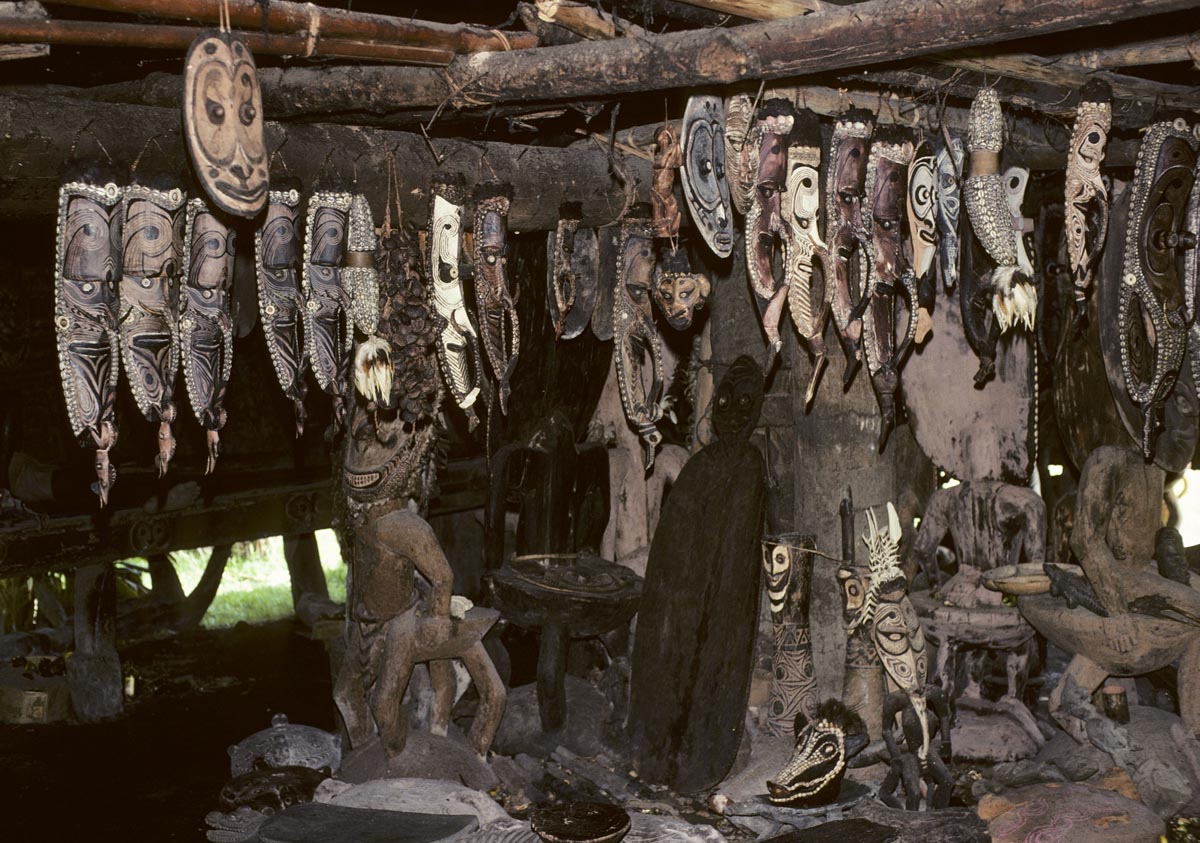
Contrary to the impression the film gives, every community in this region is immensely rich in land. This provides the people with all of the food and shelter they require on a daily basis – either directly, or indirectly through trade with neighbours. However, for older people who are not literate and cannot speak English, such as the main persons interviewed, there are few sources of cash available locally. For them, tourism has long been an important source of income (Fig. 10). Tragically, following Independence in 1975 much of the country’s infrastructure collapsed. Among other things, many of the airline services to remote areas ceased to operate and elsewhere they became less reliable. The unreliability of the airline services, even to major towns, led to the company that ran the tour O’Rourke documents closing down. Such tours are now a thing of the past. An anthropologist who did fieldwork in one of the villages that was previously on the company’s tour circuit reports that this dealt a major blow to village economies (Silverman 2012:109-10, 113; 2013:226).
Despite the collapse of much of the country’s infrastructure following Independence, schools continued to operate. In Papua New Guinea there is no welfare system and people regard education as the best way for young people to enter the modern world. When they can afford to do so, they send their children to school.
Over the last fifty years or so thousands of young people in this region have completed primary and secondary school and left their home areas to pursue economic opportunities elsewhere. Some lose contact with their families and never return. But others remain in close contact and remit substantial sums of money to relatives, who use it for purchasing consumer goods and paying school fees. Others, after working elsewhere for a number of years, return permanently to their home areas, in some cases to establish small businesses.

An example is provided by the man on the left in Fig. 11. This man’s father was a very distinguished Kwoma artist whose work I documented (Bowden 2006: 102-125). But he told me that unlike his father he had no talent as an artist and had no interest in becoming one. But with the financial support of an older brother, who was working elsewhere in the country as a schoolteacher, he finished high school in the 1980s – during the period when O’Rourke was making his film – and then obtained a degree in mechanical engineering from the University of Technology at Lae, the nation’s second largest city. After working for several years for a multinational mining company he decided to return to his home area, partly to help look after his ageing parents and partly to establish a small engineering business at Ambunti, the nearest urban centre to his home village. His business mainly involves refurbishing and hiring out outboard motors – the universal means of powering the large canoes in which people travel up and down the Sepik.
I keep in touch with him via the internet, since there is no longer a postal service at Ambunti, and he recently informed me that both of his oldest sons are also now undertaking degrees in mechanical engineering at the same university.
This region, in other words, is far from the poverty-stricken backwater that O’Rourke depicts in Cannibal Tours.
[1] I give a detailed account of this new building in Bowden 2022:23-4, 30-39, 68-70, 110-11. The older building can be seen in Fig. 5.
[2] Sago was, and still is, the staple vegetable food, but this grows wild.
[3] One of the early Australian government officers who was instrumental in bringing intertribal fighting in the Sepik to an end was G.W.L. (‘Kassa’) Townsend (1968). This man is mentioned by one of the men interviewed in the film but the translator misheard the name and spells it ‘Sorensen’ (@34.45 mins).
Bibliography
Bowden, Ross. 1983. Yena: Art and Ceremony in a Sepik Society. Oxford: Pitt Rivers Museum.
Bowden, Ross. 2006. Creative Spirits: bark painting in the Washkuk Hills of north New Guinea. Melbourne: Oceanic Art Pty Ltd.
Bowden, Ross. 2022. Art and Creativity in a New Guinea Society: The Kwoma in Cross-Cultural Perspective. Lanham (MD): Lexington Books.
Hamel, Enzo. 2020. “Cannibal Tours”: cannibalisme, tourisme et capitalisme. Website Casoar.org: ‘Océanie en scène’. https://casoar.org/2020/10/28/cannibal-tours-cannibalisme-tourisme-et-capitalisme/
Lutkehaus, Nancy Christine, and Dennis O’Rourke. 1989. “Excuse me, everything is not all right”: on ethnography, film, and representation: an interview with filmmaker Dennis O’Rourke. Cultural Anthropology, vol. 4, No. 4, pp. 422-437.
Mihalic, F. 1971. The Jacaranda Dictionary and Grammar of Melanesian Pidgin. Milton (Qld.): The Jacaranda Press.
O’Rourke, Dennis. 1987. Cannibal Tours. Cairns: O’Rourke and Associates/CameraWork. 72 min.
Silverman, Eric K. 2012. From Cannibal Tours to cargo cult: on the aftermath of tourism in the Sepik River, Papua New Guinea. Tourist Studies, vol. 12, no. 2, pp. 109-130.
Silverman, Eric K. 2013. After Cannibal Tours: cargoism and marginality in a post-touristic Sepik River society. The Contemporary Pacific, vol. 25, no. 2, pp. 221-257.
Silverman, Eric K. 2018. Totemism, tourism, and trucks: the changing meanings of paint and colors in a Sepik River society. Journal de la Société des Océanistes, no. 146, pp. 151-163.
Townsend, G.W.L. 1968. District officer. Sydney: Pacific Publications.
Ross Bowden taught anthropology at Monash and La Trobe universities in Melbourne for many years and is now an independent researcher. He lives on a farm outside Melbourne.