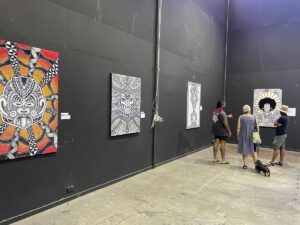
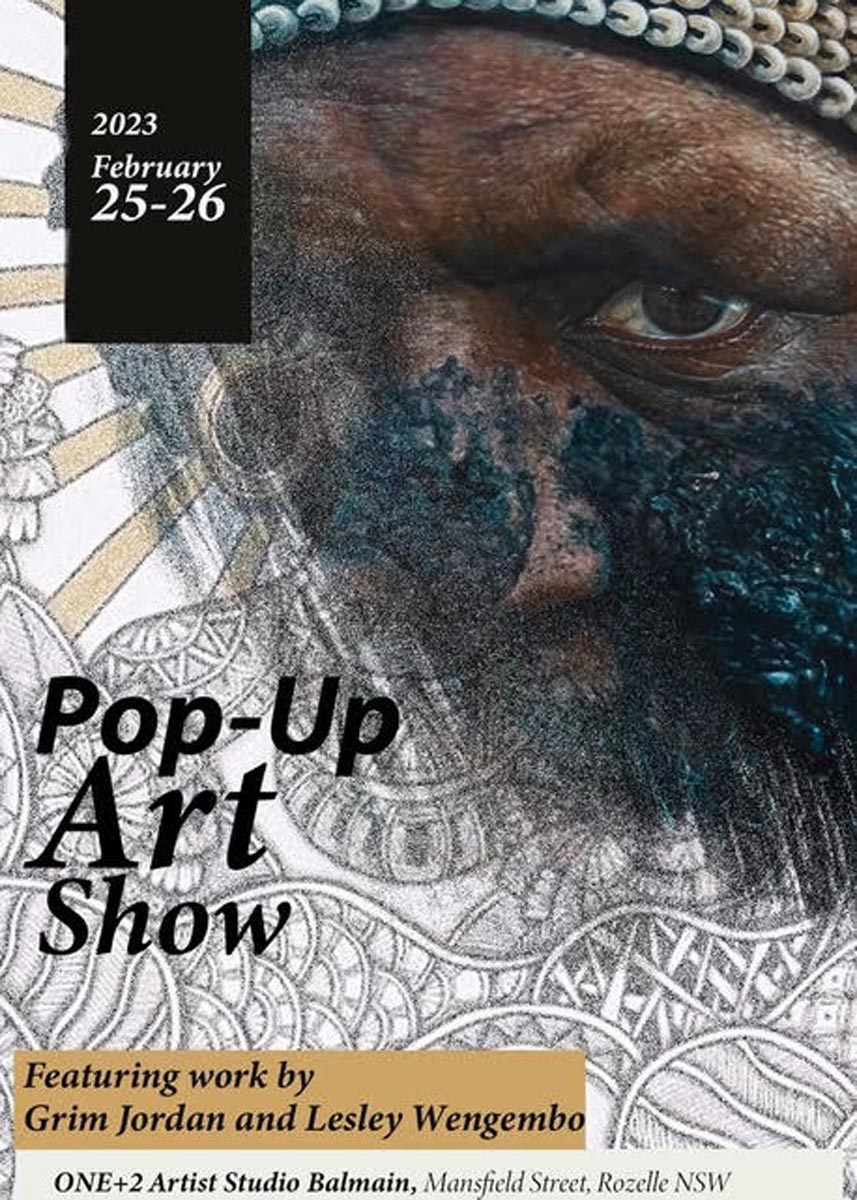
25 & 26 February at the One + 2 Artist Studio Balmain, Mansfield Street, Rozelle, NSW.
Review by Rita Uechtritz & Margaret Cassidy
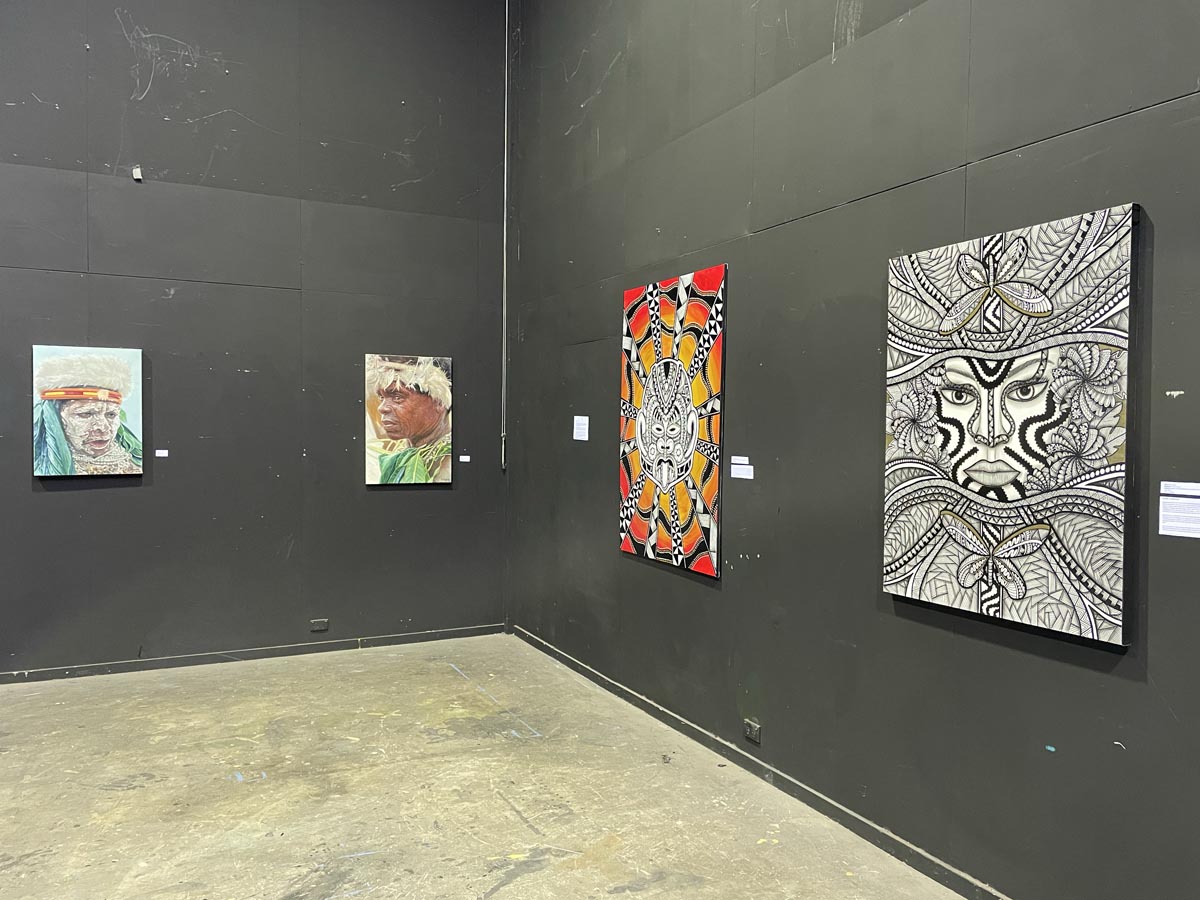
In many ways the work of two emerging artists from Papua New Guinea, Lesley Wengembo and Grim Jordan, which was the focus of this recent pop up exhibition held in Sydney are quite different. Walking into the stark artists’ studio with its sombre black walls, the paintings of both artists immediately capture the eye due to their size and also their boldness. Their works are very different in style but both artists have great ambitions to tell stories of their people, capturing them on the canvas.
Grim Jordan told us that he is self-trained but seeing his works up close the paintings are very detailed drawings made mainly using marking pens (including Sharpies) and graphite pencils. Some are predominantly black and white, others are glowing with the vibrant colours of PNG, regardless they are bold and eye-catching. Some of the detailed line work is reminiscent of the traditional face and body markings of ritual skin scarification found in the Sepik and other regions and highlighted in the photographic work of Wylda Bayron (see www.wyldabayron.com/new-page-1) as well as commercial graphic art practices.
Growing up in Goroka in the Highlands, Jordan has a story for each of his artworks that positions them back into the aspect of traditional cultural life featured in the specific image. One work, Mudmen Mask, brings to life his “all-time favourite tale from the area”, the story behind the famous Asaro Mudmen. During a tribal conflict a group of men escaped to the banks of the Asaro River. With nowhere to hide, they covered their bodies with white clay from the riverbanks to trick their enemies into believing they were ghosts. They formed grinning masks out of the clay and placed them over their heads. The attacking tribe saw them and fled. Jordan says that he created this as a symbolic piece to “keep the enemies away”.
With other works on show Jordan has reflected his mission to celebrate Papua New Guinea women. These include portraying them having undergone the traditional practice of having their faces marked (tattooed), a practice that has died out since the missionaries arrived.
Mama Graun II is a tribute to his grandmother because of “her endless stories about what life was like before and what women were like”; she had distinct markings, tattooed on her face and body. “When asked what they meant, she said she had them done because it was a ‘cool’ thing to do back then, and men found them to be attractive”. These permanent markings are intrinsic to the image and are meticulously drawn in great detail. They are complemented by the inclusion of equally detailed traditional bilas of Western Highlands women, reflecting the heavy and organic bilas worn by Jordan’s grandmother at tribal shows during the 1970s. She is decorated with the leaves of the forest and the feathers of various birds found in the area including three species of the Birds of Paradise. This attention to detail drawn from a reference photograph of Jordan’s grandmother shows the origins in nature. Today’s drawing includes elements of what developed as a PNG modernist design during the 1970s.
In another painting, Oro Kaiva – Coming of Age, Jordan has shown the traditional face markings indicating that the young woman has come of age and is ready for marriage. This was the traditional practice for young women from Tufi in the Oro Province on the South East coast. However, in this image the young woman is ready for change. Placed in the centre of the canvas, her face markings are in the style of a popular tapa bark cloth pattern. According to Jordan, these patterns are known to hold both the stories of the past and the dreams of the future; this young woman is ready for the future. She is surrounded by stylised butterflies with intricate patterns hovering over a closely woven bilas; they are attracted by her energy.
With Rosa at the end of the display wall, Jordan has presented the harrowing tale of the black woman ‘everywoman’ inspired by his mother, who after graduating from University in Australia has headed back to PNG to help this ‘everywoman’. The full story of Rosa is found on his website at: https://www.grimjordan.com/blogs/our-stories/rosa It makes for difficult reading, highlighting the abuse and suffering of so many women in PNG society today. The same women that Jordan wants to celebrate.
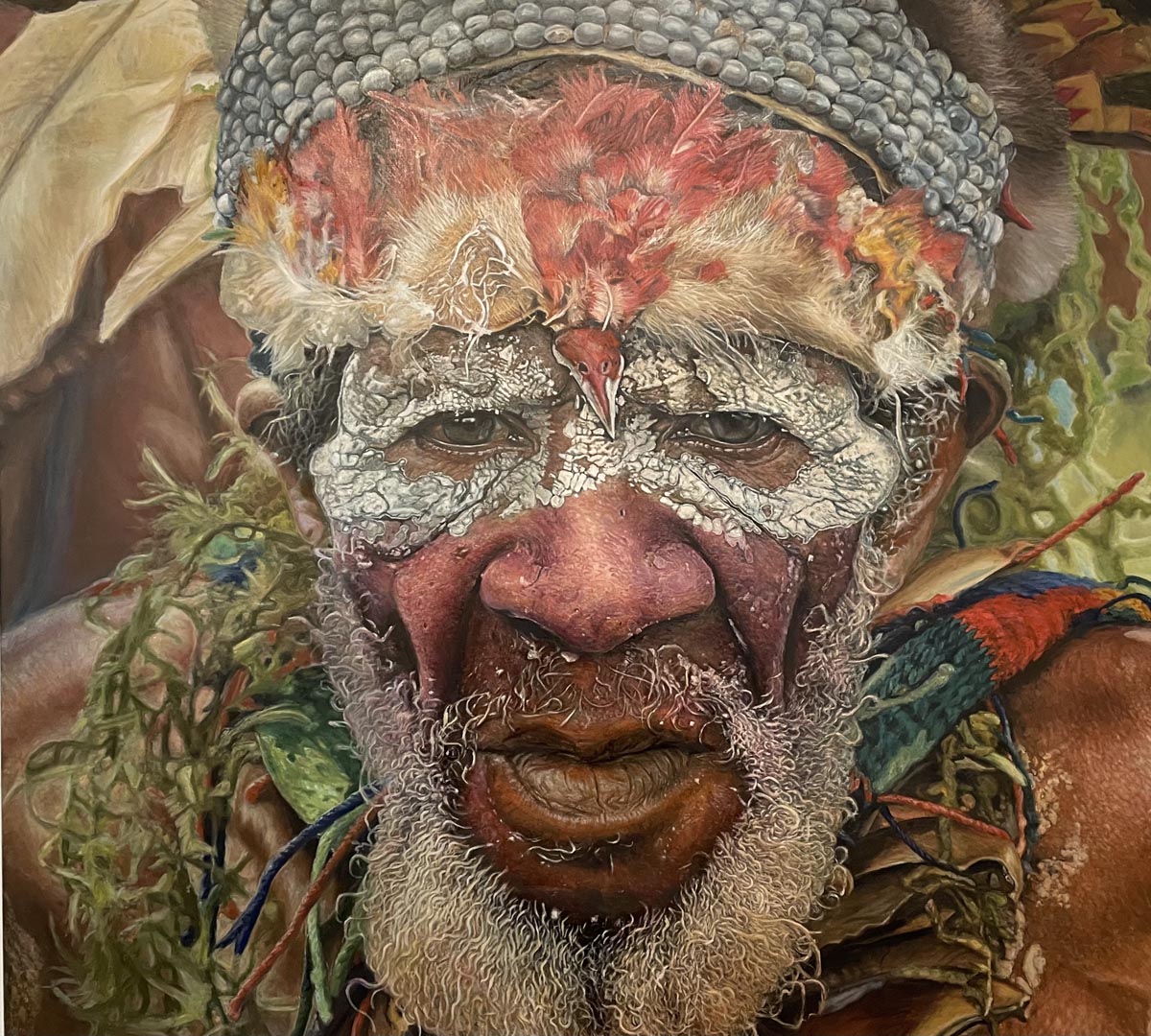
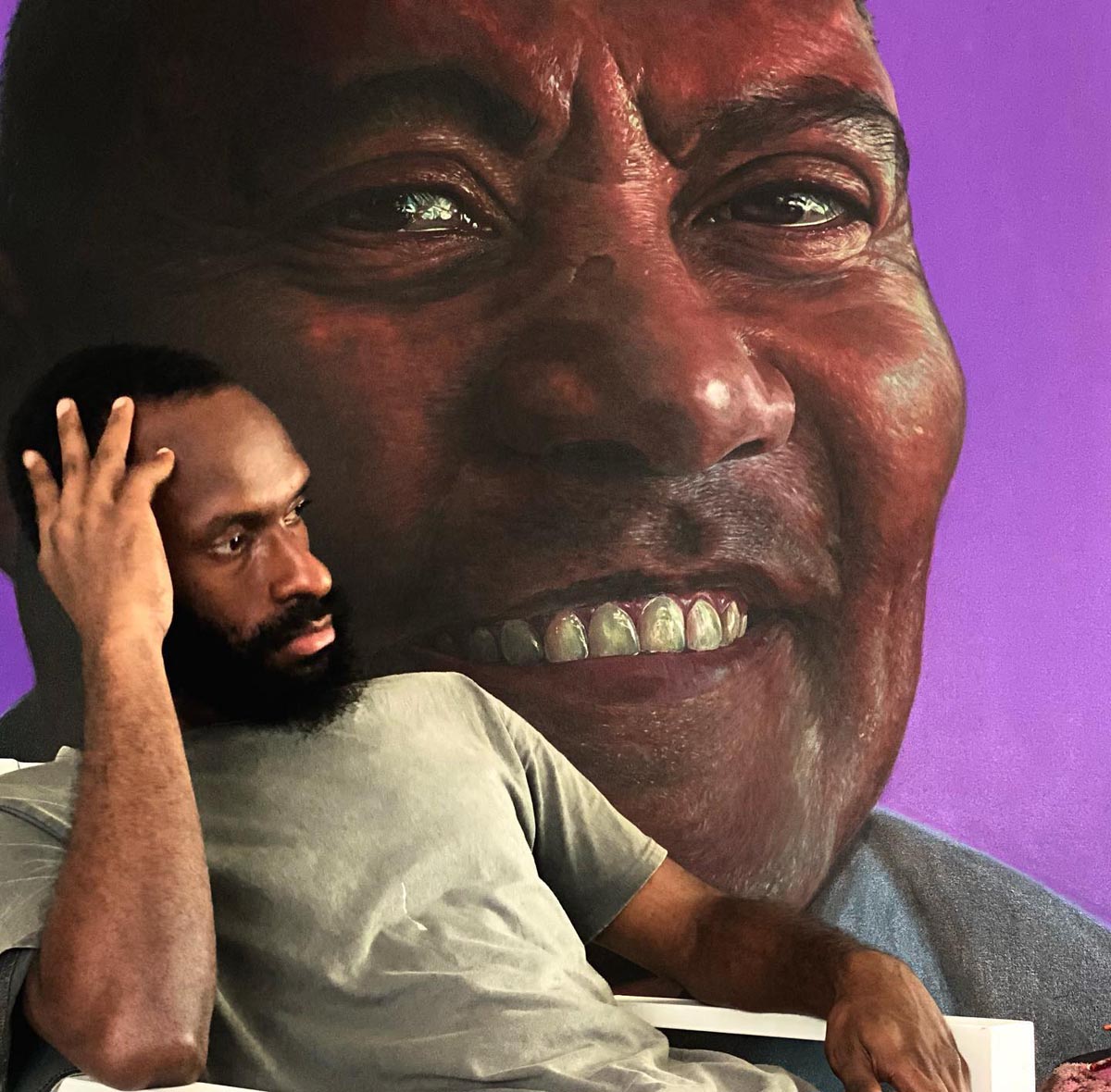
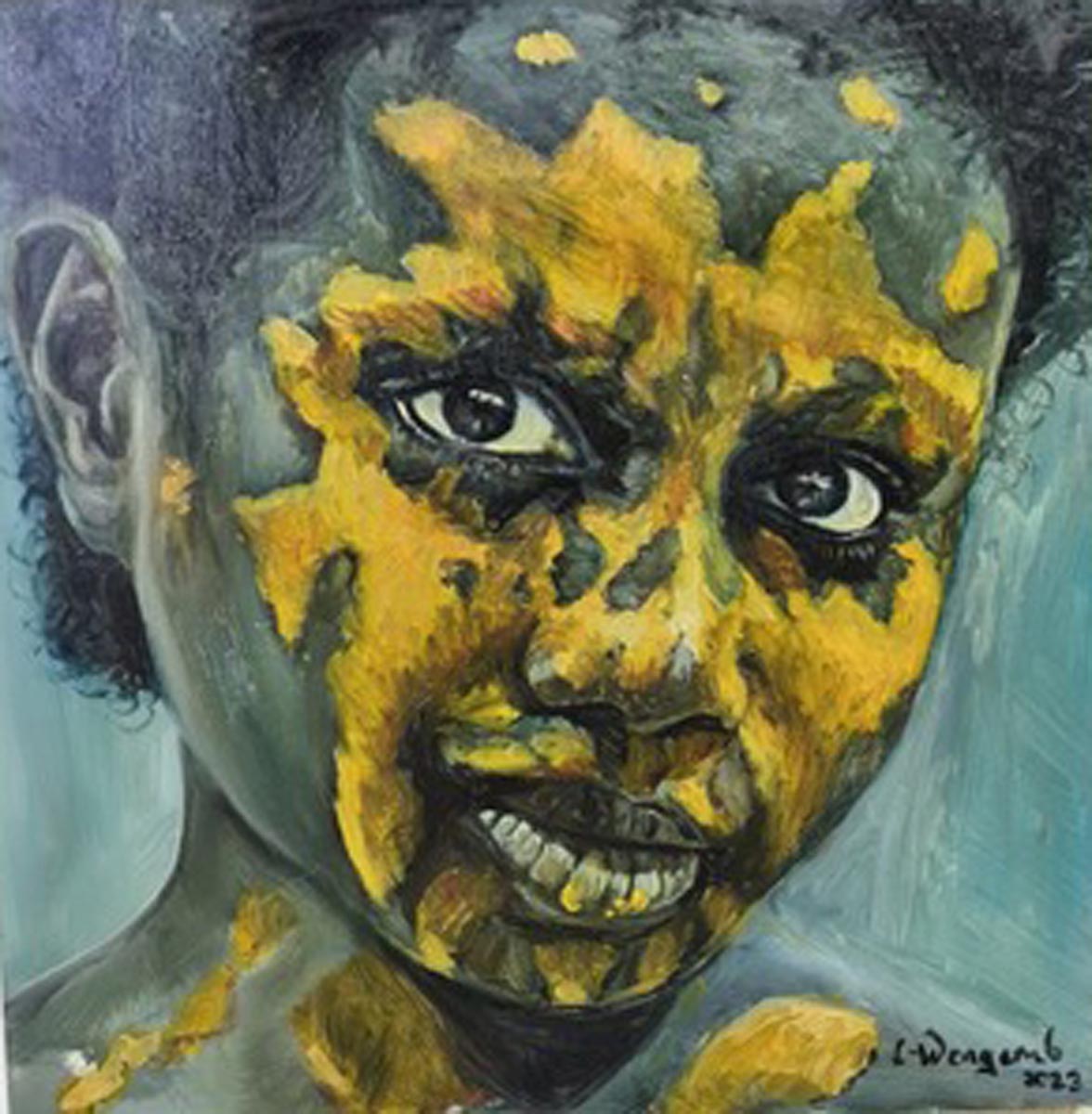
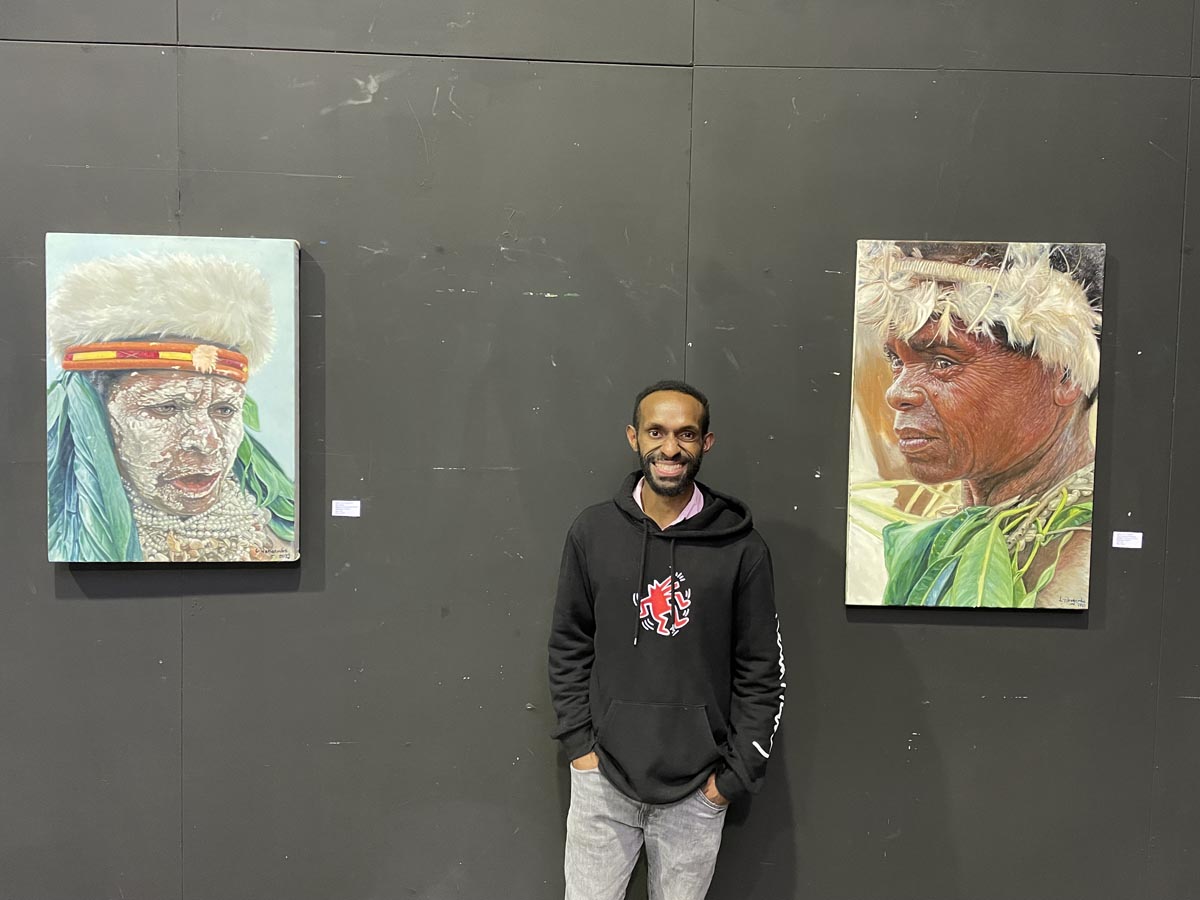
In contrast, Lesley Wengembo works in oils and is a graduate of the National Art School in Sydney. While he grew up in the suburbs of Port Moresby, his family are from Pangia, Southern Highlands and Bundi, Madang Province. When talking to us, he rejects the academy’s description of his work as hyper-realistic and describes it as emotional realism. This realism is both meticulous and very detailed.
Wengembo likes to use the word ‘emotive’ when asked to describe his work, and when fortunate enough to stand in the same space as one of his soulful paintings, it is easy to understand why. His work is certainly evocative and, at times, almost feels magnetically three dimensional. There is no denying his self-proclaimed mantra that “his greatest asset is his cultural identity”.
It seems that he chooses his oils palette and piercing eye for detail to connect to culture. He uses the emotion fusion he speaks of to translate his consciousness of his subjects of everyday life, whether it be portraiture, the detail of traditional ornaments or the landscape. He doesn’t wish for his work to be pigeonholed, stylised, or labelled, rather it is evolving in depth and understanding. He captures and commits the storyline of his life to canvas.
Paintings such as Seven Faces of Mother speak straight at the viewer and it is unlikely that you will want to let her go. Surely this would be any artist’s greatest aspiration.
In paintings such as Bird Man, his attention to the minute details of the subject are his trademark from the smallest skin blemish through to the delicate individual feathers that are used in traditional head dresses.
Another highlight of Wengembo’s works in this exhibition is the portrait of Brisbane Broncos rugby league legend Petero Civoniceva, which he subsequently entered for this year’s Archibald Prize. As someone who grew up in a country where rugby league is huge, for Wengembo to meet and paint someone like Civoniceva is a huge honour. Wengembo has also described this enormous work as a response to his first Archibald entry, Malachi’s Soul, submitted in 2020. Wengembo has said that he believes that “the journey is more important than the [outcome of the] competition because it teaches you to be better”.
Petero Civoniceva wrote on Facebook in response to Wengembo’s painting, “I know I’m no oil painting… but I guess I am now. You captured me to a perfection – my smile and eyes and greying hair …. and all my imperfections – footy scars and stitches and countless broken noses!!”