2023, 272 pages, edited by Kevin Conru, Conru Editions, Brussels
Reviewed by Crispin Howarth In June, Lempertz Art house and Auction rooms hosted a spectacular exhibition titled Polynesian Art.The exhibition was only held for a month but the eponymous accompanying catalogue to the exhibition will last somewhat longer. To call this oversized publication a catalogue somewhat lessens what it really is: a massive, unique contribution to the field of Oceanic arts. While reading through the 270 pages of Polynesian Art I had a very real sense this book could sit comfortably within the realm of luxury goods reflective in its retail price and its limited print run of only 500 copies; it oozes quality in its lavish execution of beautiful design and exquisite photography.

The list of contributors and their essays are of equally high quality. The first is Māori artist George Nuku’s “Manatunga — Standing Mana” addressing the potency imbued into works, the concept of mana and its inextricable spiritual connections within their respective cultures and their continuing powerful presences.
“C14 Chronology of Ancient Polynesian Statuary” by Bernard de Grunne is a data-gathering inquiry across a comprehensive range of Polynesian works, mainly in private hands, which have undergone carbon testing (C14) over the past 20 or so years. Considering the continuing cautiousness in some circles about difficulties when dating objects believed to be two or three centuries old, the results compiled here make for fascinating reading. The accessibility of, and scientific advancements in C14 testing for the arts of Polynesia is thought provoking.
Some cultural areas of Polynesia have received widespread research attention for centuries while others, perhaps due to being atoll scaled societies, from an art history perspective are still as remote as their shores. Kevin Conru’s chapter “Art of the Polynesian Outliers” redresses this with a refreshing survey of sculptural arts from Nukuoro, Ontong Java, Tikopia, Rennell and Bellona islands. This is a welcome contribution expanding our art understanding of these distant places.
Anne Vanderstraete’s “Speaking Bodies” lays out for the reader some of the tenets of Polynesian societies in the 18th and 19th century through the study of barkcloth clothing and adornments. The descriptive words adornment or ornament really do not convey the significant powers of some of these objects which adorn the body: articles designed to amplify and broadcast the power, authority and status of the wearer. The inherent power of certain mediums such as feathers, greenstone, human hair are explained as well as the importance of colour. Tapa cloth and its function as dress and skin markings are also covered here. Vandersraete’s deeply informative writing touches upon so many elements of Polynesian art and culture.
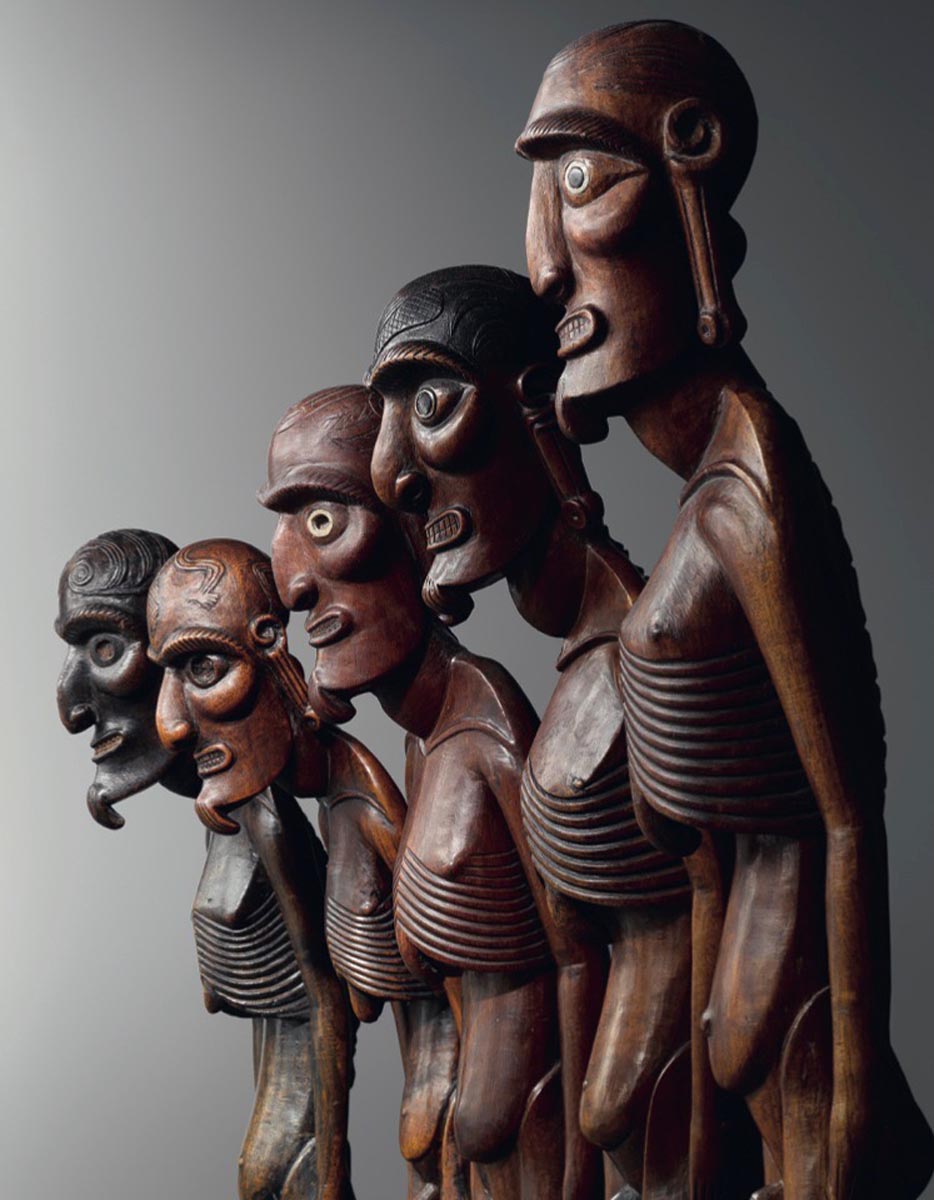
The body of the book is taken up with photography of the Polynesian works, the majority of which have seldom been published before, making this publication a serious visual resource. Interspersed with the images is Tim Teuten & Kevin Conru’s survey essay “Life and Art in Polynesia”. Here is a vast slab of important readable knowledge covering the history and cultures of the Polynesian world. Bringing such vast layers of information together like this, in a readable format that is absorbing not oblique, is one of the crowning achievements of this book. I have always thought it an impossible task to survey all the arts of Polynesia in one volume; however, the latter two chapters combine to take the reader on a voyage across the Pacific towards such a goal. Overall, this publication Polynesian Art is a remarkable celebration of Polynesian arts. Like the taonga (heritage treasures) shared in this book, or, as Nuku reframes what we think of conceptually as taonga in this volume as eminently more powerful in the sense of manatunga; a form of inherent totality Polynesian Art will continue to affect and impress all who open it and learn from its pages.
Available from Vasco & Co books
www.vascobooks.net and other outlets.
caption: Male figures, moai kavakava Easter Island Image by Hughes Dubois.