
Patterns in Beaded Aprons of Cenderawasih (Geelvink) Bay – Symbols of Cultural Beliefs
by Professor Peter McCabe, University of Adelaide
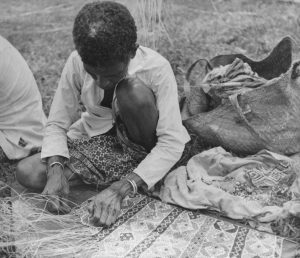
Aprons of varying styles have traditionally been worn throughout New Guinea, especially for festive occasions, but the aprons of Cenderawasih Bay (formerly Geelvink Bay), in the northwest part of the island, were unique in being composed of imported beads and having intricate and complex designs not found elsewhere in the island. In contrast to the common rectangular shape of aprons, Cenderawasih aprons have an irregular pentagonal shape with a squared top and pointed bottom. The bottom two sides are usually fringed by strands of imported cotton from imported fabrics. For centuries, the peoples of the northwest coast were in much closer contact with the outside world than the rest of New Guinea. The inhabitants of the Bay were seafaring folk who traded wood, resins, birds of paradise skins, and slaves with the nearby Spice Islands. Portugese and Chinese traders also visited the area. The beads, textiles, iron objects and ceramics gained from this trade became valuable possessions and heirloom items. Aprons were made by women from the imported beads (Figure 1) and were kept for special occasions such as weddings.

What is the source of the complex patterns seen on the aprons? Are they copied from patterns seen on imported textiles or did these patterns have special meaning to the inhabitants of Cenderawasih Bay? Certainly many of the patterns are ones found elsewhere on the Indonesian archipelago. The hooked X-pattern (Figure 2 and 3), for example, is common in textiles from Timor, from the Toraja of Sulawesi, and the Dayaks of Borneo. Other patterns, including the square spiral (Figures 2 and 4) are also common in those areas. Missing, however, are patterns common in Java, Sumatra and Bali – the areas of the archipelago strongly influenced by Malay traders who brought Buddhism, Hinduism and eventually the Islamic faith to the region – yet it would have been those designs that might have been expected to have been commonly encountered in trade with the Islamic rulers of the Spice Islands.


The inhabitants of Cenderawasih Bay have something else in common with many inhabitants of Timor, Sulawesi and Borneo – they speak an Austronesian language that is quite distinct from the Papuan language families mainly spoken in New Guinea (with the exception of some other maritime-focused areas such as the Bismarck Archipelago and the easternmost part of the main island). This shared heritage suggests that the symbols may also have a shared cultural meaning. Many of the symbols relate to the Austronesian spiritual beliefs in the power of ancestors and the afterlife – something that is also reflected in the Cenderawasih Bay area in the carving of Korwar figures. The hooked X-figure, for example, is thought to represent an ancestor figure with embracing arms and the squared spiral a representation of the afterlife.
Another cultural aspect of the Austronesian people, from the Dayak of Borneo to the Maori of New Zealand, is the importance of tattooing. Early images of the inhabitants of Cenderawasih Bay show extensive body and facial tattoos on both men and women. Such tattooing continued until the mid-20th century and in 1961 Galis published a series of drawings he had taken of tattoos with explanations provided by the owners as to what the images represented. Some of the Austronesian symbols such as hooked figures and squared spirals are again common but there are additional images that are also commonly found on the beaded aprons. An animal figure is described as a “sea-demon in the shape of a turtle” (Figures 3 and 5). The apparently random arrangements of dots on the tattoos (Figures 3 and 6) are described as the stars and cross of the Morning Star (Figure 4).


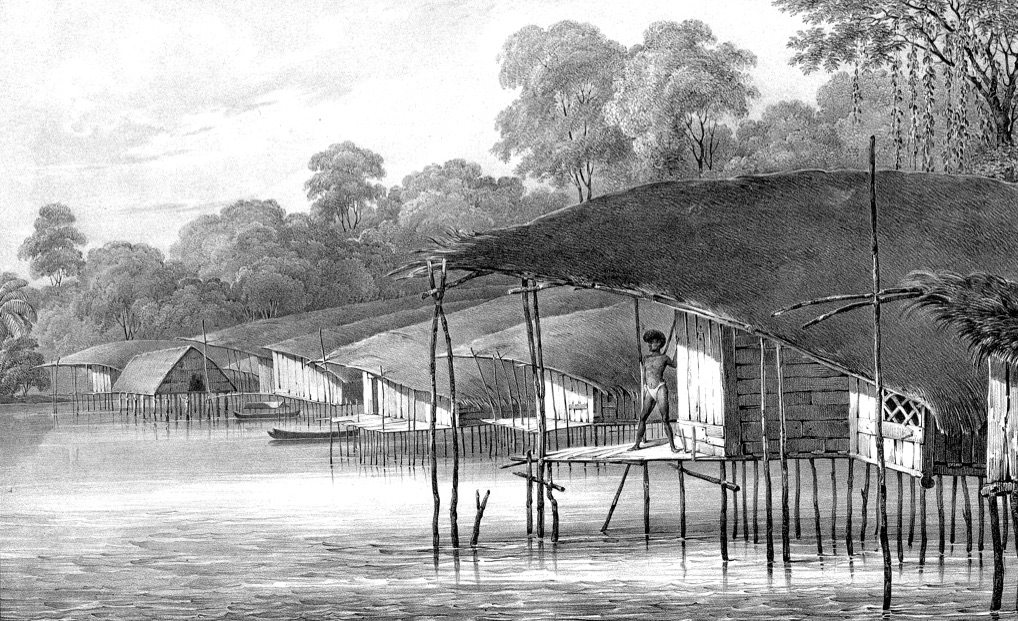
Intriguingly a complex pattern of squares in an overall triangular pattern, that resembles the squared pattern of many beaded aprons, is described as the constellation Pleiades (Figure 7). The Morning Star and the Pleiades figure prominently in the mythology of Cenderawasih Bay: a fact that is perhaps not surprising given that the inhabitants made long sea voyages and presumably navigated by the stars. Even today the Morning Star is a powerful symbol for the inhabitants of the area. Likewise the importance of the turtle and other sea creatures depicted in the tattoos points to their maritime focus and mythologies. In fact, the turtle was so important in the mythology of the area that houses were built in the shape of turtles (Figure 8).

Rather than being copies of images borrowed from other cultures, the patterns seen in the aprons of Cenderawasih Bay appear to have had deep meaning for their wearers as they speak of their ancestors and mythologies. The aprons clearly reflect the unique culture and beliefs of the region.
Peter McCabe
References:
de Clercq, F.S.A., 1893, Ethnographische Beschrijving van de West- en Noordkust van Nederlandsch Nieuw-Guinea, Leiden, 300 pp.
Galis, K.W., 1961, Biak-Noemfoorse tatouage: Kultuurpatronen v. 3 / 4, p.102-119.