George Nuku’s presentation at the Pacific Arts Association 2022 Conference
Review by Pierre Laffont
George Nuku has become one of the best-known Māori artists due to his creation of a large number of works in situ in various museums over the last 20 years. Since his most recent exhibition at the National Museum of Australia in Canberra in 2014, he has created, amongst others, Bottled Ocean for the Museum of Contemporary Art, Taipei, Taiwan which has toured the world in adapted versions (Rouen, France in 2015, Pātaka Art + Museum in Porirua, New Zealand and Tjibaou Centre, New Caledonia in 2016, La Rochelle, France and Kaohsiung Museum, Taiwan in 2017 and Bourges, France in 2019). Garance Nyssen reviewed the La Rochelle exhibition in her article on George Nuku’s Bottled Ocean Project published in this Journal (Volume 26 Issue 4, Summer 2021-2022).
Nuku presented another exhibition titled Voyage autour du Monde, l’aventure Maori de Dumont d’Urville at Musée Hèbre, Rochefort in 2021. Here he aimed to reinterpret Dumont d’Urville’s Māori legacy, as well as botanist Pierre-Adolphe Lesson’s drawings of people, tattoos, canoes and architecture. Nuku gave Dument d’Urville’s legacy a new dimension both metaphorically and physically, by scaling up the Lesson prints to fit the walls and framing them with polystyrene frames and filling the remaining space with Perspex canoes and other forms. He also displayed a sculptured portrait of Dumont d’Urville with a tattooed face (moko).

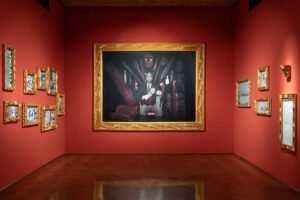
This new exhibition, Oceans, Reflections, Collections, currently at the Weltmuseum in Vienna takes this concept further on a much larger scale. In the words of George Nuku,
“this project represents my largest work to date … comprising 9 separate spaces within the Weltmuseum and 1 outside, it covers a wide range of topics and narratives. Expressions of Ocean environment are presented in “Bottle Ocean 2122” installed in the Thesus Temple. The further 9 installations inside cover “Collecting and Collections”, “Male and Female Roles as represented in Oceanic Art”, “Contemporary interventions within established museum scenography”, “a presentation of both alternative and complementary views on decolonising the museum”, “restitution of collections” and “the controversial topic of human remains in relation to both their return to their source communities and their public display in public institutions”.
Added to this is a presentation of a contemporary Oceanic response to the current pandemic in the form of a major art installation.

George Nuku is indeed an engaging artist and it is entirely impossible to summarise the richness of the visuals he creates. He is definitely not shy about intellectual controversies, not just by making plastic rubbish into art and asking us to see them both as terrible but also as beautiful. He strongly believes that “ethnographic museums are the place to be” for an artist and he is determined to carry on his journey.
While in Vienna, he has been exploring the complex interaction in the historical past and for our present time between the former Austro-Hungarian Empire and Aotearoa/New Zealand, with one space dedicated to the first large scale scientific circumnavigation by the Austrian Imperial Navy in 1857-1859 and another to the journey of two Māori men who visited Vienna in 1858-1859 culminating in a personal audience with the emperor Franz Joseph and the Empress Elisabeth (Sisi).

In the underground world space, he reflects on the relationship between past, present and future conveyed by the moko as worn by the artist and the moko as worn by deceased ancestors’ moko mokai. National Gallery of Australia Curator of the Pacific Collection Crispin Howarth gave a thought-provoking lecture on the return of ancestral remains, which involves the role of the repatriation unit at the Museum of New Zealand Te Papa Tongarewa in charge of the full return of all moko mokai. To paraphrase George Nuku, this moko tradition has not yet been trivialised, yet this is a risk in a world of globalised mediocrity, where both the haka and the tattoo have been popularised.
The Power and Prestige exhibition on the arts of Clubs in Oceania was taking place at Musée du Quai Branly – Jacques Chirac during the conference. Nuku was asked to comment on New Zealand clubs whose axes and handles are bound together by ligaments. He said that they illustrate his role as an artist. “People sometimes tell me that I believe that the world revolves around me. And I believe it: as an artist, I am here to bind the world which spins around me”.
And this is what he does with his engrossing “Oceans, Reflections, Collections”.