
by Eric Kjellgren
In contrast to the rich diversity of sculptural traditions in other areas of Oceania, surveys of Oceanic Art (including Kjellgren 2007 and 2014) often describe Micronesia as a region with almost no figurative sculpture. The division of the Pacific Islands into the broad geographic and artistic regions of “Melanesia,” “Polynesia” and “Micronesia” is, of course, an externally imposed one that remains both largely arbitrary and problematic. Nonetheless, it is true that the quantity of figurative sculpture that exists from “Micronesia” (comprising the archipelagos of the Caroline, Mariana, and Marshall Islands, together with Kiribati and the “Micronesian Outliers” (see below)) is extremely small in comparison to that from other regions of the Pacific. But, while the number of surviving Micronesian sculptures is small, often limited to a handful of examples in little-known museum collections, Micronesia as a whole is home to a remarkable diversity of traditions of figurative sculpture, to which this essay is intended to serve as an introduction.
As with nearly all customary Oceanic art forms, Micronesian sculptures represent the products of artistic traditions with histories spanning many centuries or millennia. But, with few exceptions, the origins, forms, and development of Micronesia’s sculptural traditions prior to European contact remain almost entirely unknown. Spanish explorers first encountered Micronesian peoples in the 1500s. However, virtually all the information that we have on Micronesia’s art forms as they are, or were, practiced by the region’s diverse indigenous cultures exists within the traditional knowledge of their contemporary practitioners and the accounts of, and objects collected by, European, Japanese, American, and indigenous observers between the late 1700s and the present. It is only rarely that any vestiges of Micronesia’s earlier sculptural traditions remain.
Probably the earliest surviving Micronesian sculptures are a group of thirty eight monolithic stone carvings from Belau (Palau), which have been extensively documented by archaeologist Dr. Jo Anne Van Tilburg. These stand at a number of different locations on the islands of Babeldoab and Koror, where they are predominantly associated with past and present village sites, dwellings, and bai (meeting houses) (see Van Tilburg 1991). However, although believed to be ancient by both contemporary Belauans and archaeologists, none of these monoliths has been securely dated and their precise ages remain unknown (Van Tilburg 1991: 52). Of the thirty eight known examples, ranging in size from a broken carving around 40 cm high to an imposing image nearly 3 meters tall, twenty eight of them incorporate stylized anthropomorphic imagery. Other motifs include images of quadrupedal animals, some of which are identified by Belauans today as crocodiles (ibid: 3, 21-26). With one exception, which shows the head and torso, all the anthropomorphic images consist solely of one or more human-like faces, such as that in Figure 1, which are sometimes accompanied by quadrupeds or other motifs. Belauans refer to this category of images generically as klidim (“face”) and identify some examples with particularly large, rounded eyes as chesuch (“owl”)(ibid: 9-10, 17). Most have individual names, some male and some female, and many are identified by Belauans today as village or guardian deities and two of them are associated specifically with the usurper deity Medechiibelau (ibid: 53). In some klidim, the eyes are the only features shown (or that have survived the centuries of erosion). Many, however, include other facial features such as the nose and mouth, shown, in some instances, with what appear to be protruding fang-like teeth (ibid: 26-30).
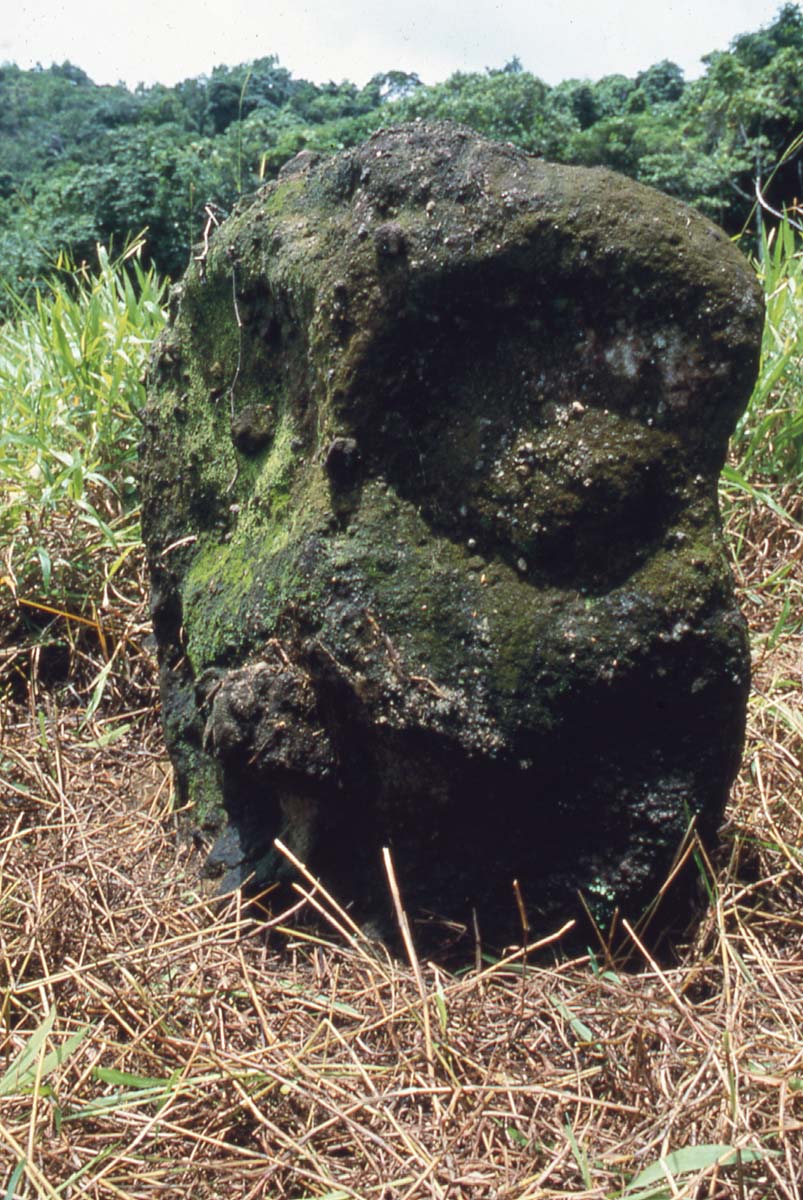
Whether these ancient stone faces and other images originally had the same names and associations that they do today is uncertain. But the fact that contemporary Belauans continue to associate them with a diversity of supernatural beings, as well as the enormous investment of time and labour that would originally have been required to carve them out of solid stone, strongly suggests that they are, or were, sacred religious images, intended to represent, and pay homage to, a variety of divine beings from Belauan cosmology. In addition to the large stone monoliths, a smaller freestanding Belauan stone figure, measuring 28 cm high, that appears to be of some antiquity also survives. Depicting a crouching anthropomorphic figure with facial features similar to those on the monoliths, it is said to represent a deity named Temdoki, and was originally kept in a cave together with a Triton shell trumpet and several unusually shaped natural stones, one of which, like some of the monoliths, was said to represent an owl (see Heermann 2009, p. 42-43, pl. 24).
In addition to its ancient stone sculpture, the islands of Belau, the westernmost of the Caroline Islands, are also home to the greatest diversity of forms of sculpture in Micronesia. As in many New Guinea cultures, the most prominent focus of Belauan art and sculpture are the ornate men’s houses, or bai. Used for meetings and informal social gatherings as well as for dances and ceremonial feasts, up to the mid twentieth century, bai formed the centre of men’s social lives. In some communities women also had their own social associations and bai some of which, to judge from a model of a women’s bai now in a German museum collection, were adorned with architectural sculpture (see Krämer 1926: 353, Brown 2012: 300).
Women were customarily prohibited from entering men’s bai, with the exception of the mongol, a woman who, until the early 1900s, lived within the bai and served as a sexual consort for its associated men (Feldman 1986a: 40, Kjellgren 2007: 267-68). Bai, of which one early example still survives and a second was constructed in the 1990s on the grounds of the Belau National Museum, are imposing structures with steeply pitched thatched roofs and high triangular facades. While the gables of some bai were thatched, in many cases they were, and are, constructed from a series of horizontal wooden planks, which, along with the interior wooden architectural elements, are often lavishly carved with a variety of symbols or narrative scenes depicting episodes from Belauan oral traditions, vividly painted in red, yellow, black, white and other colours (Feldman 1986a: 39, Kjellgren 2007: 267).
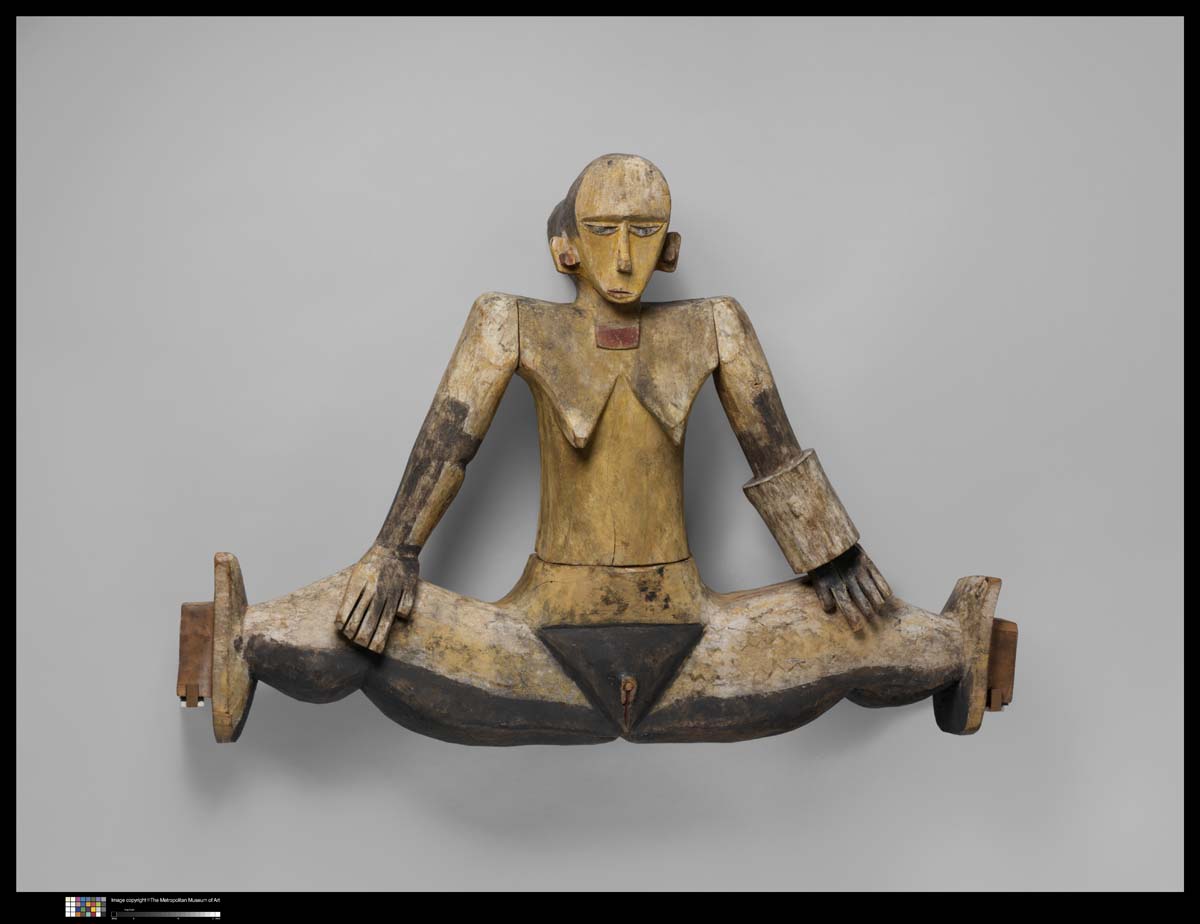
The planks on the gables of bai today are decorated exclusively with incised and painted designs. However, prior to around 1920, these decorated planks were often accompanied by separately made female and male figures, carved in the round and fitted onto the facade by tenons on their feet (like those seen on feet of the gable figure in Figure 2) or other areas. In what is likely the earliest European depiction of a bai, a watercolour by British artist Arthur Devis, part of the crew of the British ship Antelope, which was shipwrecked in Belau in 1783, its façade consists of decorated planks above a large horizontal lintel atop which a large standing anthropomorphic figure appears at the centre, flanked by a pair of similar standing figures on either side (see Brown 2012, p. 301). While the gender of these 18th century figures is unclear, by the late 19th century, the gable sculpture on many men’s bai centred on the dilukái (Figure 2) a female figure positioned above the main entrance.
Depicted with her legs outspread and genitals conspicuously displayed, the dilukái image was flanked on either side by a series of male figures with greatly enlarged phalluses pointing inwards toward it, which were typically incised and painted into the plank behind it (Feldman 1986a: 40). However, in some cases, these ithyphallic male images were represented by separately carved figures. Two male gable carvings, one with a greatly enlarged, separately carved phallus, said to depict the being Mogoulou of Ngaraus, and a second, unidentified, example, with a square mortice cut into the genital region into which a similar phallus was likely fitted are almost certainly examples of such figures (see Heermann 2009: p. 49, pl. 28, p. 63, pl. 52). The overtly sexual symbolism of the dilukái and her accompanying male figures, together with other fertility symbols that often appear on the gable, all suggest these images were collectively associated with fertility and procreation (Feldman 1986a: 40).
The identity and significance of the dilukái are uncertain. In some Belauan oral traditions, a woman named Dilukái is said to have been the sister of a quarrelsome man named Atmatuyuk, who fled into a men’s bai to escape his enemies, where he subsequently made her serve as the mongol. Atmatuyuk soon wore out his welcome and was expelled from the bai by the other men, who carved a naked image of Dilukái and placed it over the entrance to prevent him from reentering, since it was forbidden by incest prohibitions for a brother to see his sister naked. Subsequently, when a new bai was consecrated, the troublesome spirit of Atmatuyuk would be ceremonially expelled from it and a dilukái image placed over the entrance to prevent his return (Krämer 1926: 297, Heermann 2004: 234, Kjellgren 2007: 268). Other accounts, likely influenced by Christian missionaries, assert that the dilukái image depicts a woman whose excessive promiscuity made her brother, or other men, carve an image of her and place it on the bai to remind other women to be moderate in their sexual activities (Robinson 1983: 171, Treide 1997: 31, Heermann 2004: 234). Dilukái images are apparently intentionally portrayed naked, as evidenced by several surviving standing female architectural figures, who are carved wearing traditional women’s skirts (see Treide 1997: p. 217, no. 3, Heermann 2009: p. 62, pl. 51). Despite their lack of clothing nearly all dilukái, as in Figure 2, are shown wearing valuable jewelry consisting of a báchel (a traditional valuable fashioned from a section of an ancient glass trade bracelet) around their necks and a deruál (a precious women’s armband made from stacked rings of turtle shell, see Treide 1997: no. 75, p. 228) on one arm. The presence of these potent symbols of wealth and status strongly suggests that, whatever her identity, the dilukái represents a woman, or female supernatural being, of wealth and high status (Heermann 2004: 233, Kjellgren 2007: 268).
In addition to the carvings that adorned the bai, Belauan architectural sculpture also included kumereu (“fish posts”), supernaturally powerful wooden posts dedicated to guardian deities associated with the ocean, which stood near many dwellings. The finials of some kumereu were carved in the form of miniature representations of dwelling houses or bai of which a handful of heavily weathered examples, likely cut from their original posts and often identified as “house models,” survive, though the significance of this imagery is uncertain (Krämer 1926: 72-73, fig. 57, see also Kaeppler, Kaufmann and Newton 1997: p. 507, pl. 413).
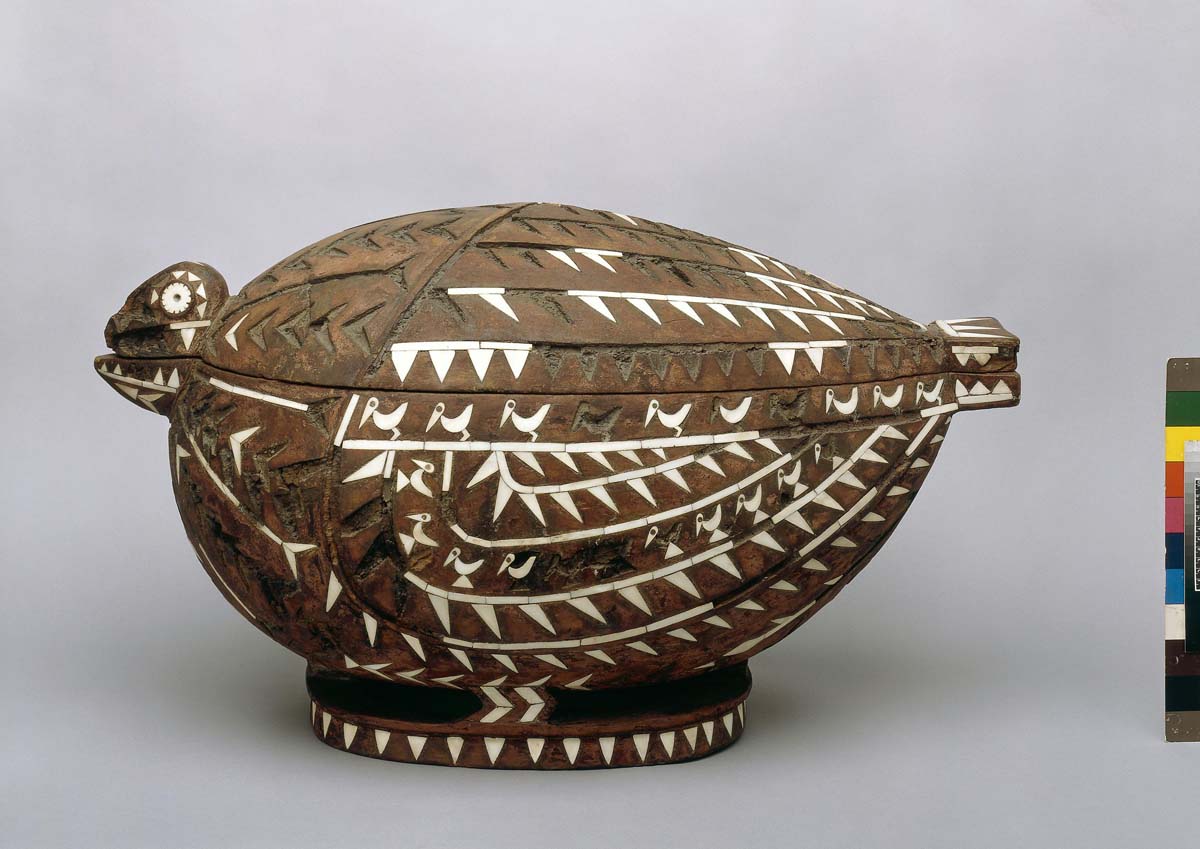
Apart from architectural carvings, there are a number of freestanding forms of Belauan figural sculpture. Many of these are prestige objects, exquisitely crafted and often lavishly decorated with shell inlays or created from prized materials, which served as potent visual symbols of wealth and status among high ranking Belauan families. Among them are a number of zoomorphic lidded containers, employed, like punch bowls, to hold and serve a sweetened beverage on important occasions. The best known of these is an enormous bird-shaped vessel, reportedly capable of holding 40 litres of liquid (Figure 3). This enormous lidded bowl is intricately carved and lavishly decorated with shell inlays representing the eyes, smaller bird images, and rows of triangular forms possibly denoting feathers. Among the most iconic works of Micronesian sculpture, it was presented in 1783 by the ibedul, the high chief of Koror, to Capt. Henry Wilson, the commander of the Antelope, in thanks for Wilson’s assistance in warfare during the three months he and his crew spent on the island repairing his shipwrecked vessel and is now in the British Museum (see Keate (ed.), 1803: 101-1-2).
A smaller inlaid bird-shaped vessel, now in a German museum collection, is probably of a somewhat later date as it includes inlays made from both shell and imported white porcelain (Treide 1997: no. 10, p. 218). Its long beak suggests that it may represent a curlew, a bird symbolically associated with the bringing of wealth in the form of traditional currency (Krämer 1926: 113). The tradition of carving enormous zoomorphic serving vessels continued into the early 20th century, and expanded to incorporate images of introduced animals, including a monumental matched pair of near life-sized lidded beverage vessels depicting a bull and a cow, carved for a traditional women’s association on Koror by the Belauan sculptor Golegeril in 1905 and now in the Linden-Museum Stuttgart (Krämer 1926: 116, pl. 6, Heermann 2009, p. 25, pl. 4). In addition to functional vessels, two freestanding Belauan images of other introduced animals, one depicting a seated cat and the other a pair of monkeys, are also preserved in the Linden-Museum (Krämer 1926: pl. 6).
In addition to stone and wood, in rare instances, Belauan artists also created sculptures from Tridacna shell. These include a Tridacnashell valuable, said to be a ceremonial club for cracking coconuts, carved in the form of an elongated, stylized fish, which also has phallic features (Krämer 1926: 297, fig. 202, Treide 1997: p. 219, no. 12). This ceremonial club was passed down as an heirloom over several generations within a high ranking Belauan chiefly family and was later presented by Fraklai, the high chief of Ashgreb to the Polish ethnographer Jan Stanislaus Kubary in the late 1800s (see Treide 1997: p. 219, no. 12). A second Tridacna shell image, depicting a smoothly contoured human face with eyes inlaid with a different type of shell, remains in Belau today in the state of Ngiwal (see Van Tilburg 1991: fig. 19).
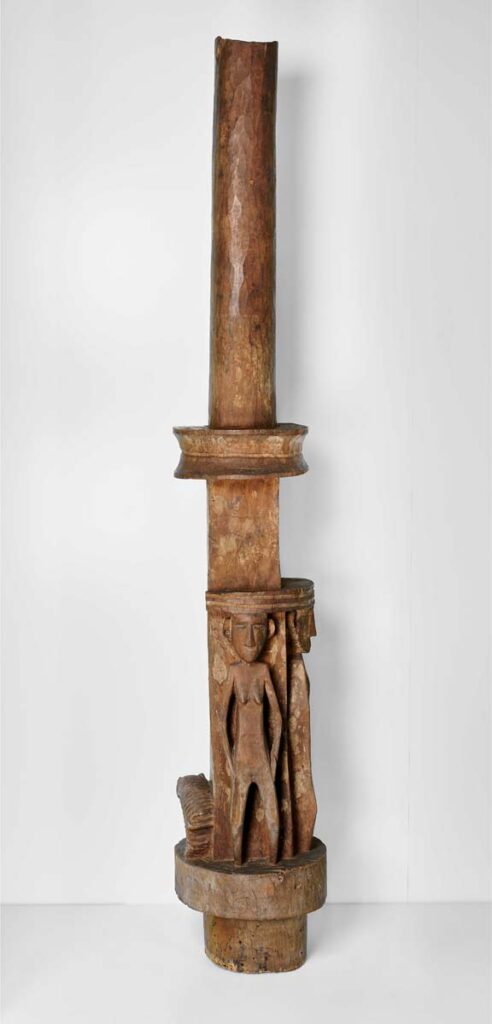
Moving eastwards across the Caroline Islands, the island of Yap, whose most famous sculpted objects are its massive carved rai or “stone money” disks that are the world’s largest form of currency, are also home to a substantial tradition of figurative sculpture. As in Belau, Yapese sculpture primarily consists of architectural carvings that adorn, or once adorned, important Yapese buildings, especially the pebai (men’s meeting house) constructed on a massive stone platform at the centre of the village (Feldman 1986a: 35-37). Within the pebai, its supporting houseposts and lintels are often extensively decorated with both painted and carved figurative images including fish and other sea creatures, birds, dogs, cats, lizards as well as representations of traditional valuables and human figures (ibid: 37). The pebai housepost in Figure 4 shows two standing human figures along with a more abstract form, possibly representing an animal (Treide 1997: p.220, no. 20). Another Yapese housepost, now in the Ethnologisches Museum, Berlin, depicts two cats, one in the act of catching a mouse with each of its front paws, above carved representations of two large ma (long ceremonial Tridacna shell pestles set in tall wooden mortars (see Treide 1997: no. 101, p. 231)), while a long fish, carved in high relief, appears on the side. The significance of the diverse anthropomorphic and animal images that appear on Yapese houseposts is uncertain. While some certainly portray culturally important objects, such as ma, and the animals shown may have had supernatural or clan associations, others, such as the cats on the Berlin housepost, appear more informal and may have been purely decorative.
In at least one community, Yapese sculptors also created architectural stone carvings as evidenced by a carved paving stone now in a German museum collection. According to its associated documentation, it originally formed part of the stone pavement of the ceremonial plaza in front of the pebai in Kadai village, which was reportedly completely paved with similar stones with images carved in high relief. It depicts a canoe crewed by three standing human figures holding paddles or club-shaped implements and shows traces of pigment indicating it was originally painted (see Treide 1997: no. 90, p. 230).
In addition to images carved directly into architectural elements, Yapese wood sculptors also created freestanding images of birds, both resting and in flight. Depicting frigatebirds, terns and other species, such bird images were reportedly mounted atop, or suspended from, the rafters of Yapese men’s houses (see Heermann 2009, p. 41, pl. 24, pp. 178-179, pls. 207, 208).
Perhaps the most widespread form of Micronesian sculpture were “weather charms,” such as that in Figure 5. Up to the mid 1900s and, in a few places, reportedly today, weather charms, known by various local names including hos, gos, xos, or osonifei were widely made and used across the Caroline Islands from Yap in the west as far east as the islands of Chuuk (Truk) (Horstmann and Maaz 2005: 85, Kjellgren 2007: 273). The widely scattered islands and archipelagos of Micronesia were, and are, linked through complex inter-island voyaging networks, made possible through the practical and supernatural knowledge of master navigators. Among the greatest threats to Micronesian voyagers are powerful storms, whose raging winds and towering waves can easily destroy or disable a canoe at sea.
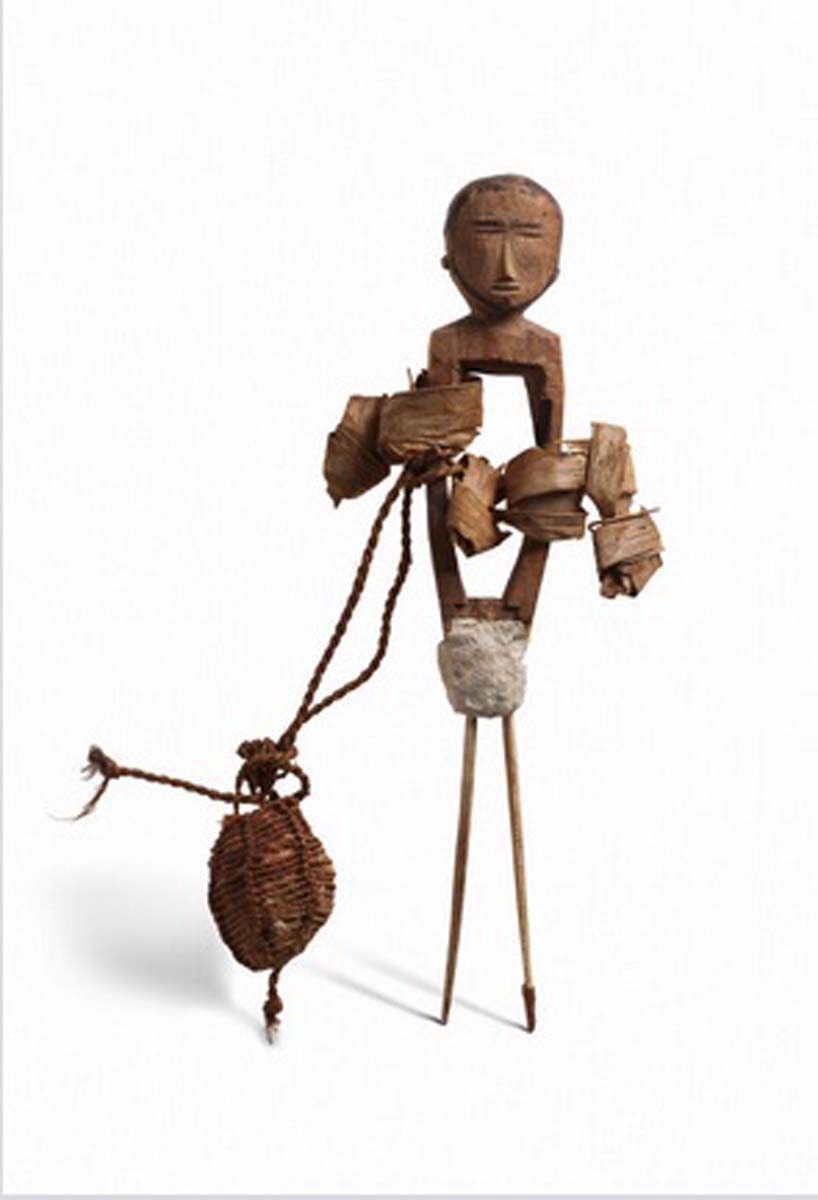
In an attempt to avert this constant threat, Carolinian navigators created and used weather charms, which were believed to have the supernatural ability to prevent or divert the path of approaching storms. Weather charms consist of a wooden handle, often carved in the form of a single human figure or two human figures shown back to back (see Figure 5), whose “legs” are formed by a series of serrated, dagger-like stingray spines attached to the base. Although the sculptural qualities of the anthropomorphic images on weather charms are admired by Westerners, it is the stingray spines that are believed to be the source of their supernatural power (Lessa 1950: 152, Kjellgren 2007: 272).
On land, weather charms were stored in the canoe house and were not allowed to be kept in an ordinary dwelling (Lessa 1950: 157, Alkire 1965: 119). Before embarking on a voyage, a navigator would take the charm from the canoe house and, grasping it by the handle, sound a shell trumpet to invoke the associated spirits. Pointing the spines away from his body, he would manipulate the charm in a stabbing motion while reciting incantations in order to drive off any approaching storms (Kjellgren 2007: 273). Afterwards, the charm was carried aboard the canoe, and often kept in a small spirit house erected on the booms connecting the main hull to the outrigger. If a storm threatened, the navigator would repeat the ritual, thrusting the sharp spines, believed to supernaturally irritate the approaching storm, in an effort to drive it away (Horstman and Maaz 2005: 77-78). The exact nature and significance of the human images on Carolinian weather charms are unknown and may have varied from place to place. However, it seems likely they either depict, or were associated with, spirits whose supernatural powers protected the canoe and its occupants.
In the western Caroline Islands, another widespread form of sculpture were distinctive seated figures, carved from dark wood with inlaid shell eyes and shown seated on the ground in a “squatting” position with their legs sharply bent and their hands resting on their knees (see Kjellgren 2007: 270-71). Often generically associated in the literature with the island of Hatobei (Tobi), such seated figures are also documented from Belau, Yap, and the islands of Ulithi, Ngulu, Lamotrek, Woleai, Sonsoral, Satawal and Satawan, indicating that the tradition was practiced across an extensive area (Wavell 2002: 64, Wavell 2010: 48-56). While the vast majority of such figures were, and are, made for sale to outsiders, a number of early examples show clear evidence of considerable age and indigenous use (see Kjellgren 2007: 270-271, no. 160). Depicting both male and female subjects, the little information that exists about their nature and use was recorded on Hatobei, where some of them were reportedly ancestor figures, kept in family dwellings. In some instances, such figures apparently served as offerings during canoe burials, in which a pair of them was placed with the deceased within a sealed, canoe-shaped coffin, which was set adrift at sea. In others, seated figures were reportedly used to expel malevolent spirits from the community, which were lured away by, or supernaturally captured within, the images and then sent out to sea in miniature canoes (Wavell 2002: 66-71, Wavell 2010: 48-52).
In addition to seated figures, a single taller standing female figure, some 71 cm high, with carved and painted facial features and separately made movable arms attached to its body with iron nails also survives from Hatobei but its exact nature and function are unknown (see Treide 1997: no. 89, p. 230). At the eastern extreme of the Caroline Islands, another standing female figure, 53.3 cm high, carved from dark brown wood with shell-inlaid eyes, exists that is attributed to Nauru. This image was reputedly in an English museum collection prior to 1895. However, its exact origin and age are unclear (see Kaeppler, Kaufmann, and Newton 1997: p. 507, pl. 411).
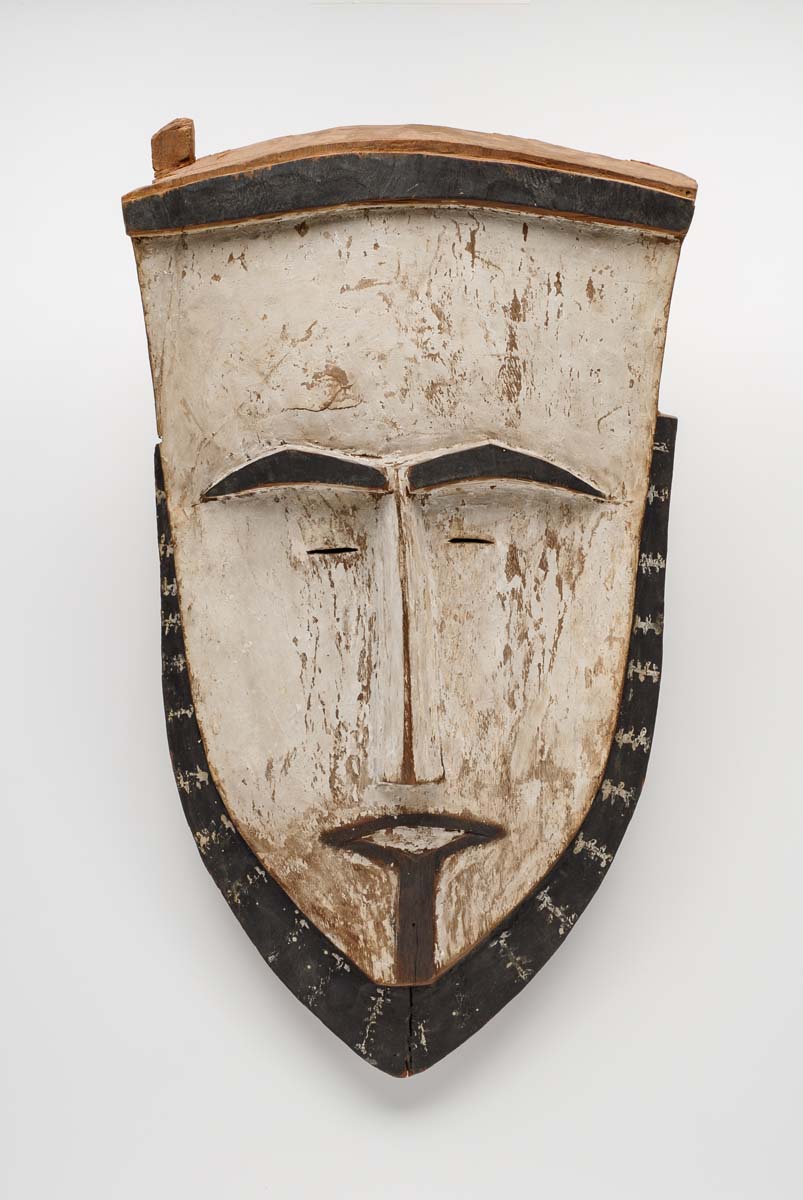
The Caroline Islands are also home to Micronesia’s only masking tradition, the distinctive masks from the Mortlock Islands known as tapuanu (Figure 6). Like Carolinian weather charms, tapuanu masks were used in rituals intended to ward off approaching storms, which could devastate whole communities and destroy breadfruit and other crops. Depicting powerful ancestral spirits known as anu, the masks were under the care of the soutapuanu, a men’s secret society, who kept the masks, and performed their associated rituals, primarily within the ceremonial house (falefol) (Feldman 1986a: 31). Inside the falefol, the masks were hung from its structural beams and similar mask-like images were sometimes carved directly into its supporting pillars (ibid: 31).
If a storm was approaching, members of the soutapuanu would put on the masks and perform a ritual dance as a group in an attempt to supernaturally drive it off. A brief film showing dancers wearing tapuanu masks performing on a beach was made by an early twentieth century German expedition. However, it is unclear whether this footage records a traditional context for a tapuanu performance or was staged outdoors at the request of the filmmakers because the interior of the falefol was too dark for filming (Feldman 1986a: 31, Treide 1997: no. 37, p. 222).
With their elegant lines that seamlessly blend curving and angular elements to depict their eyes, browline, hair and long thin triangular noses, the faces of tapuanu masks resemble those of both Carolinian weather charms and Belauan dilukái images and epitomize the spare, minimalist approach to the human form characteristic of much of Micronesian sculpture. Many tapuanu masks, as in Figure 6, also have an angular or rounded projection (or, occasionally, both) extending above the black hairline at the top, likely representing a decorative comb and/or topknot of hair. Nearly all surviving tapuanu masks closely resemble each other. However, there is a single “Micronesian” mask, with highly rounded features and an unusual painting scheme that is more reminiscent of masks from northern Vanuatu. Reputedly collected on Lukunor Island, it may not have been made there but possibly brought to the island either by returning Micronesian voyagers or the crew of a visiting Melanesian vessel (see Treide 1997: no. 131, p. 234).
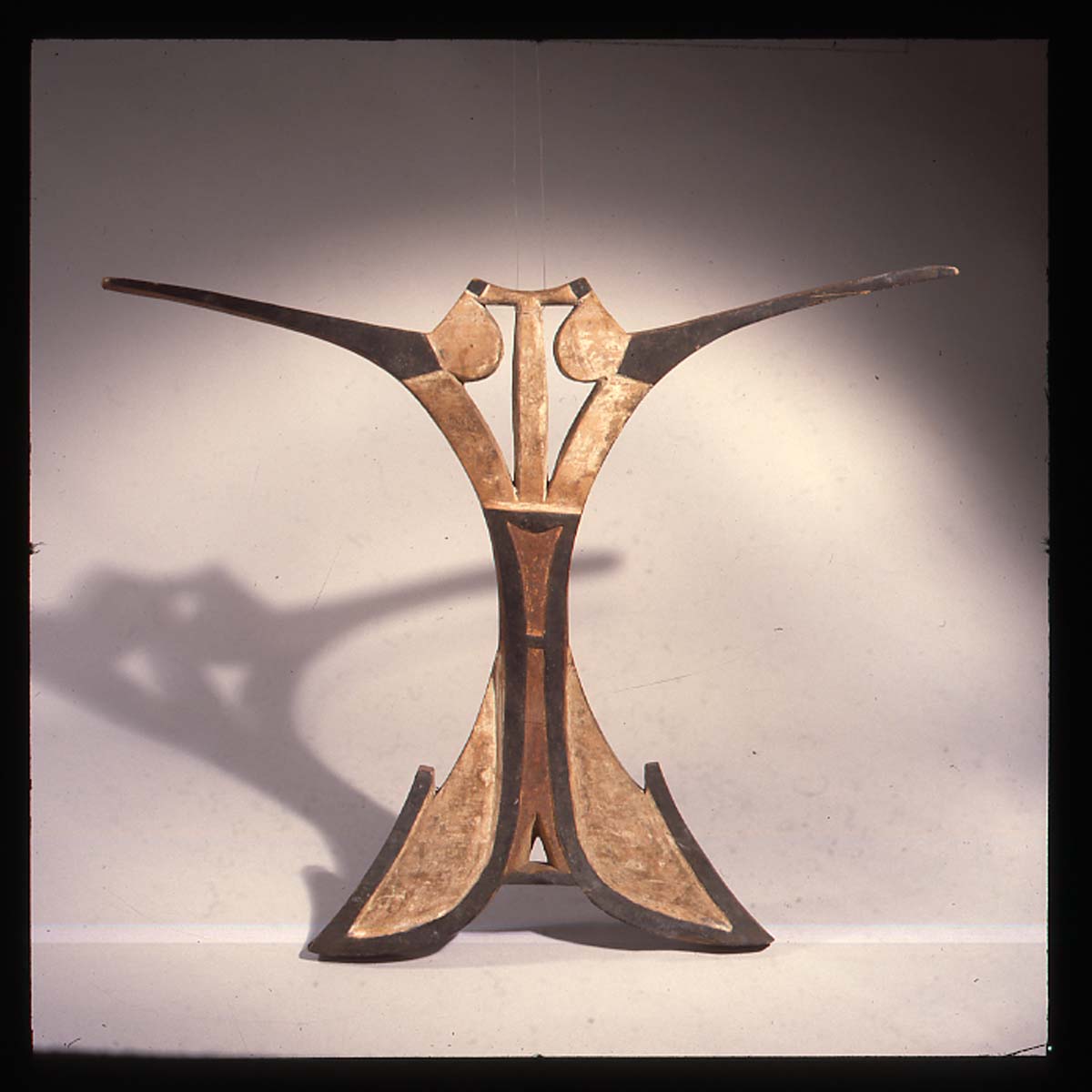
Together with human images, depictions of birds form one of the central themes in Micronesian sculpture. Among the most striking are the stylized bird images on the canoe ornaments (aten) from the islands of Chuuk (Figure 7). With their seamless blending of curving and angular forms painted in contrasting shades of black and white, the overall design scheme of aten closely parallels the aesthetic of the tapuanu masks and weather charms. Affixed to vertical wooden sticks, these ornaments were attached to the bows and sterns of the large, paddled war canoes known as waa faten during warfare and on other important occasions (Feldman 1986a: 25, Treide 1997: no. 30, p. 221). In peacetime, it was customary for those aboard a waa faten to lower its aten ornaments when approaching other canoes as a signal that their intentions were peaceable. When a waa faten was not in use, its ornaments were removed and carefully preserved (Kubary 1889: 53, Feldman 1986a: 25).
Always strictly symmetrical, aten were carved by master canoe builders (soufanafan) (Feldman 1986a: 25, Treide 1997: no. 30, p. 221). The upper portion consists of two stylized bird images, variously identified as either terns or frigatebirds, depicted face to face with their beaks touching a central projection and long curving tails (see Figure 7) (Treide 1997: no. 30, p. 221, Heermann 2009: p. 214, pls. 231-233). The imagery of the lower section is more highly stylized. Most have a roughly “W” shaped motif at the base, said to represent the wings of a frigatebird, and a slender vertical element in the centre, typically painted in red, that, on some examples, is clearly a stylized representation of female genitalia (Heermann 2009: p. 214, pls. 231-233). However, the meaning(s) and cultural significance of this remarkable combination of imagery are unknown.
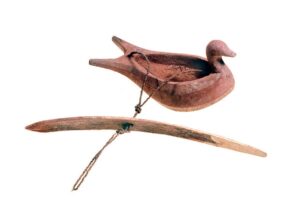
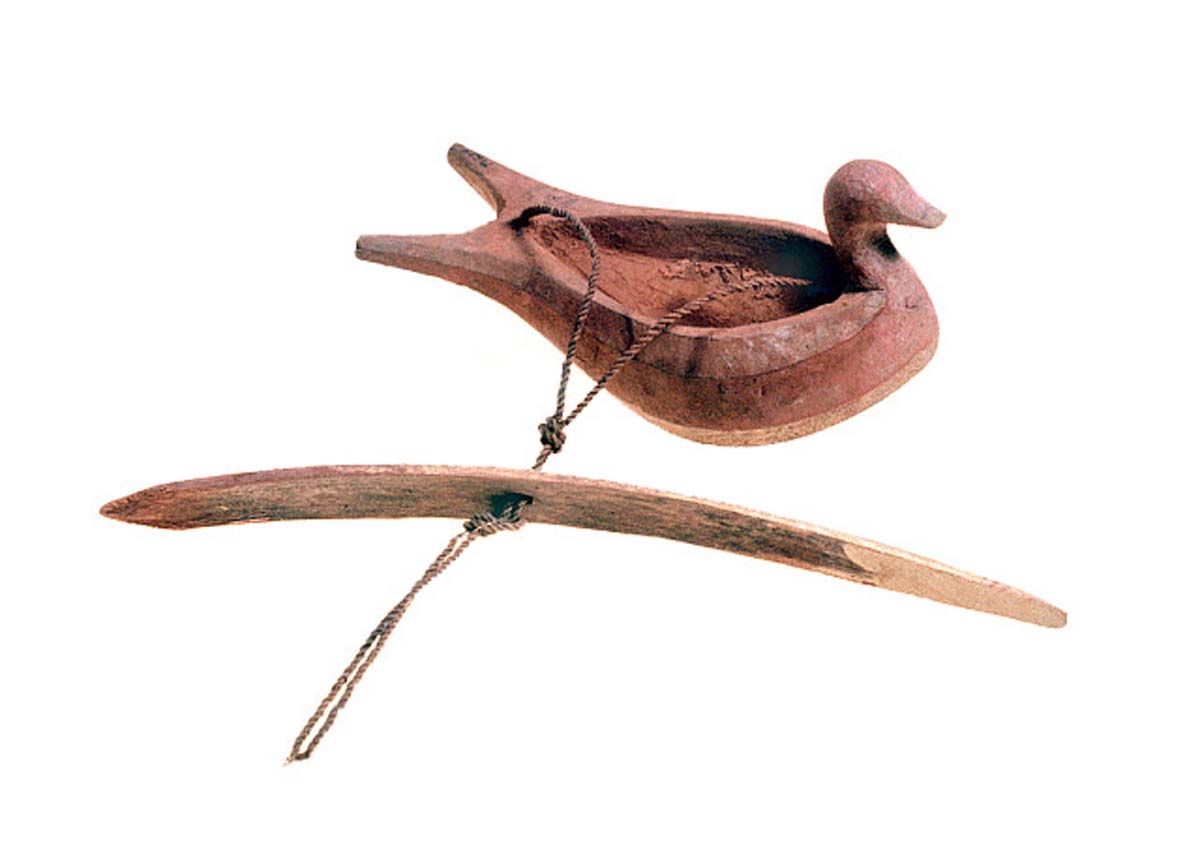
Other examples of Micronesian avian imagery include a number of superbly carved bird-shaped hanging bowls from the western Caroline Islands including Satawan and Puluwat. Some of these vessels reportedly served as food bowls, while others, such as that in Figure 8, were used to hold paint used for adorning canoes. Although typically painted red, according to some sources, the birds depict white gulls, shown as if resting on the sea. Such bird-shaped bowls were treasured household objects passed down by women as treasured heirlooms from mothers to daughters over succeeding generations (Damm 1935: 65-66, Someki 1936: 172-90, Feldman 1986b: 16-17). A different form of bird-shaped container from the island of Lunkunor, said to represent a frigatebird, also has a hollow in its body, which was reportedly used to hold religious offerings (see Treide 1997: no. 128, p. 234).
Beyond the main archipelagos of Micronesia, the so-called “Micronesian Outliers” of Wuvulu, Aua, Ninigo and the Hermit and Kaniet Islands off the northern coast of New Guinea are also home to cultures who have closer cultural, linguistic, and artistic affinities to Micronesian societies than to those of the neighbouring areas of New Guinea. Of these, the Hermit and Kaniet Islands both had traditions of figurative sculpture. However, in contrast to the spare lines and minimal surface ornamentation typical of most Micronesian sculpture, the surfaces and openwork compositions of Hermit and Kaniet Islands woodcarvings are ornately carved and intricately detailed, rivalling the well-known “paddles,” “scoops,” and related carvings from the Austral Islands in Polynesia in terms of the intricacy, complexity, and masterful execution of their designs.
Only around half a dozen examples of freestanding human figures from the Hermit and Kaniet Islands survive and there is conflicting information in the published sources as to precisely where within these two neighbouring island groups some of the individual figures originated (see Bourgoin 1997: 70-71, 77-79, Treide 1997: no. 60, p. 226). All of the known examples are either explicitly male or appear to have masculine features and the majority are shown with long beards and lubun, a distinctive men’s hairstyle that is well documented from the Kaniet Islands (see Figure 9).
Among Kaniet men, hair was regarded as a highly sacred part of the body. Young Kaniet boys wore their hair cut short. However, when they reached adolescence, they were taken to a special initiation house, constructed on an isolated island. There, they lived in seclusion for a number of years during which they did not cut their hair and were forbidden all contact with women as well as their own fathers. While in ritual isolation, they were instructed in the knowledge and skills needed for their adult lives by a senior male elder, called the uta, and other initiated men. When their instruction was complete and their hair had begun to get long, they were initiated and reunited with their fathers. Another period of seclusion then followed until their hair finally grew long enough to be arranged into the lubun, a crest-like hairstyle worn only by adult men. Following a final ceremony, they at last returned to the community as fully adult men. From then on, their heads and lubun coiffures were considered so sacred that women were not permitted to touch them (Bourgoin 1997: 73-75, Kjellgren 2014: 143).
Although their prominent lubun indicate that most of the surviving figures depict their subjects as adult men, there is little information about their identity and function. However, it seems probable that at least some of them represent ancestors. One example, said to have been kept in a “temple” on the Hermit Islands, is identified as an ancestor figure while another was reportedly placed near a tomb, again suggesting that the figures portray either remote or recent ancestors (see Treide 1997: no. 60, p. 226, Bourgoin 1997: 79).
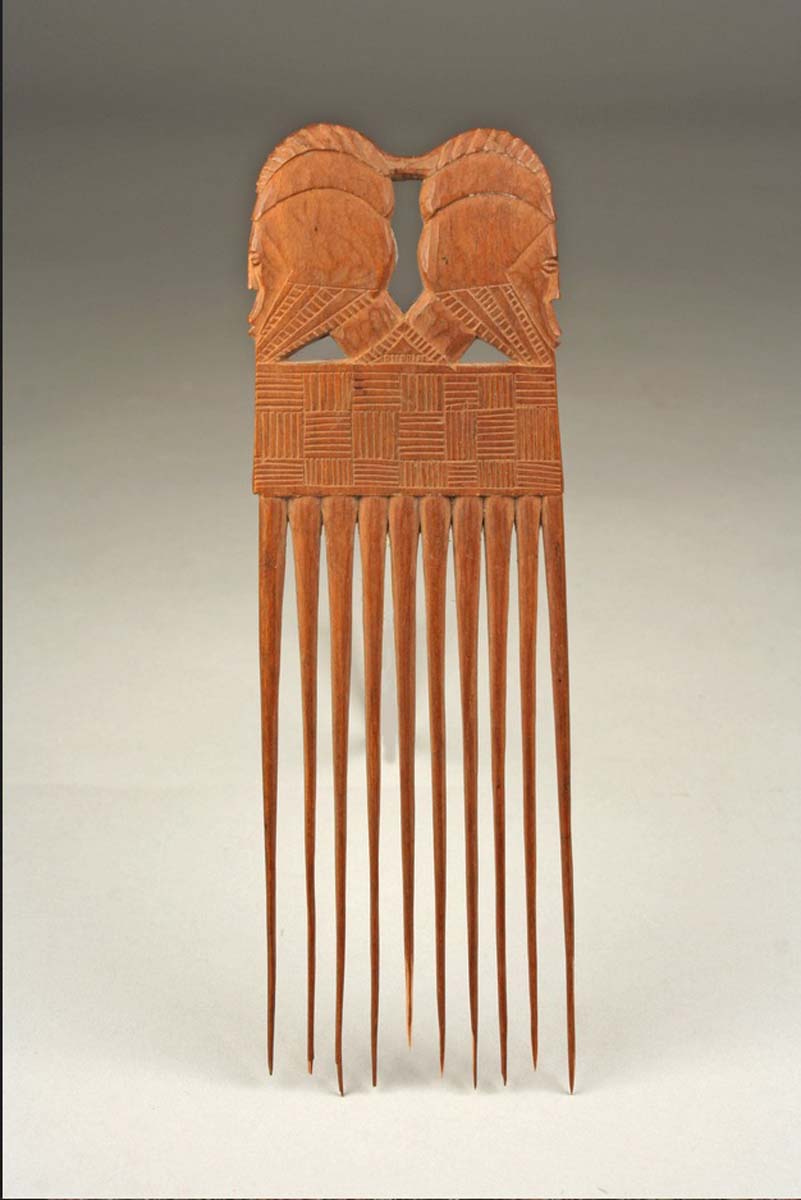
In addition to full figures, images of men’s heads with lubun hairstyles and long beards appear widely in Kaniet Island wood sculpture. Examples include two intricate openwork carvings resembling highly stylized adze handles, on which, on one example a single head and, on the other, two small men’s heads with beards and lubun are carved into the upper edges. To judge from their delicacy and lack of any obvious utilitarian function, these stylized implements were likely ceremonial objects (see Bourgoin 1997: 77-78, Treide 1997: no. 61, 61a, p. 226). Pairs of similar bearded heads with their distinctive lubun also appear on men’s decorative combs (kalakala) from the Kaniet Islands (Figure 9). While kalakala were worn by both genders, women’s combs were adorned exclusively with geometric motifs. However, men’s kalakala, as here, were frequently adorned with pairs of bearded men’s heads, shown back to back, often with the trailing portions of their lubun extending backwards to join in the middle. Worn by men as decorative accessories on important occasions inserted diagonally into their own lubun above the forehead, the intricately detailed heads on men’s kalakala portray, in miniature, the same hairstyle that they were created to adorn (Bourgoin 1997: 71, 74-75, Kjellgren 2014: 142-143, no. 34).
In addition to freestanding figures, combs, and ceremonial objects, Hermit and Kaniet artists created lime spatulas whose intricately detailed and delicately carved openwork handles are often miniature masterworks of Oceanic sculpture. Although primarily decorated with geometric designs, the handles of some examples are adorned with tiny representations of human figures or heads as well as a variety of animals including fish, turtles, and cuscus (possum-like marsupials also found in New Guinea and parts of Island Melanesia) (Bourgoin 1997: 69-71). However, whether these human and animal images had any supernatural or totemic si
gnificance or were simply decorative is unknown.
As this brief introduction is intended to demonstrate, despite its reputation as a region nearly devoid of figurative sculpture, Micronesia is, in fact, home to a rich and varied series of sculptural traditions. Among the three major geographic and artistic regions of the Pacific Islands, the arts of Micronesia continue to remain the least studied, and least known, among both scholars and general audiences. It is the hope that this essay will inspire both Micronesian scholars and traditional knowledge keepers as well as Western researchers and enthusiasts to explore, preserve, and appreciate this remarkable series of traditions within Oceanic art.
References
Alkire, William. 1965. Lamotrek Atoll and Inter-Island Socioeconomic Ties. Illinois Studies in Anthropology, 5. Urbana: University of Illinois Press.
Bourgoin, Philippe. 1997. “The Forgotten islands of the Bismarck Archipelago: The Hermits and Kaniets.” Tribal Arts, 15 (summer 1997): pp. 64-79.
Brown, Deidre. 2012. “Colonial Styles: Architecture and Indigenous Modernity.” In: Brunt, Peter et al. (eds.) Art in Oceania: A New History. New Haven and London: Yale University Press. pp. 298-321.
Damm, H. 1935. Inseln um Truk: Polowat, Hok und Satowal. Ergebnisse der Südsee Expedition 1908-1910, II, B., Vol. 2, part 2 (ed. By G. Thilenius). Hamburg: Friederichsen de Gruyter.
Feldman, Jerome. 1986a. “Beyond Form and Function.” In: Feldman, Jerome and Donald H. Rubenstein (eds.) The Art of Micronesia: The University of Hawaii Art Gallery. Honolulu: The University of Hawaii. pp. 25-43.
Feldman, Jerome. 1986b. “Form and Function in the Art of Micronesia.” In: Feldman, Jerome and Donald H. Rubenstein (eds.) The Art of Micronesia: The University of Hawaii Art Gallery. Honolulu: The University of Hawaii. pp. 15-23.
Heermann, Ingrid. 2004. “Dilukais Blick über Grenzen.” In: Deterts, Dorothea (ed.), Auf Spurensuche: Forschungsberichte aus und um Ozeanien zum 65 Geburtstag Dieter Heintze. Ten Den Zen, Jahrbuch 11 (2003, pub. 2004). Bremen: Übersee Museum Bremen. pp. 233-238.
Heermann, Ingrid. 2009. Südsee Oasen: Leben und Überleben in Westpazifik. Stuttgart, Germany: Linden-Museum Stuttgart.
Horstmann, Udo and Klaus Maaz. 2005. “I Pierce the Sky’s Eye (Weather Incantation in Micronesia).” Art Tribal (9) (Autumn 2005): pp. 72-89.
Kaeppler, Adrienne L., Christian Kaufmann, and Douglas Newton. 1997. Oceanic Art. New York: Abrams.
Keate, George (ed.). 1803. An Account of the Pelew Islands. London: G. Nicol.
Kjellgren, Eric. 2007. Oceania: Art of the Pacific Islands in the Metropolitan Museum of Art. New York and New Haven, The Metropolitan Museum of Art and Yale University Press.
Kjellgren, Eric. 2014. How to Read Oceanic Art. New York and New Haven, The Metropolitan Museum of Art and Yale University Press.
Krämer, Augustin [translated by Audrey Weinland]. 1926. Palau, Volume 3 Micronesia. Ergebnisse der Südsee Expedition 1908-1910, II. Ethnography, B. Micronesia. (ed. By G. Thilenius). Hamburg: Friederichsen de Gruyter.
Kubary, Jan. 1889. Ethnographische Beiträge zur Kenntnis des Karolinen Archipels, Part 1. Leiden: P.W.M. Trapp.
Robinson, David. 1983. “The Decorative Motifs of Palauan Clubhouses.” In: Mead, Sidney and Bernie Kernot (eds.) Art and Artists of Oceania. Palmerston North, New Zealand: Dunmore Press. pp. 163-78.
Lessa, William. 1950. “The Ethnology of Ulithi Atoll.” Typescript report prepared for the Pacific Science Board, National Research Council. Los Angeles: University of California.
Someki, A. 1936. The Wooden Dishes Used in the Caroline Islands [original text in Japanese]. Minzokugaku Kenkyu 2: pp. 172-190.
Treide, Barbara. 1997. In den Weiten des Pazifik: Ausgewählte Objekt aus den Sammlungen der Museen für Völkerkunde zu Leipzig und Dresden. Wiesbaden: Dr. Ludwig Reichert Verlag.
Van Tilburg, Jo Anne. 1991. “Anthropomorphic Stone Monoliths on the Islands of Oreor and Babeldoab, Republic of Belau (Palau), Micronesia.” Bishop Museum Occasional Papers, 31 (July 1991): 3-62.
Wavell, Barbara. 2002. “From Sacred to Souvenir: The Squatting Figure as a Motif in Micronesian Art.” Tribal Arts 7(3) (Summer-Autumn): 62-75.
Wavell, Barbara. 2010. Arts and Crafts of Micronesia: Trading with Tradition. Honolulu: Bess Press.