
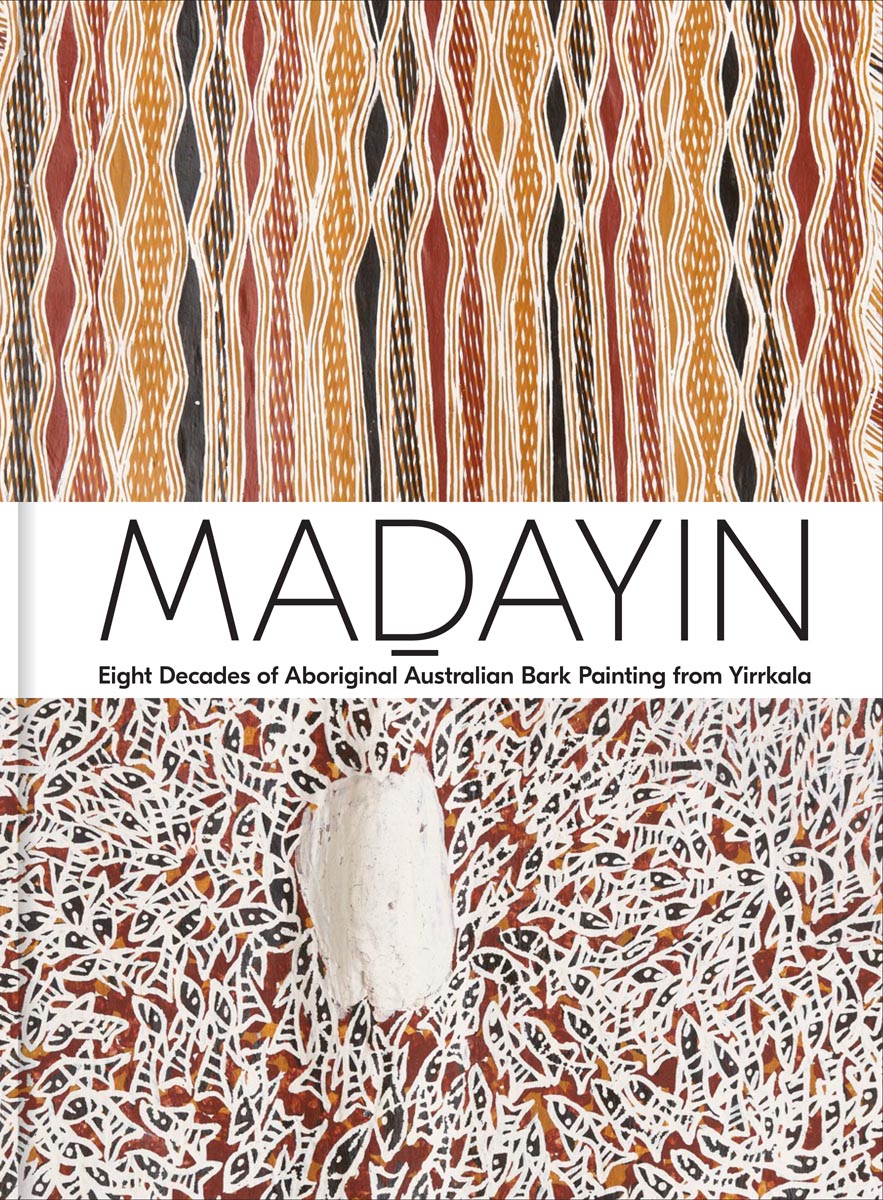
2022, 352 pages, edited by Wukuṉ Waṉambi, Henry Skerritt and Kade McDonald, published by Kluge-Ruhe Aboriginal Art Collection of the University of Virginia, Charlottesville, USA and Delmonico Books, New York, USA
Review by Noëlle Rathmell-Stiels
Maḏayin, a monumental survey of Australian Aboriginal bark paintings, is transcendent: it transports you to another world of beauty and sacredness. One of the unique features about the Maḏayin exhibition of nearly 90 works – is that it originated with Yolŋu people themselves – from the Buku-Larrŋgay Mulka Centre in north-east Arnhem land in Australia. Developed over seven years, Maḏayin has been curated with a strong focus on gurruṯu. This is the Yolŋu kinship system which extends to people, Country, waterways and all that they contain. Embracing the separate yet connected moieties Yirritja and Dhuwa, it unfolds as a unified whole with historical works mixed in with contemporary works.
Djambawa Marawili suggested the project during his 2015 Australia Council sponsored artist residency at the Kluge-Ruhe Aboriginal Art Collection of the University of Virginia (USA). When Wukuṉ Waṉambi made the first curatorial visit to Charlottesville, he agreed to assume the role of lead curator and consultant. He was tasked with protecting Yolŋu authority in interactions with non-indigenous collaborators. Sadly, he passed away and was unable to celebrate the fulfilment of his substantial efforts over the previous six years.
The artworks in Maḏayin have been drawn from several institutional and private collections in Australia, the United States, and Europe. Kluge-Ruhe, under the terrific leadership of director Margo Smith, was fortunate to acquire a bark painting by Wukuṉ among the thirty-three works commissioned for Maḏayin. Expertly curated by Henry Skerritt, the university collection holds more than 2,200 works of art – the largest collection of Indigenous Aboriginal Art outside Australia. Moreover, with residencies and fellowships for indigenous artists who actively teach and work with students and faculty, Kluge-Ruhe forges connections with people and cultures across distance and time.
Thanks to the substantial support of governments, public and private foundations and individual donors, this travelling exhibition has gone from the Hood Museum of Art, Dartmouth College in New Hampshire in late 2022, to the American University’s Katzen Art Centre in Washington DC in early 2023. It will travel to the Fralin Museum of Art at the University of Virginia in Charlottesville from February – July 2024 and, finally, to the Asia Society in New York, from September 2024 – January 2025.
The superbly illustrated exhibition catalogue of 352 pages is bilingual thanks to a host of linguists and translators. Professor Howard Morphy and Honorary Associate Professor Frances Morphy, both at the Australian National University, have demonstrated a huge personal commitment to the people and their language, and they have developed relationships with them over many decades.
The exhibition and catalogue represent all that is best in intercultural collaboration. For those unable to see the exhibition there is a special website: Madayin: Eight Decades of Aboriginal Australian Bark Painting from Yirrkala (kluge-ruhe.org). But the catalogue stands on its own. It not only illustrates the outstanding bark paintings in the exhibition, but it also contains articles by the artists themselves, explaining the cultural messages of the various works. There are also detailed articles on the kinship system and on the Yolŋu language. The oldest painting in the exhibition is the Woŋgu Munuŋgur bark “Sacred Clan Designs” which is associated with the anthropologist Donald Thomson’s involvement in the ending of the Caledon Bay crisis of the early 1930s – said to have been a decisive moment in the history of Aboriginal-Balanda (European) relations in Australia. As is well known, artworks from Yirrkala have played important roles in the development of those relations over the eight decades since.
It is a crying shame, that with all the money being spent on so-called “world-class” museums, galleries and cultural centres in Australia, and with all the mining royalties flowing from the exploitation of Country, that funds have not been made available from any source to allow this outstanding show to travel here. We did have recently in the University of Sydney’s Chau Chak Wing Museum another excellent exhibition that emphasised Yolŋu bark painting curated by Rebecca Conway and Matt Poll: this also had an outstanding catalogue (reviewed in this Journalvolume 26, issue 2, 2021). But this show did not travel at all and its impact was attenuated by the restrictions of the pandemic. Now that we are in the midst of a major controversy about the authenticity of some recent Aboriginal art works, it is greatly to be regretted that these impeccable shows did not get any more exposure to Australians – but we can at least buy the books.