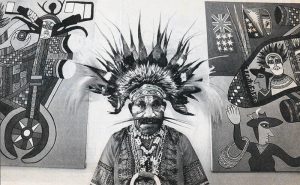
Image: Mathias Kauage at Ray Hughes Gallery February 1999. Image by Ben Rushton.
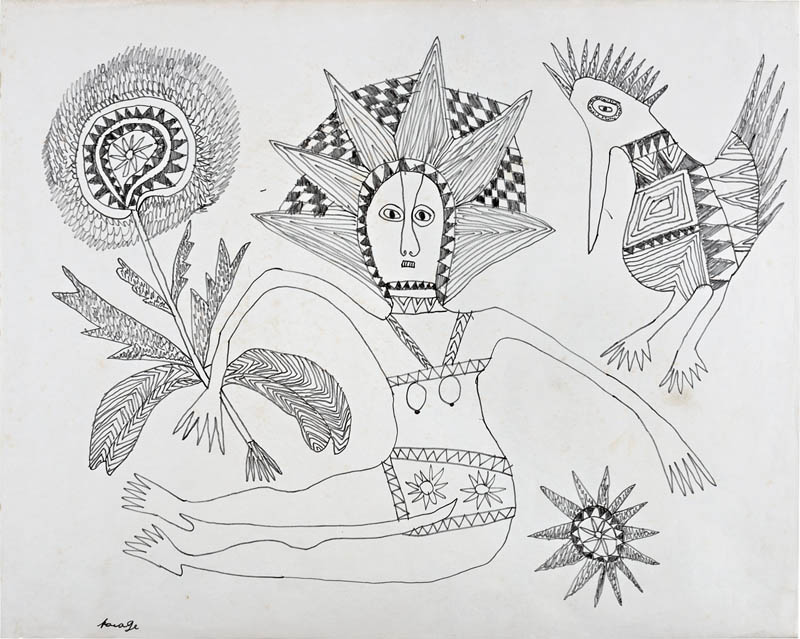
Mathias Kauage O.B.E. was Papua New Guinea’s best known and most highly awarded artist of the contemporary era. He was artistically active in the six crucial years leading up to 1975 (when PNG became an independent nation), until 2003 when he died. He is arguably PNG’s most significant contemporary artist and possibly the most highly regarded Melanesian artist ever.
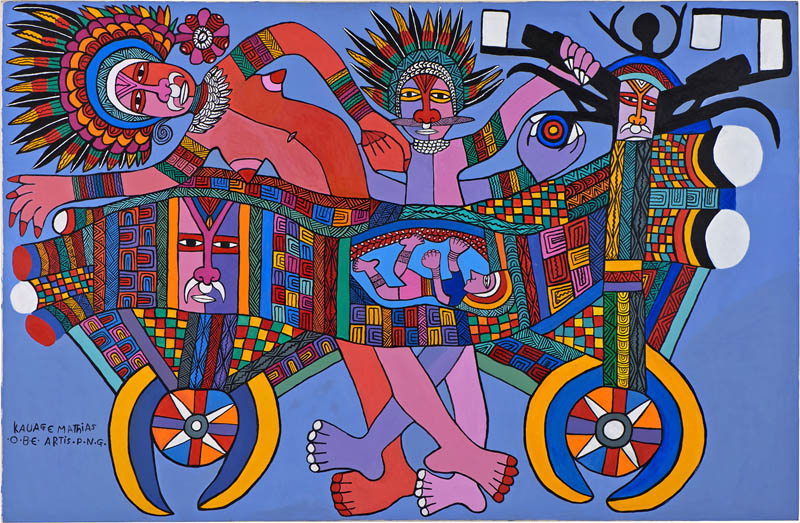
A man of singular vision, Kauage’s most powerful and best-known works define him as an incomparable recorder of (and social commentator upon) the collision between pre- and post-colonial life in his home country. Kauage might also be considered a significant artist on a world-wide basis, solely because he was one of the last on the planet to move from a customary existence into the overwhelming reality of twentieth century urban life.
As a child, Kauage was nurtured by a community of pre-European contact elders. His adopted son was born around the time of Independence and his own children in the years that followed. While Kauage’s early years were nourished by dictums and narratives of customary Chimbu belief systems, the most significant influence on his adult life was the myth of benign colonial conquest of his people.
Spawning generations of imitators, Kauage’s influence on the visual culture of Papua New Guinea has been profound. Using European-introduced materials and a genuinely naïve vernacular, Kauage’s incisive post-colonial observations secure his pre-eminent place among PNG-born artists. His bold and unique artistic style helped the newly independent nation to define an understanding of its emerging national identity, which is no small achievement in a country comprising more than 800 separate language and cultural groupings.
He was physically and metaphorically a giant of Papua New Guinean art and culture.
Andrew Baker