Australian National Maritime Museum. Review by Margaret Cassidy

In recent years the Australian National Maritime Museum has used its Indigenous maritime curatorial team to build what some are regarding as the nation’s pre-eminent collection of contemporary art from Zenadth Kes or the Torres Strait Islands. This is enriching the museum’s ability to share Australia’s maritime history and life from both Indigenous and European aspects as well as support an extensive program of exhibitions based on the Museum’s collection.
One result is a retrospective of the works of arguably the most important contemporary Zenadth Kes artist, Alick Tipoti. His works are so varied, strong and representative that the exhibition Mariw Minaral (Spiritual Patterns) was selected for the Indigenous Projects award at the 2021 Museums and Galleries National awards. Due to restricted viewing opportunities because of the pandemic, this exhibition has been extended until early 2023 and will then travel to across Australia and New Zealand.
Carving is a theme of the objects in this exhibition with Tipoti’s linocuts derived from the Melanesian cultural traditions of carving. In the 1990s, Tipoti was one of a group of Zenadth Kes artists who found that carving was easy and effectively translated into lino and printmaking, leading to a more economical carving medium than wood. The artists developed a unique regional style that is now widely recognised. An example by Brian Robinson (Maluyligal, Wuthathi and Dayak) Hunting dhangal (hunting dugong) from 2011 is an example currently on show in the Shaped by the Sea exhibition downstairs in the Museum.
Tipoti pushes the boundaries in terms of both size – this exhibition contains some extremely large linocuts such as Zugubal from 2006 that are intricately carved and technically perfect – as well as in his approaches to art, such as his ‘hidden images’, both as a technique and also to protect sacred cultural information. These hidden images are secrets within the works and with them Tipoti erases patterns around images and exposes the unexposed.
“Printmaking is the best way to obtain that traditional feel, carving patterns on ancient artefacts, painting to capture the same feel of ancient rock paintings seen around the island. This is all for the purpose of showing the world my culture”.
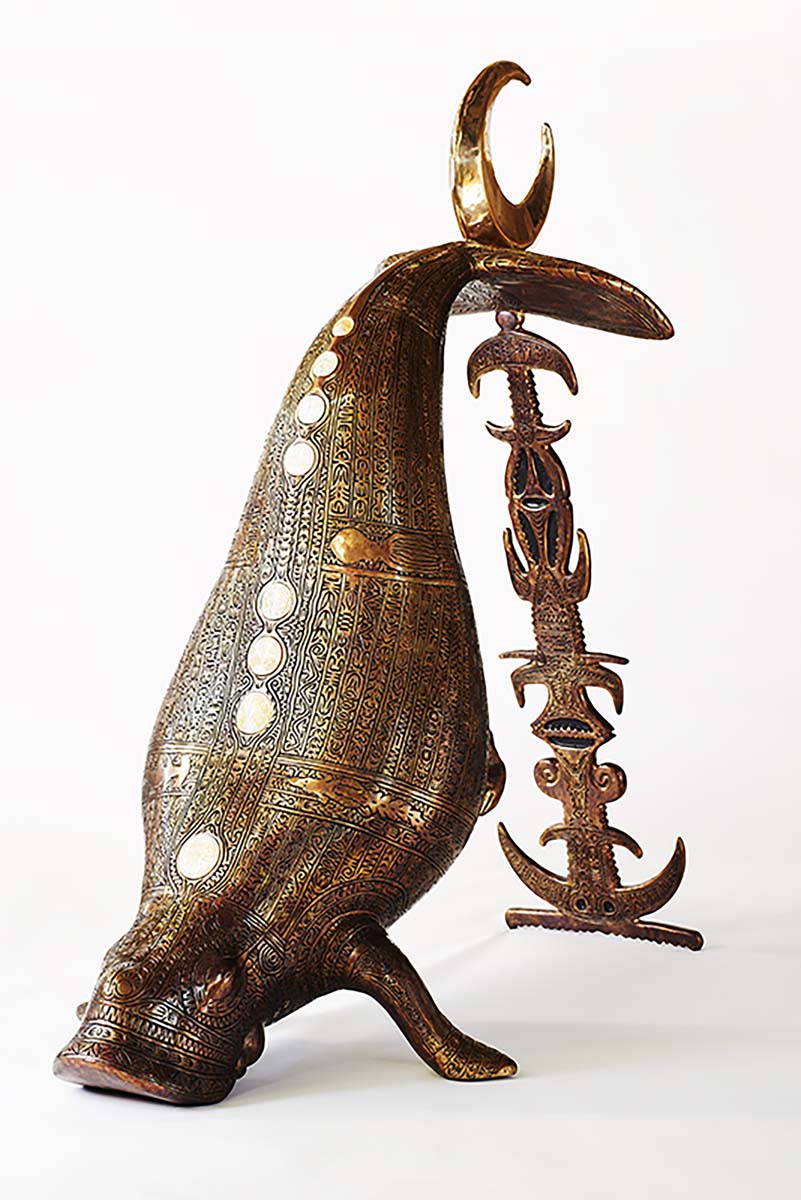
From Badu Island, Tipoti has openly stated throughout his career that he considers himself a carver and not a printmaker, and the ease of his carving of the cast for the monumental bronze sculpture Kisay Dhangal (moonlight dugong) in 2016 is demonstrated in the video Kisay Dhangal – making the bronze cast which can be viewed as part of the exhibition. Kisay Dhangal reflects the life cycle and feeding patterns of dugong in the Zenadth Kes. Inscribed with traditional motifs and mother-of-pearl inlay, the dugong was sculpted in the position known as san tidayk in Kala Lagaw Ya language, which marks the moment the mammal flips its tail to dive down and graze on the sea grass beds. It is extraordinary in detail.
Tipoti isn’t afraid to eschew traditional materials. Downstairs in the Shaped by the Sea exhibition can be seen a mawa (turtle shell mask) produced in 1993 by Patrick Thaiday from Iama (Yam Island). Historically waru (turtle) were used throughout the Torres Strait Islands to make masks for ceremony in dance and other rituals.
Tipoti has travelled to museums in Britain and searched out the masks made of turtle shell by his ancestors and acknowledges their spirits. There he introduced himself, showed respect and recognised the spiritual connections to his ancestors1. However, his Kaygasiw Usul (the trail of dust underwater created by the shovel nose shark) is a mask comprised of wood, fibreglass, resin, wax, rope, feathers, shells – he has said that the turtle should not be killed for commercial purposes to create works of art, only for cultural ceremony. He is concerned about marine environments and ocean conservation – focusing on what it means to be a sea person. Through careful staining and texturing these modern fibreglass masks look just like turtle shell.
Inspired by coastal life, family, traditional plants and medicines, the constellations and the ancestral stories, he brings these stories to life in his prints and sculptures.
- Lui-Chivizhe, Leah. (2022) Masked Histories: Turtle shell masks and Torres Strait Islander people. Carlton: The Miegunyah Press, pp xxi-xxii.