
2023, 352 pages, Elise Patole-Edoumba & Helene Guiot, La Geste
Review by Pierre Laffont
Thanks to an alert on the Oceanic Art Society’s Facebook page, I participated in the public book launch of Ma’ori in the library of the Muséum d’Histoire naturelle in La Rochelle, France presented by co-authors Elise Patole-Edoumba, Chief Curator of the Museum, and Helene Guiot, the foremost French expert on Polynesian material production.
Ma’ori or Maʔori (a more accurate way of designating the glottal) is the word used in Rapanui by the people of Easter Island to designate themselves. It also means expert, crafted or wise people worth remembering. This book is dedicated to both groups, as the objects will not have survived without the contribution of both those who create them and those who preserve them.
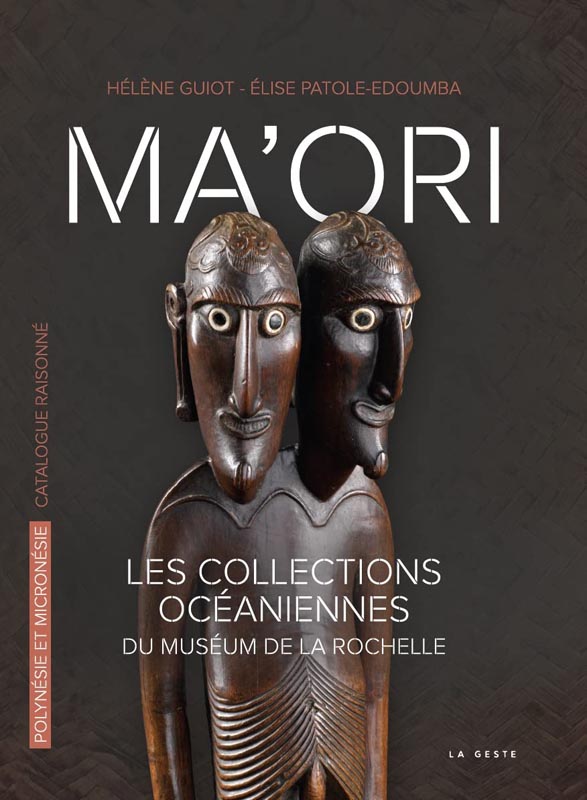
While the authors wanted this book to be a catalogue raisonné i.e. a comprehensive, annotated and illustrated listing of all Polynesian objects in the collection of the Museum, it is far more than that. This is only the second catalogue raisonné of any Oceanic Art collection in a French museum; the first being the one made by Claude Stefani and Helene Guiot for the Musée de Chartres in 2002. The authors believe that, compared to major English-speaking countries, Germany and Switzerland, France lags in this effort to have a complete and detailed inventory in the Pacific collections in its public institutions.
I have rarely found in museum libraries and bookstores specific books on their comprehensive Pacific Art collections, let alone something so interesting and pleasing, both extremely well researched and beautiful. No wonder that it took eight years from the start of the inventory in 2014 to the publication of this 350-page catalogue at the end of 2022, with this volume covering only the 362 objects of the Polynesian and Micronesian collection! The Museum plans to continue its inventory of the rest of its Pacific collection (more than 2000 objects) with the future publication of five similar catalogue raisonné dedicated to Vanuatu, New Caledonia, Solomon Islands, New Guinea and finally Australia.
The book provides the reader, through the depth of its researched text and the hundreds of well sized and sometimes stunning photographs, an impact that is close to touching or seeing the real objects. The catalogue presents in detail many unique pieces with particular effort to date the objects and to clarify provenance. However, there is a lack of clarity of provenance for the oldest object, a ceremonial Marquesan club which has been carbon-dated to 1415-1485. Older than the first Spanish voyage to the Marquesas Islands from 1595, this object has been in the La Rochelle municipal collections for centuries.
Better documented are some of the very few surviving pieces from later French expeditions to the Pacific. One of many remarkable pieces is the large (1.08 m high) anthropomorphic container of the deity Rongo from the Gambier Islands. One of seven similar statues identified in public Institutions globally, “maybe the most remarkable of all” according to a former curator of the Bishop Museum, it was collected in 1836 on Mangareva island and given to Dumont d’Urville in 1838, to be displayed in the French national collections in Paris. Having fallen out of public favour, it was deposited in La Rochelle in 1923 alongside more than another 500 Pacific objects which were taking too much room at the Louvre. Another illustration of “your junk is my treasure”?
However, the former Louvre objects, including some 20 from the voyages of Dumont d’Urville are not the oldest from French explorations. A 6m x 1.75m tapa collected during Bougainville’s expedition to the Society Islands in 1768 was exhibited to the public in a famous cabinet de curiosités in La Rochelle in 1804. This cabinet de curiosités would morph over 200 years into the present Muséum.
Tapas remained collectors’ items but with their larger numbers precision is sometimes lost on their exact geographical origin. Cataloguing helps to restore some order. For example, Quoy, who was the chief surgeon on the Dumont d’Urville voyage attributed one of the tapas he collected in 1827 “either to the Sandwich (Hawaiian) Islands or the Tongas”, whereas Helene Guiot could demonstrate that it originated in Fiji. Quoy admitted that he wasn’t a specialist, “What could be said of an educated person from India who would come to Europe without speaking any of the local languages, would limit himself on landing a few times on the coast and not staying more than 2 weeks anywhere, would collect from various hands without understanding one out of a hundred words, and, through his hurried collecting, would pretend to be an expert in the places he visited?” (page 21).
There are many more Polynesian objects and stories from Easter Island to New Zealand within this work which is so much more than a catalogue raisonné. I am anxiously awaiting the next instalment focused on the art of Vanuatu.