Dr Michael Mel, Co-curator of Bilas: Body Adornment of Papua New Guinea, Australian Museum, Sydney.
I am blessed to see so many of you here and so humble that you could have come and be a part of this show.
Firstly I want to acknowledge the country that we are on, the Gadigal people of the Eora Nation, and acknowledge their contribution to our wellness and our lives, friendship to us. Thank you for those. And I also want to acknowledge my history and my heritage and I recognise that they have also left a legacy that we need to protect and indeed so much so that this exhibition tonight is an indication of that legacy and the continued support and belief in those legacies and stories.
And I want to acknowledge the Australian Museum, in particular in the number of shows that have showcased Papua New Guinea heritage.
Who could forget the Birds of Paradise? That was my first engagement with the Australian Museum and a stunning exposure of colour and bird life and in the way that Papua New Guineans celebrate and acknowledge nature and how in turn these avian creatures of nature nurture humans.
That relationship between humans and nature is critical in relation to both today and the future. The relationship between ourselves and nature, that is a crucible that needs to be protected at all cost. Papua New Guineans and their local communities are very much interlinked and connected within that relationship.
Following the Birds of Paradise exhibition, who could forget the appearance of the Holosa, the ghost clay masks of the Asaro Mud Men. When they came through the smoke here at the Museum and the members of the audience suddenly see these masks appearing with both anticipation and apprehension, just as intended by their makers.
Those are some of the shows that really highlight the deep-seated connection between Australia and Papua New Guinea.
I acknowledge and thank the Australian Museum for the efforts and the time that they take to acknowledge this relationship between the two countries and the Museum’s celebration and recognition of its rich and highly valued Pacific collection. Putting valued objects from the collection on show to share with the community through these exhibitions including Bilas tonight is an example of that commitment to Pacific communities, to our diverse cultures and to our deep and long history.
A very sincere thank you to Kim McKay and to everyone who has been involved in bringing the Bilas project to fruition. It is a stunning show shared together with Wylda Bayrón and her amazing photographic work capturing and celebrating the breadth and diversity of Papua New Guinean culture.
Bilas translates to body adornment in Tok Pisin, an official language used throughout Papua New Guinea. In our culture, the body has long served as a ‘canvas’ for self-expression and to convey a multitude of messages to the outside world. Beyond being a vehicle for social communication and living art, there are also spiritual domains and meanings to the body adornment.
Our connection with everything living is innate to us. It is through the domain of the natural world that the spirits and our ancestors supply us with cosmological and spiritual knowledge, prosperity, balance and materials to decorate our bodies and beyond. Adorning the body with a feather or skin from the natural world activates a metamorphosis within us, and thus we become a living embodiment of the living environment.
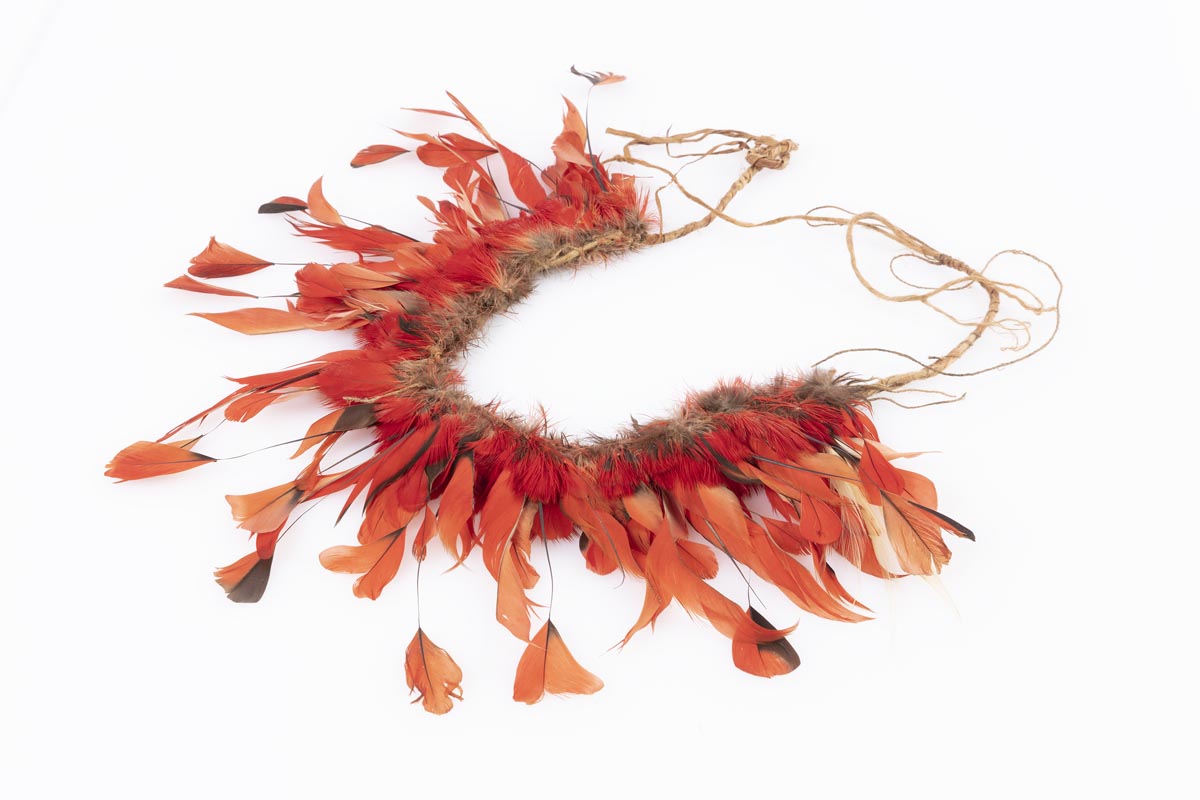
Our bodies are transformed into platforms for elaborate headdresses made up of bird feathers, marsupial fur, leaves, flowers, insects, shells, beads and bones.
Through songs, dance and stories of ancestors, myths are born, linking with birds, hornbills, cuscus, pigs and eagles. These creatures inspire us to create our masks, ornaments and body decorations.
One very important point that I wish to make is that what we see tonight in the exhibition is still. Both the images and objects are motionless. However, the objects together with these stunning images are momentary captures of a movement, of moving energy, of performance caught for in a moment of time. The objects are intended for movement, not to lie still as an exhibit.
These objects perform for us an activity and a relationship because together these things come alive during performance, they are very much part of deeply felt experiences. From the origins of the materials from which they are constructed, these objects are connected with the environment and they also belong to living communities.
The images captured so magnificently by Wylda Bayrón and the objects that have belonged for a long time in the collection from the Australian Museum, together with the collection of newly made cultural objects that is joining the Museum from three communities in Papua New Guinea: together they provide for us a very important link in relation to performance and engagement. In all, there are 83 newly created cultural objects from three PNG cultural groups: Koki, in the Laiagam District of the Enga Province, Yalu, Kagua District in the Southern Highlands Province; and Meingik in Koinambe, Jimi District in the Jiwaka Province. It is a privilege with this new exhibition, as was the case with the two earlier exhibitions, the Birds of Paradise and the Masks of the Asaro Mud Men, to provide opportunities for the commissioning and inclusion of new additional cultural objects to showcase our continuing and living culture so very clearly.
Thank you for presenting and highlighting Papua New Guinea’s history, which is also our shared history that continues today. For cultural institutions like the Australian Museum to showcase this provides for a great opportunity to maintain and continue this relationship between our two countries. I thank the Museum for taking these opportunities and highlighting those connections through the sharing of culture for all of us.
I’d like to say a little in relation to the collection and the environment and people. In my language, when we talk about a relationship, I am no more than the environment, than nature itself.
When nature speaks to me, I respond, I connect with it in some way to find within myself how well I am seated with my family, with my community.
Nature has a way of speaking to me, that connection is very strong. Quite often we exemplify that when it comes to performance, when nature is part of the human performance and materials from nature adorn the physical body to the point where we have a connection that is there, to be experienced, to be felt, and then to be lived through life and to protect and sustain the environment as much as ourself. Those relationships between the natural world and nature and humanity are quite significant to communities in Papua New Guinea but I hope that in this changing landscape and context and the shifting environment with climate change and the rest that there is a challenge and an opportunity for all of us.
I hope that this exhibition of Bilas is not only about the colour and the variety and the difference but even more about the relationships that the exhibition demonstrates. These relationships include the long-standing relationships between PNG communities and their cultural materials that are derived from the natural environment around them.
This exhibition presents aspects of the material culture of every area of PNG; a culture that is deeply cherished and which we are holding onto as the world changes. For the communities of PNG whose cultural material is on display and shared with us all; this exhibition shares a little bit of the story that lies deeply within us and what makes us human.
I want to thank the Australian Museum for giving us the opportunity to share and showcase our culture and really celebrate what is unique and different and also what is more important, our shared histories in this part of the world.
Thank you so much for everyone who has worked behind the scenes – I worked on this exhibition back in PNG – and through all the telephone calls and emails and the rest of it has come to a stunning result. Thank you to everyone including all the supporters and to the Australian Museum, which holds the largest collection of Papua New Guinea artefacts in the world. Papua New Guinea feels very honoured to have been given this space.
Thank you.
Dr Mel Michael is from Kilipika Village, Mt Hagen, Western Highlands, Papua New Guinea.
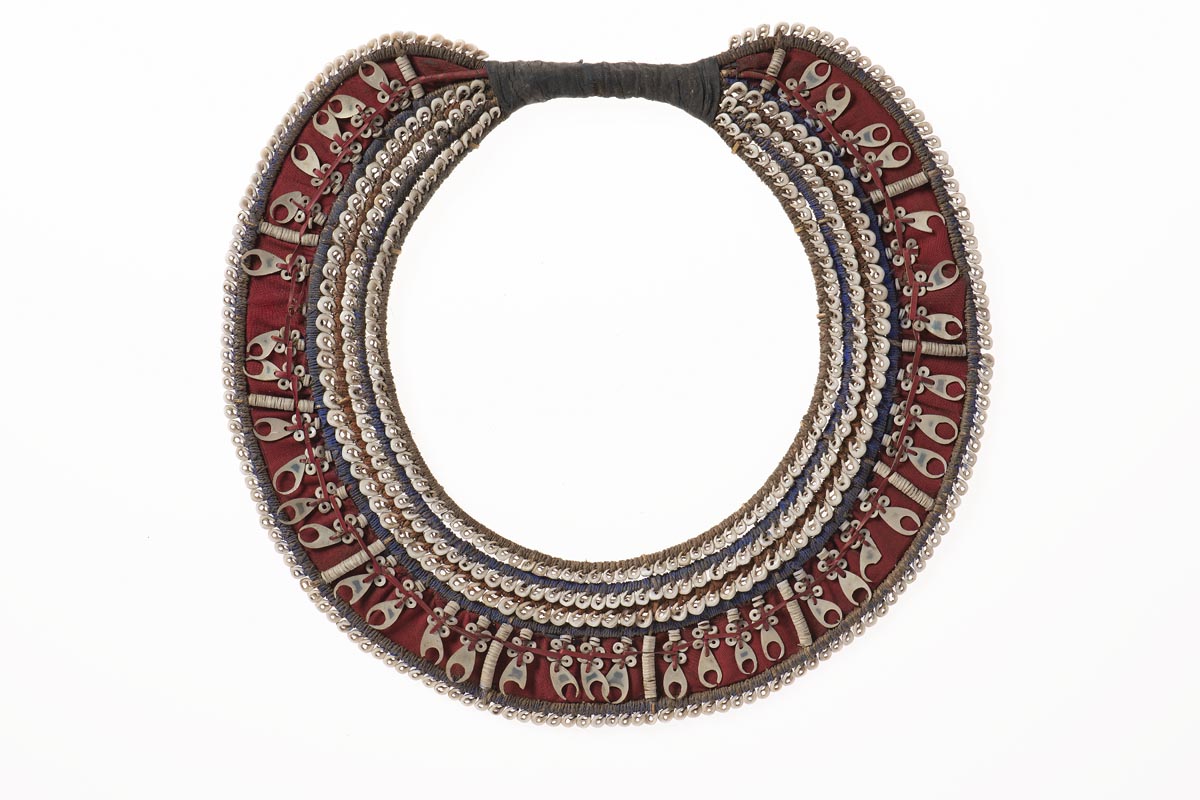
caption: Middi (ornamented collar), Shell currency, cloth, natural fibre, pigment. Made by Ancestor. Ratavul, Inland, East New Britain Province, Papua New Guinea. Image: Stuart Humphreys © Australian Museum.