by Crispin Howarth
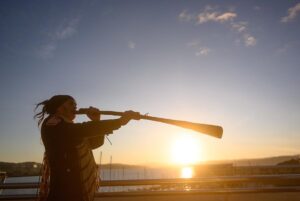
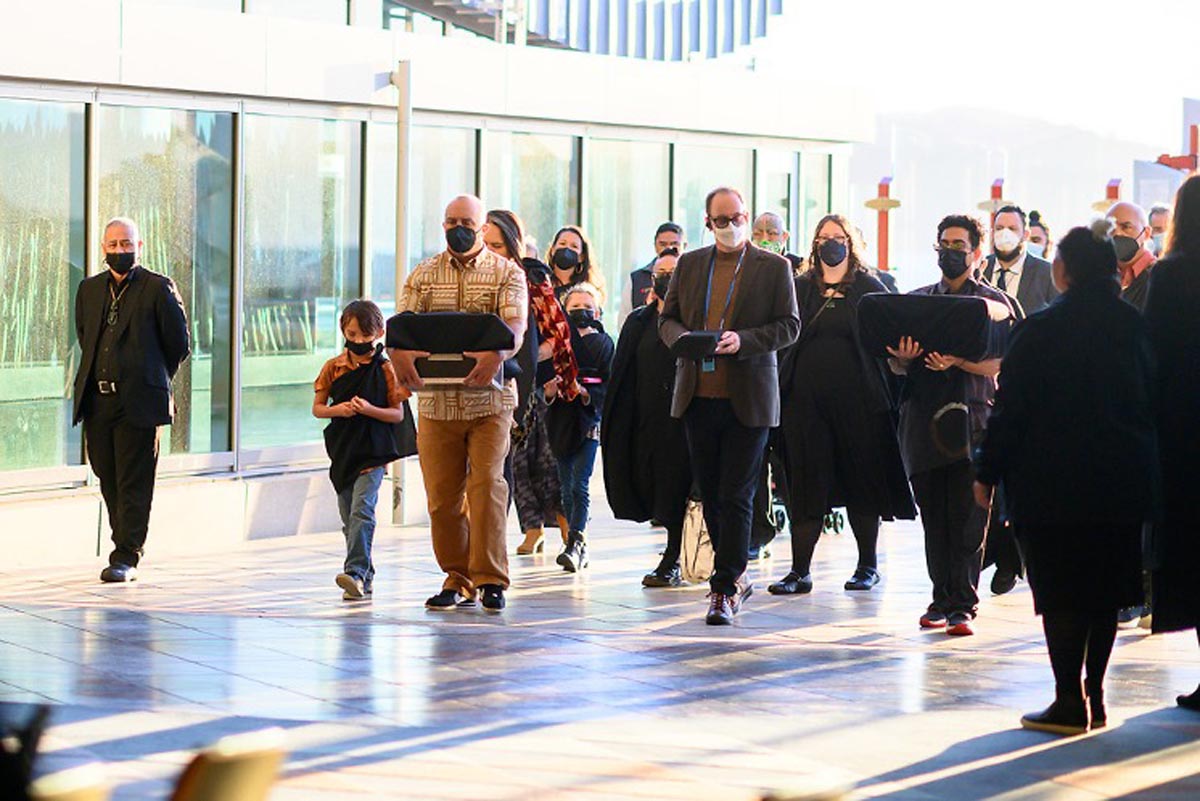
Image Caption: Shane James uses the pūkaea (horn) to signal our arrival and that we can approach the wharenui. Image courtesy Mark Tantrum.
The National Gallery of Australia is now into its 40th anniversary. Building the Pacific arts collection began in 1968 then stopped in 1973 – there were several acquisitions over the years but little with a definite focus until a Pacific Arts department was established in 2007, only 15 years ago.
As a Gallery, the core of the National Art collection was built during the 1960s, ‘70s and ‘80s to represent the finest visual achievements from every culture, every art movement, genre and period, era, and epoch of humanity. So, our collections are an attempt at being fully universal.
In the Pacific Arts collection, there was an object that struck me as an oddity – something that should not be in the collection. So, I’d like to report on my work with this oddity.
It’s a Māori hei-tiki but it’s not. When you work with lots of things in museum collections intuitive senses develop. This hei-tiki I dismissed as a late 19th century souvenir-level craft item, there was something off about it in terms of its manufacture and patterns. It was, I thought, made of whale bone – not whale tooth like this example (image 1).


I began researching the object which was once in the private collection of Dadaist and Surrealist artist Max Ernst. It passed to his widow, artist Dorothea Tanning in 1976. While I was unable to pin down exactly where Ernst acquired it – it most probably entered his collection between 1941 and 1946 in New York, or, in France between 1953 and 1976.
The Gallery acquired the object as part of a larger 96-object collection representing a large part of Max Ernst’s personal collection of African, Pacific, and American arts in 1985. The collection is strong in Hopi arts which Ernst acquired from his Hopi neighbours when he lived in Sedona, Arizona. Also, Ernst had an appreciation of art from the Papuan Gulf as there are quite a few spirit boards and figures from this area too.
The object was clearly not authentic when considering style cannons but it became apparent that it was not unique as I have found elsewhere other examples I could identify as highly likely from the same hand. It is from the work of Hermione Waterfield on another forger, James Edward Little, that I found the name of the possible culprit behind this object. Hermione’s writing referenced a 1970s article by Henry Devenish Skinner, Director of the Otago Museum, ‘The faking of Māori art’. I want to thank Hermione for mentioning this article as it gave images and information that really helped in the attribution of the object to the hand of a New Zealand maker of faux-Māori artefacts, Frank James Robieson.
Around 1900 to 1910, Robieson worked for the New Zealand Tourist and Publicity Department based in Rotorua. It was here he met major Arawa carvers of the time and learned basic carving skills. His skill in carving, and his interest in Māori culture, led him to apply his talent to creating curiosities such as Image 2. These did not go unnoticed when purchased and sent to England with James Edge-Partington, a volunteer at the British Museum in 1909 commenting ‘…a very clever workman there (New Zealand) is making most of them; the man has excellent patterns to work from, and his forgeries are very hard to detect’. In 1910 Augustus Hamilton, the Director of the Auckland Museum stated, ‘I have reason to believe that some things … are not genuine … So long as they are simply bought as curios by the ordinary tourist it does not matter so much, but, if they proceed to give them to museums and they take their place in the showcases as specimens of Māori work, the matter is more serious’.
The material the object was made from turned out not to be whale bone as first thought. It was slightly convex with the reverse showing the arterial grooves of a section of parietal bone from a skull. I had it checked out; the thickness, grooves and overall form all pointed to human bone. There are exceptionally few hei-tiki in this medium[i].
Robieson was known to have used human remains in his productions – Skinner noted Robieson’s fossicking activities as ‘ransacking burial caves’ both around the Rotorua region and around Otago once he moved to the Dunedin office of the Tourism Department. He moved to England just after the end of the First World War. Terrence Barrow is recorded in the same article noting that Robieson took a considerable stock of raw materials from New Zealand for his own workmanship, this undoubtedly included greenstone, shell, bone, and ivory.
Subsequently Māori-like curiosities objects started appearing in London auction rooms and many would have been accepted at the time as authentic. While his activities are less known these days, Skinner, Terence Barrow, Kenneth Webster and others in the 20th century were wise to such activities. It is unsurprising that faux artefacts get labelled as authentic because over a century few people have investigated these things and fewer people again have written or spoken upon them.
Today this report is less about Robieson the forger, but the medium of the object as societies across the world have very different values and ways to treat the dead. From a Māori perspective the object being human bone, is Koiwi tangata and therefore is a tupuna – an ancestor to be cared for.
In 2019 when preparing for the exhibition Tā Moko, I was really honoured to work with colleagues from Toi Māori and Te uhi a Mataora. As part of the exhibition opening events, it had been arranged for the gallery space to be given over for Australian Māori community members to receive moko from practitioners who had come over from New Zealand. To double up opportunities I also arranged for the Māori collection to be available for private viewing by visiting community members in the Gallery’s collection study room.
The object was something I had concern about, so, I invited Derek Lardelli to view it and we discussed it. Ahorangi/Professor Sir Derek Arana Te Ahi Lardelli KNZM is a New Zealand tā moko artist, painter, carver, kapahaka performer, composer, graphic designer, researcher of whakapapaand oral histories and kaikōrero. It was with Derek that the first of many karakia – prayers – were spoken to the tupuna. So, I began communication with the Repatriation Unit’s manager Te Herekiekie Herewini and while Covid effectively stopped the process for a year or so, the tupuna was deaccessioned from the collection in preparation for its return.
With no known community, this tupuna’s whakapapa is lost. They might have lived around Rotorua or around Otago or anywhere in between. It was decided the tupuna would rest with the Karanga repatriation unit until such a time that further knowledge might assist identifying the iwi or community the tupuna comes from and steps can be taken to return to the community.
The deaccession was relatively easy as the Gallery’s Art Deaccession Policy has room for removal of works that are inauthentic. The National Gallery of Australia is completely open and receptive to any repatriation request on the basis of an object or collection of objects having community significance.
For the travel of the ancestor home I was charged with personally carrying the tupuna. They never left my side throughout the journey – this meant communicating in advance with both Australian and New Zealand border security staff as I’m sure that there are many pitfalls travelling internationally with human remains without checking first.
Early one morning in May 2022, a pohiri was conducted to welcome the tupuna home at Te Papa Tongarewa (Museum of New Zealand) in Wellington. This event also included the return of Hawaiian ancestral remains from Canterbury Museum to a Hawaiian community. The morning commences in the wahi tapu (keeping place), with karakia for the tupuna and the kupuna (Hawaiian ancestors) spoken. Rangimoana Taylor a member of Te Papa staff instructed all attendees on the morning’s kawa protocols to be followed.
Repatriation Manager Te Herekiekie Herewini’s work in this field is amazing; he is an excellent coordinator with a graceful charm that made the process of repatriation become far smoother than I anticipated. I am grateful for the financial support from the Karanga Repatriation unit enabling me to bring the tupuna home.
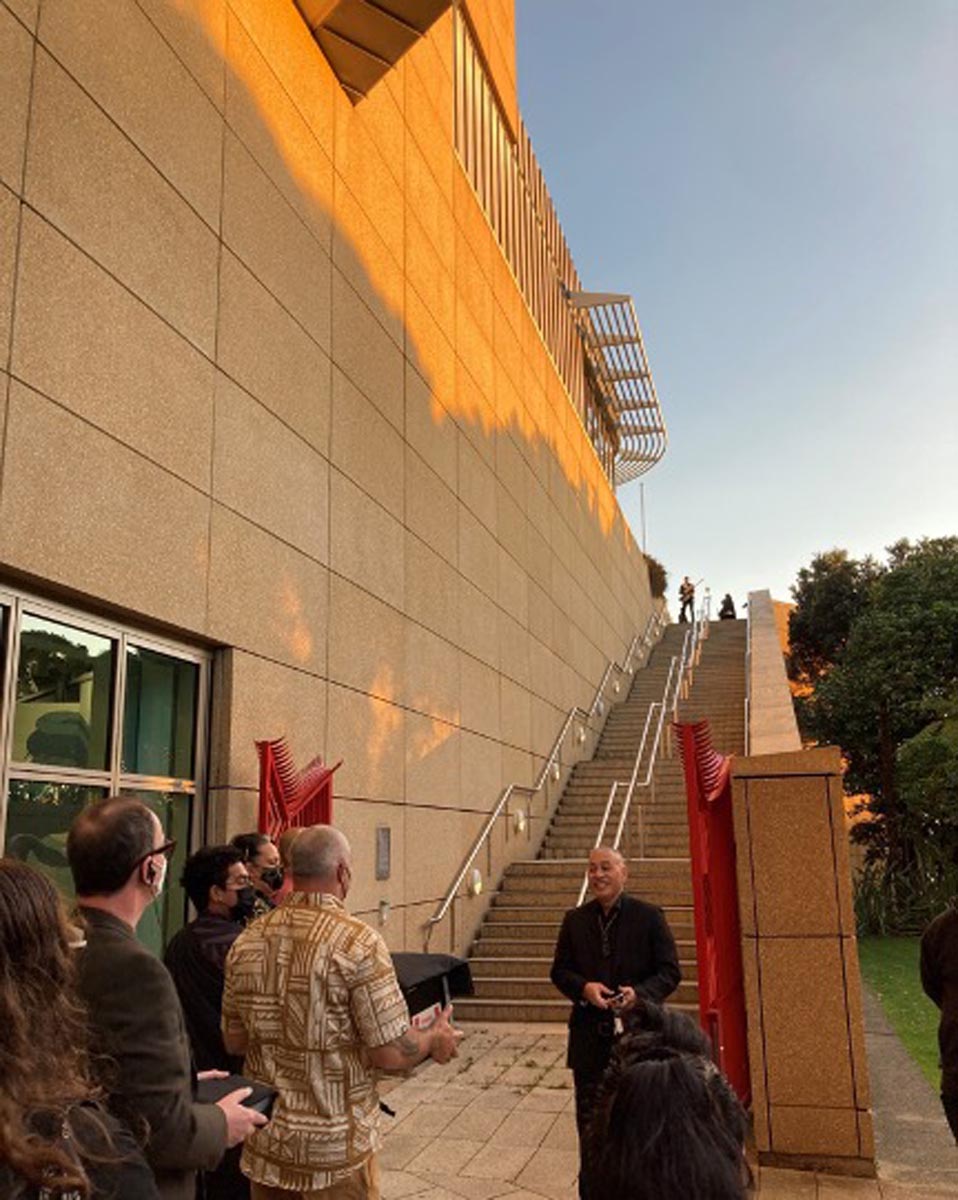
The event commenced with Te Herekiekie Herewini gathering the procession at the stairs and gates leading to the marae (meeting ground) and wharenui (meeting house) of the national marae at Te Papa Tongarewa. When Te Papa was built it was an essential part of the design to have a meeting place on top of the museum for all Māori (see image 4).
When the timing was right, horns were played to signal our approach and the group could begin the procession up the stairs (see image 5) to the entry to the meeting ground and meeting house.
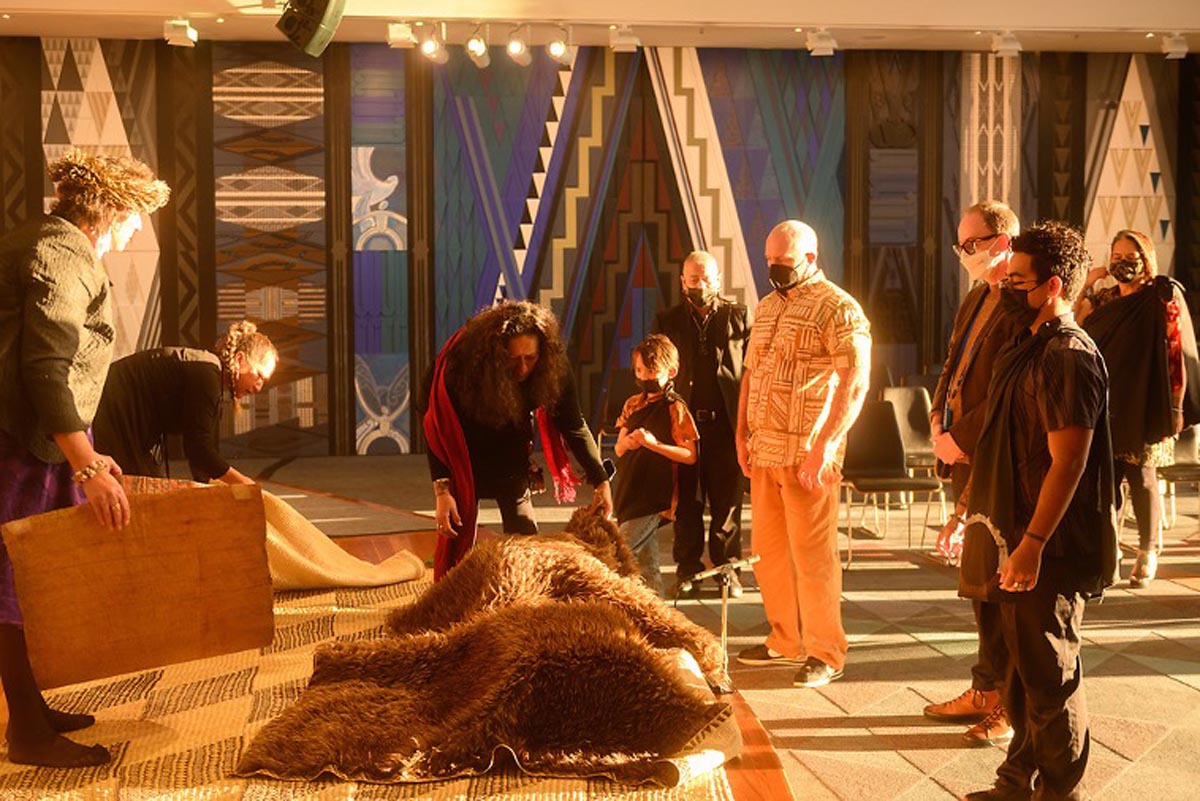
While I do not have an image, the entry to the Rongomaraeroa (the meeting ground) is an incredible stained-glass window by Cliff Whiting which mechanically raises upwards. Architecturally everything has been orhcestrated for the direction of the sun and on that morning the light was just glowing (Image 6).
The wharenui called Te Hono ki Hawaiki is truly spectacular. At the top are the figures of ancient ancestors who migrated to New Zealand, then there are representations for each Māori community and within the meeting house are representations of the migrated cultures since the 19th century as well. The ancestral remains were placed on the threshold of the house, they were attended by three community members. The ancestors were covered in cloaks and also a section of Hawaiian kapa cloth was used in respect for the Hawaiian ancestirs (image 7).
Tamahou Temara, Director Toi Māori Aotearoa, then gave his korero (speech) explaining why an Australian Pākehā was present, that Toi Māori’s support of the Tā Moko exhibition had led to this moment. His message was simple, by building relationships, our ancestors return.
It was my turn to deliver my korero. It was emotional to speak from the heart, from the wharenui across the marae at such an important gathering. Having the remains of four ancestors nearby imparts a certain gravity and is overwhelming.
I spoke to acknowledge the returned ancestor should never have left their resting place a century ago. I spoke to the good advice given to me by a Māori authority years earlier, “that nothing is worth doing if it is void of integrity in its purpose. The meeting house has a ridge beam – this is said to be the backbone, the spine, upholding the community’s values – anything with real value can be completed if you walk supported by a spine of integrity – this shows through your actions.”
These events spanned the entire morning with many speakers, from the Hawaiian community, the Māori community, Te Papa and Canterbury Museum staff. The speeches were followed by the formalities of signing paperwork. Concluding the ceremonial events, each person who brought the ancestors to the marae uplifted our charges and returned them to the wahi tapu keeping place. The procession this time was much louder, with shell conches, horns and singing.
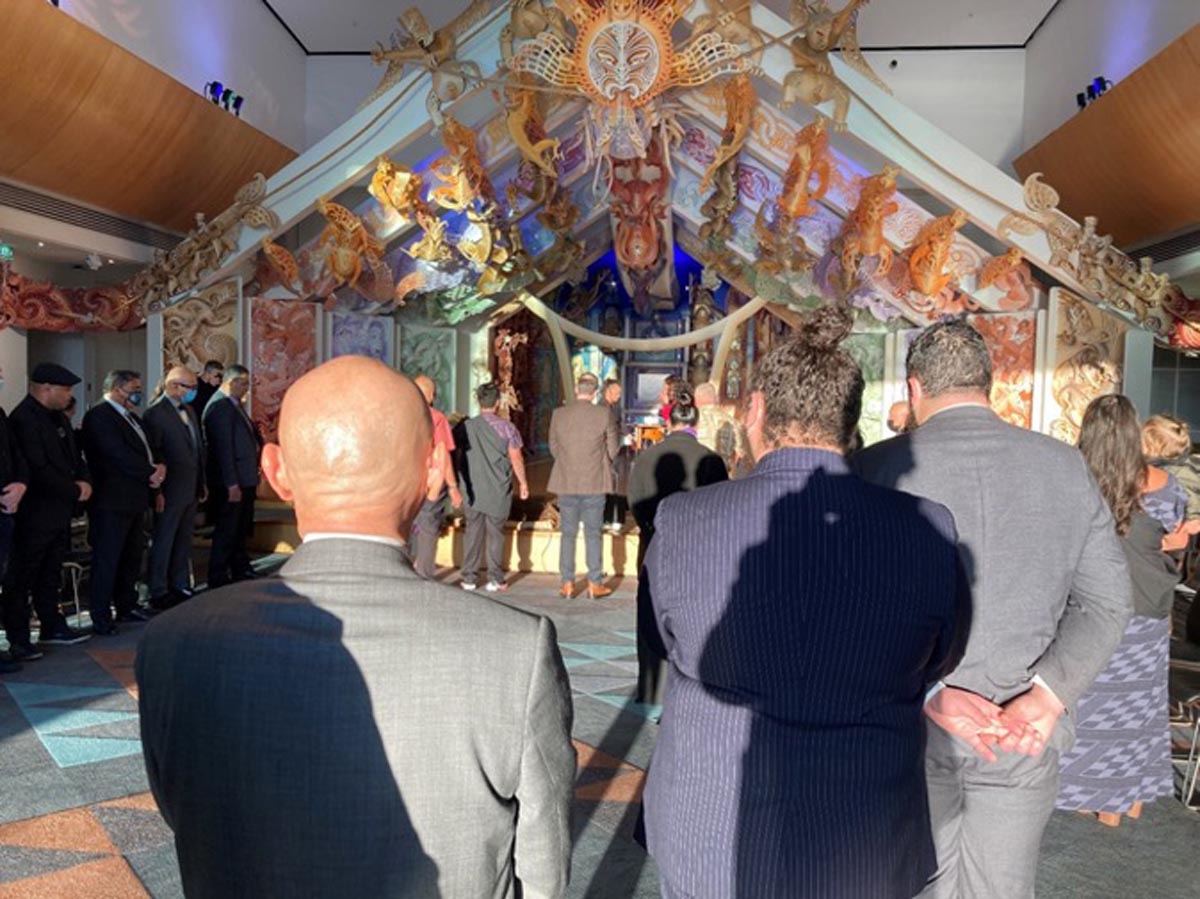
A final karakia was conducted in the wahi tapu before koha lunch and gift giving between the various attendees brings this moving event to a close.
A question often asked is ‘How do you know the bone is Māori?’
I’m confident with the attribution to Robieson’s hand, the knowledge he took ancestral remains comes from a reputable source, and that the object has been identified as Māori for about a century even if the object is ‘in the manner of’.
The question of DNA testing the bone for myself and Māori colleagues did not seem appropriate. Any binary question of is it? or isn’t it? fell by the wayside early on, it is a matter of identity, it was considered to be – felt to be – Māori, (it was also sensed to be female by a community member after a karakia).
The object has with agency, including myself, moved through the 20th and 21st century in a transformative manner from being a biological part of someone to a faux artefact, to being identified as art and appreciated by a major surrealist artist, to being identified as a grim forgery, to being identified as an ancestor by Māori.
I thank the following for their words, advice, knowledge, goading, assistance and support:
- Te Papa Tongarewa – Te Herekiekie Herewini, Arapata Hakiwai, Moana Parata, Rangimoana Taylor, Shane James, Te Arikirangi Mamaku, Grace Hutton.
- Toi Māori Aotearoa – Tamahou Temara, Garry Nicolas.
- Te Rere O Te Tarakakao Māori Cultural Association – Natalie Aroha Sullivan, Jo Marama Kamira.
- Sir Derek Lardelli
- Hermione Waterfield
- Michael Graham-Stewart
- and everyone at the New Zealand Customs Service.
[i] There are two hei-tiki of crania in the collection of the British Museum Oc,NZ.157. & Oc,NZ.156. Both are believed to have come from Akaroa on the South Islands around 1840 but the full acquisition details are unknown. The BM website notes repatriation claims for these tupuna were received in 2004.