
Hurstville Museum and Gallery – 29 October 2022 to 29 January 2023
Review by Margaret Cassidy
At the OAS Adelaide Forum in November 2022 keynote speaker Djon Mundine (Bandjalung) presented a wide-ranging talk including some of his projects to place Aboriginal people in locations, often country towns, where many of the existing local inhabitants don’t see the Aboriginal people currently residing within their community nor recognise the long history of Aboriginal people living within the locality.
One such project was part of the Guraban: Where the Saltwater meets the Freshwater exhibition on show during the summer at the Hurstville Museum and Gallery in suburban Sydney.
Mundine had been asked to participate as part of a project to bring Aboriginal history back to every part of Australia. In the context of a large city like Sydney, this means to look at the local area, around the Georges River, an important waterway in southern Sydney.
For thousands of years, Aboriginal peoples have lived in the Georges River area – the Dharug, Bidjigal, Cabrogal to the north and the Dharawal, Gandangara, Norongaragal, Gweagal to the south.
By the 1920s there was an independent settlement of Aboriginal people along an important tributary Salt Pan Creek near Peakhurst. Families were able to fish and collect wildflowers while Aboriginal men worked in local industries while others made boomerangs from gathered mangrove wood. Local resident Joe Anderson, also known as King Burraga, was one of the first Aboriginal men to use film to demand recognition for his people.
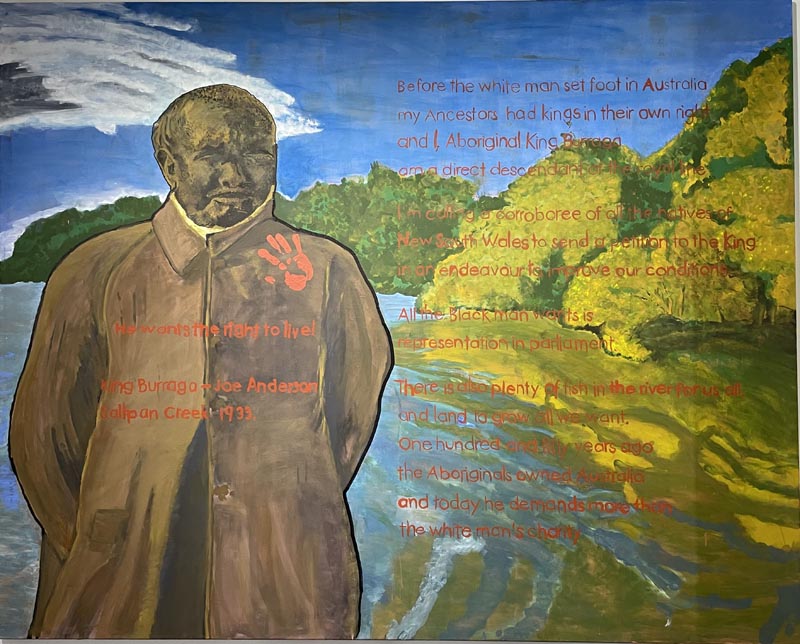
Wanting the history of First Peoples to be constructed of named human beings, Mundine’s art practice is “to bring these invisible in plain view Aboriginal individuals into the light”. As his contribution to this project ,Djon Mundine worked with Annemaree Dalziel, McCallum Mundine (Yorta Yorta/Bundjalung/Gamilaraay/Yuin) and Charleene Mundine (Bundjalung/Yuin/Kamilarioi/Anaiwan) to paint an enormous mural of King Burraga who lived on Salt Pan Creek.
In 1933 King Burraga appeared in a Newsreel played before the main film in cinemas following a recording of “God Save The King”. Mundine’s mural includes the words spoken by Burraga in that Newsreel seventy years ago. Today, those words remain relevant and contemporary as Australians consider the upcoming referendum on an Indigenous Voice to Parliament,
“All the Black man wants is representation in parliament.
There is also plenty of fish in the river for us all, and land to grow all we want.
One hundred and fifty years ago the Aboriginals owned Australia and today he demands more than the white man’s charity.
He wants the right to live!”
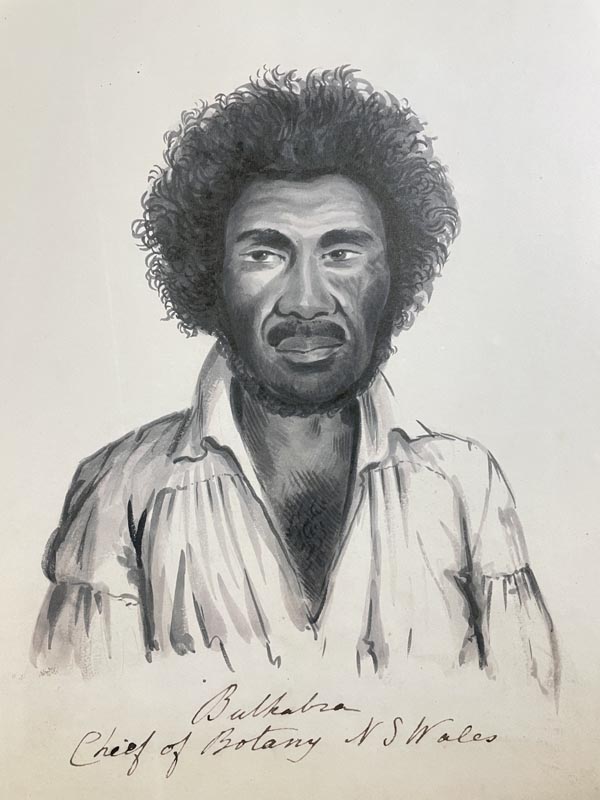
This major exhibition is the second to interweave social history from the Hurstville Museum and other collections with contemporary art – reflecting both the museum and gallery.
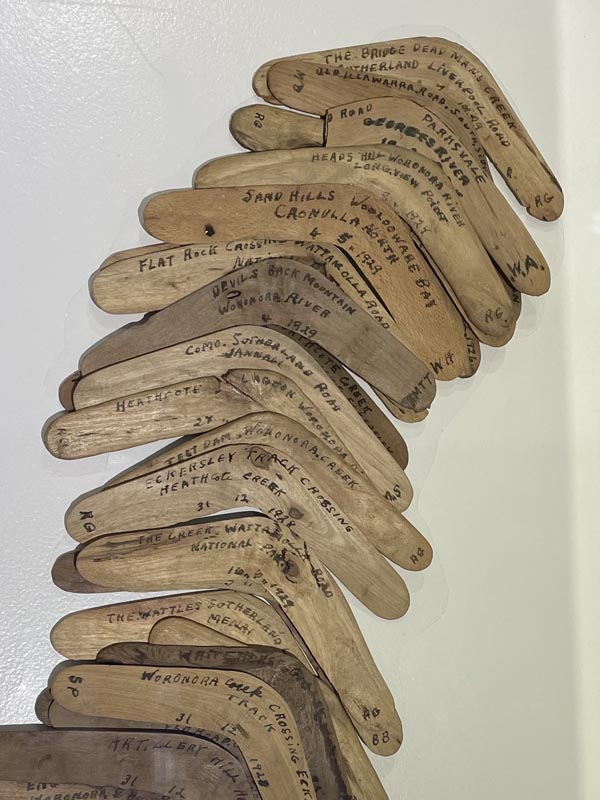
This mural is the largest item in the exhibition but it is displayed alongside delicate detailed miniature timber boomerangs made by Ancestors and collected in the 1920s and 1930s, a modern Kangaroo Cloak made by mother and daughter Nicole Monks and Jenine Boeree as well as the work of other commissioned First Nations visual artists Dennis Golding and Jason Wing is featured as well as a range of items made by Ancestors and European settlers.
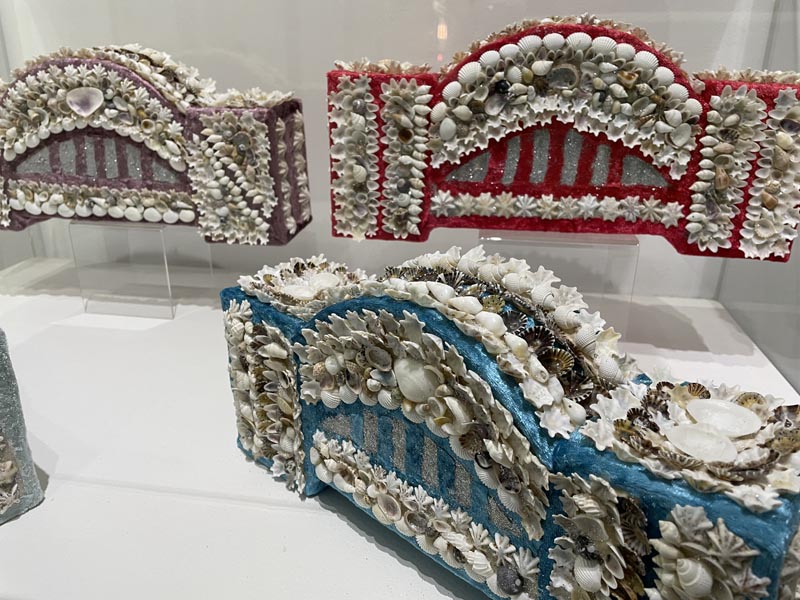
Another highlight is the intricate shellwork created by Aunty Marilyn Russell (Bidjigal), slippers, jewellery boxes and bridges that are a celebration of the ongoing shell tradition of Aboriginal families in La Perouse, where the waters of the Georges River meet the Pacific Ocean.
The Georges River has always been an important focal point for Aboriginal life and culture in southern Sydney, for food, transport and trade, as well as connections to Country with this exhibition highlighting Aboriginal perspectives on significant historical and contemporary stories and connections to the river.
While this locality based exhibition has closed, the detailed catalogue can be purchased from https://www.georgesriver.nsw.gov.au/Community/Art-and-Culture/Hurstville-Museum-Gallery/Shop