Edited by Ngahiraka Mason and Zara Stanhope. Auckland University Press in association with Auckland Art Gallery Toi o Tamaki, 20l6. Reviewed by Marina Garlick
This splendid tome complements a fascinating exhibition of mainly Maori portraits by Gottfried Lindauer held at the Auckland Art Gallery, Toi o Tāmaki, from October, 2016 to February, 2017 . Smaller exhibitions were held in Berlin in 2014 and Pilsen in 2015, each with a separate volume. The book comprises all of the Lindauer paintings (portraits and scenes from Maori life and customs) in the Auckland Art Gallery Toi o Tāmaki Partridge collection plus five from other New Zealand institutions together with a variety of articles providing background information on Lindauer and his techniques. The exhibition also contained a number of additional, mainly Maori, portraits from the collections of private individuals and other institutions including the National Library of Australia.

Gottfried Lindauer was bom in Pilsen, now in the Czech Republic, in 1839. He studied in Vienna and his early work involved religious paintings for a Catholic parish church in Moravia. After a few years running his own portrait studio, Lindauer left for New Zealand in 1874, having seen some Maori artefacts in an exhibition in Berlin. He set up initially in Nelson where he began to paint Maori portraits, later settling in Woodville. In 1875, he met Henry Partridge who became his patron and commissioned sixty-two Maori portraits and eight “scenes from Maori life and custom”. In addition, Lindauer was commissioned by Maori to paint portraits of significant family members and also painted Pakeha.
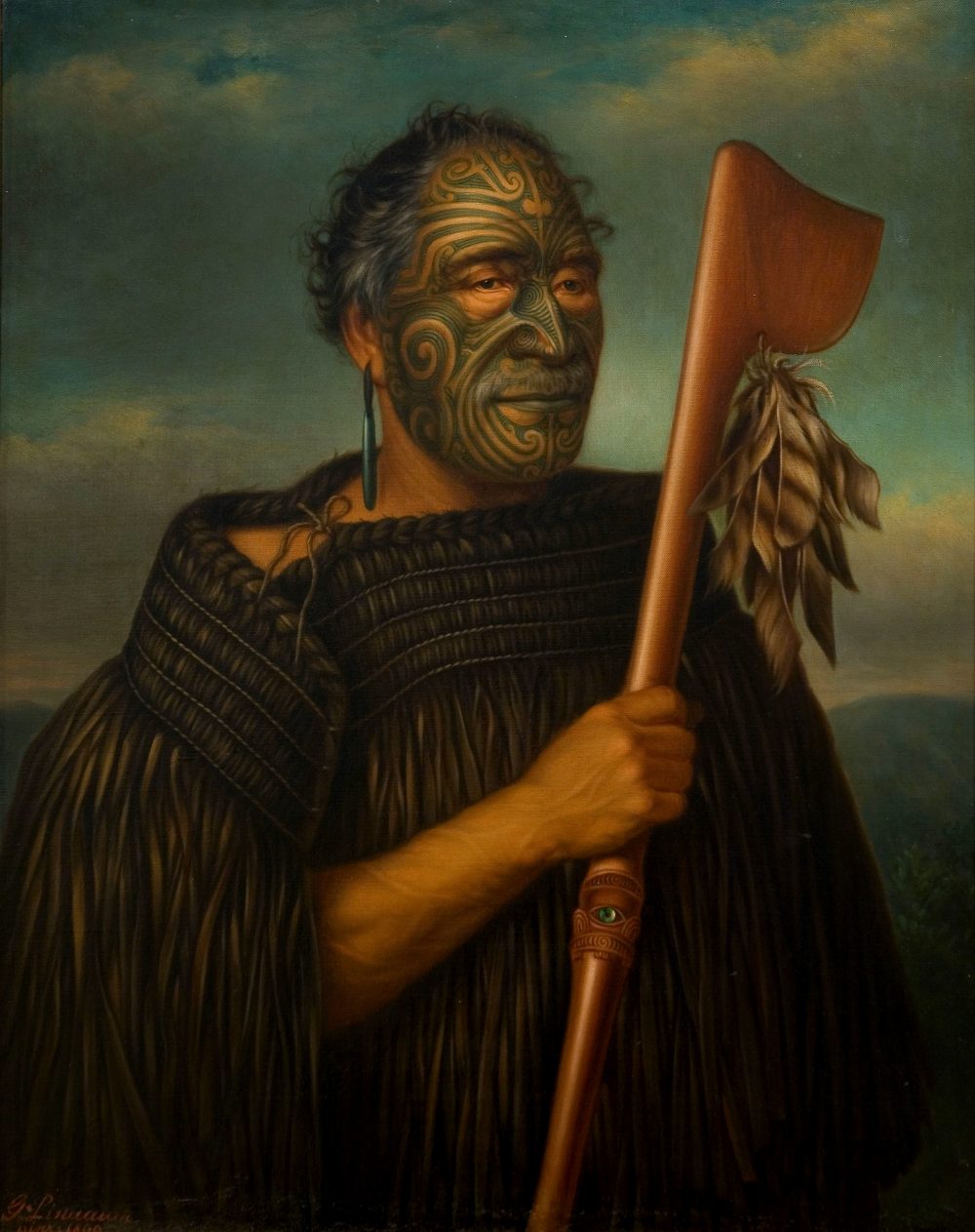
Early chapters in the book deal with Lindauer’s background in Bohemia and New Zealand. The portraits are arranged by region of origin of the subject and are given a full page each with explanatory text on the opposite page. This often provides insights into Maori history, such as whether the subject signed the Treaty of Waitangi, belonged to the Maori King movement or supported the govemment. Most are of men, mainly in traditional dress of flax, feather or dog hair cloak, with moko (tattoo), adornments such as earrings, huia feathers or heitiki and often carrying a weapon. A handful are in European dress and three in military uniform. Most of the women also wear traditional dress while those in European clothes often wear a heitiki or similar omament. A portrait of a young woman, Heeni Hirini (1878, Plate 29) with a child was shown at the 1904 Louisiana Purchase exhibition, winning a gold medal. On the basis of this success, Lindauer painted thirty similar versions, ten of which were in the exhibition, though only one in the book. The portraits (illustrated), of Tamati Waka (Plate 5) and Pare Watene (Plate 33) are examples of Lindauer’s style.

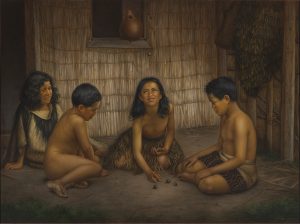
Particularly fascinating are the eight “Scenes from Maori life and custom” showing, for example, women plaiting flax baskets, a tattoo being administered to a young chief, family groups eating a variety of foods and children playing knuckle bones (illustrated). They are incredibly evocative of the people, their daily lives and environment.
Lindauer was very prolific and ninety-five percent of his portraits were based on photographs, often as small as a carte de visite. This is in contrast to the better known Charles Goldie, who paid his subjects and sold the result to Pakeha. While there has been some criticism of Lindauer for this approach, it enabled him to complete his work more quickly and still achieve a very high artistic standard. This is discussed in a chapter in the book, “Under the lens: Gottfried Lindauer, the photographer-painter” by Ute Larsen and Jane Davidson-Ladd. Other chapters deal with Lindauer’s painting materials and techniques, and discussions of Victorian and Maori dresses and personal adornments in the portraits. There is also a chapter by Jane Davidson-Ladd on the Pakeha portraits, and the earliest of these is a self portrait from 1862 plus several others held in the Museum of West Bohemia in Pilsen. Those painted in New Zealand include several ‘portrait pairs’ of married couples turned to face each other, as well as of church leaders such as the Rev. Dr. John Kinder, and Miriam Partridge, his patron’s wife.
The book concludes with a useful chronology of Gottfried Lindauer, Henry Partridge and the Partridge collection, and an essential glossary of Maori terms. I was privileged to see the exhibition in Auckland where additional features included screenings of interviews with descendants of some of the subjects and a section demonstrating techniques and examples of Lindauer fakes, of which there are many.
The book is an invaluable record of most of the works and it provides important background information and analysis of Lindauer and his oeuvre. The large format allows the portraits and other works to be viewed in some detail and the explanatory texts provide useful information about the subjects and an indication of the complexity of Maori/Pakeha relations. The editors are to be congratulated on producing such a comprehensive and valuable work.