by Lesley Wengembo
Presented at the Sydney Oceanic Art Fair at the National Art School in 2021, updated in 2023
My life as an artist, the challenges I experienced in Papua New Guinea, as well as finding my way to the National Art School and my future plans in art are my journey. This journey has highlighted what identity is and the challenges that I have faced to overcome social structures while focusing on my passion as an artist and using this to inspire others to look at what they have.

My early life
I grew up in a suburb of Port Moresby, the third of four boys; both of my parents didn’t complete high school or graduate with any certificates but still earn a modest income. It was not easy financially for them to raise us compared to my life now.
My parents worked hard just for us kids to have a better future. While I was born in Goroka in the Eastern Highlands Province in 1997, we moved to Port Moresby in 2000 during a time of mass migration to the city for a better life and opportunity. While my parents both lacked formal education, both are skilled at what they do; my dad worked his way up from a pool cleaner to be in a managerial position in the hotel while my mum has creativity (that’s where I think I got my creativity from) and she sews meri blouses and makes bilum (handmade bags) and sells them at a local market in the city. I have always admired their work ethic – even though they earn little, they managed to save some for our school fees and they put a little aside for our travel once every four or six years back to our family’s villages. For me that is a blessing because not everyone can get on a plane to travel back to their villages when they are living in the city as it is expensive. I remember my friends used to ask me ‘What is it like in a plane’?
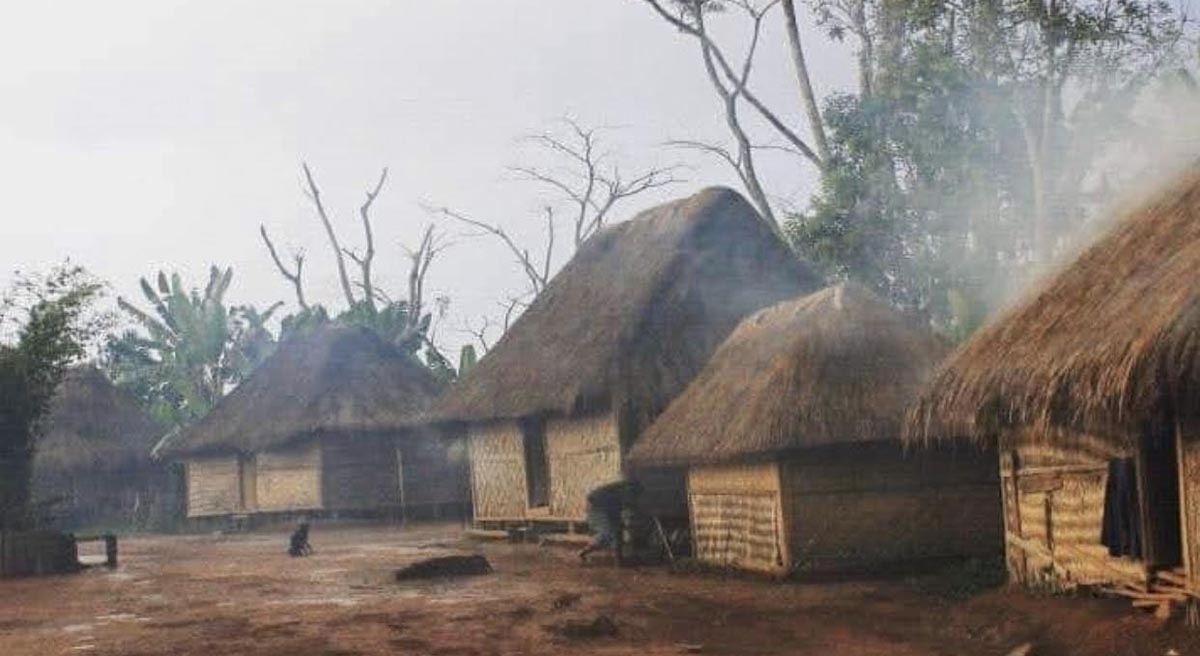
That occasional travel impacted me greatly when I first saw my mum’s and dad’s villages, I wasn’t sure of how I would connect with my cousins and relatives because of the language barrier. However, to my surprise, most of the kids in the village speak Pidgin English. Even as a kid I knew that modernisation had influenced even the most rural parts of my country, even where the only way to travel to the village is by walking on foot.
Starting to paint
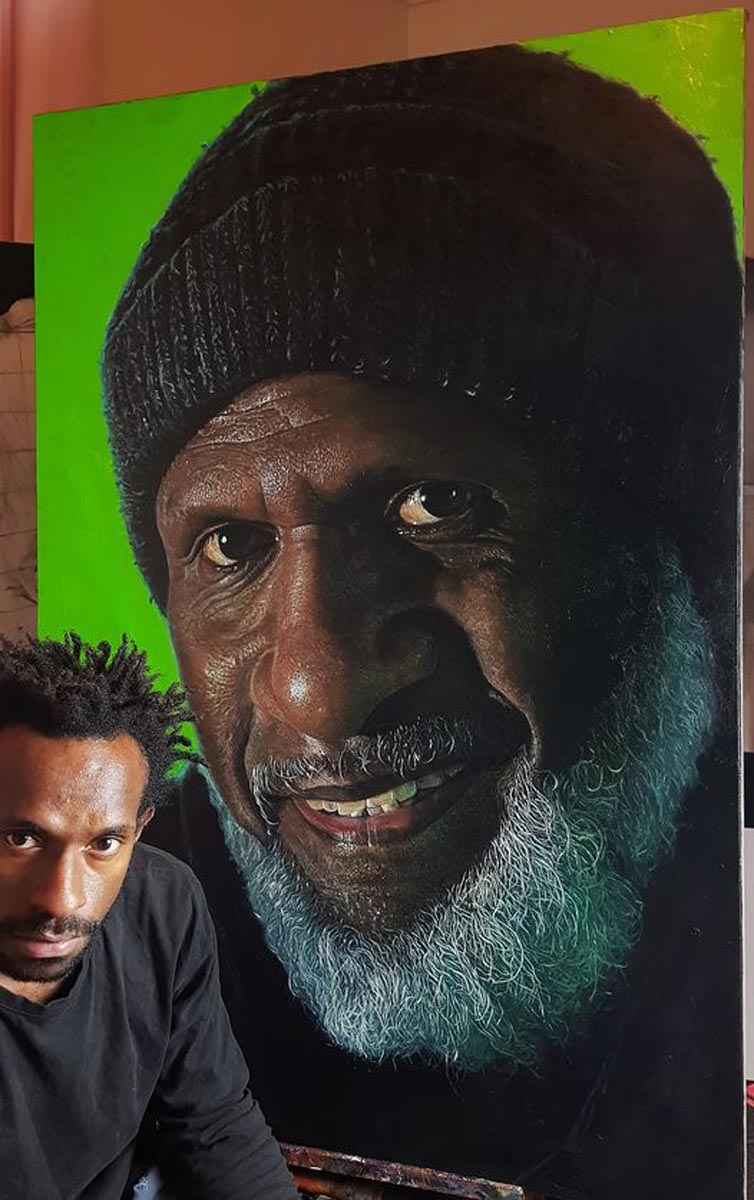
I spent one year in my mum’s village with my grandmother when I was 12; the experience I had with her has played an important part to my art as I often like painting elderly people as my subjects.
These experiences commenced when I first started drawing at around the early age of five. My first ever masterpiece drawing was of my grandfather, unfortunately the drawing does not exist anymore because I burnt it! I tried to tell my parents to print it and they didn’t, so it was lost. It reflects how I was a naïve child at that time. These are the reasons I’m so obsessed with elderly faces or people whose faces interest me to draw and paint.
I was greatly influenced by my father. Though he is not an artist he used to draw helicopters and I tried to copy him and beat my elder brothers; from there I then started drawing faces. I used to ask older people to sit for life drawing but they didn’t want to most of the time; after all, why would they waste their time sitting for a seven-year-old kid who wanted to draw them? So, I got a bit smarter and started drawing people in life when they are in a barber having their hair trimmed because then I had found someone who will sit there for more than 15-20 minutes which is a decent time to complete an easy life drawing.
I believe I was gifted with good observation skills at an early age. I can remember correcting my classmates on drawing houses or the perspective of tables and even of landscapes, that was when I was aged seven or eight. It was not that I drew incidentally but rather that I draw and paint because it is what I like to do, I tap into my own world which I found more fascinating than the real world around me.
Growing up in a notorious part of town
I grew up in a suburb of Port Moresby that was in complete contrast to the peacefulness of my family home. Being a decent person with a friendly personality is due wholly to my parents and my elder brothers. Our suburb Morata is in the most notorious part of Port Moresby. Occasionally we would see stolen vehicles being chased by police or hear gun fire. Also, clashes between communities would sometimes lead to killings and when that happens, fights spread like wildfire putting fear into many homes. Having this violence and sense of fear is one of the things that had led me to find art fascinating, it was the only thing I could do to escape reality.
As Papua New Guineans we are always proud of being the most diverse multicultural country in the world, with over 800 languages spoken and thousands of tribes that we boast of wherever we are in the world. However, we are losing this diversity and these cultures slowly and do not realise because we live there. This needs to be addressed and I know that it is my task as an artist to do something with my practice to highlight the need to retain our diverse cultures and languages.
The West’s history is preserved in literature, in architecture and art; it is written on paper, whereas ours is an oral history, written in our hearts and minds. So for example when an old person dies, they take with them all that history, culture and language with them – that’s our identity being lost.
We are easily influenced by the Western lifestyle. Our country’s history is that of being colonised many years ago by different countries – the English, the Germans and then the Australians – until our Nation was able to establish independence in 1975 from Australia.
Throughout the years, after independence, the presence of the West is still evident with their influence on our culture and the lifestyle of today’s contemporary Papua New Guinean. This has also influenced my work greatly and I have had to find my voice through this.
What art does to me
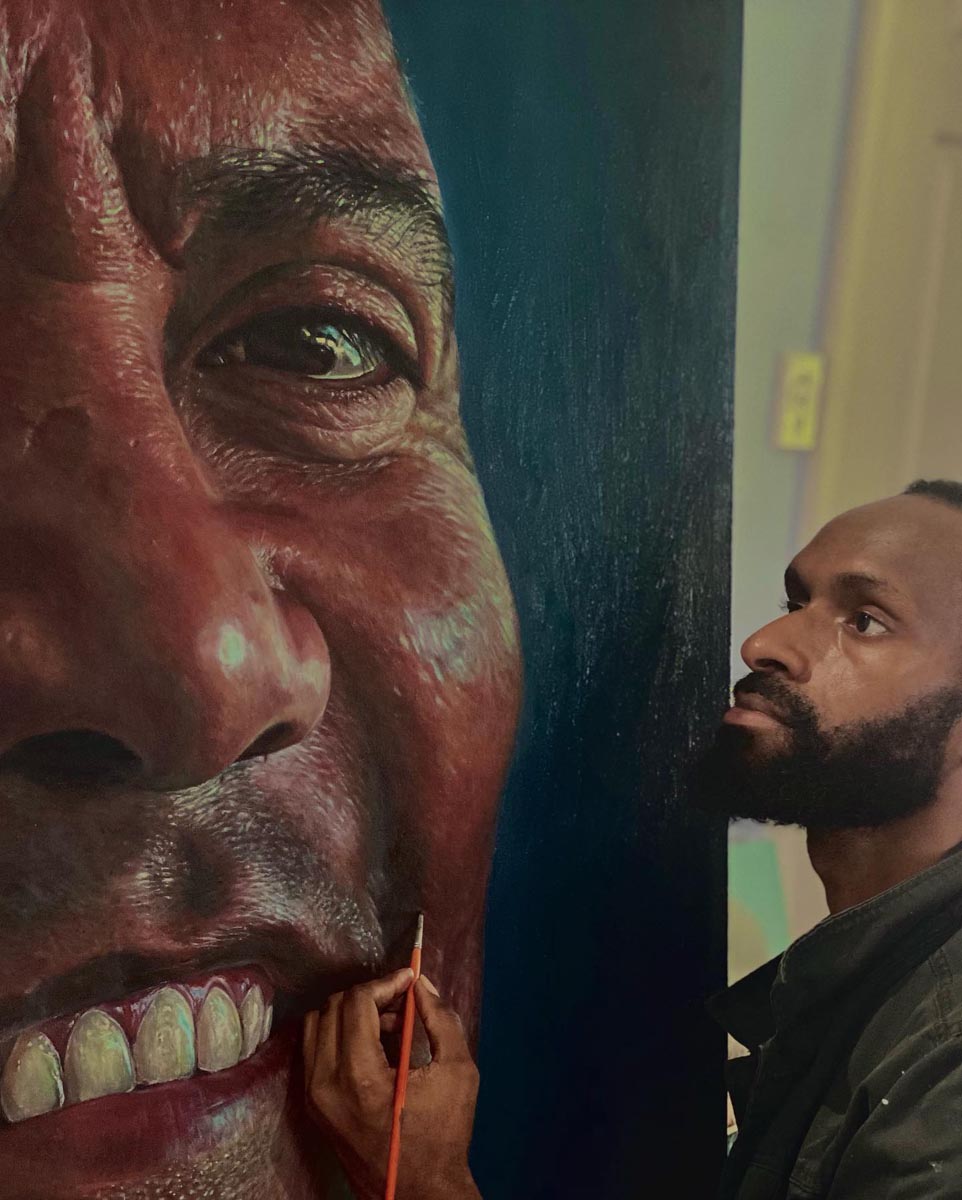
For me as an artist, I remember the very first time I touched a paint brush. It was in my street. I was just watching people doing face painting. Then a man gave some leftover paints with an old broken brush to me to paint another little kid who was standing next to me. I vividly remember that moment when I first held that brush. My hands were shaking. As I dipped the brush into the paint tube and slowly lifted it up to the kid’s face. The soft brush loaded with paints, separated about 5 millimetres away from the moment of touching his cheeks, for several seconds, time stood still. That moment felt like Michelangelo’s Creation moment, as Adam reaches out to God. This was the experience that set me on my journey of painting.
My desire to learn more
As I was growing up and painting as a boy, I felt a need to learn more about the Great Masters of Western Art. I did not have a phone nor a computer with internet. All I had was the only public library in town. That library serves the entire city of Port Moresby.
So once or twice a week you would find me in the big book section where all the picture books are kept. While everyone else was in the fiction and non-fiction sections, I was lying on the floor with an art encyclopaedia spread out before me.
I must confess that I tore out a few pages from this book to get references to those masterpieces to appropriate them in my own way. Looking through books in the library let me think globally and not nationally while I see most artists back at home copy each other.
Trying to appropriate the methods and sometimes the style of those works, I used lots of multiple grey layers of transparent oil base paint, mixed with linseed oil to create those paintings. It was only after I ended up five years later at the National Art School that I learnt that what I had done all alone was called the glazing technique, that this was the very technique used by those old masters and that I was unwittingly using it.
Travelling overseas
Which brings me to the National Art School (NAS) in Sydney. Getting to the NAS was not something that even I had dreamt of attending. I was busy trying to sell my artwork on the street while still in primary school where I would join my mum at the monthly craft market.
After finishing High School in 2017, I had to turn down an offer to study at Pacific Adventist University in order to follow my dream of being an artist. My family did not take this decision too kindly because making it into university back home is a huge deal for my family and tribe. However, I had proved to them that I could live off my artwork through major commissions and selling paintings.
By 2018, I had received a few international invitations which I had to turn down because my parents would not allow me to travel alone; however, I knew I was ready to conquer the world so eventually I did it anyway. The decision to travel to Sydney led me to places I had only dreamed of going like Paris, Berlin and Switzerland and many other places.
Sydney was the first place outside of PNG I had been and never in my wildest dreams did I think that it would end up becoming my second home. Coming to Sydney for the first time was only supposed to be a temporary stop before travelling on to an International Art Symposium in Paris. However, missing one document for my Paris travel visa changed the course of my art career and led me through the gates of the National Art School. If I had stepped foot on that plane in November 2018, I might not even be standing here today. You can read the entire story in The Sydney Morning Herald at https://nas.edu.au/smh-my-best-worst-lesley-wengembo/
The National Art School
It wasn’t easy to fit in at first at the NAS even though everyone seemed to be friendly. It was a huge cultural shift and I was living pretty much a different lifestyle but I found things in common with people and was able to make good friends and find people who are like me and mean a lot to me.
During my two and half years here on campus I have learnt and done a lot, both in and outside of the campus including submitting my work for the Archibald Prize in 2020. This was my childhood dream while living in the Morata Settlement in Port Moresby and although my work didn’t make the cut to be a finalist, it was an amazing experience.
The Future
After completing my degree at the NAS at the end of this year, I am thinking of doing my Masters. If that doesn’t work out, I will probably go home for a few months to learn more of my ancestors’ history and culture which I believe is slowly dying as we haven’t learnt enough of it. However, coming out here and travelling to Europe has helped me to see in a new and fresh perspective to start again and give something back to my country.
In spite of all these experiences, it still seems like a dream, for someone like me who has come from a middle to lower class background and from a notorious part of Port Moresby. My talent has taken me this far so far, and I always credit and thank God for this gift but also importantly I am practising it with passion and continuing to learn.
Unfortunately, not many kids from my background have the same opportunities as me. Seeing the social structure in which we were raised and how we were taught to see the world saddens me, we tried to copy the archetypal structures from the West that are safe and conventional while we abandoned our own culture that has been here before everything came to be.
I want to be that someone who can inspire other young kids like me in the block who have something special but are scared to express themselves or to let people know what they are and who they want to be. A quote by Jeffry Benjamin says ‘fear is the destroyer of dreams and the killer of ambition’. For me as a kid, I fear not my future as an artist but, as the child of my parents, I worry how I can please them with the expectation of society to do well in school and complete university to then work in jobs just for the money.
If I can get out of that social structure and am able to turn my hobby into my career, others can. I love doing it and I hope that in turn my art serves the country and inspires others to go for anything they want to.
I like to express my work as both contemporary artwork but at the same time balancing my heritage with what I have experienced, and translate into my paintings what is relevant today. For that I believe that we can preserve our culture and be proud of that culture instead of turning 180 degrees to other influences.
Where am I now?
After spending some time residing in Cairns I am now back in PNG to follow that dream of capturing stories of elderly people and their faces. I will be up here for the next few months filming videos, recording stories, and capturing their faces with charcoal pencil for my next painting collection.
It is a dream to create this new series titled ‘Seven Faces Of Mother Earth’ and I cannot wait to start that journey in the next few weeks by travelling back to the villages.
I entered the Archibald prize this year, as well as last year but I haven’t made the finalists list yet. However I was a finalist with the Brisbane portrait prize in 2021.