
by Pierre Laffont
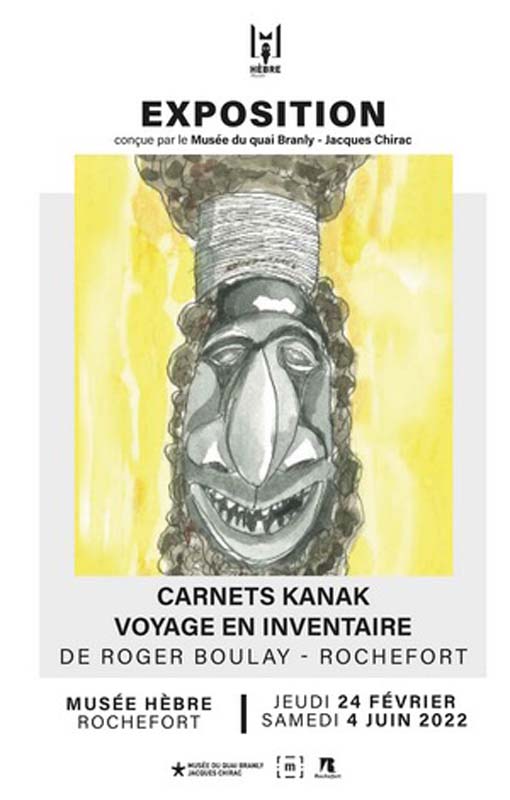
As a local precursor to a similar exhibition being hosted later this year in Paris at the Musée du quai Branly – Jacques-Chirac, the exhibition Kanak Notebooks, Journey in Inventory by Roger Boulay was shown at the Musée Hèbre in Rochefort, France until 4 June. This exhibition was an adaptation by the local regional curator of Rochefort\’s museums Claude Stéfani and inventory notebook author Roger Boulay. The Musée Hèbre was the first museum in mainland France to take an interest in the transmission of Kanak culture and to establish complete provenance of its collection of objects.
This exhibition introduces the concept of developing an inventory for public collections. As such, this is not an exhibition of original Kanak art but of works from the sketchbooks that accompanied the very significant inventory project on these objects.
This project began in 1979 when Jean-Marie Tjibaou, leader of the Kanak independence movement in New Caledonia, asked ethnographer Roger Boulay to record all the Kanak objects in French and European museums. Tjibaou wanted to know where to find these collections, in what state they were kept and what is said about the Kanak world in their presentation. This project became part of the Matignon agreements of 1988, the road map for New Caledonia negotiated between the Kanak independence movement and the French loyalists.

After Tjibaou was assassinated in 1989, attention was focused on the establishment of an agency in New Caledonia for the promotion of Kanak culture and the arts. The inaugural cultural director was Emmanuel Kasarhérou and Roger Boulay became Project manager at the Jean-Marie Tjibaou Cultural Centre in Nouméa with the Renzo Piano buildings opening in 1998. In 2010, Emmanuel Kasarhérou, now at the Musée du quai Branly, was asked to finish the project, now called “Dispersed Kanak Heritage Inventory”, which was completed by 2013.
225 museums across the globe were identified with Kanak works in their collections. These include six institutions in Australia.
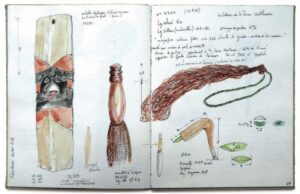
In the development of the inventory, 16,600 objects were actually examined out of an estimated total of 20,000. It is not just photos or lists sent by museums; they also include the complete description of more than 6,000 objects chosen for their visual, symbolic and historical interest, each supplemented with photos and pencil and watercolour sketches.
Roger Boulay undertook visits of meticulous investigation spread over more than 30 years to produce these coloured sketches, annotated and collected in sketchbooks. In the exhibition eleven Kanak notebooks are presented in dialogue with a few Kanak objects as well as photographic reproductions. The sketches are the perfect complement to the photographs and the original objects. They make it possible to directly note dimensions, details, and nuances.
Magic stones were an area of particular interest for Boulay; often neglected because they are modest and look like nothing, they are first and foremost sources of reflection on Kanak society itself. Each of them has a name and purpose: rain magic, magic for the cultivation of yams: magic for diseases, for fishing, for hunting birds, for the fertility of women.
This work shows that the Kanak material culture was more complex, richer, and more diversified than had been perceived. This inventory will be put online to allow the public to have access to this heritage.