
by Chris Boylan
Bruce Seaman will be remembered as a great family man, married to his beautiful Tahitian wife, Ramine, for 61 years, and as a Voyager and collector of Oceanic art. Over his lifetime, Bruce collected Oceanic objects, a collection he did not promote; only close relationships had the privilege to appreciate its beauty. On two occasions did he lend objects; first to the 1979 Art of the Pacific exhibition at the National Gallery of Art, Washington and then to the 2006 exhibition at the Metropolitan Museum, New York, entitled Coaxing the Spirits to Dance.
Bruce was born in Sydney, Australia, to his Australian mother and American father, followed by his brother Laurie three years later. Soon after, his father tragically died in a skiing expedition on the slopes of Mt Kosciusko in the Australian Alps. His American grandfather from an established engineering firm in New York, and also the mayor of Long Island, supported the young widow Chrissy and her children. After graduating from Cranbrook School in Sydney, both Bruce and Laurie were educated as engineers at Swarthmore College, Pennsylvania.
Bruce joined the US Navy in the final years of World War II, and spent some time in Papua New Guinea, stationed on Manus Island. Bruce recounted that he did not collect artworks then, but when the other soldiers were busy with the drinking and gambling on the base, he always organised visits outside, finding village life and culture much more to his liking.
After the war, Bruce was offered an engineering job in the United States and stayed on. Eventually, Bruce’s love of travel led him to accept an offer from Sita World Travel; he became one of their global tour guides for, among other places, the South Pacific. It was during this period that Bruce’s keen interest in Oceanic art developed, and it became his life-long passion.
Bruce made a trip to exotic Tahiti in 1955, then settled in Hawaii, where he met, fell in love with, and courted Ramine, a beautiful Tahitian dancer. They married in 1960 and Bruce continued his work with Sita. In 1960 they built a house in Ramine’s birthplace on Bora Bora, Tahiti and this became the family home where they raised their two children: Terii born in 1965 and Maui born in 1968.
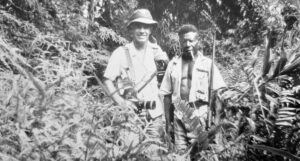
Bruce’s early collecting was spurred on by the excitement and opportunity of field collecting, as he often took his up-market clients to the more remote locations on the globe. Collecting artworks was possible in the ‘60s, notably in the Melanesian islands of New Guinea, New Hebrides (Vanuatu) and the Solomons. Bruce made trips to Papua New Guinea, meeting up with such known characters as Wayne Heathcote in the Sepik River area or George Craig in the Papuan Gulf. Bruce did much of his own collecting, often being the first “white man” visiting some villages, and seeing the same owners of nice items many times to eventually get their decision to sell him pieces. Dealers who lived in these (still colonial) places helped find objects for Bruce. George Craig comments that when he left PNG to set up his crocodile farm on Green Island, off Cairns, he parted with pieces to Bruce that gave him the necessary investment capital. Bruce later also acquired pieces from other dealers and auctions in Europe, the USA and Australia. He searched for pieces that were needed to complete areas of his collection, with a developing goal to make the best of his collection.
Bruce’s collecting was very much of the “old style”, where he considered the culture as a whole, acquiring many ethnographic objects also, that enhanced the understanding of these cultures. Importantly, these ethnographic objects were also chosen with an eye to both their cultural importance and aesthetic beauty; Bruce had a great knowledge and a fine eye when selecting objects for his collection.
On his travels to the Highlands, Asmat, Vanuatu, etc, he was often accompanied by Ramine, who encouraged Bruce’s passion for Oceanic art, and, when school allowed, by his two sons, Terii and Maui.
Bruce was a keen photographer, photographing both in the field, and when back at home. He often made notes on the back of the photographs, but he never did so consistently. He developed plans to establish a museum in Bora Bora, and then publish a book on his collection. For various reasons. this never eventuated; but up until his last few years, Bruce continued adding to his collection.
Bruce attended the famous Parcours des Mondes in Paris every year, always accompanied by Ramine and often by Terii and his wife Viviane; sometimes also the grandchildren. He regularly attended the known US tribal art shows held in New York and San Francisco. On his regular visits to Australia, he was a great participant in the Oceanic Art Society events (their yearly forums and lectures) and the yearly Sydney Oceanic Art Fair. These international shows became a source to acquire pieces when he was no longer doing his beloved field collecting. Bruce has left behind a beautiful collection. I have seen parts of it, many of which are aesthetically superb.
Ramine and Terii are working on a project, as a legacy to Bruce’s lifelong collecting passion, to give some insight into his photographic archives and the collection. There are hopes that this project will result in a publication, to be presented at Parcours des Mondes in 2023.