
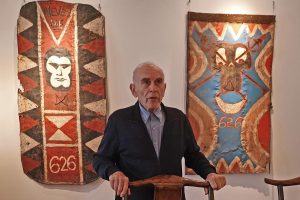
William Nathaniel Evans
Born 29 May 1946, Minneapolis, USA — Died 14 February 2024, Sydney, Australia.
By Jim Elmslie
Bill Evans had an extraordinary life as a father and grandfather; as a Tribal Art and antique rug expert, dealer and collector, and as a friend to a vast and eclectic group of people spread across the globe. Bill’s collections of shields – from New Guinea, Australia, Indonesia and elsewhere are probably the greatest such collections ever assembled by an individual and are now in, or destined for, some of Australia’s leading cultural institutions.
Bill was born in Minneapolis, in the heart of America’s Midwest; his father an ex-soldier turned salesman and his mother a typical stay-at-home housewife of the era. It was a humble start to a life that took him around the world and delivered fame, fortune and a wealth of rich experience. An early bout of polio had left Bill exempt from military service in Vietnam so after graduating summa cum laude in History from the University of Minneapolis Bill set off travelling.
Following the hippie trail Bill found himself in Afghanistan in 1968 at the age of 24. Fascinated, Bill stayed in Afghanistan for four years, becoming a ‘local’ and developing a deep passion for, and understanding of, the region’s antique rugs. This immersion into a tribal culture at a young and impressionable age was to establish the guidelines of his future life. While Bill is famous for his Oceanic and Aboriginal art collections, his first love was tribal rugs – an enchantment that stayed with him throughout his life. He once commented to me on the close connection he found between the designs on tribal shields and those on antique rugs, which I think gave him an insight into traditional iconography that few other people have ever developed.
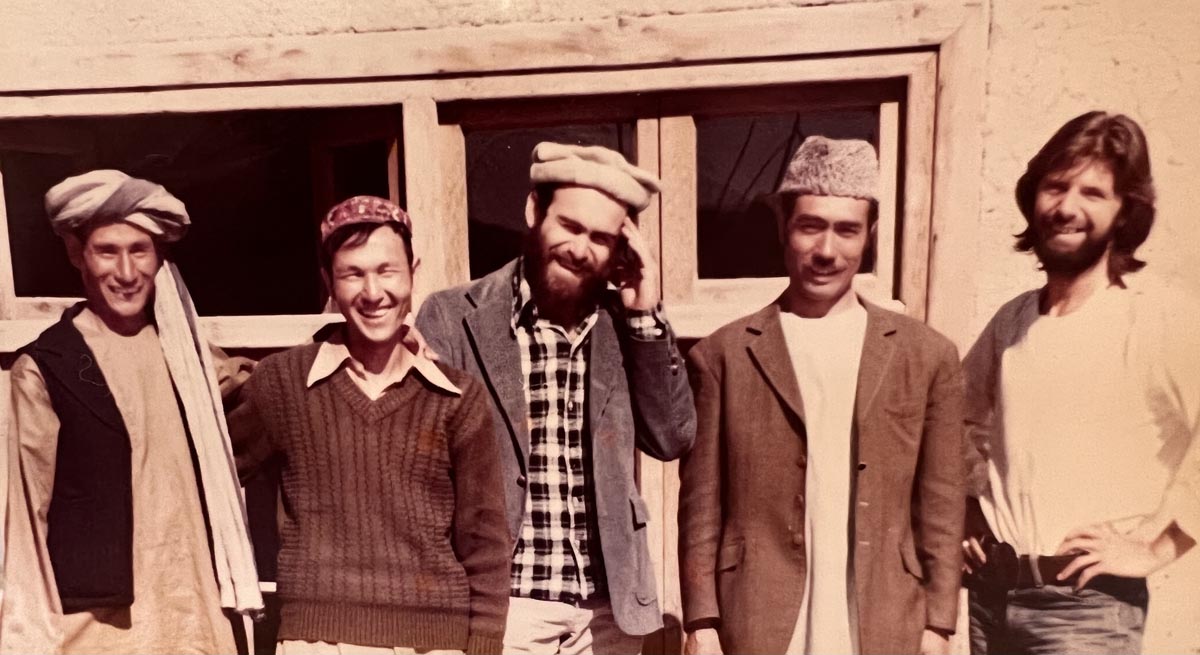
The hippie trail eventually led all the way to Australia and Bill fell in love with the place. He had become disenchanted with the US which he felt was too full of so many competing and angry groups, locked in perpetual conflict. He was also deeply anti-war and only too quick to point out America’s many failings. Australia seemed a very harmonious country in comparison. Bill settled in Sydney where he met and married his wife, Nicoletta. They lived together in the grand mansion on Oxford Street where they raised their much-loved daughter, Sabina. Bill renounced his US citizenship shortly after the death of his parents and was grateful and proud to be an Australian.
Bill established Caspian Gallery on Oxford Street, Paddington, in the early 1980s specialising in antique rugs at a time when superb examples were still emerging from the tribal areas of Central Asia (where you will find the Caspian Sea). There was a strong market for fine rugs at this time in Sydney and also a vibrant Oceanic art scene given Australia’s close connections with the Pacific. Bill became exposed to, and fascinated in, the rich offering of Oceanic art then available.
This was formalised in 1995 with the creation of the Oceanic Art Society with many of the early meetings held at Bill’s Caspian Gallery. The Gallery evolved over time into one of Australia’s leading Oceanic art galleries and Bill became an energetic dealer and collector, traipsing around the country advertising for artefacts and building networks between collectors and lower-level dealers. Great pieces were sourced from the wide range of people who had engaged directly with first nations peoples in Australia and the Pacific as plantation and station owners and workers, missionaries, government officers and early travellers.
Bill also interacted with collectors across the world, becoming the Australian representative of Tribal Art Magazine. Bill developed a reputation as a fair trader with great contacts – contacts that went both ways, as a buyer of art in Australia, and as a seller of art internationally. As the business grew Bill realised that he had to focus his own collection in one genre, and he chose shields because of the resonance they had with his affinity for the antique rugs of Central Asia.
It is fair to say that Bill developed an obsession for Pacific shields. His became a name synonymous with shields: Aboriginal and Pacific but also Dyak and Indonesian. People around the world would contact Bill when any example came up anywhere, whether it was Sotheby’s in New York or an obscure auction house in rural England or Holland. Besides his own shield collections he also built incredible collections that he sold to Australia’s premier art institutions as well as private collectors.
This culminated in the self-publication of his definitive tome, War, Art & Ritual: Shields from the Pacific, edited by Bill and featuring some of the leading experts in the field including Harry Beran, Kevin Conru, Barry Craig and Crispin Howarth. This book is an essential for any serious collector of shields. It confirmed, if such was needed, that Bill had become the global expert on Pacific shields as a genre and its success prompted him on to his next literary adventure: one of the first detailed surveys of north-eastern Australian shields.
War, Art and Ritual: Shields of North Eastern Australia, edited by Bill with contributions from Michael Aird, Wally Caruana and Philip Jones became a labour of love for Bill. He wrote to a friend of the collaboration:
“I am working on a book at the moment with the support of the Art Gallery of Queensland and the Queensland Museum. I am the editor and have three experts also writing essays. We have been having zoom meetings once a week for over two years. We are enjoying it so much we might never get the book done. The real pleasure of this project, although I am the leader, is that the other three are smarter and better than I am”.
The other project that gave Bill great pleasure towards the end of his life was managing the Facebook page, Aboriginal Tribal Art and Contemporary Paintings. Bill posted nearly every day and was elated that the site had grown from humble beginnings to have many thousands of subscribers – a veritable who’s who of academics, collectors, curators and dealers from all over the world.
Bill never stopped working. The last time I saw him was twelve days before his death. He was lying on a white leather couch too weak to stand, but strong enough to still be driving a hard bargain. He was in high spirits as just the day before two particularly fine north-eastern Aboriginal shields had arrived from overseas and they were so good he announced triumphantly, “they have to go in the book!”. His daughter, Sabina, was assisting him along with Bill’s long-term partner, Pavinee. The mood in the room was extraordinary: serene but intense. Death was clearly imminent but there was no trace of fear or regret, or even sadness, but a kind of ethereal acceptance. He seemed a completely resolved man.
Bill died under New South Wales’ recently enacted Voluntary Assisted Dying legislation. He chose the timing, manner and location of his death. He had the fortitude and determination to end life on his terms, as Sabina noted, “he chose to do things his way – no matter what.” Nursed by his beloved daughter and partner, Bill’s life story ended on 14 February 14 2024, Valentines Day. His legacy, however, continues.
Bill leaves behind his daughter, Sabina, his grandchildren, Stanley and Gaia, his partner, Pavinee, and a legion of friends, colleagues and fellow travellers.