
by Margaret Cassidy
This recent exhibition at the National Gallery of Victoria shows the works of eleven Yolŋu women artists. The works combine traditional fine lined detail on bark with a mix of traditional and new materials. Some artists have maintained the traditional practice of using ochre to paint on bark with brushes made from hair; others have moved to acrylic paints, fibre-tipped pens and acetate and to create pigments using ink from discarded printer cartridges.

Yolŋu women have only been able to paint since 1970; traditionally painting on bark or the ceremonial larrakitj or poles was strictly men’s business. More recently these women have also challenged the Yolŋu tradition of painting only with materials collected from Country. The result is a stunning combination of old and new.
Gulumbu Yunupiŋu or Star Lady was the first Yolŋu woman to receive international recognition for her works. Based on the traditional stories told by her father Mungurrawuy, her style is a distinctive network of crosses tied together by a field of dots; her use of fine lines remains within the realm of traditional Yirrkala painting. Her fascination with the stars is the basis of her works; each cross represents a star with the dots found between the crosses representing everything that isn’t seen.
The cosmos is also the subject of the vinyl floor-based work titled Ringitjmi gapu, commissioned for the exhibition by Naminapu Maymuru-White. She has used graphic black and white ochre applied with a skewer stick and marwat (human hair paintbrush) to map out the stars and galaxies of the Milky Way. It makes for a spectacular entrance to the exhibition that is reflected back by the mirrored ceiling above.

Larrakitj were traditionally made by Yolŋu artists across Arnhem Land by painting trees that have been hollowed out by termites. Stringybark trees had traditionally been used to make funerary objects or ossuaries. These Yolŋu artists are continuing customary cultural practices but instead of being intended for mourning ceremonies they are producing a major contemporary art form.
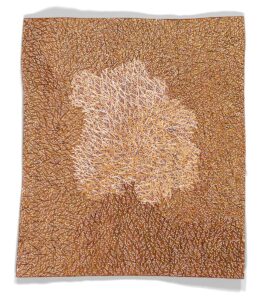
Another highlight of the exhibition is the Gana (self) installation by Ms N Yunupiŋu; comprised of sixteen irregularly shaped bark paintings and nine larrakitj, these are completed in shades of ochre. While her works may appear in terms of materials and techniques, artists like Ms N. Yunupiŋu have moved away from traditional stories and designs to paint in their own way, telling stories of their life and expressing themselves in new ways. In Wild apple orchard, 2008, Yunupiŋu has represented the place where she collected wild apples as a child.
A magnificent illusion of infinity is created with the grid of variously decorated larrakitj in the Reflection gallery lined with mirrors. The larrakitj include brilliant blue poles by Dhambit Munuŋgurr, recycled print toner bright pink and white works by Noŋgirrŋa Marawili and green ochre works by the late Malaluba Gumana.
After being left with a physical disability after a car accident, Munuŋgurr couldn’t grind up ochre by hand anymore, so she was given permission by elders to paint using acrylic paints instead.
Marawili later challenged the Yolŋu tradition of painting with materials collected from Country in late 2017 when she became the first artist to start using the brilliant pink, magenta and fuchsia tones of pigments from disused printer cartridges after finding a discarded print toner on Country. The colour is breathtaking while the brush markings are traditional.

