
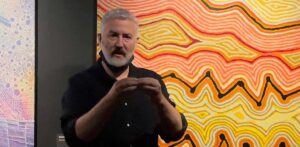
2021, 396 pages, John Carty, UWA Publishing Crawley WA
Review by Margaret Cassidy
While in my final term break of my undergraduate degree in Art History in 1986 I visited the Adult Education Centre at Balgo (Wirrimanu), a remote Aboriginal community on the edge of the Great Sandy Desert at its intersection with the Kimberley in Northern Western Australia. There I met Sister Alice Dempsey and some of the amazing artists and was blown away by the immediacy and dynamism of the artworks. Some months later I saw more of these works in the seminal Art of the Great Sandy Desert exhibition at the Art Gallery of Western Australia. Fortunately for me and many others, anthropologist John Carty travelled to Balgo in 2002 to learn from the artists about their work and has now spent the last two decades firstly completing his doctorate on this subject in 2011 but also continuing to analyse and study Balgo art of the last forty years.
In 2019 John Carty was contacted about a number of early works from Balgo that had been discovered muddy and water-damaged in a shipping container in the Kimberley. These works had been accidentally lost for nearly forty years and they completed the visual study for Carty, resulting finally in the publication of this very detailed and comprehensive study of the artists and art from Balgo. This book was launched to coincide with the recent exhibition at the South Australian Museum, Balgo Beginnings, which featured a number of those lost early works carefully restored by Artworks Australia, as well as modern works painted by the children and grandchildren of the original artists in response to their forebears’ paintings.
The raw power of the early works is counterpointed by the more diffuse and abstract contemporary items. John Carty’s book is comprehensive as the book includes many full-page illustrations and also groups of images that visually tell the story of Carty’s analysis of the evolving trends in art created within the Balgo arts community.
However, the book is much more than merely a stylistic analysis of art. Carty delves into the history of the community from the movement north and west of first-contact Aboriginal people from the desert region, the history of the three locations of ‘Balgo’. This is the story of the intersection of the desert people and the Kimberley; the convergence into one community of peoples from the west and south of a number of language groups; the intertwined influences on the desert diaspora of the evolving Catholic mission, other early visitors including Aboriginal arts and crafts traders as well as anthropologists, non-Aboriginal artists bringing art materials into the community as well as strong local Aboriginal leaders.
Carty reminds us that there has been limited research conducted by art historians with Western Desert artists – most contributions have been conducted by anthropologists. “While there are productive dialogues between Australian anthropologists and art historians, their research agendas have nevertheless continued to operate in isolation. This has more to do with methodology than ideology. Art historians have neglected Aboriginal artists’ concepts and values … because, due to a lack of linguistic and cultural competency, they don’t know how to interpret them.”
He concludes by stressing the need for a wider focus for the study of Balgo art – a focus that takes into account both past practices, the domain of the anthropologist, and the concerns of art historians and critics of the contemporary, for “neither adequately treats Western Desert painting as an emergent tradition; a novel and evolving form of material culture that remains deeply connected to aesthetic traditions many thousands of years old”.
Carty argues that you can’t understand Balgo art with any sophistication without understanding the economic aspects, that “painting is a form of work and work is a deeply cultural practice”. His scholarship base for the book is an economic and demographic analysis of over 12,000 paintings painted between 1983 and 2005 looking at a range of aspects for each artist including age, gender, previous works; works of family members; and the stylistic aspects of every painting. He asked important questions – what was done and who did it, and what does it mean to paint ngurra or Country in Balgo?
The early works reflect an aesthetic variety prior to the commencement of painting for the market that came with the creation firstly of the Balgo Hills Art Group and later Warlayirti Artists. The 1990s and 2000s saw increasing abstraction as art and a decline in kuruwarri – the sacred designs associated with ‘traditional’ iconography in Desert art – and a proliferation of those aesthetic elements, particularly dotting, used to accompany icons in early days of the painting movement. Carty also explains the move from the use of clearly visible iconic circles, lines and tracks in early works to the fluid application of dotting that has always been used to highlight content, bringing an optical dynamism to
the paintings.
Ultimately for these artists, Country is everything, it is a kind of memory, laid down by the lives of one’s family, the events of one’s childhood. According to the Balgo people, the most successful artists tend to be those who regularly paint with family, a shared domestic activity particularly with their nyupa or spouse. The transmission of style tends to play out along the lines of descent within a family but also arising from collaborations between wife and husband. Today this Country is reproduced by contemporary desert people with the resulting art works being an excellent starting point for all Australians to engage with Aboriginal Australians. This book provides an easy to read and fascinating explanation to the Aboriginal artists of Balgo and their art.
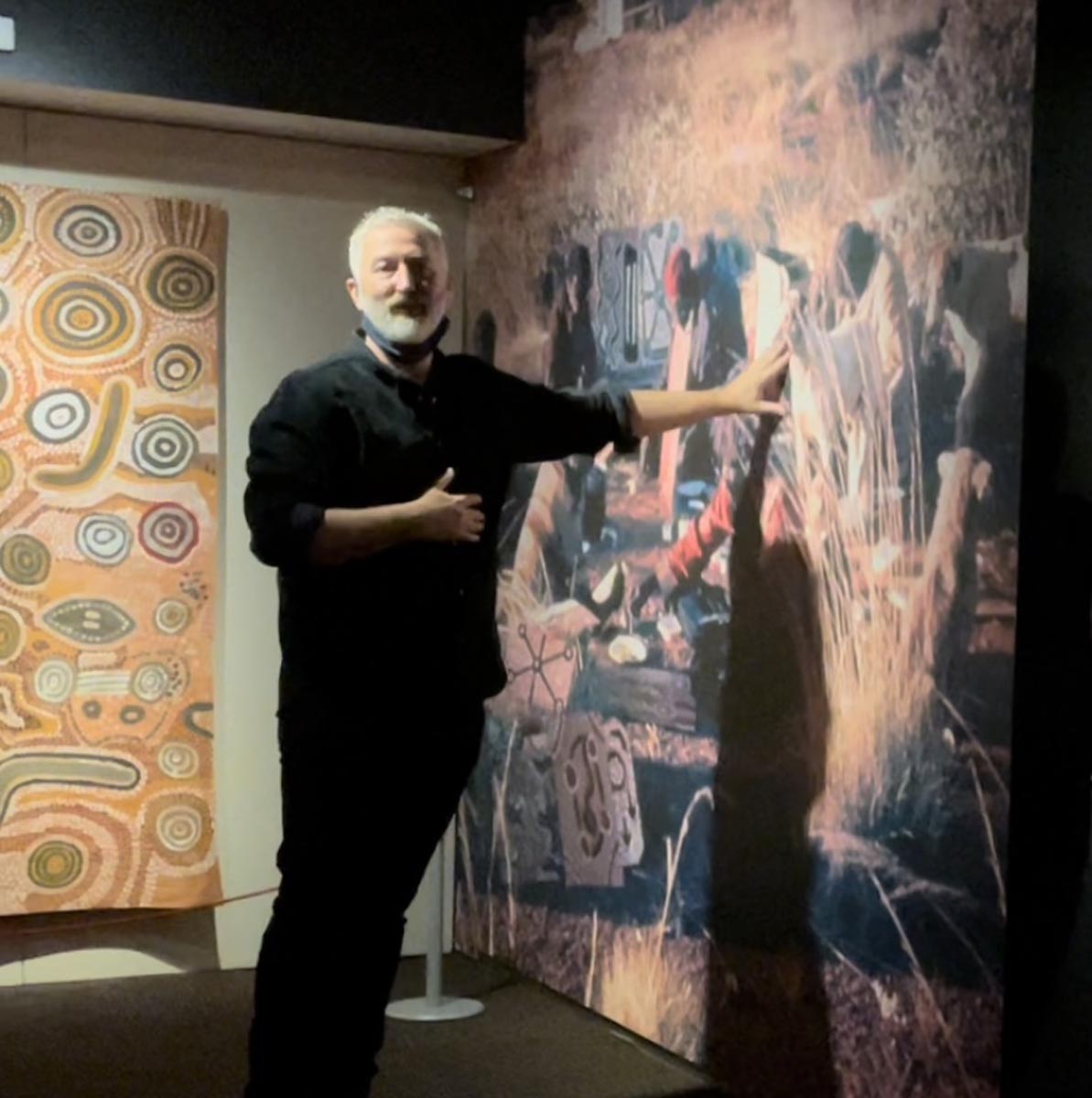
Top Image: John Carty explaining evolution of dot painting at Balgo Beginnings exhibition, SA Museum, February 2022. Photograph: Margaret Cassidy