
By Bill Rathmell, OAS President
Half-a-dozen members of the Oceanic Art Society were present on 30th July at the opening of the “Cultural Collections Centre”- the new storage for the bulk of the Pacific Island collections of Sydney’s Australian Museum. Since its inception in 1995, the OAS has tried to lobby for this superb world-renowned collection – possibly the largest of its kind in the world – to be more accessible. The good news is that the new storage (in a converted warehouse in Rydalmere, a western suburb of Sydney) is more spacious than the old, and that the Museum has developed a strategy for granting “reasonable access for a wide variety of purposes” to the “Pacific community, researchers, the media and other stakeholders on request”. Rita Uechtritz, OAS Treasurer and descendant of Richard Parkinson (who acquired a core part of the Museum’s collection in the late 19th century) sits alongside four other representatives of the NSW Pacific community on the newly-established Pacific Cultural Collection Advisory Panel.

The opening began with heartfelt and emotional traditional welcomes from Aboriginal and Pacific people; it included one from Dr Michael Mel, who was born in PNG and who is now Manager of the Pacific and International Collections at the Australian Museum. Michael is well known to members of the OAS for his equally heartfelt opening and participation in the OAS Forum in February. Michael will be the person to contact about access to the collection. Logan Metcalfe, who also works at the Museum, provided a Maori welcome.
In her address, the Director of the Museum, Kim McKay, promised that, when the Museum reopens – after the Tutankhamun: Treasures of the Golden Pharaohexhibition ends in 2021 – a new Pacific Spirit gallery will be established in the refurbished space of the main downtown Sydney premises. This is another piece of good news for lovers of Oceanic Art and Culture.
Meanwhile, the opening of the Cultural Collections Centre concluded with a characteristically stunning performance by the Matavai Pacific Cultural Arts group. The VIPs in the front row could have been forgiven for thinking they were witnessing a hakawar dance at rather close range; other parts of the performance were more tranquil, reflecting the unsettled feeling that many in the Pacific communities were said to have experienced while their cultural heritage was in transit.
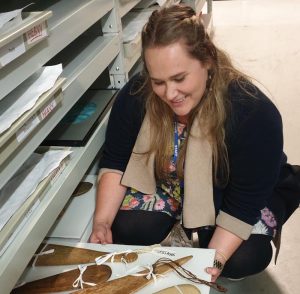
Invitees were led around the new storage by Museum staff. There is an ante-room for meetings and presentations, after which forty thousand items are to be found placed in purpose-built racks and shelves in two large climate-controlled storage spaces. Many breathtaking pieces could be seen hiding in the crates that had been specially constructed for them by the commercial partners in the removal process. This had been so quick that there had been little time to fully update the inventory and take proper photographs of the pieces – an opportunity missed; it has to be said.

One of the two storage areas at the Centre is accessed via a huge bank-vault type door with enormous bolts, presumably reflecting the previous usage of the room. On the day of the opening it had a temporary notice on it, asking staff to be sure to check for anyone inside before locking the door. Presumably “anyone” didn’t include Pacific spirits.
Half-a-dozen members of the Oceanic Art Society were present on 30th July at the opening of the “Cultural Collections Centre”- the new storage for the bulk of the Pacific Island collections of Sydney’s Australian Museum. Since its inception in 1995, the OAS has tried to lobby for this superb world-renowned collection – possibly the largest of its kind in the world – to be more accessible. The good news is that the new storage (in a converted warehouse in Rydalmere, a western suburb of Sydney) is more spacious than the old, and that the Museum has developed a strategy for granting “reasonable access for a wide variety of purposes” to the “Pacific community, researchers, the media and other stakeholders on request”. Rita Uechtritz, OAS Treasurer and descendant of Richard Parkinson (who acquired a core part of the Museum’s collection in the late 19th century) sits alongside four other representatives of the NSW Pacific community on the newly-established Pacific Cultural Collection Advisory Panel.
The opening began with heartfelt and emotional traditional welcomes from Aboriginal and Pacific people; it included one from Dr Michael Mel, who was born in PNG and who is now Manager of the Pacific and International Collections at the Australian Museum. Michael is well known to members of the OAS for his equally heartfelt opening and participation in the OAS Forum in February. Michael will be the person to contact about access to the collection. Logan Metcalfe, who also works at the Museum, provided a Maori welcome.
In her address, the Director of the Museum, Kim McKay, promised that, when the Museum reopens – after the Tutankhamun: Treasures of the Golden Pharaohexhibition ends in 2021 – a new Pacific Spirit gallery will be established in the refurbished space of the main downtown Sydney premises. This is another piece of good news for lovers of Oceanic Art and Culture.
Meanwhile, the opening of the Cultural Collections Centre concluded with a characteristically stunning performance by the Matavai Pacific Cultural Arts group. The VIPs in the front row could have been forgiven for thinking they were witnessing a hakawar dance at rather close range; other parts of the performance were more tranquil, reflecting the unsettled feeling that many in the Pacific communities were said to have experienced while their cultural heritage was in transit.
Invitees were led around the new storage by Museum staff. There is an ante-room for meetings and presentations, after which forty thousand items are to be found placed in purpose-built racks and shelves in two large climate-controlled storage spaces. Many breathtaking pieces could be seen hiding in the crates that had been specially constructed for them by the commercial partners in the removal process. This had been so quick that there had been little time to fully update the inventory and take proper photographs of the pieces – an opportunity missed; it has to be said.
One of the two storage areas at the Centre is accessed via a huge bank-vault type door with enormous bolts, presumably reflecting the previous usage of the room. On the day of the opening it had a temporary notice on it, asking staff to be sure to check for anyone inside before locking the door. Presumably “anyone” didn’t include Pacific spirits.