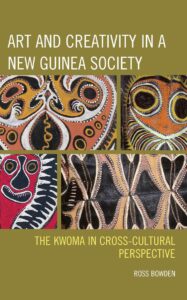
2022, 143 pages, by Ross Bowden, published by Lexington Books, Lanham, Maryland, USA.
Review by Bill Rathmell
This book really is a “must read” for those of us whose interest in Oceanic or any other kind of Indigenous art is primarily aesthetic and not underpinned by much, if any, anthropological or art-history expertise. Ross Bowden has done many years of academic research and has returned several times, over a period of more than three decades, to the remote Bangwis village, a Kwoma language-group community in the middle Sepik River region of Papua New Guinea. By virtue of his Kwoma language skills, he has learned from the local people about the sources of inspiration of their visual arts, including painting, architecture, ritual dancing and statues.
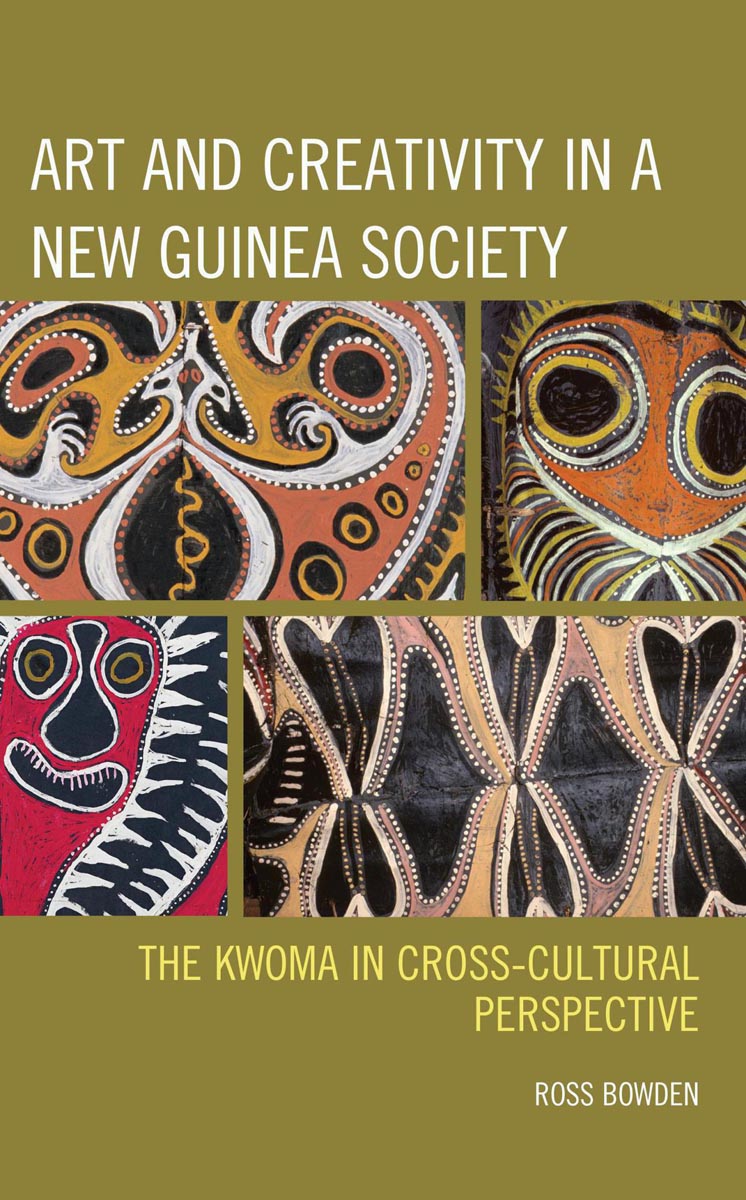
Like many non-western societies, “all of the most reliable and culturally valued knowledge about the physical and social worlds, including that expressed in the arts, is thought to derive not from humans but from spirits”. Kwoma believe that all art faithfully reproduces the supernatural prototypes on which it’s based, and which is transmitted to craftsmen through descriptions in orally transmitted myths and stories, dreams (the soul visiting the underworld when asleep), and by observation, when spirits manifest themselves to people in daily life. Ross Bowden gives many detailed examples of these processes from prolonged interviews with individuals, with some of whom he became very friendly over the years.
Because of their beliefs, Kwoma do not attempt to repair or preserve the work of any individual artist(s). Even the arduously constructed, named and lavishly decorated men’s houses are rarely repaired, and are abandoned or demolished at the end of their useful life. Kwoma believe that any man with the necessary skill with adze or brush can make a replacement with the same cultural value, provided it is made in keeping with the relevant cultural prototype. Decaying ritual sculptures can be copied and the originals sold or left to rot, and the memory of the original creators even of the greatest works quickly fades – artists are in a real sense “anonymous”. And their language has no word that corresponds to “art”.
Cross-cultural comparisons with western art and related issues are covered at length in the final two chapters, five and six. In this masterful survey, Ross Bowden shows how at various times in the evolution of western art there were striking similarities with the understandings of the Kwoma. Prior to the Renaissance, for example, “the scholarly view was that the physical world was a divine creation…all culturally important knowledge…had been revealed by God himself”. Only later, as individual architects and then painters such as Abbot Suger and Cimabue had departed from the rigid frameworks of Romanesque, Byzantine and Orthodox art in what Talbot Rice called the Proto-Renaissance, did the individual creators start to lose their anonymity.
Ross Bowden’s book has many valuable illustrations (mostly from his own photography) which this reviewer has seen at the recent OAS Forum in full colour. Unfortunately, the reproductions in the physical book are rather poor quality – monochrome and low contrast. It is said that the eBook has better quality images.
Available for online purchase in Australia from Booktopia and Fishpond.